

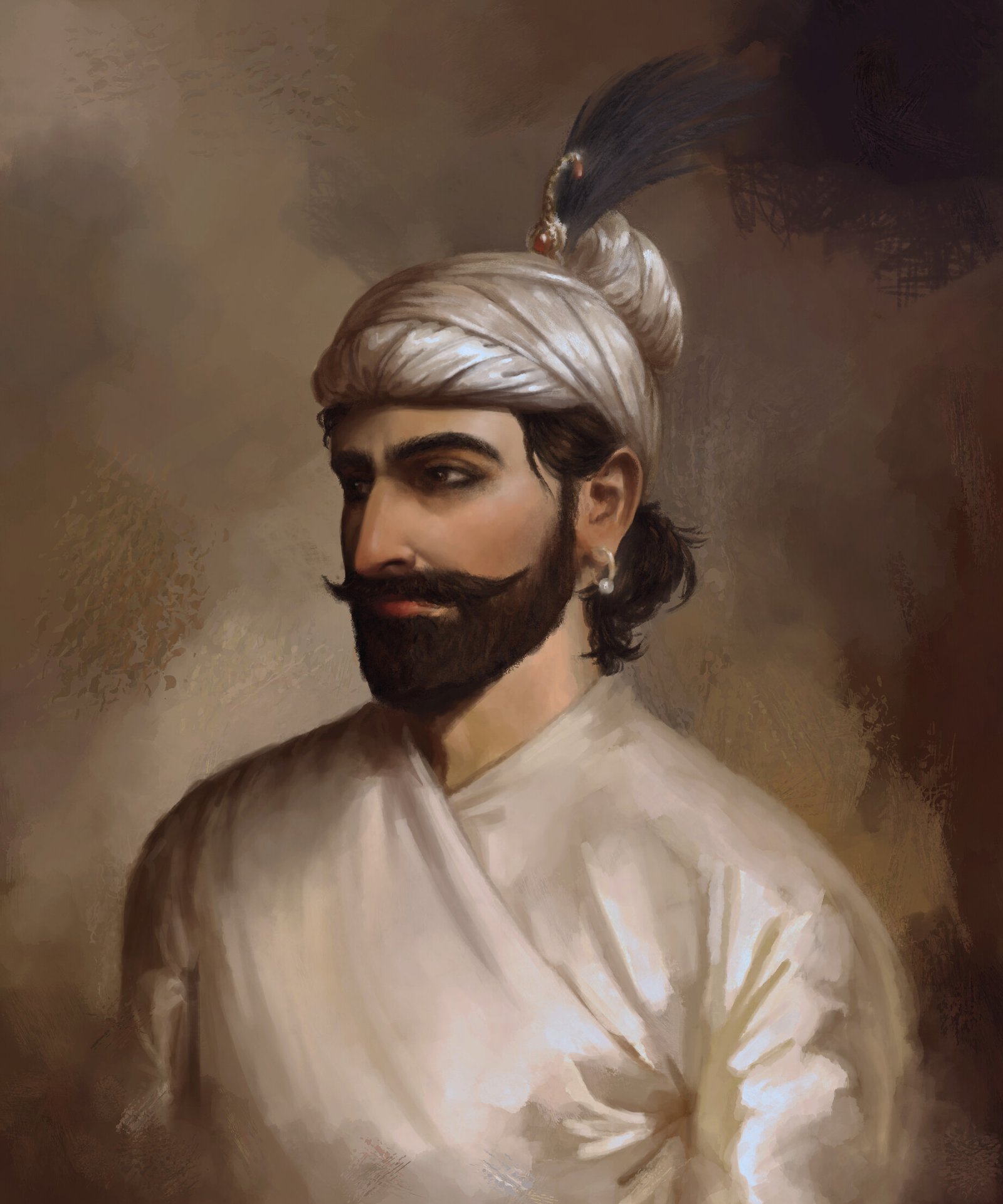
Raja Sultan Khan, son of Raja Suleman Khan, was the last independent Chib ruler of Bhimber. He ruled in a time of upheaval, when Mughal power had faded, Afghan governors held Kashmir and the Sikh kingdom of Lahore was swallowing the hill states of the Punjab one by one. Sultan Khan was a faithful ally of the Afghans and a determined enemy of Sikh expansion.
Resistance
When Maharaja Ranjit Singh first moved against Bhimber in 1810, Sultan Khan fought hard before he was forced to pay tribute. In 1812 he defeated an army sent under Prince Kharak Singh from a strong position on the heights above Bhimber, a victory remembered as the Battle of Bhimber.
Prisoner of Lahore
Lured to Lahore by promises of an honourable settlement, he was instead held in irons in Lahore Fort for six years. In 1819 he was set free to accompany the Sikh army against Kashmir, where he furnished a large contingent and took a leading part in the conquest of the valley. Afterwards part of his country was given back to him.
The traveller William Moorcroft, passing through in 1822, found Sultan Khan living at Samahni. His state was then about twenty-five kos long and contained three towns, Bhimber, Samahni and Mangal Devi, with a revenue of sixty thousand rupees.
Death at Jammu
Some time after 1822, Sultan Khan was invited to Jammu, by then the seat of Raja Gulab Singh, and there he was killed. Hutchison and Vogel record only that he was invited to Jammu and put to death; Jammu traditions add that he was blinded and held prisoner in the forts of Bahu and Gajpat before he died. According to Hutchison and Vogel, his nephew Faiz Talab Khan succeeded to the chiefship with Ranjit Singh’s permission, but he lost most of the territory in 1840 and left the hills in 1847, when the region passed to Maharaja Gulab Singh. The family afterwards lived at Pothi in Gujrat District.
His place in the shajra
The family’s shajra traces Raja Sultan Khan back, father to son, through Raja Suleman Khan, Raja Naeem Khan, Raja Mian Ji Khan, Raja Shair Safdar Khan, Raja Karamullah Khan, Raja Rehmatullah Khan, known as Raja Roop Singh, and Raja Chowk Jannat Khan, known as Raja Jogu Khan, to Ismail Khan, son of Raja Madan Khan. Through Raja Ghani Khan the line reaches back to Baba Shadi Shaheed and to Raja Chib Chand himself. See his line in the family tree.
The last king of Bhimber
With Sultan Khan’s death the independent rule of the Chibs, which had begun with Partab Chand around 1400, came to an end. The family’s shajra remembers him as Raja Sultan Khan, Akhri Wali-e-Bhimber: the last ruler of Bhimber. The Chib Rajputs honour him as the raja who would not give up his country without a fight.
Sources
- J. Hutchison and J. Ph. Vogel, History of the Panjab Hill States, vol. II (Lahore, 1933), “Bhimbar and Khari-Khariyali”, pp. 725–729.
- William Moorcroft and George Trebeck, Travels in the Himalayan Provinces of Hindustan and the Panjab (London, 1841).
- Shajra-e-Nasab (family tree) of the Chib Rajputs of Malot, Azad Kashmir.