

The early nineteenth century brought the greatest challenge the Chibs had ever faced. Maharaja Ranjit Singh had made himself master of the Punjab and was determined to take Kashmir, and the road to Kashmir ran straight through Bhimber, ruled by Raja Sultan Khan.
The first attack, 1810
In 1810 Ranjit Singh sent his first force against Bhimber. Sultan Khan, described by the historians of the hill states as “a brave and resolute man”, put up a determined resistance but was finally forced to submit and pay a tribute of 40,000 rupees. To weaken him, a large part of his territory was handed to a relative, Ismail Khan. He was a namesake of the much earlier Ismail Khan, son of Raja Madan Khan, from whom, according to the family’s shajra, the rajas of Bhimber descended.
The battle, 1812
Two years later fighting broke out between Sultan Khan and Ismail Khan, and Ismail Khan was killed. Ranjit Singh at once sent an army from Lahore under the nominal command of his heir, Prince Kharak Singh, to crush the Raja of Bhimber.
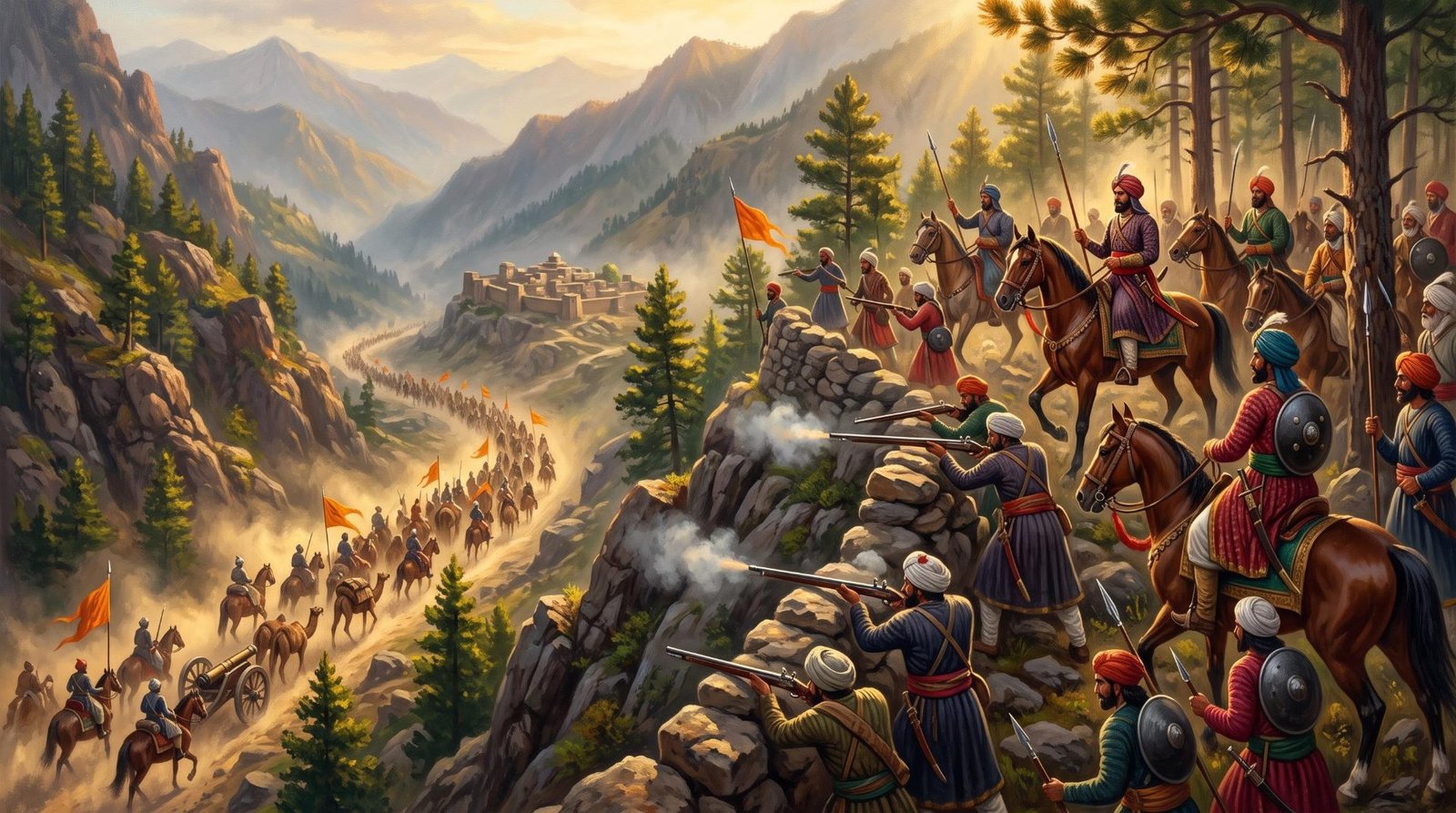
Sultan Khan did not wait to be shut up in the town. He took up a strong position on a height above Bhimber, so well chosen that it was practically unassailable. The Sikh army, drawn into the broken hill country the Chibs knew so well, was defeated and forced to retreat. It was the proudest day of the Chib rajas: a small hill state had turned back an army sent by the most powerful ruler in the Punjab.
Betrayed after victory
Victory in the field did not end the war. A second Sikh force was sent, and its commander opened negotiations, promising that Sultan Khan’s territory would be restored and that he would be treated with honour if he came to Lahore. Trusting these terms, the Raja went to Lahore, but Ranjit Singh refused to honour them. Sultan Khan was put in irons in Lahore Fort and held there for six years, while Bhimber was annexed and given in jagir to Kharak Singh.
Even so, the Sikhs could not do without him. When Ranjit Singh made his final advance on Kashmir in 1819, Sultan Khan was released to go with the army, and he played a leading part in the conquest of the valley. The rest of his story is told in our profile of Raja Sultan Khan, the last ruler of Bhimber.
Sources
- J. Hutchison and J. Ph. Vogel, History of the Panjab Hill States, vol. II (Lahore, 1933), “Bhimbar and Khari-Khariyali”, pp. 725–729.
- Shajra-e-Nasab (family tree) of the Chib Rajputs of Malot, Azad Kashmir.