

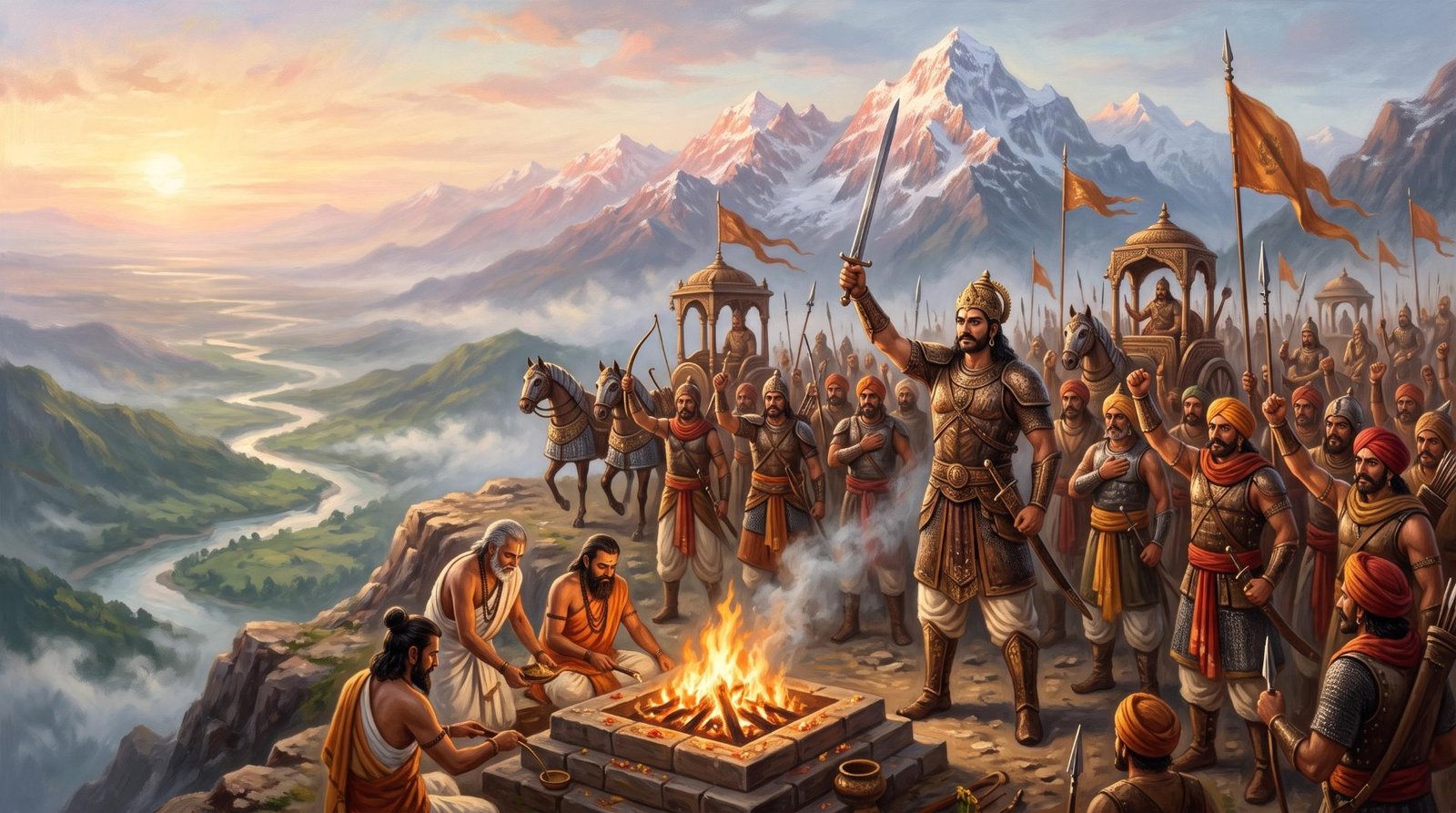
Every Chib family that keeps its shajra-e-nasab can trace its line back beyond Bhimber, beyond the great fort of Kangra, to an ancient Himalayan kingdom called Trigarta. It was the realm of the Katoch rajas, the royal house from which the Chibs descend, and it appears in the oldest literature of India, including the great epic, the Mahabharata.
The land of three rivers
The name Trigarta is usually explained as “the land of three rivers”, taken to mean the Ravi, the Beas and the Sutlej, which flow out of the Himalayas into the Punjab. Hutchison and Vogel, the historians of the Punjab hill states, preferred another reading. The word garta can also mean a hollow or valley, and they suggested the three valleys of the Banganga, the Kurali and the Nayagul, streams that meet near Haripur in Kangra and fall into the Beas. Either way, the heart of the kingdom lay in the Kangra valley, beneath the snows of the Dhauladhar range.
The kingdom had two parts. The plains around the city of Jalandhar gave it its other ancient name, Jalandhara, while Trigarta proper was the hill country. The Chinese pilgrim Hiuen Tsang passed through Jalandhara in the seventh century, and our shajra remembers Adam Chandra as the raja whom he visited. Copper-plate grants of the eleventh century from neighbouring Chamba still name Trigarta, and the Rajatarangini, the chronicle of Kashmir, records that King Ananta of Kashmir married daughters of Indu Chandra, the lord of Jalandhara.
Susharma in the Mahabharata
In the Mahabharata the king of Trigarta is Susharma, a powerful ally of the Kauravas. He appears at two important moments in the story. While the five Pandava brothers were living in disguise at the court of King Virata of the Matsyas, Susharma led a raid on Virata’s cattle, a raid that helped to bring the hidden Pandavas into the open. Later, in the great war at Kurukshetra, the warriors of Trigarta, the Samsaptakas, swore a solemn oath to kill Arjuna or die in the attempt, and drew him away from the main battle to fight them.
The Katoch rajas of Kangra regarded Susharma as their ancestor. Our shajra remembers him as Susharma Chandra II, who “fought against Arjun in the Mahabharata”, and places him about 1500 BC. Katoch tradition adds that the family’s first seat had been at Multan, and that after the war, having lost Multan, Susharma led his people into the hills, settled in Jalandhara and built the fort of Kangra. The shajra places the loss of Multan later, under Udaivan Chandra, who “fought against Ashoka”.
A royal line of nearly five hundred names
The Katoch rajas kept a vansavali, a genealogical roll of their house, which Hutchison and Vogel describe as containing nearly five hundred names, from the first raja, Bhumi Chand, down to modern times. In it Susharma Chandra stands 234th. The English traveller William Moorcroft saw the roll at the court of Raja Sansar Chand of Kangra in 1820, and later historians were struck by it. Alexander Cunningham, the founder of the Archaeological Survey of India, thought it had a stronger claim to belief than the pedigrees of the Rajput houses of Rajasthan, and Sir Lepel Griffin called the Katoch genealogies “more ancient and unbroken than can be shown by any other royal families in the world”.
The shajra of the Chibs of Malot preserves fifteen of these names, each with a date and the deed for which he is remembered. It begins with Rajanaka Bhumi Chandra, placed about 4300 BC, and continues with Nanamel Chandra, said to have fought against Lakshman in the Ramayana, Susharma Chandra II of the Mahabharata, and Parmanand Chandra I, remembered as Porus, who fought against Alexander the Great.
From Trigarta to Chibhal
Trigarta’s later history is the history of Kangra. The kingdom lost its lands in the plains of Jalandhar in the twelfth century, in the time of Laxmi Chandra II, but its rajas held the hills and the great fort for centuries more. Around 1400 Raja Megh Chandra II of Kangra had three sons: Hari Chand founded Guler, Karam Chand ruled Kangra, and Partab Chand went west to found the Chib state of Bhimber. When a Chib elder recites the names of his ancestors today, he is reciting a line that began in the hills of Trigarta.
Read more in our articles on the Katoch origins of the Chib Rajputs, Kangra Fort and Porus and the Battle of the Hydaspes, or explore the full family tree.
Sources
- J. Hutchison and J. Ph. Vogel, History of the Panjab Hill States, vol. I (Lahore, 1933), “Kangra State”.
- The Mahabharata, Virata Parva and Drona Parva.
- Kalhana, Rajatarangini: A Chronicle of the Kings of Kashmir, trans. M. A. Stein (Westminster, 1900).
- Shajra-e-Nasab (family tree) of the Chib Rajputs of Malot, Azad Kashmir.