

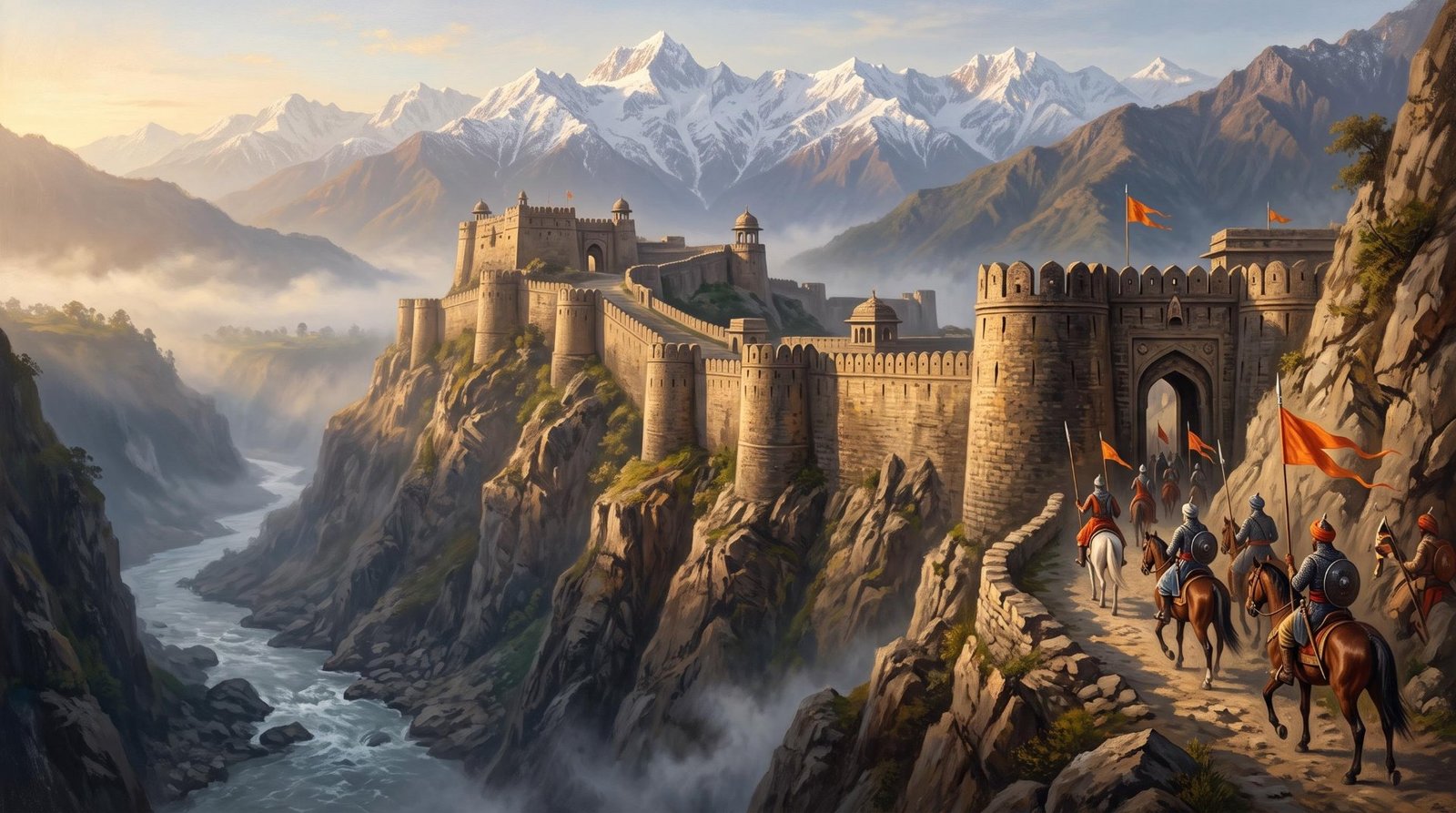
High on a ridge in the Kangra valley of Himachal Pradesh stand the walls of one of the oldest forts in India. Kangra Fort, known in the old histories as Nagarkot, was the seat of the Katoch rajas, the royal house from which the Chib Rajputs descend. Katoch tradition says it was built by Raja Susharma after the war of the Mahabharata, and for centuries whoever held it held the hills.
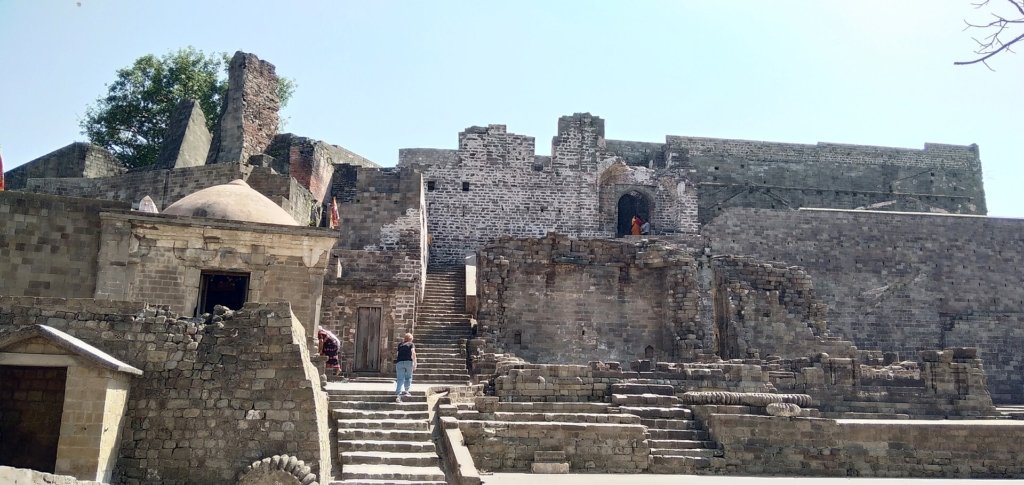
A fortress on a ridge
The fort stands on a long, narrow ridge between two rivers, with cliffs falling steeply to the Banganga below. Alexander Cunningham, who described it in the nineteenth century, found walls more than two miles round, and noted that the fort could be approached only along a narrow neck of rock. It is often called the largest fort in the Indian Himalayas. A line of gateways leads up through the defences to the palace area at the summit, where old temples, among them a Jain shrine, still stand.
The plunder of Mahmud of Ghazni
The fort’s wealth made it famous far beyond the hills. Its temple held treasures given over many centuries, and in 1009 Mahmud of Ghazni, fresh from his victory over the Hindu Shahi king Anandpal, marched on it in his fourth expedition into India. His secretary al-Utbi called the fort Bhimnagar and described it standing “on the promontory of a lofty hill, in the midst of impassable waters”. The garrison surrendered, and the booty was immense: Utbi speaks of seventy million royal dirhams, gold and silver ingots weighing hundreds of thousands of mans, and even a house of white silver, thirty yards long and fifteen wide, that could be taken apart and put together again.
According to Hutchison and Vogel, the raja of Kangra at the time was Jagdish Chand, 436th in the roll of his house. Our shajra remembers him as Jagdish Chandra III, who “fought against Mahmud Ghazni” in AD 1009. A garrison from Ghazni held the fort until 1043, when the Raja of Delhi and his allies took it back after a siege of four months.
Sultans at the gates
The rajas of Kangra recovered their fort and with it their power. From the time of Prithvi Chand, about 1330, they struck their own coins, and our shajra notes the coins of several of them: the Pithana coins of Prithvi Chandra II, the Rupmundra coins of Rup Chandra V and the Meghmudra of Megh Chandra II. Rup Chand was bold enough to raid the plains, the shajra says, as far as the gates of Delhi. About 1365 the Sultan of Delhi, Firoz Shah Tughlaq, came to punish him and besieged Nagarkot for six months, until the raja made peace and was confirmed in his kingdom. In the temple the sultan’s men found a library of 1,300 books, one of which was translated into Persian for him.
A generation later, in 1398, the armies of Timur swept into northern India. Timur’s memoirs speak of Nagarkot as “a large and important town” and record fighting with the forces of its raja between the Sutlej and the Beas, but the great fort itself was not attacked. The raja at the time was Megh Chand, who, our shajra says, fought against Timur. It was his son Raja Partab Chand who would found the Chib state of Bhimber.
Mughals, Sikhs and the British
The Katoch rajas held Kangra Fort from 1043 until 1620, when it fell to the Mughal emperor Jahangir after a long siege. Mughal governors held it for more than a century and a half. As Mughal power declined it passed briefly to a Sikh chief and then, in 1786, back to the Katoch raja Sansar Chand, under whose patronage the Kangra school of painting reached its height. A Gurkha army besieged the fort from 1806, and in 1809 Sansar Chand was forced to hand it to Maharaja Ranjit Singh in return for his help. The British took it in 1846, after the First Anglo-Sikh War, and on 4 April 1905 a great earthquake shattered many of its buildings.
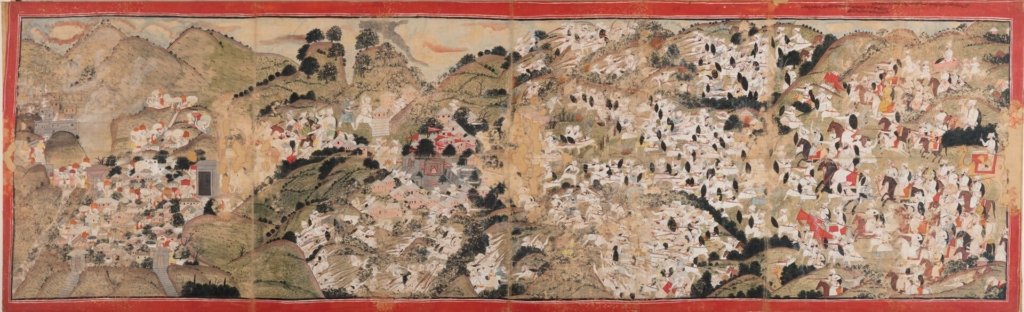
Today the ruins of Kangra Fort draw visitors from across India and beyond. For the Chibs it is a place of special meaning: the stronghold of the ancestors from whom Raja Partab Chand set out, around 1400, to found a new kingdom at Bhimber. Read his story in From Kangra to Bhimber, and meet his brothers in Guler and Kangra: The Brother Houses of the Chibs.
Sources
- J. Hutchison and J. Ph. Vogel, History of the Panjab Hill States, vol. I (Lahore, 1933), “Kangra State”, with the accounts of al-Utbi, Firishta and the memoirs of Timur quoted there.
- Shajra-e-Nasab (family tree) of the Chib Rajputs of Malot, Azad Kashmir.