

The Chib Rajputs are one branch of a larger family. Our shajra gives Raja Megh Chandra II of Kangra, who fought against Timur, three sons: Hari Chandra I, who founded Guler; Raja Partab Chand, founder of Bhimber; and Karm Chandra II, who received the title of Bada Raja. From these three brothers came three royal houses: Kangra, Guler and the Chib state of Bhimber.
The prince in the well
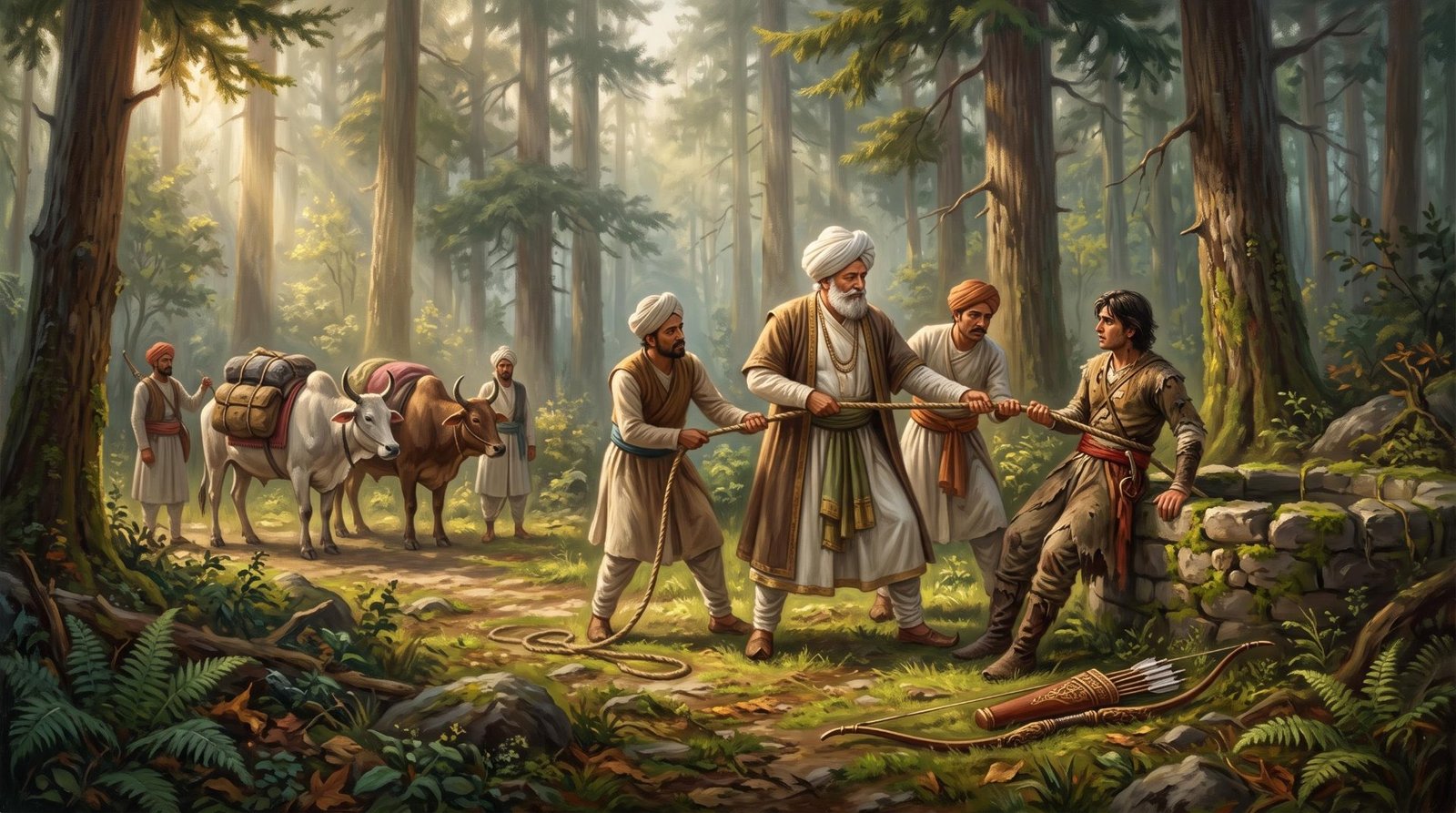
The chronicles of Kangra tell how the eldest brother lost his throne. About 1405 Hari Chand, who had succeeded his father as raja, went hunting near Harsar, became separated from his companions and fell into an old dry well. His followers searched for him in vain and at last gave him up for dead. His ranis became sati, the funeral rites were performed, and his younger brother Karam Chand was installed as Raja of Kangra.
Hari Chand was not dead. After twenty-two days in the well a passing merchant found him and drew him out. By then the throne was no longer his to claim. The chronicles say that Karam Chand offered to give it up, but Hari Chand refused, and with his brother’s knowledge and consent he founded a capital of his own at Haripur, near the meeting of the Banganga, the Kurali and the Nayagul. In gratitude he freed the merchant’s family from customs duties for ever, and the well near Harsar is still pointed out to visitors.
The cowherd’s sign
Hari Chand’s state took its name from Haripur’s older name, Gwaliar, from gwala, a cowherd. Local tradition tells that a cowherd showed the raja a place where a tiger and a goat drank side by side from the same stream, a good omen for a new capital. In time Gwaliar became Guler. Hari Chand built the fort of Haripur and six frontier forts around his small kingdom, and his descendants ruled there until the nineteenth century.
Guler always kept a special place among the hill states. Because Hari Chand was the eldest brother, his house was regarded as the senior branch of the Katoch family and took precedence even over Kangra; in British times its raja was the first of the Viceregal Darbaris of Kangra District. Younger branches of the Guler house founded the small neighbouring states of Siba and Datarpur, and our shajra remembers them too: beside Hari Chandra I it notes that Guler’s “offshoots are Dada Siba”.
Kangra and the third brother
Karam Chand ruled Kangra from about 1415. His son Sansar Chand I left an inscription in the temple of Vajreshwari Devi at Bhawan, near Kangra, naming both Karam Chand and Megh Chand, one of the few contemporary records of this generation. Our shajra adds that Karm Chandra II received the title of Bada Raja and issued the Karam mudra coins. His descendants remained rajas of Kangra even after the Mughals took the fort in 1620, and won it back under Raja Sansar Chand in 1786. The fort’s long story is told in Kangra Fort: Ancestral Stronghold of the Katoch Rajas.
The third brother, Partab Chand, had no throne waiting for him. He set out westwards with his own following, settled near Bhimber and won a kingdom there, and his son Raja Chib Chand gave the Chibs their name. That story is told in From Kangra to Bhimber: The Katoch Origins of the Chib Rajputs.
The painters of Guler
Guler has one more claim to fame. In the eighteenth century its rajas, among them Dalip Singh and Govardhan Chand, were patrons of the family of the painter Pandit Seu and his sons Manaku and Nainsukh. Their delicate, naturalistic style became the first phase of the Kangra school, one of the glories of Indian painting, and Guler paintings now hang in museums around the world. Guler itself was annexed by the Sikh kingdom of Lahore in 1813.
Today the descendants of the Katoch rajas of Kangra and Guler live in Himachal Pradesh and are Hindus, while the descendants of Partab Chand are the Muslim Chib Rajputs of Azad Kashmir and the Punjab. Faith has divided them, but their genealogies meet in the same names, and the Chibs remain proud of their kinship with the Katoch. Explore it in our family tree.
Sources
- J. Hutchison and J. Ph. Vogel, History of the Panjab Hill States, vol. I (Lahore, 1933), “Kangra State” and “Guler State”.
- Shajra-e-Nasab (family tree) of the Chib Rajputs of Malot, Azad Kashmir.