

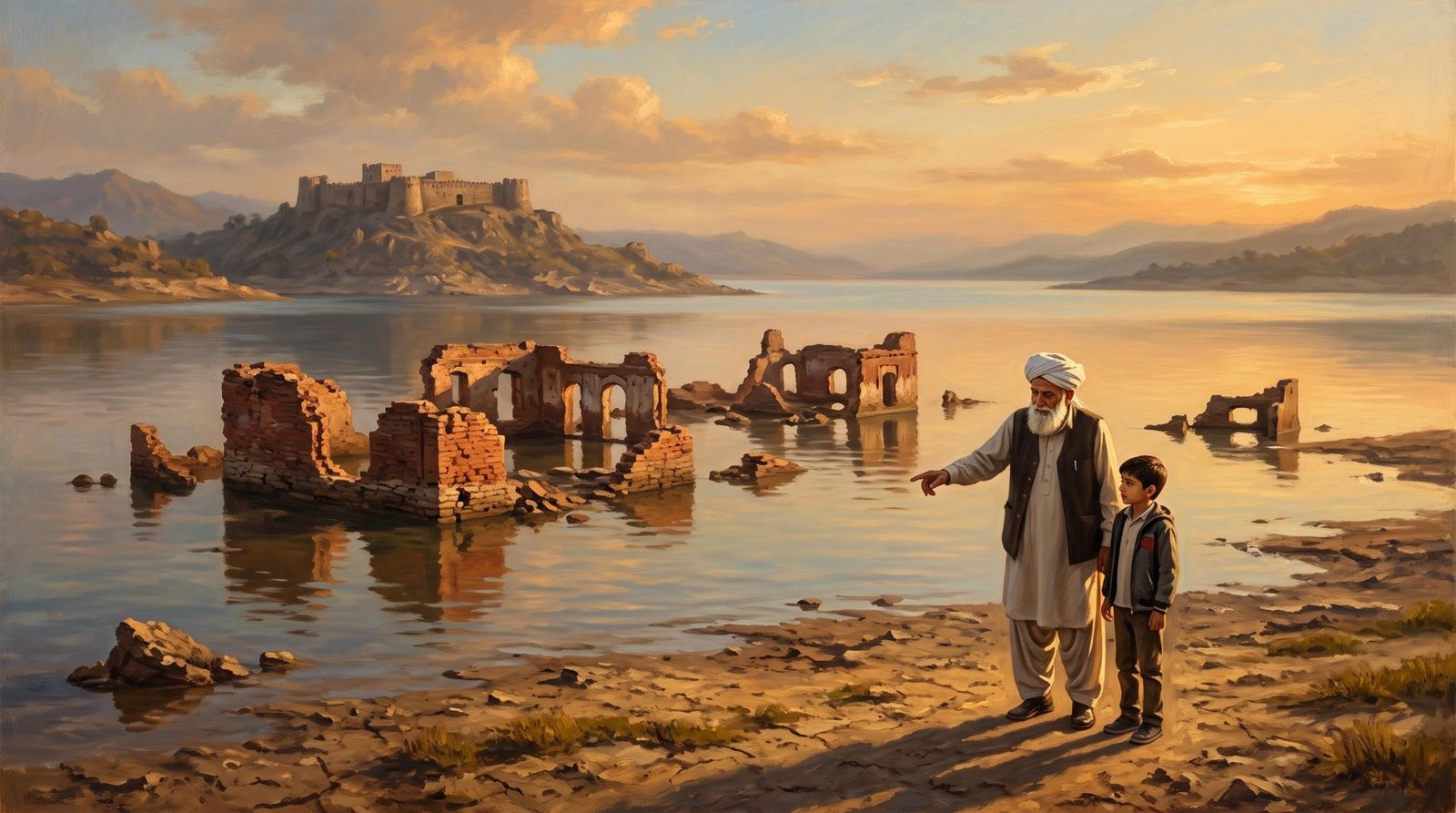
In the twentieth century the history of Chibhal took a turn that no raja could have imagined. A great dam was built across the Jhelum at Mangla, below the old fort of the Chib rajas of Khari-Khariali, and its waters rose over the homes of more than a hundred thousand people. The flooding of the valley, and the migration that followed, shaped the modern Chib story as deeply as any event in the clan’s long past.
Building the dam
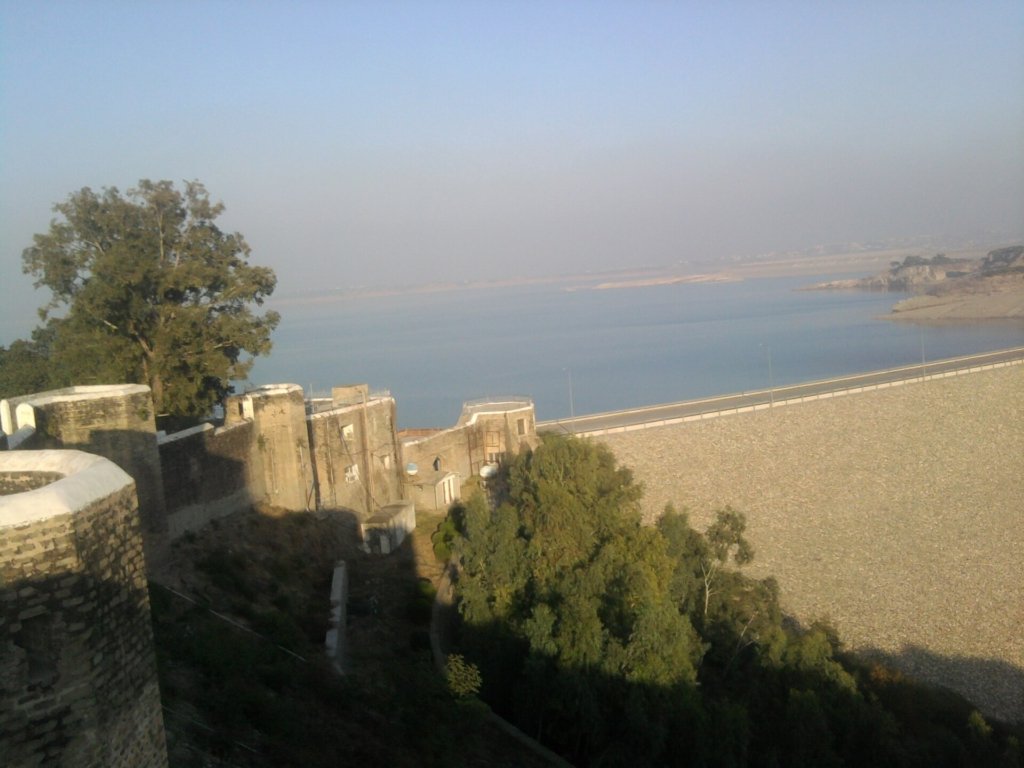
The partition of 1947 drew a new border across the rivers of the Punjab. Under the Indus Waters Treaty of 1960, agreed with the help of the World Bank, Pakistan received the waters of the western rivers, the Indus, the Jhelum and the Chenab, and began great works to store them. The first was Mangla Dam, built between 1961 and 1965 where the Jhelum leaves the hills and opened in 1967. It took its name from Mangla Fort, the ancient seat of the Chibs of Khari-Khariali, which still stands on its hill above the water.
The drowned valley
The reservoir submerged the old towns of Mirpur and Dadyal and more than 280 villages, and over 110,000 people lost their homes. Among them were many Chib families whose forefathers had lived in the valleys around Mirpur since the days of the rajas. A new town, New Mirpur, was built on higher ground above the lake. In dry seasons, when the water falls, the ruins of old Mirpur still rise out of the lake: broken walls, arches and the shells of old buildings that were once streets and homes.
Some forty years later the dam was raised by thirty feet to store more water. The raising project, completed in 2009, affected more than 40,000 people, who were resettled in New Mirpur City and in four new satellite towns at Islamgarh, Chakswari, Dadyal and Siakh.
The road to Britain
Mirpuris had begun to travel overseas long before the dam. Men from the district worked on British ships, and from the 1940s a few settled in Britain, where industry was short of labour after the Second World War. From the 1950s they became the first links in a chain of migration. When the waters of Mangla rose, the Government of Pakistan gave some of the displaced work permits for Britain, and up to five thousand people from Mirpur, about one in twenty of those displaced, resettled there. Many more followed, often helped by the compensation paid for their lost land. Through the 1960s and 1970s whole families joined them, until large communities from Mirpur, Kotli and Bhimber had grown up in Birmingham, Bradford, London, Manchester, Leeds, Luton and other towns.
Today an estimated 60 to 80 per cent of the British Pakistanis of England trace their roots to this region. Mirpur itself is sometimes called “Little England”, for its houses built with money earned in Britain and its close family ties with British cities.
Chibs around the world
The Chibs were part of this movement. Families from Bhimber, Mirpur, Kotli and Dadyal settled in Britain, and others found work in the Gulf, in Europe and in North America, while many more remain in Azad Kashmir and the Punjab. Distance has not broken the clan. Families return for weddings and funerals, visit the shrine of Baba Shadi Shaheed at Jandi Chontra and keep their shajras with care. The shajra of the Chibs of Malot on this site runs from the Katoch rajas of Kangra down to the present generation, including Raja Khubaib Ahmed Khan and his sons.
The waters of Mangla now cover much of the land where the Chibs of Khari-Khariali once ruled, but the fort still stands above the lake, and the people of Chibhal have carried its history across the world. This website is one small part of that effort: to make sure that wherever Chib children grow up, they can find their place in a story that began in the hills of Trigarta.
Sources
- Indus Waters Treaty, signed at Karachi, 19 September 1960.
- Wikipedia, “Mangla Dam” and “British Kashmiris”, accessed October 2026.
- Shajra-e-Nasab (family tree) of the Chib Rajputs of Malot, Azad Kashmir.