

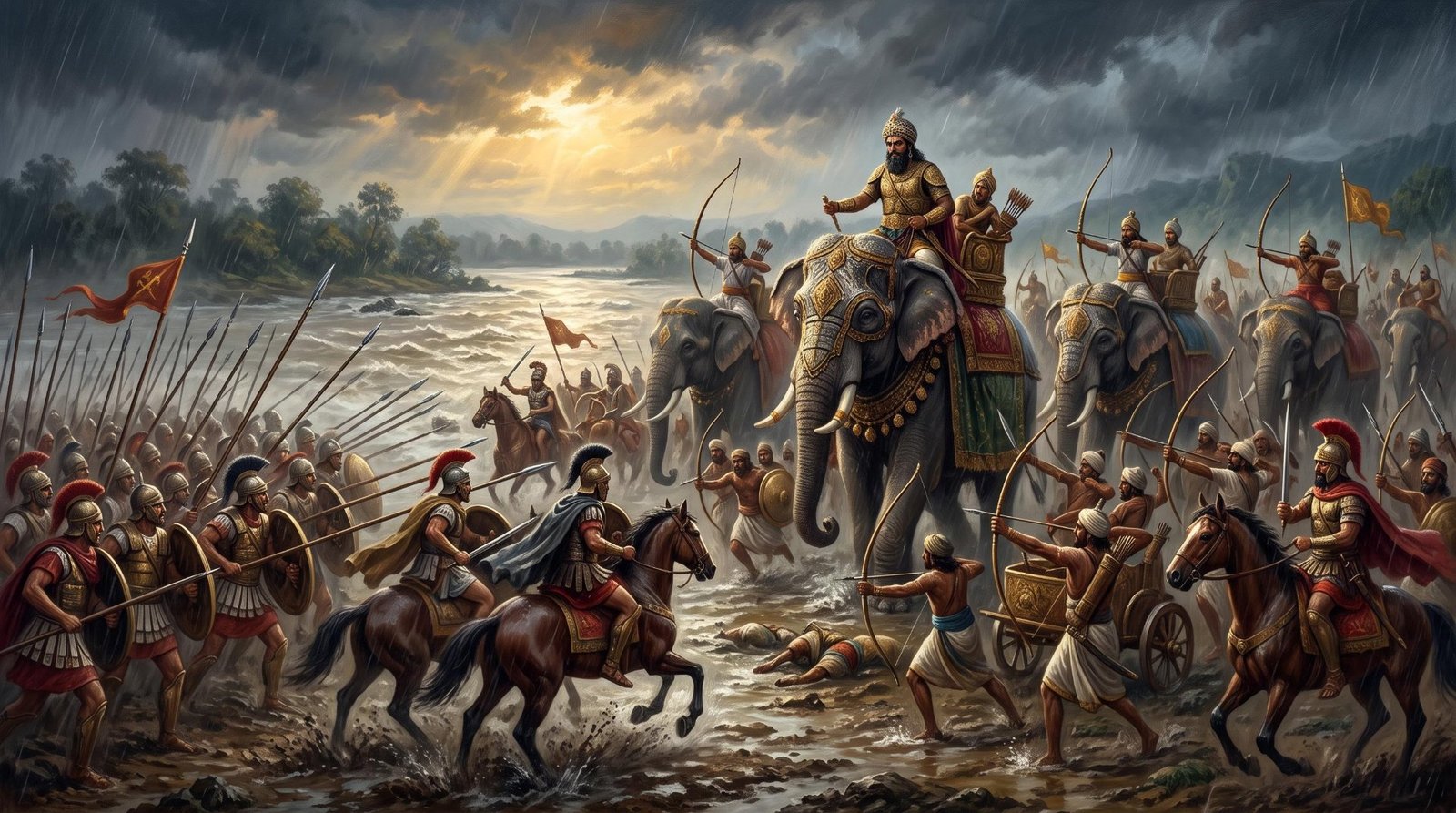
Of all the names in the Chib shajra, one is known around the world. Beside Parmanand Chandra I the shajra notes that he “fought against Alexander the Great” and was “known as Porus”. The battle in question was fought in 326 BC on the banks of the Hydaspes, the river we call the Jhelum, which still flows past the Chib homeland of Bhimber and Mirpur today.
Alexander reaches the Jhelum
By the spring of 326 BC Alexander of Macedon had conquered the Persian empire and crossed the Indus. At Taxila the local king submitted to him, and envoys arrived from Abisares, the king of the hill country between the Jhelum and the Chenab. But beyond the Jhelum stood Porus, who ruled the rich plains between the Jhelum and the Chenab and refused to submit. He drew up his army on the eastern bank, with his war elephants facing the crossing places, and waited.
The river was swollen with rain and melting snow, and Alexander’s horses would not face the elephants. For days he marched his troops up and down the bank to confuse Porus. Then, on a stormy night, he left his general Craterus in the main camp and slipped away with a picked force, crossing the river at a wooded island some seventeen miles upstream. A son of Porus rode out with chariots to stop him and was killed.
The battle
Porus turned to meet Alexander with the bulk of his army. The Greek historian Arrian, who wrote from the memoirs of Alexander’s officers, gives him some 30,000 infantry, 4,000 cavalry, 300 chariots and 200 elephants; other ancient writers give fewer elephants. Porus himself, a man of unusual height, rode a great elephant at the centre of his line.
Alexander attacked the Indian cavalry on the wings and drove them back on to their own elephants. His infantry closed in, their long spears aimed at the mahouts, and many elephants, wounded and without riders, turned and trampled through their own ranks. The fighting was long and hard, and the Macedonians remembered it as one of the most difficult battles of the whole campaign. When at last the Indian army broke, Porus, wounded, was among the last to leave the field.
“Like a king”
Brought before Alexander and asked how he wished to be treated, Porus is said to have replied: “Like a king.” Alexander was so impressed that he restored Porus to his kingdom and, according to Arrian, added more territory to it. Porus became Alexander’s ally and governor in the Punjab. Near the battlefield Alexander founded a city called Nicaea, “Victory”, and across the river another, Bucephala, named after his famous horse Bucephalus, who died at this time.
A few months later Alexander’s army reached the Beas, the river of the old Katoch kingdom of Trigarta. There his soldiers, worn out by years of war and shaken by the fighting on the Jhelum, refused to go any further, and Alexander turned back towards the west.
Porus and the Katoch tradition
Historians usually explain the name Porus as the Greek form of Paurava, a ruler of the ancient Puru line, and the Greek writers do not record his personal name. The Katoch rajas of Kangra, however, kept his memory as one of their own, and our shajra names him as Parmanand Chandra I, the next name after Susharma Chandra II of the Mahabharata and before Udaivan Chandra. The shajra places him about 320 BC, close to the date of 326 BC given by the Greek historians.
Whether or not every link in that tradition can be proved, it says something important about how the Chibs see themselves: as heirs of a king who stood his ground against the greatest conqueror of the ancient world, on the banks of the river that still runs through their homeland. Across the Jhelum, in the hills where the Chibs would later rule, another king was watching. His story is told in From Abhisara to Chibhal.
Sources
- Arrian, Anabasis of Alexander, book V.
- Plutarch, Life of Alexander, chapter 60.
- J. Hutchison and J. Ph. Vogel, History of the Panjab Hill States, vol. II (Lahore, 1933).
- Shajra-e-Nasab (family tree) of the Chib Rajputs of Malot, Azad Kashmir.