

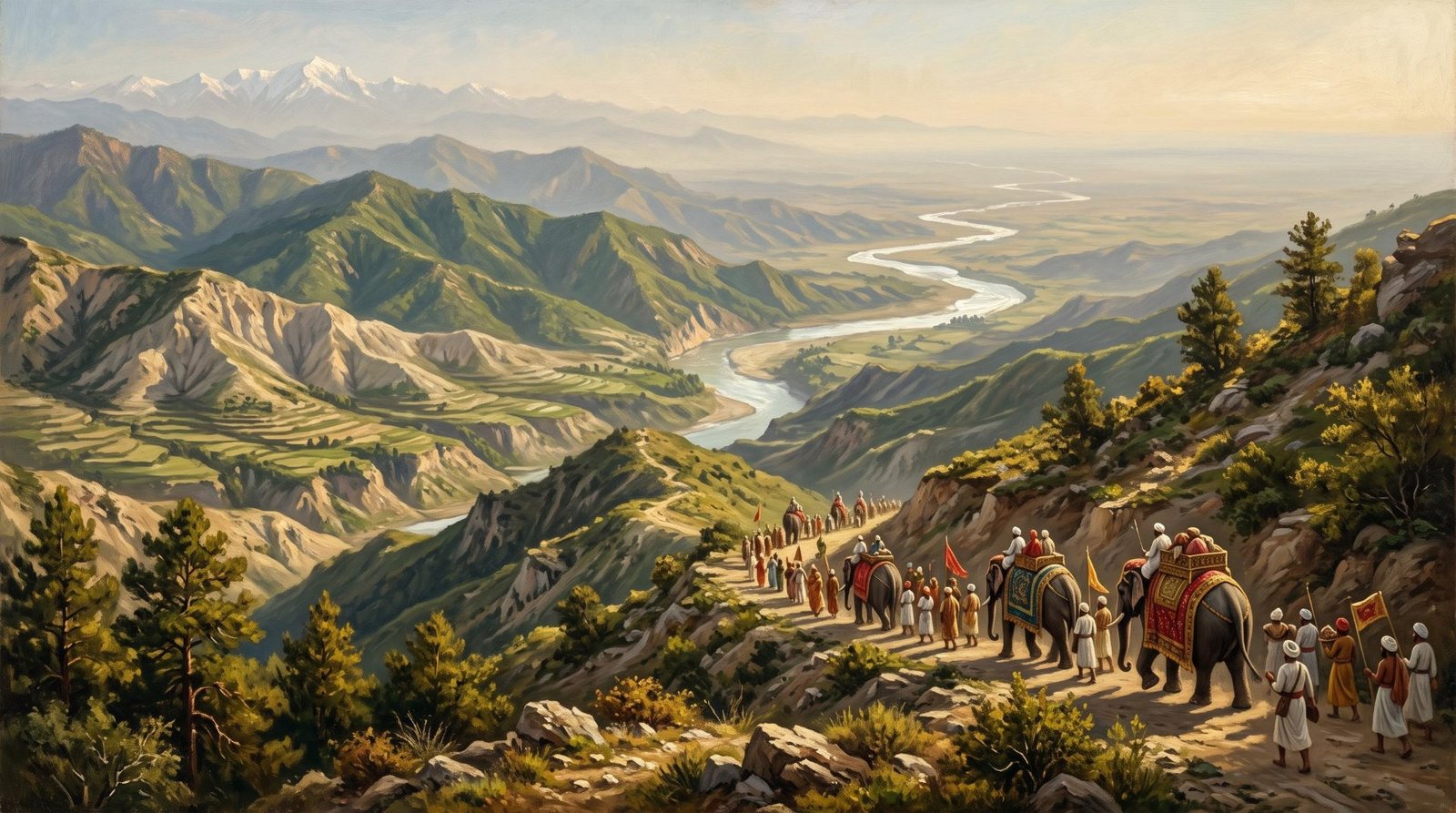
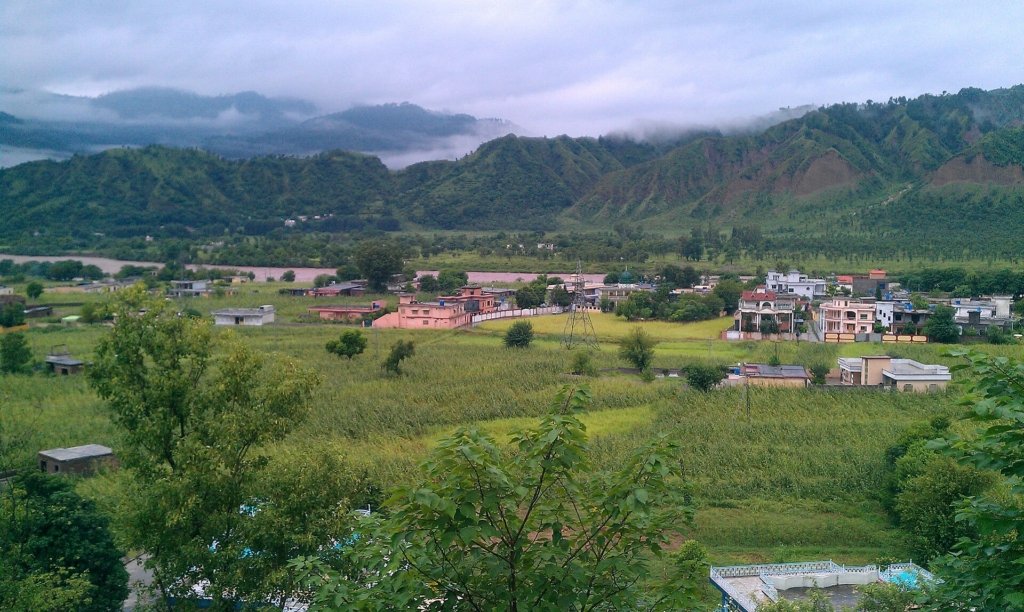
The Chib homeland lies in the outer hills of the Himalaya, between the Jhelum and the Chenab: the green ridges and sandstone hills of today’s Bhimber, Mirpur and Kotli districts and, across today’s Line of Control, the country around Nowshera and Rajauri. For more than five centuries this country has been called Chibhal, the land of the Chibs. But it is an old land, and it had other names long before the Chibs arrived.
Darvabhisara
In the Mahabharata, the Puranas and the astronomical work of Varahamihira, the hills between the Jhelum and the Chenab appear as the land of the Darvas and the Abhisaras, two peoples whose names were joined as Darvabhisara. Sir Aurel Stein, the translator of the Kashmir chronicle, concluded that the name covered all the lower and middle hills between the two rivers, including the old hill kingdom of Rajapuri, today’s Rajauri.
Abisares and Alexander
The Greek historians of Alexander the Great knew the king of this country as Abisares, the ruler of the Indian mountaineers. When Alexander arrived at Taxila in 326 BC, Abisares sent envoys to him, but he was secretly in league with Porus, the king of the plains beyond the Jhelum, and set out to join him. He came too late: by the time his army came down from the hills, the Battle of the Hydaspes had been fought and lost.
Abisares was quick to make his peace. He sent his own brother to Alexander with money and forty elephants and later, when the Macedonians reached the Chenab, thirty more, excusing himself from coming in person on the grounds of illness. Alexander confirmed him in his kingdom and placed the neighbouring ruler Arsakes of Urasa, today’s Hazara, under his authority. Hutchison and Vogel thought that the heart of Abisares’s kingdom lay in the very country later ruled from Rajauri and Bhimber.
A land on the road to Kashmir
The Rajatarangini, Kalhana’s chronicle of Kashmir written in the twelfth century, mentions Darvabhisara several times. One early king of Kashmir, Abhimanyu, is said to have spent his winters there to escape the snows of the valley. In AD 633 the Chinese pilgrim Hiuen Tsang came down from Kashmir to Rajapuri on his way to the Punjab, along the route through the hills that would one day become the Mughal road. The old name was still in use in Kalhana’s time.
The name Chibhal
Some time after the twelfth century the old name faded, and the country came to be called Chibhan or Chibhal. Chib tradition derives the name from Raja Chib Chand, son of Partab Chand, whom our shajra calls Raja of Chibhal State, Bhimber. Historians have debated this. Hutchison and Vogel thought the derivation from Chib Chand improbable, and H. A. Rose pointed out that the historian of Timur’s invasion of 1398–99 already knew the name “Jibhal”, earlier than tradition places Chib Chand. Perhaps the name is older than the man, or perhaps the Chibs came to the hills a little earlier than the traditional date. Either way, by the fifteenth century the land and the clan shared one name, as they do today.
Writing in 1875, the geographer Frederic Drew defined Chibhal as “that part of the Outer Hill region lying between the Chinab and Jhelam rivers”, and called its people Chibhalis after their country. The Imperial Gazetteer of India of 1909 put its eastern limit at the Manawar Tawi. Earlier, Alexander Cunningham had described Bhimber and Khari-Khariali as the two divisions of the Chibhan branch of the lunar-race (Somavanshi) rajas of Kangra and Jalandhar, the only chiefs of that line among the hill states of the Jammu group.
Chibhal today
The old kingdom of Bhimber stretched for about twenty-five kos along the hills, bordered by Rajauri and by the Chib sister state of Khari-Khariali, whose capital was Mangla Fort on the Jhelum. Borders have changed many times since the days of the last Chib raja, but the name has survived. Chib families still live throughout the old Chibhal and, wherever they have settled since, from Gujrat and Jhelum to Britain and the Gulf, they carry the name of their homeland with them.
Sources
- J. Hutchison and J. Ph. Vogel, History of the Panjab Hill States, vol. II (Lahore, 1933), “Rajauri State” and “Bhimbar and Khari-Khariyali”.
- Kalhana, Rajatarangini: A Chronicle of the Kings of Kashmir, trans. M. A. Stein (Westminster, 1900), note on Darvabhisara.
- Arrian, Anabasis of Alexander, book V.
- Frederic Drew, The Jummoo and Kashmir Territories (London, 1875).
- H. A. Rose, A Glossary of the Tribes and Castes of the Punjab and North-West Frontier Province, vol. II (Lahore, 1911), “Chibh”, pp. 169–170.
- Gazetteer of the Gujrat District, 1892–93 (Lahore, 1893).
- Imperial Gazetteer of India, Provincial Series: Kashmir and Jammu (Calcutta, 1909).
- Shajra-e-Nasab (family tree) of the Chib Rajputs of Malot, Azad Kashmir.