

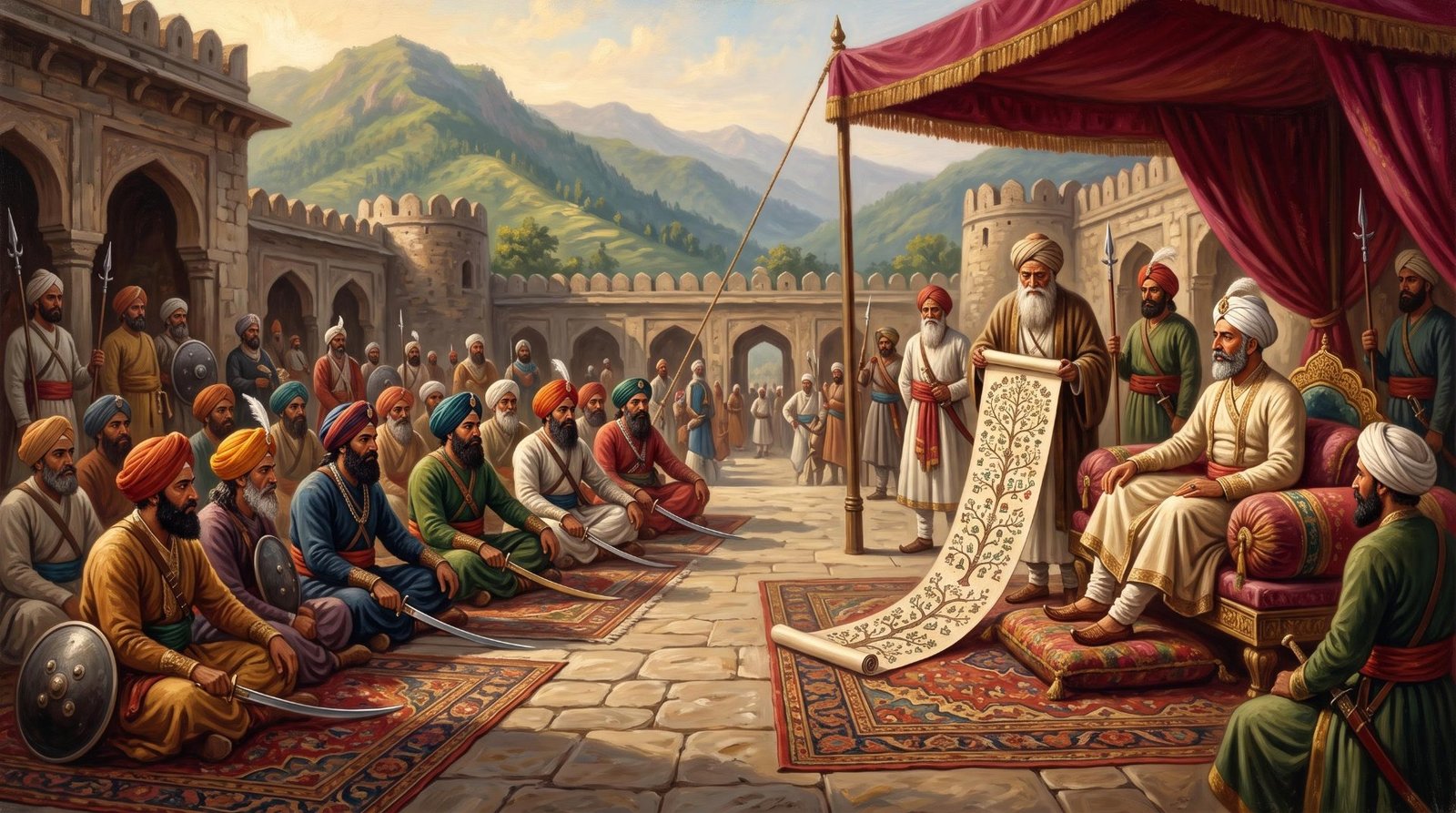
Ask a Chib elder which branch of the clan he belongs to and you may hear a name such as Rupyal, Ghaniyal or Jaskal. These are the septs of the Chib Rajputs, family branches named, for the most part, after the ancestors from whom they descend. Colonial records list fourteen of them, all descended from Baba Shadi Shaheed, the first Muslim raja of Bhimber.
The fourteen septs
The list below follows H. A. Rose’s Glossary of the Tribes and Castes of the Punjab, published in 1911, with the ancestor from whom each sept was said to descend:
- Rupyal, from Rup Khan
- Barwana, from Baru Khan
- Daphral, from Daphar Khan
- Dhural, from Dhaur Khan
- Darwesal, from Darwesh Khan
- Jaskal, from Jaisak Khan
- Maindal, from three ancestors, among them Jalal Din and Bhura Khan
- Baranshahia, from Baran Khan
- Samwalia, from Muhammad Khan
- Miana, also from Muhammad Khan
- Malkana, also from Muhammad Khan
- Malkal, from Malik Khan
- Ghaniyal, from Ghani Khan
- Ghaghial, from Ghaghi Khan
Several of these ancestors appear in our shajra. Rup Khan is Raja Rupo Khan, a son of Baba Shadi Shaheed. Ghani Khan and Ghaghi Khan are Raja Ghani Khan and Raja Ghaghi Khan, sons of Raja Bhom Khan and grandsons of Baba Shadi Shaheed; Rose calls Ghaghi Khan a cousin of Ghani Khan, while the shajra makes them brothers. Malik Khan may be the shajra’s Raja Mal Khan, another son of Baba Shadi Shaheed. The other ancestors are not named in our shajra, which follows the line of the Chibs of Malot.
The ruling sept
Rose records that the throne of Bhimber stayed with the Ghaniyal, the descendants of Ghani Khan, grandson of Shadi Khan. Our shajra agrees. The line of the rajas runs from Raja Ghani Khan through Raja Jamshaid, Raja Tughu Khan, Raja Hajj Khan and Shah Muhammad Khan to Raja Madan Khan, and from his son Ismail Khan down to Raja Sultan Khan, the last ruler of Bhimber. Another son of Raja Madan Khan, Darya Khan, jagirdar of Ali Malot, was the ancestor of the Chibs of Malot.
Mandis, garhs and dheris
Under the Chib rajas the kingdom of Bhimber had a remarkable feudal order. The raja’s younger sons and kinsmen had a right to a share of the land, and Rose describes three kinds of fief. The four great fiefs, the mandis of Mahlot (Malot), Bundala, Kahawalian and Rajal, were each held by a prince of the royal blood. The four strongholds, the garhs of Dewa, Butala, Ambarial and Kadhala, were in the charge of the Ghaghial. Below them came some eighty-four smaller fiefs called dheris, given to younger sons: a dheri ala had a few villages attached to it, while a dheri adna had none.
The Gazetteer of the Gujrat District, drawing on an older report by Captain Mackenzie, adds that the head of a mandi bore the title of Rai and ruled twenty-two villages, while a dheri chief was a Thakar with twelve. From this order came the three grades into which the Chibs were still divided in Rose’s day, the Mandial, the Garhial and the Dherial, and Rose observed that feeling about these distinctions still ran high.
Marriage and status
Rose also noted that the Samwalia, Miana and Malkana were regarded as superior “for unknown reasons”, and that they married among themselves or sought matches for their daughters among the Sayyids and the Gakkhars. The Gujrat gazetteer recorded that the Chibs held themselves superior to other Rajputs and, as a rule, gave their daughters in marriage outside the tribe only to Sayyids. It also recorded a simpler division of the clan into seven groups, among them the Jaskal, the Baranshahi and the Darweshal.
A living heritage
The old fiefs have long disappeared, but the septs remain. Many Chib families still know their sept and their place in the clan, the shrine of Baba Shadi Shaheed at Jandi Chontra remains the spiritual home of every branch, and family shajras like the one on this site keep the links between them alive. Read more in Customs and Traditions of the Muslim Chib Rajputs, or find these ancestors in our family tree.
Sources
- H. A. Rose, A Glossary of the Tribes and Castes of the Punjab and North-West Frontier Province, vol. II (Lahore, 1911), “Chibh”, pp. 169–170.
- Gazetteer of the Gujrat District, 1892–93 (Lahore, 1893).
- Shajra-e-Nasab (family tree) of the Chib Rajputs of Malot, Azad Kashmir.