

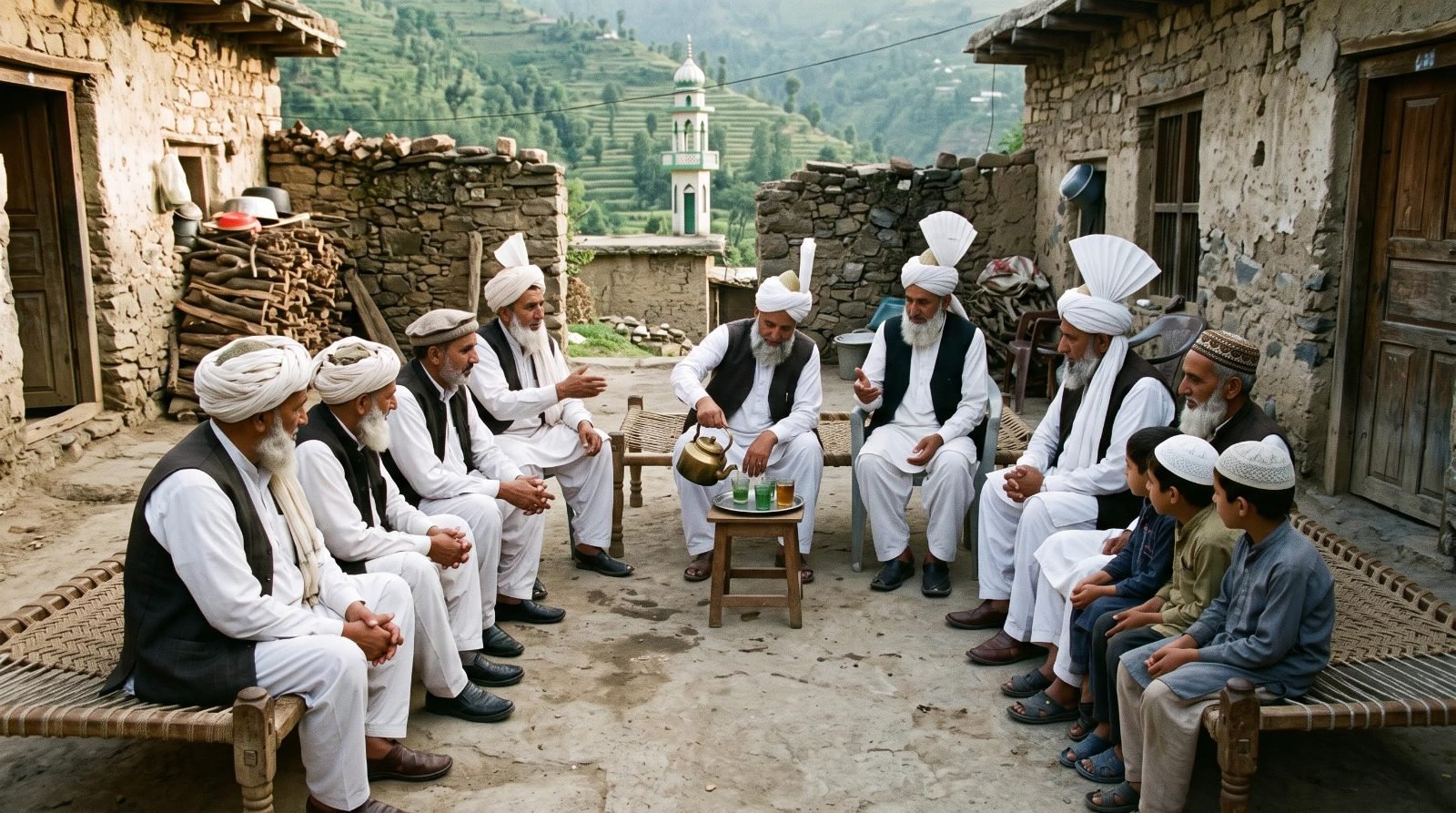
The Chibs are a Muslim Rajput clan. They have followed Islam since the time of their ancestor Baba Shadi Shaheed, yet they have never let go of the Rajput heritage they inherited from the Katoch rajas of Kangra. Faith and lineage strengthen each other in a distinctive identity that Chib families carry with pride wherever they live.
Faith
Islam is at the centre of Chib life. Daily prayer, Friday congregations, Ramadan and the two Eids shape the year, and the shrine of Baba Shadi Shaheed at Jandi Chontra gives the clan a spiritual home of its own.
Lineage and titles
Chib families keep careful record of their descent, and many still preserve a written shajra-e-nasab (family tree); the shajra of the Chibs of Malot can be explored on our Lineage page. The title Raja, inherited from the rulers of Bhimber, is widely borne, together with the name Khan. Historical records list fourteen septs of the clan descended from Shadi Khan’s sons and grandsons, among them the Rupyal, Barwana, Daphral, Jaskal, Malkal, Ghaniyal and Ghaghial, and the shajra names several of the ancestors behind them: Raja Rupo Khan, son of Baba Shadi Shaheed, and his grandsons Raja Ghaghi Khan and Raja Ghani Khan. The shajra also names family branches: the descendants of Raja Saleem Khan are the Khori family, and those of Raja Kasib Khan are the families of Bandi, Mughlora, Salam Kot and Samangla Sarsala.
The old order of the Bhimber kingdom
Old records describe a remarkable feudal order among the Chibs. The throne of Bhimber passed to the eldest son, but younger sons had a right to a share, and the kingdom was divided into four great fiefs, the mandis of Mahlot (Malot), Bundala, Kahawalian and Rajal, each held by a prince of the royal blood. Alongside them stood four strongholds, the garhs of Dewa, Butala, Ambarial and Kadhala, held by the Ghaghial branch, and some eighty-four smaller fiefs called dheris for younger sons. From this order came the three grades of Chib families, the Mandial, Garhial and Dherial, a memory of which survives to this day.
Courage and service
The Chibs are proud of a long martial tradition, from the defence of Bhimber against the armies of Lahore to the many sons of the clan who have served in the armed forces and in public service in modern times. Courage, loyalty and the duty to protect one’s people remain central Chib ideals.
Hospitality and brotherhood
Generous hospitality is a point of honour in every Chib home. Weddings, funerals, the urs at Jandi Chontra and village gatherings bring the extended clan together, and the bonds of biradari link Chib families across Bhimber, Mirpur and Kotli, Gujrat and Jhelum, and the many Chib communities overseas.
Do you know a family custom, a saying or a story that should be recorded here? Please share it with us.
Sources
- H. A. Rose, A Glossary of the Tribes and Castes of the Punjab and North-West Frontier Province, vol. II (Lahore, 1911), “Chibh”, pp. 169–170.
- J. Hutchison and J. Ph. Vogel, History of the Panjab Hill States, vol. II (Lahore, 1933), “Bhimbar and Khari-Khariyali”, pp. 725–729.
- Shajra-e-Nasab (family tree) of the Chib Rajputs of Malot, Azad Kashmir.