

For centuries Bhimber stood where the plains of the Punjab meet the hills, on the main road to Kashmir. Many travellers passed that way, and a few of them wrote down what they saw. Three European visitors in particular left vivid pictures of the Chib capital and its country, one in the days of the Mughals and two in the age of the Sikhs.
François Bernier, 1665
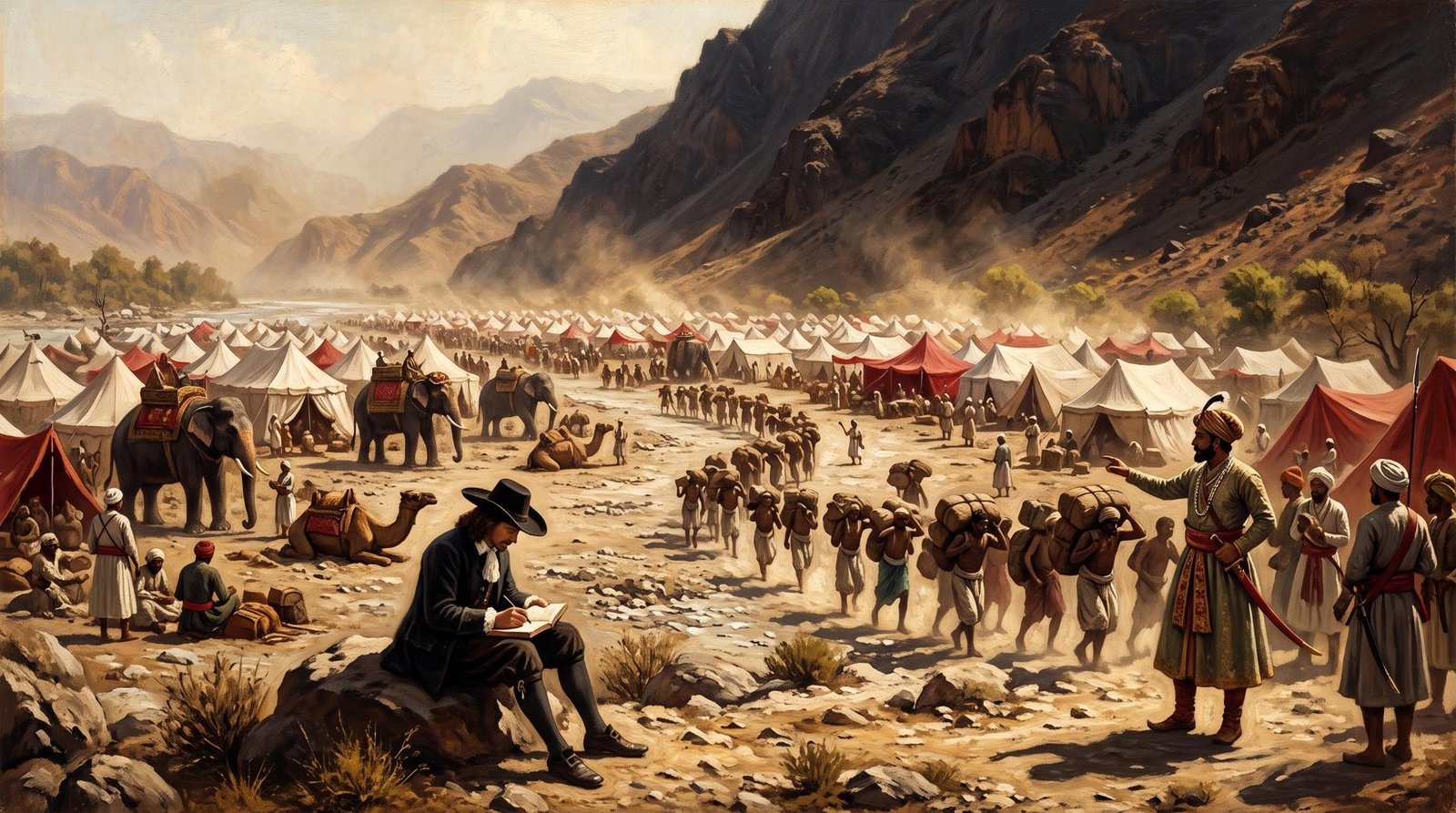
François Bernier was a French doctor who spent more than ten years in India and travelled to Kashmir in 1665 in the enormous camp of the emperor Aurangzeb. He described the journey in letters to a friend in France, and wrote the eighth of them at Bhimber itself. After a march of eleven or twelve days from Lahore in fierce heat, the army had at last reached “Bember, situated at the foot of a steep, black, and scorched mountain”, and was camped in the dry bed of a torrent, on pebbles and burning sand.
Bhimber was where the imperial camp had to change its whole way of travelling. Camels could not climb the mountain paths into Kashmir, so everything had to be carried by men. Bernier was told that the emperor alone needed six thousand porters and that at least fifteen thousand had already gathered at Bhimber, some sent by the governor of Kashmir and by the neighbouring rajas, among whom the Chib raja of Bhimber was the nearest, and others who had come of their own accord to earn a little money. In all, some thirty thousand would be needed. A royal order fixed their pay at ten crowns for every hundred pounds carried, and an officer stationed at the pass counted every person who went through, to keep the crowds out of the small valley. Those who were not allowed to go on had to wait out the hot months in what Bernier called “this burning Bember”.
William Moorcroft, early 1820s
A century and a half later the English traveller William Moorcroft, veterinary superintendent of the East India Company’s stud, came down from Kashmir by the same road on his long journey towards Central Asia. Crossing the hills from Rajauri by way of the old Mughal sarai at Naushahra, he descended to a sandy plain and the town of Bhimber.
Moorcroft left the best description we have of the Chib state in its last years. The people of the country, he wrote, were called Chibs. Most had once been Hindus and were now Muslims, though Hindu and Muslim Chibs still intermarried. The raj of Bhimber was about twenty-five kos long and contained three towns, Bhimber, Samahni and Mangal Devi, where the Sikhs kept a post. Its raja, Sultan Khan, lived near Samahni on a revenue of sixty thousand rupees. The old town of Bhimber, at the foot of a low hill to the north, had been deserted soon after the time of the Mughal emperor Muhammad Shah; the newer town had about a thousand low, flat-roofed houses and some hundred and fifty shops.
G. T. Vigne, 1830s
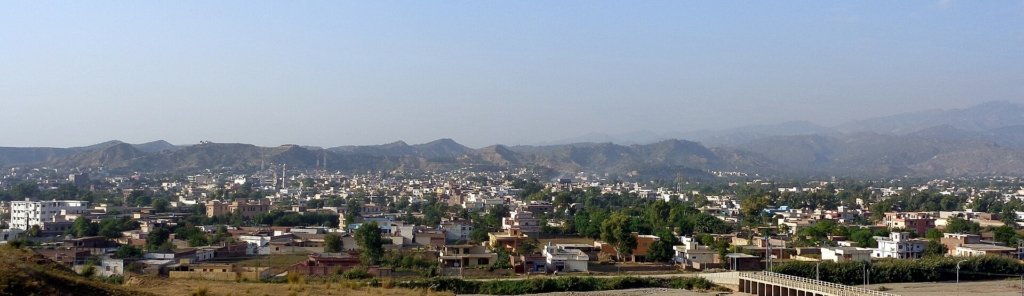
Godfrey Thomas Vigne, an English artist and traveller, passed through Bhimber on his way to Kashmir in the later 1830s. He reckoned it seventy to seventy-five miles from Lahore and described a small town at the edge of the plain, where a stream came out of the hills: cottages of rough stone, mud and wood, two or three mosques and a house kept for the Maharaja. Behind it rose sandstone ridges that he called “the first stepping-stones of the Himalaya”, and Rajauri lay three days’ march away.
Vigne’s Bhimber was already a Dogra town. Its new master was Raja Dhian Singh of Jammu, who had built a castle called Amar Garh, “the immortal fortress”, six miles away, and who protected the wild boar for his own hunting. The ruins of the old Chib rajas’ palace stood beside the road to Kashmir, and Vigne recorded what he had heard of the fate of Raja Sultan Khan: imprisoned, taken to Riasi and blinded, he had died about twelve years earlier.
Three snapshots of a changing land
Together these three travellers give us glimpses of Chibhal across nearly two centuries: the Mughal gateway crowded with the emperor’s porters, the last years of the Chib raj and the first years of Dogra rule. None of them stayed long, and all of them saw Bhimber as a place on the way to somewhere else. For the Chibs it was home. Read more in Bhimber: Gateway on the Mughal Road to Kashmir and The End of Chib Rule.
Sources
- François Bernier, Travels in the Mogul Empire, A.D. 1656–1668, trans. Archibald Constable, 2nd edn revised by Vincent A. Smith (London, 1914), “The Eighth Letter”, pp. 390–392.
- William Moorcroft and George Trebeck, Travels in the Himalayan Provinces of Hindustan and the Panjab, ed. H. H. Wilson, vol. II (London, 1841), pp. 301–303.
- G. T. Vigne, Travels in Kashmir, Ladak, Iskardo, vol. I (London, 1842), pp. 234–241.