

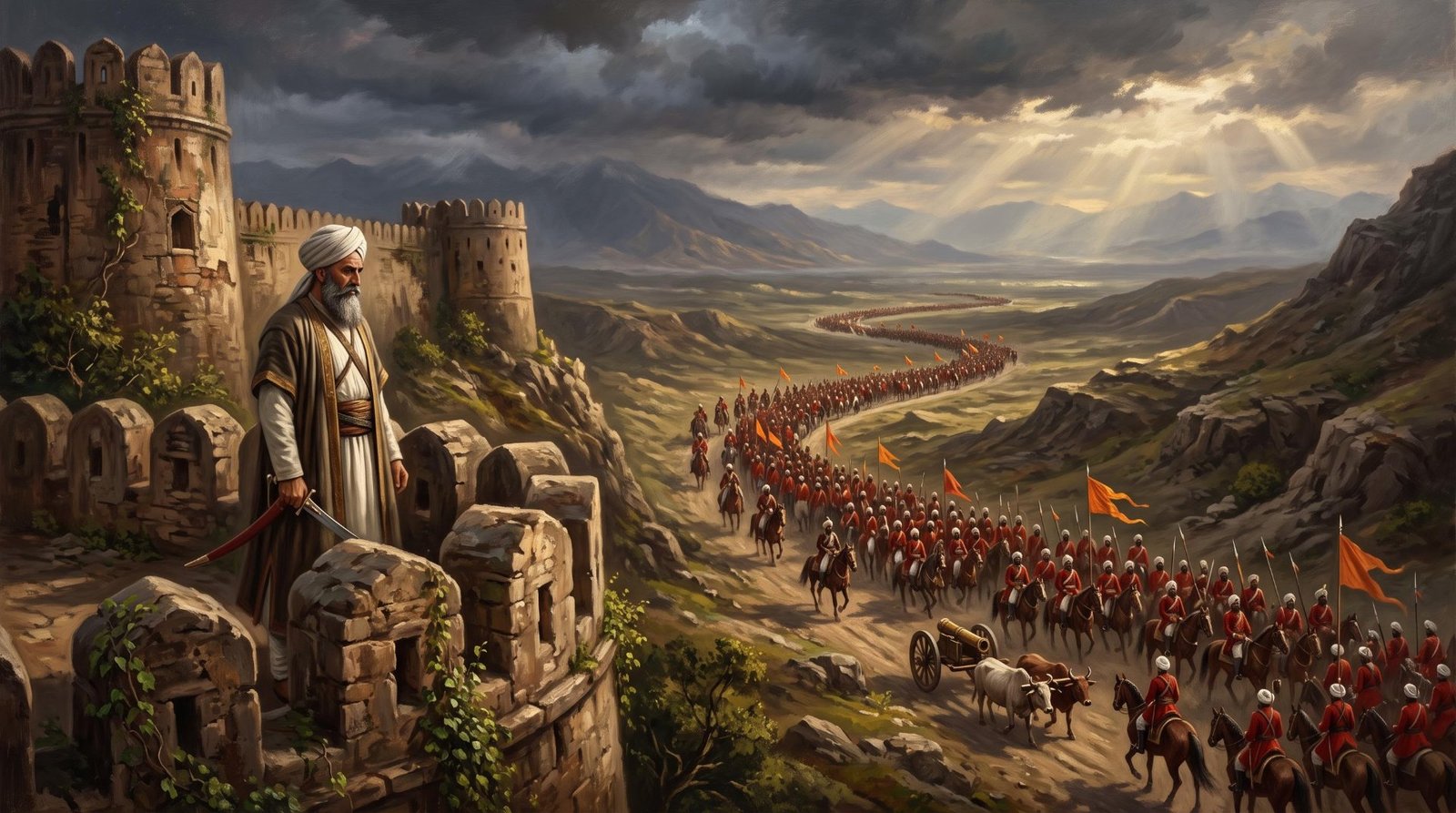
For more than four hundred years, from the time of Raja Partab Chand around 1400, the Chib rajas ruled Bhimber. Their kingdom outlasted the Sultans of Kashmir, the Mughal emperors and the Afghan governors who followed them. It did not survive the nineteenth century. Between the 1820s and 1846 the Chibs lost their country to a new power in the hills: the Dogra rajas of Jammu, led by the ambitious Gulab Singh.
The rise of the Jammu brothers
Gulab Singh and his brothers Dhian Singh and Suchet Singh, Dogra Rajputs of a junior branch of the Jammu ruling family, rose to power in the service of Maharaja Ranjit Singh of Lahore. In 1822 Ranjit Singh made Gulab Singh Raja of Jammu, and Dhian Singh rose to become his chief minister at Lahore. Over the next twenty years the brothers brought one hill state after another under their control, and Chibhal, lying across the road from Lahore to Kashmir, was soon in their hands.
The fate of Raja Sultan Khan
After his release from Lahore in 1819 and his part in the conquest of Kashmir, Raja Sultan Khan recovered part of his country. William Moorcroft found him living near Samahni in the early 1820s, on a revenue of sixty thousand rupees. Some time after Moorcroft’s visit, according to Hutchison and Vogel, Sultan Khan was invited to Jammu and put to death. When the traveller G. T. Vigne passed through Bhimber in the 1830s, he was told that the raja had been imprisoned at the instance of Gulab Singh, taken to Riasi and blinded, and that he had died some twelve years before. Our shajra remembers him as Raja Sultan Khan, the last ruler, the wali, of Bhimber.
Bhimber under the Dogras
Bhimber itself passed to Dhian Singh, to whom Ranjit Singh had given it. Vigne found the new order everywhere: a house kept for the Maharaja in the town, wild boar protected by Dhian Singh’s order for his hunting, and a new castle, Amar Garh, “the immortal fortress”, built by Dhian Singh about six miles away. The ruined palace of the old rajas stood beside the road to Kashmir.
With Ranjit Singh’s permission the chiefship passed to Sultan Khan’s nephew, Faiz Talab Khan (Vigne calls him his son), who held what remained of the family’s lands until 1840, when Gulab Singh dispossessed him. Faiz Talab Khan does not appear in our shajra, which closes this branch with Raja Sultan Khan; he is known from the historical record.
The Treaty of Amritsar
Ranjit Singh died in 1839, and the Sikh kingdom fell into turmoil. In the First Anglo-Sikh War of 1845–46 Gulab Singh stayed out of the fighting and acted as a go-between with the British. By the Treaty of Lahore of 9 March 1846 the defeated Sikh state ceded the hill country between the Beas and the Indus to the East India Company. A week later, by the Treaty of Amritsar of 16 March 1846, the British transferred to Gulab Singh “all the hilly or mountainous country” east of the Indus and west of the Ravi, including Kashmir, for seventy-five lakh rupees. Chibhal became part of the new princely state of Jammu and Kashmir under the Dogra maharajas.
Leaving the hills
The settlement made provision for the old ruling families. Under an agreement guaranteed by the British, the dispossessed hill chiefs received allowances of some 62,300 rupees a year and were free either to remain in Gulab Singh’s territory or to leave. To pay for them, Gulab Singh ceded to the British lands near Pathankot and on the Beas worth about 42,800 rupees a year. The rajas of Rajauri, Bhimber and Khari-Khariali chose to leave, and in 1847 Faiz Talab Khan settled at Pothi in Gujrat District, in British territory, on a pension of ten thousand rupees.
The cousins of Khari-Khariali, whose capital had been Mangla Fort, had already lost most of their state to the Sikhs in 1810. Their family lived on pensions and a small jagir, which was resumed in 1864. Writing in 1933, Hutchison and Vogel recorded that the head of the Bhimber family was then Senior Viceregal Darbari in Gujrat District, and that its members had “served Government with great distinction, both in the army and in civil employ”.
So ended more than four centuries of Chib rule in Bhimber. The rajas lost their kingdom, but the clan endured: in the villages of Chibhal, in the ranks of the army and in families that still keep their shajras and remember the last raja who would not give up his country without a fight. The story continues in Mangla Dam and the Chib Diaspora.
Sources
- J. Hutchison and J. Ph. Vogel, History of the Panjab Hill States, vol. II (Lahore, 1933), “Bhimbar and Khari-Khariyali”, pp. 725–729.
- G. T. Vigne, Travels in Kashmir, Ladak, Iskardo, vol. I (London, 1842), pp. 234–241.
- William Moorcroft and George Trebeck, Travels in the Himalayan Provinces of Hindustan and the Panjab, vol. II (London, 1841), pp. 301–303.
- Treaty of Amritsar, 16 March 1846.
- Shajra-e-Nasab (family tree) of the Chib Rajputs of Malot, Azad Kashmir.