

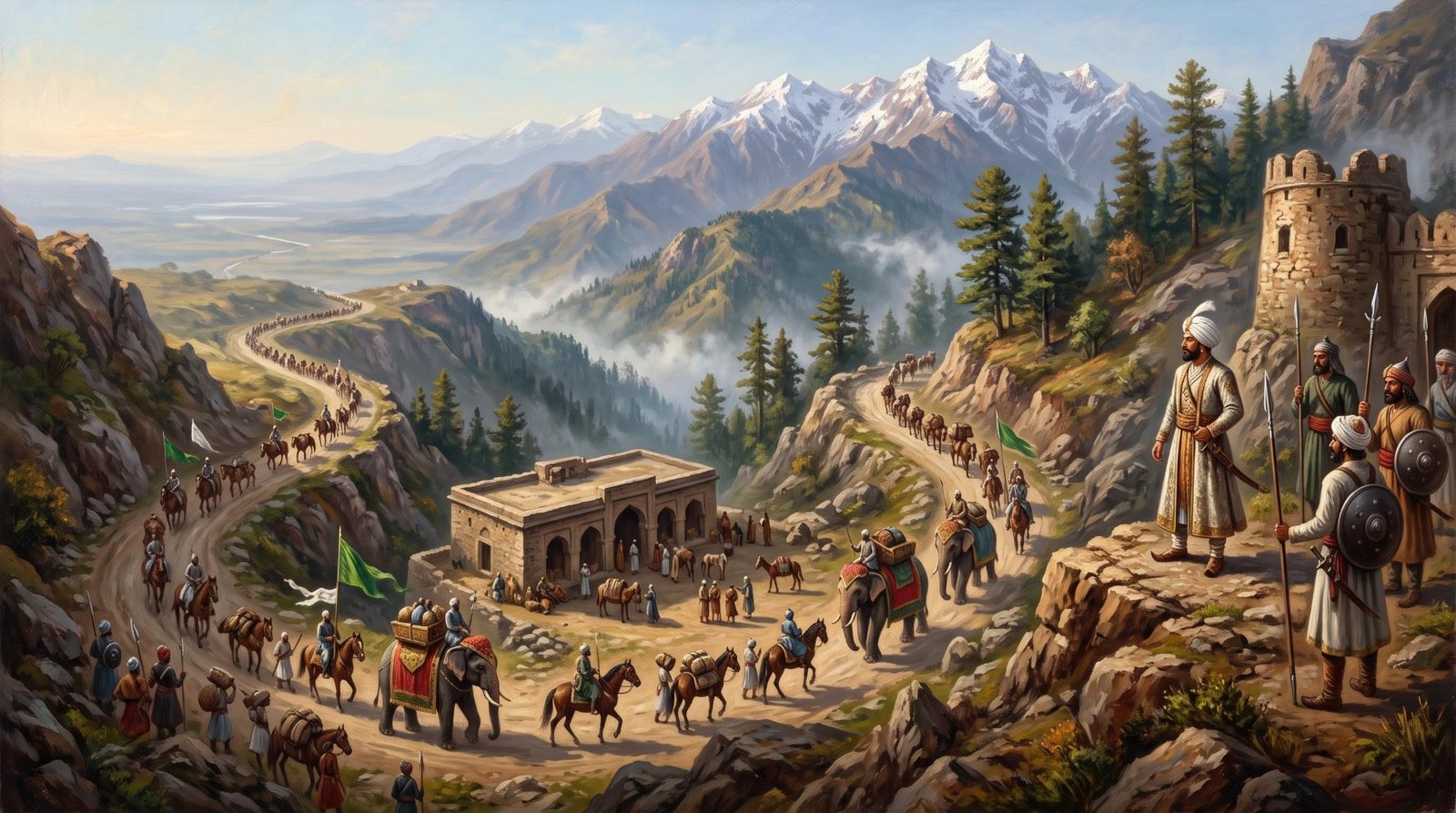
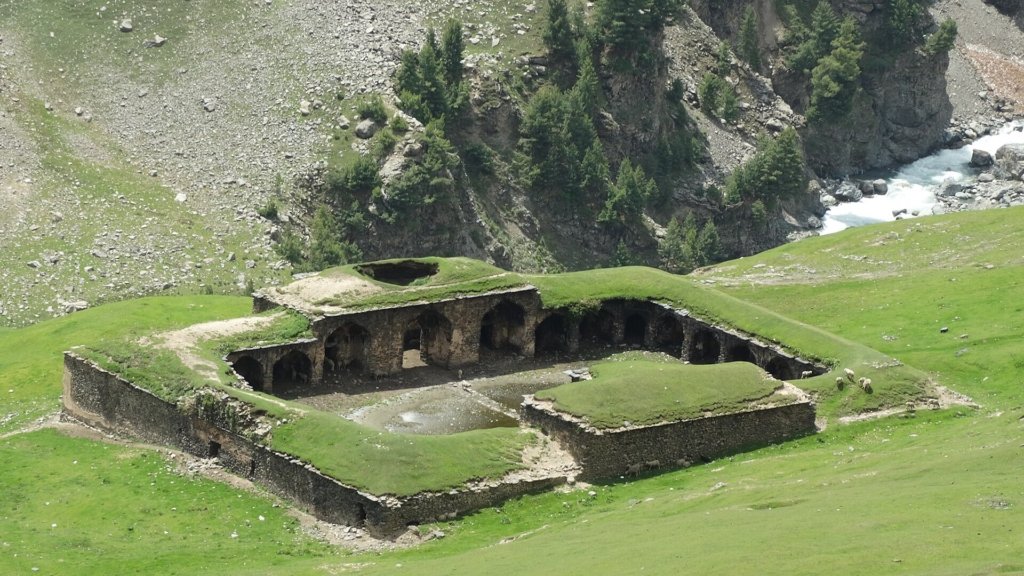
Long before the Mughal emperors made it famous, Bhimber was the southern gateway of Kashmir. From the plains of the Punjab the road climbed through Bhimber to Naushahra and Rajauri, crossed the Pir Panjal range and came down by Hirapur and Shupiyan into the valley. In the age of the independent Sultans of Kashmir, from the fourteenth to the sixteenth century, it was one of the great routes into the valley, open for about seven months of the year, and the Chib rajas who held its lower end were men whom kings had to reckon with.
The Sultans and the road
The Shah Mir dynasty ruled Kashmir from 1339, and under Sultan Zain-ul-Abidin (1420–1470) the kingdom reached its height. The road through Bhimber was its link with the Punjab, used by traders, pilgrims, armies and fugitives alike. When Zain-ul-Abidin’s rebellious son Haji Khan was defeated by his father’s forces, he fled across the Pir Panjal by Hirapur and made for Bhimber, the first safe ground beyond the mountains.
The raja who turned back an army
The Chib rajas appear in the Kashmir histories at a dramatic moment. In the troubled reign of Sultan Muhammad Shah, in the 1480s, a party of Sayyids who had been driven out of Kashmir asked Tatar Khan Lodi, the governor of the Punjab for the Delhi Sultanate, to help them return. His troops marched north, but when they reached Bhimber, the historian Mohibbul Hasan writes, its raja “checked their advance, and compelled them to retreat”.
Hutchison and Vogel name this raja as Hans, about 1486, and remark that he is the only early raja of Bhimber whom the histories mention by name. Raja Hans is not named in our shajra, which records five rajas between Raja Chib Chand and Baba Shadi Shaheed; he belongs to the historical record rather than the family tree.
Between empires
In the sixteenth century the road through Bhimber carried ever larger armies. In 1549 the Afghan emperor Islam Shah Sur pursued the rebel Niazi chiefs as far as Bhimber as they tried to escape into Kashmir; Mirza Haidar Dughlat, the Mughal adventurer who then ruled the valley, closed the way against them. Later the Chak sultans of Kashmir fought their own wars along the same road, and Yusuf Shah Chak marched out towards Bhimber and defeated a rival, Yusuf Dar, at Naushahra.
The decisive moment came in the 1580s, when the Mughal emperor Akbar resolved to conquer Kashmir. In December 1585 his commanders argued for the road through Bhimber: it was easier than the alternatives, they said, and the chiefs who held it were well disposed. Akbar sent his first army by the northern route through Pakhli instead, where it was caught by the snows and forced to make terms. The next year he changed course. His general Qasim Khan left Lahore on 28 June 1586 and passed the defile of Bhimber on 1 September, and soon afterwards Kashmir was in Mughal hands. It became a province of the empire, and the Bhimber road became the emperors’ own highway to their summer paradise.
The Chib rajas and the Mughals
According to Hutchison and Vogel, the ruling family of Bhimber had embraced Islam probably by the time of Babur, the first Mughal emperor. Its head, Raja Shadab Khan, remembered as Baba Shadi Shaheed, received confirmation of his lands from Babur, and the Chib rajas held Bhimber as hereditary chiefs under the Mughals for the next two centuries. Every emperor who travelled to Kashmir passed beneath their hills, and the story of those journeys is told in Bhimber: Gateway on the Mughal Road to Kashmir.
Sources
- Mohibbul Hasan, Kashmir under the Sultans (Calcutta, 1959).
- J. Hutchison and J. Ph. Vogel, History of the Panjab Hill States, vol. II (Lahore, 1933), “Bhimbar and Khari-Khariyali”, pp. 725–729.
- Shajra-e-Nasab (family tree) of the Chib Rajputs of Malot, Azad Kashmir.