

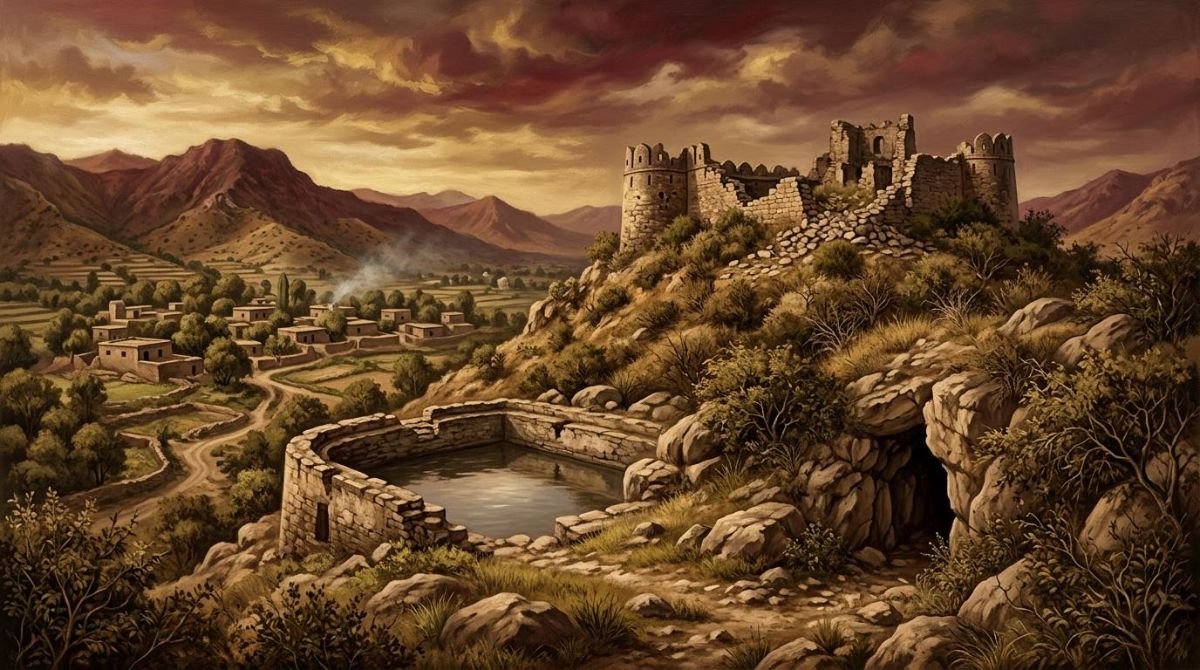
Mandi Da’ora (منڈی دعورہ), also written Mandi Daora, Daura or Dhaurah, is a Chib Rajput village about five kos from Bhimber in Azad Jammu and Kashmir and the seat of the Dhauryal got, founded by Raja Tahwar Khan, known as Raja Dhaur Khan, a grandson of Baba Shadi Shaheed. Its families remember a Sikh assault that only two boys survived, while neighbouring Kalri, a Jaskal village of the old Panjeri mandi, is known for its soldiers, among them Lt. Gen. Raja Muhammad Akbar Khan.
At a glance
- Where
- Near Bhimber, Tehsil and District Bhimber, Azad Jammu and Kashmir
- Got
- Dhauryal (Rose: Dhorral), named after Raja Dhaur Khan
- Founder
- Raja Tahwar (Tahawwur) Khan, alias Dhaur Khan, son of Raja Mal Khan
- Chief’s title
- Khan (Khan Sahib)
- Old fort
- Kot, about four miles north of the present village
- Today
- Two mauzas, Da’ora and Dhok Da’ora, about 25–30 square miles
- Divisions
- The Khanka wand and the Chaudhri wand
- Kalri
- Jaskal got; about five miles north-west of Panjeri
Mandi Da’ora (Mandi Daora) and Raja Dhaur Khan
Da’ora and Kalri are neighbours with different ancestors. Both belong to the house of Raja Mal Khan, the son of Baba Shadi Shaheed who inherited the western half of the old Chib state of Bhimber, but they descend from different sons. Kalri’s Chib Rajputs come from Raja Jaisak Khan, founder of Panjeri; Da’ora’s come from his brother Raja Tahwar (Tahawwur) Khan, remembered as Raja Dhaur Khan. Each brother founded a mandi, a chief’s seat with its own villages and its own got.
According to an account written for the book by Raja Khizar Hayat Khan of Da’ora, the village takes its name from its founder: first called Tahwara, it became Dhaurha and finally Da’ora. Its Rajputs are the Dhauryal got — the Dhorral of H. A. Rose’s list of fourteen Chib gots — and their chief bore the title Khan. Thakur Major Singh, quoted in the book from his Tarikh-e-Rajgan-e-Bhimber wa Qaum-e-Chibhal, placed Da’ora five kos from Bhimber (a kos is roughly two miles) and named Chaudhri Ata Muhammad Khan as its jagirdar and numberdar (village headman) in the 1920s.
Where the settlement began, Raja Tahwar Khan built a fort, about four miles north of the present village. The place is still called Kot, “the fort”, and traces survive of a tank (talab) built at the same time. His eldest son, Raja Hasan Khan, stayed at Da’ora, while his other sons settled the villages around it — Pir Khana, Khal Khanpur, Sheikhpur Andarla, Kastila, Bakohal, Chowki Bandi and Sambli (some readings uncertain) — and Da’ora’s authority extended over them all. The Da’ora family tree printed in the book names seven sons of Dhaur Khan and the village linked to each:
- Hasan Khan — Da’ora
- Pira Khan — Pir Khana
- Haji Khan — Khal
- Sheikho Khan — Sheikhpur Andarla
- Sikandar Khan — village name unclear in print
- Ahmad Khan — Bakohal
- Niaz Muhammad Khan — village name unclear in print
A second genealogical account in the book gives the Dhauryal chief the title Khan Sahib and a holding of twenty-two villages, adding Thal, Dak, Malikpur and Sirla to the list of Dhauryal villages.
Sources differ
Thakur Major Singh calls Dhaur Khan the second son of Raja Mal Khan. The book’s chapter on Mal Khan’s line makes him the third, after Ali Ghiyas Khan and Jaisak Khan, with Naru (or Baru) Khan the fourth, and notes that Tarikh-e-Chibhal adds a fifth son, Darbar Khan. The Da’ora family tree lists Mal Khan’s sons as Ali Ghiyas Khan, Tahwar Khan, Jaisak Khan and Nadir Khan.
A stand against the Sikhs
The most dramatic memory of Da’ora is of its near-destruction. Family tradition, as recorded in the book, says that when the Sikhs of the Punjab began to attack the small hill states of the region, a Sikh force fell upon Da’ora. Rather than let their women and children fall into the attackers’ hands, the defenders killed their own families and threw the bodies into the tank, and then died fighting.
Only two children survived: Momin Khan and Sadar Khan (reading uncertain), who hid in a cave. Two or three days later people came from Barhang to find out what had happened. They found the boys and took them home, and the two were brought up in Barhang. As grown men they returned and founded a new village on the site where Da’ora stands today. Da’ora now consists of two revenue villages (mauzas), Da’ora and Dhok Da’ora, covering some 25 to 30 square miles.
The family tree remembers the survivors too. Momin Khan and Sadar Khan appear in it as brothers, sons of a Raja Khan who stood seventh in descent from Hasan Khan, and the Chaudhri family of Da’ora traces its descent through Sadar Khan’s son, Nasrullah Khan.
When was the raid?
The family account places the raid in the first decade of the eighteenth century. Sikh armies reached the hills around Bhimber mainly in the later eighteenth century and, under Maharaja Ranjit Singh, in the early nineteenth (see Raja Sultan Khan and the Sikh Wars). Counting the generations in the family tree points the same way, so the raid may be somewhat later than tradition remembers.
The Khanka and Chaudhri wands
Da’ora’s landholding families are divided into two wands, or shares: the Khanka wand and the Chaudhri wand.
The Khanka wand
About a century before the book was written, the leading men of the Khanka wand were Raja Farman Ali Khan, Raja Sherbaz Khan and Raja Faiz Talab Khan. Sherbaz Khan’s descendants include Honorary Captain Raja Muhammad Akram Khan and Raja Muhammad Azam Khan, a former numberdar. Faiz Talab Khan had no children of his own. He brought up his sister’s daughter, from the village of Bhattian Chhiban, and married her to Raja Mardan Ali Khan of the Kasgumah jagir; she became the grandmother of Raja Muhammad Zulqarnain Khan, head of the Kasgumah family and a former minister in Azad Kashmir. From the line of Faiz Talab Khan’s brother comes Raja Muhammad Jamil Khan, a businessman and a former President of the Azad Kashmir Chamber of Commerce.
The Chaudhri wand
The Chaudhri wand descends from Raja Siddiq Khan. His grandson Raja Karamullah Khan, already the village numberdar, received a jagir from Maharaja Partab Singh of Jammu and Kashmir together with the title Chaudhri Sahib, which gave the wand its name. Karamullah Khan’s sons, as the book and the family tree give them, were:
- Raja Karamullah Khan — numberdar; jagir and the title Chaudhri Sahib from Maharaja Partab Singh
- Raja Amir (Mir) Ali Khan — ADC to Maharaja Partab Singh; his line ended in the second generation
- Raja Faiz Talab Khan — Risaldar in the Maharaja’s bodyguard; his line ended after one generation
- Raja Allah Dad (Ilahi Dad) Khan — died young; his two sons left no children
- Raja Ata Muhammad Khan, “Bare Chaudhri Sahib” (the Elder Chaudhri) — jagirdar and numberdar; died about 1945
- Raja Ali Akbar Khan, “Chhote Chaudhri Sahib” (the Younger Chaudhri)
The two Chaudhris and their families
A memoir by Raja Muhammad Akram Khan, an advocate of Bhimber and the Younger Chaudhri’s son, gives a warm portrait of the brothers. Ata Muhammad Khan trusted his youngest brother so completely that he handed him the management of his whole estate and the numberdari. Ali Akbar Khan ran both for twenty years, until his nephews came of age, and then passed them to Ata Muhammad’s son Raja Zaman Ali Khan, who was also his own son-in-law.
Ata Muhammad Khan was a devout man who, after his prayers, would walk from house to house asking after everyone’s welfare. In the days before Partition, Akram Khan recalls, Hindus and Muslims alike would rise to their feet when he passed. He died, the writer believed, in 1945, when Akram Khan was seven years old.
Ali Akbar Khan was counted highly educated for his time. Taught in the mosque school, he had read Sa’di’s Persian classics, the Gulistan and the Bostan, wrote a firm, fine hand in Urdu and Persian, and was sought out from all over the area to write and read people’s letters. He was also a dashing horseman who loved to keep a good mare.
The eight sons of Chaudhri Ata Muhammad Khan
| Son | Career and notes |
|---|---|
| 1. Raja Mardan Ali Khan | Served in the state Police and Revenue departments and held office under Maharaja Hari Singh; resigned at Chaudhri Ghulam Abbas’s urging to work for the Muslim Conference, alongside A. R. Saghar, Chaudhri Hamidullah, Raja Fazal-ur-Rahman Khan, Sardar Fateh Muhammad Kariyalvi and Colonel Mahmood Khan; d. 30 January 1970 |
| 2. Raja Farman Ali Khan | Police officer in Sindh, retiring as an Inspector |
| 3. Raja Zaman Ali Khan, “Raja Bana Khan” | Head numberdar of Da’ora for many years |
| 4. Raja Lal Khan | Served briefly in the army |
| 5. Haji Raja Muhammad Iqbal Khan | DSP, retired 1975; settled local disputes by mediation; d. 22 June 1994 |
| 6. Raja Muhammad Sarwar Khan | Jamadar (Naib Subedar) in the army; lived at Da’ora |
| 7. Raja Muhammad Murawwat Khan | Civil engineer; District Council engineer in Sindh; d. 23 May 1994 |
| 8. Raja Ghazanfar Ali Khan | Served in the army; lived in Hyderabad, Sindh |
Of the next generation, the book singles out three of Mardan Ali Khan’s sons: Raja Manzoor Ahmad Khan, a Punjab University graduate who retired as a Commercial Manager of the Pakistan Industrial Development Corporation (PIDC); Raja Bashir Ahmad Khan, a veteran political figure of Bhimber who in the early 1970s helped found the Pakistan People’s Party in Bhimber city before returning to the Muslim Conference, and who later became Da’ora’s numberdar; and Raja Maqsood Ahmad Khan, a Divisional Forest Officer. DSP Muhammad Iqbal Khan’s sons include Raja Khizar Hayat Khan, who wrote the book’s account of Da’ora, and Raja Mazhar Iqbal Khan, an advocate in Bhimber, member of the Azad Jammu and Kashmir Bar Council, district president and central secretary of the Muslim Conference, a former district councillor and a member of the advisory committee of Baba Shadi Shaheed’s shrine. Muhammad Iqbal Khan himself, though never a candidate, was a power in Constituency No. 7: he twice helped Raja Muhammad Zulqarnain Khan of Kasgumah into the Azad Kashmir Assembly.
Ali Akbar Khan’s sons were Raja Muhammad Afzal Khan, who served in the police in the Dogra period, was repeatedly elected a Basic Democracies member under Field Marshal Ayub Khan and lived all his life in the family home at Da’ora; Raja Muhammad Akram Khan, the memoirist, who studied in Lahore and Karachi and has practised law in Bhimber since 1983; and Raja Kabir Ahmad Khan, a laboratory assistant at Mayo Hospital, Lahore. Afzal Khan’s son Raja Karamat Ali Khan rose from constable to DSP in the Karachi Police.
Other men of Da’ora named in the book include Subedar Nawazish Ali Khan, a pious veteran of the Dogra state army; Jamadar Raja Muhammad Ashraf Khan, a Viceroy’s Commissioned Officer in the Second World War who later served in the Azad Kashmir forces; Raja Razi-ur-Rahman, a section officer in the Azad Kashmir secretariat at Muzaffarabad; and Raja Zubair Akhtar, Deputy Attorney for District Lahore.
Sources differ
Akram Khan’s memoir calls his father the youngest of four brothers, but the main account and the family tree list five sons of Karamullah Khan. The main account names only six sons of Ata Muhammad Khan, in a different order and without Lal Khan and Ghazanfar Ali Khan; the memoir and the family tree both give eight. The tree also names Ali Akbar Khan’s third son Sultan Ahmad, known as Mir Ahmad, where the memoir has Kabir Ahmad Khan.
Kalri: a Jaskal village of soldiers
Kalri lies about five miles north-west of Panjeri. Its Chibs are Jaskal, descendants of Raja Jaisak Khan, and the book counts Kalri the most advanced of the twenty-two villages of old Mandi Panjeri after Panjeri itself. In the book’s tables of the old divisions, Kalri appears in the share of one Muzaffar Khan, listed against his son Musa Khan.
Kalri is best known for its soldiers. Subedar Raja Jalal Khan of the British Indian Army was the father of Lt. Gen. Raja Muhammad Akbar Khan (1922–1978), who rose to Deputy Chief of Staff of the Pakistan Army and died as Pakistan’s Ambassador to Britain. The general’s son Captain Raja Muhammad Zafar Khan of the 13th Lancers was killed in the Zafarwal sector of Sialkot in the 1971 war; another son, Major Raja Muhammad Tariq Khan, flew with Army Aviation and later became personal pilot to the Sheikh of Dubai.
The general’s cousin, Major Raja Muhammad Afzal Khan, son of Numberdar Raja Lal Khan, was killed in 1948 on the Sariah front (reading uncertain) and honoured with the title Fakhr-e-Kashmir, “Pride of Kashmir”, for his bravery. He is buried at Kalri, and the town of Afzalpur in Khari Kariali, formerly Gobindpur, is named after him. The book’s account of the Banah valley in 1947 names a “Captain Raja Muhammad Afzal Khan of Kalri” as joint commander, with Colonel Khan of Mang, of the volunteers who captured Mirpur city in late November 1947 — very probably the same man (see Khan Inayatullah Khan). Those weeks brought grievous suffering to civilians of every community in the region, Mirpur’s Hindus and Sikhs among them; the wider story is told in The Chib Rajputs in 1947.
Kalri’s long service roll also includes Brigadier Raja Ghaus Muhammad Khan of the Azad Kashmir Regular Forces (AKRF) and his father Col. Raja Dilawar Khan, who began as a captain in the Indian Army; Major Raja Muhammad Zaman Khan, another of the colonel’s sons; Col. Raja Ali Akbar Khan (AKRF) and his son Major Raja Muhammad Azam Khan; Col. Raja Aurangzeb Khan of the Signals; Lt. Raja Ataullah Khan (AKRF) and his two subedar sons; and, from the British Indian Army, Honorary Lt. Raja Faqir Muhammad Khan, Subedar Raja Diwan Ali Khan and Jamadar Raja Wilayat Khan.
In civil life Kalri produced two DSPs of the Azad Kashmir Police — Raja Muhammad Mumtaz Khan, also a former district councillor of Mirpur, and Raja Shabbir Ahmad Khan, the general’s nephew — and Raja Gul Afshan Khan, a former Deputy Commissioner of Diamer in Gilgit. Its best-known political workers, Raja Zafarullah Khan, son of Col. Dilawar Khan, and his son-in-law Raja Tajammal Husain Khan, a former chairman of Union Council Kalri, both began in the Muslim Conference and later joined the Pakistan People’s Party; see Chib Rajputs in Kashmir Politics.
Frequently asked questions
Where is Mandi Daora?
Mandi Da’ora (also written Daora, Daura or Dhaurah) is a Chib Rajput village in Tehsil and District Bhimber, Azad Jammu and Kashmir, about five kos (roughly ten miles) from Bhimber. It comprises two revenue villages, Da’ora and Dhok Da’ora, covering some 25 to 30 square miles; the site of its old fort, called Kot, lies about four miles to the north.
Who founded Mandi Da’ora?
Raja Tahwar (Tahawwur) Khan, known as Raja Dhaur Khan, a son of Raja Mal Khan and grandson of Baba Shadi Shaheed. His descendants form the Dhauryal got, whose chief bore the title Khan. His eldest son, Hasan Khan, stayed at Da’ora, while his other sons settled Pir Khana, Khal Khanpur, Sheikhpur Andarla and neighbouring villages.
What happened when the Sikhs attacked Da’ora?
Family tradition says the defenders killed their own women and children rather than let them be captured, threw the bodies into the village tank and died fighting. Two boys, Momin Khan and Sadar Khan, survived by hiding in a cave, were brought up at Barhang and later refounded Da’ora on its present site. Tradition dates the raid to the early eighteenth century, though it may be later.
What are the Khanka and Chaudhri wands of Da’ora?
They are the two shares into which Da’ora’s landholding families are divided. The Chaudhri wand descends from Raja Siddiq Khan and is named after the title Chaudhri Sahib granted to his grandson Raja Karamullah Khan by Maharaja Partab Singh. The Khanka wand’s leading men a century ago were Raja Farman Ali Khan, Raja Sherbaz Khan and Raja Faiz Talab Khan.
Who are the notable people of Kalri?
Kalri, a Jaskal Chib village about five miles north-west of Panjeri, produced Lt. Gen. Raja Muhammad Akbar Khan (1922–1978), Deputy Chief of Staff of the Pakistan Army and later Ambassador to Britain; Major Raja Muhammad Afzal Khan, honoured as Fakhr-e-Kashmir, who was killed in 1948; Brigadier Raja Ghaus Muhammad Khan; and many other officers, police officials and political workers.
Sources
- Raja Muhammad Iftikhar Ali Khan, Raja Shadab Khan alias Hazrat Baba Shadi Shaheed (Urdu, Barhang/Karachi, 1997), pp. 27–28, 139–141, 231, 310–330, 404–409.
- Thakur Major Singh of Dewa Vatala, Tarikh-e-Chibhal, cited in the book as Tarikh-e-Rajgan-e-Bhimber wa Qaum-e-Chibhal (Urdu, printed 1983 Bikrami ≈ 1926), p. 88.
- Raja Khizar Hayat Khan, account of Raja Tahwar Khan and Mandi Da’ora, and Raja Muhammad Akram Khan, Advocate, memoir of the Da’ora family, both written for the book (pp. 316–330).
- Genealogical tree of the Rajgan of Da’ora Mandi, compiled by a son of DSP Raja Muhammad Iqbal Khan (book, pp. 407–409).
- H. A. Rose, A Glossary of the Tribes and Castes of the Punjab and North-West Frontier Province (1911), list of Chib gots, as given in the book.
This article is part of our series based on the 1997 Chib history; see the book, chapter by chapter. Spellings of names follow the book.
