

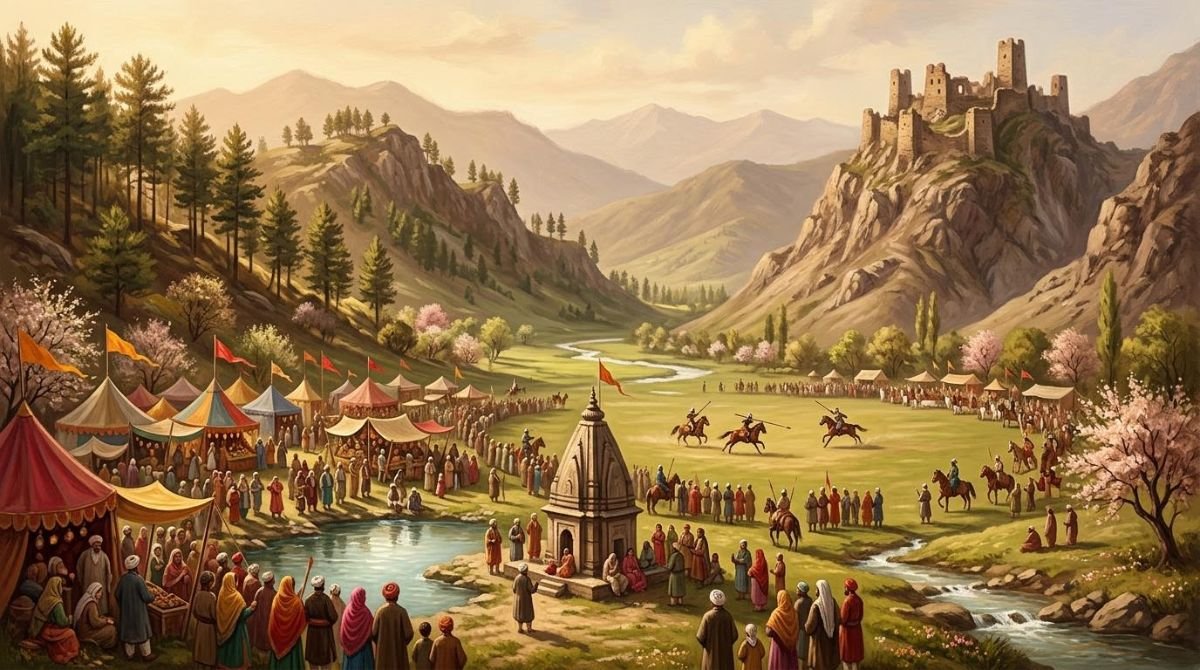
The Banah Valley (also spelt Bannah; وادی بناہ) is a green, fertile valley about seventeen miles (27 km) south-east of Kotli in Azad Jammu and Kashmir, ringed by mountains on three sides and centred on the market town of Khui Ratta. The 1997 history of the Chib Rajputs describes its springs and temple at Ban Ganga, its hill forts, the shrine of Hazrat Mai Tooti and the Baisakhi fair that became the valley’s spring festival, Jashn-e-Baharan.
At a glance
- Where
- Tehsil and District Kotli, Azad Jammu and Kashmir, about 17 miles south-east of Kotli town
- Shape
- A level plain enclosed by mountains on three sides, “like the English letter U”
- Main town
- Khui Ratta (Khoi Ratta), the valley’s market and cultural centre
- Streams
- Five seasonal nalas: Ban Seri, Ban Neriyan, Ban Khor, Ban Bhiyal and Ban Samlar
- Landmarks
- Ban Ganga, Ba’i Narah, Karjai Fort (Devi Garh), Pir Badesar, Kot Khanan, the shrine of Mai Tooti
- Leading family
- The Khanka Chib Khans of Khui Ratta, chief jagirdars of the valley
- Festival
- The Baisakhi fair, held since the war of 1947–49 as Jashn-e-Baharan at Fatehpur Dehari
Where is the Banah Valley?
The Banah Valley lies in Kotli District, in the hill country of Azad Jammu and Kashmir that rises north of the Pakistani Punjab. The Chib history compiled in 1997 by Raja Muhammad Iftikhar Ali Khan of Barhang describes it as a level strip of plain about seventeen miles south-east of Kotli, “surrounded on three sides by lofty mountains resembling the English letter U”, and known by the name Banah “since ancient times”. The mountain range that divides Rajouri, on the Indian-administered side, from Kotli, on the Azad Kashmir side, runs through the valley itself, so the Line of Control is never far away.
The book introduces the valley at the start of its chapter on the Khans of Khui Ratta, the branch of the Chib Rajputs who held a great jagir here from Mughal times until the land reforms of the twentieth century. Before telling their story, the author pauses to show the reader the land itself, place by place.
Mountains, pines and waterfalls
The mountain on the western side of the valley is clothed in evergreen chir pine. The mountain on the eastern side, known as Karjai, is green but bare of chir; instead, the book says, it “holds in its bosom treasures of valuable minerals”. In its foothills stands Karjai Fort, which the author calls a sign of “the greatness of the Mughal era”, and from its flanks spring the valley’s celebrated twenty-two waterfalls, which water the fields and supply the villages with drinking water.
Five seasonal streams (nalas) run through the length and breadth of the valley: the Nala Ban Seri, Nala Ban Neriyan, Nala Ban Khor, Nala Ban Bhiyal and Nala Ban Samlar. The two largest meet near the old garden of Fatehpur Dehari, in the heart of the valley.
Historic places of the Banah Valley
Besides Khui Ratta, the book lists nine places of historical importance in the valley. Its notes on each are summarised below, followed by a closer look at the most remarkable.
| Place | What the 1997 chronicle records |
|---|---|
| Dhanna | Where the valley begins; Hindus were in the majority here before 1947; it now has a boys’ and a girls’ middle school |
| Bagh Sain Hazuri | Garden of the holy man Sain Hazuri, a poet in Punjabi and Pahari, about three miles from Khui Ratta at the foot of the western mountain; only ruins remain |
| Kot Khanan | The rock-cut ancestral seat of the Khans of Khui Ratta, the “palaces of the fairies” |
| Seri (Sehri) | Before 1947 Hindus controlled both its trade and much of its cultivated land |
| Pir Badesar | A lofty mountain to the south-east named after a Hindu rishi; scene of a victory of Raja Sultan Khan; now across the Line of Control |
| Ban Ganga | Sacred springs, a conical temple and a brass cow; Hindu pilgrimage and a fair on 1 Baisakh |
| Pir Kalesar (Ba’i Narah) | Twenty-two spouts cut into the rock at the foot of Karjai mountain; they supply Khui Ratta with water |
| Fatehpur Dehari | The ruined paradise garden of Lala Faqir Chand, with a spring and a waterfall; now the site of the college |
| Karjai | The eastern mountain, with a fort the book calls Mughal and Devi Garh, which it attributes to Maharaja Gulab Singh |
Ban Ganga: springs, a temple and a brass cow
At the very foot of the Gyain hill, behind the village of Manjwal, springs of clean, clear water gave this place a special sanctity for Hindus, and so it came to be called Ban Ganga. In the low ground below stands a conical temple, and in a nearby cave there was once a cow made of brass. Before 1947 the Hindu families of the valley, men and women, children and the old, came here every year on the first day of the Bikrami year, 1 Baisakh (mid-April), to bathe in the springs and worship the brass cow. A public fair was held on the same day, and the book stresses that Hindus and Muslims both took part in it, “keeping their regional and local traditions alive and fresh”. Today a water-supply scheme carries Ban Ganga’s water to the Banah Valley and to Morah Manjwal.
Pir Badesar: the rishi’s mountain
On the south-eastern rim of the valley rises Pir Badesar, which the book says took its name from a great Hindu rishi who once made his home on it. From its summit most of Mirpur, Jhelum, Kharian and Gujrat can be seen. The mountain now lies in Indian-administered Kashmir. The chronicle calls it the “famous historic place” where Raja Sultan Khan, the last ruler of Bhimber, inflicted a crushing defeat on the Sikh army of Maharaja Ranjit Singh.
Sources differ
The book does not date the battle of Pir Badesar. Elsewhere (pp. 168–169) it records that Raja Sultan Khan was defeated in 1808 by Ranjit Singh’s commander Diwan Mohkam Chand, after his kinsman at Mangla withheld help, while the Khui Ratta family’s tradition (p. 235) says he beat the Sikhs in two battles before Bhimber finally fell. The victory and the defeat probably belong to different campaigns.
Ba’i Narah: twenty-two spouts in the rock
Pir Kalesar, the book explains, is also called Ba’i Narah. In the local language narah means a spout or conduit and ba’i means twenty-two: the place is named after twenty-two spouts cut into the living rock “in a special manner” at the very foot of Karjai mountain. Their water now supplies the town of Khui Ratta, and they are evidently the “twenty-two waterfalls” the author mentions when he first describes the mountain.
Karjai and Devi Garh

The eastern mountain is known as Karjai. On it stands Devi Garh, which the chronicle says was built by the Dogra ruler Maharaja Gulab Singh; the path up to the fort, it warns, is “extremely difficult to traverse”. Yet on an earlier page the same author speaks of Qila Karjai, in the foothills, as a monument of Mughal greatness. Our guide to Karjai Fort sets out what is known of both.
Fatehpur Dehari: the lost garden
The garden of Fatehpur Dehari was once the heart of the valley and, in its youth, “a paradise”. By the 1990s only traces remained, which the author pictures as lamenting their fate day and night. A large spring still flows there with a waterfall beside it, and the valley’s two largest streams meet nearby. The garden belonged to Lala Faqir Chand, head of one of the valley’s two great Hindu landowning families before Partition, whose kindness to the poor was known throughout the valley. The new campus of the Government Degree College Khui Ratta, now named Chiragh Hasan Hasrat College, has been built in the old garden: a fitting memorial, since the Urdu writer and journalist Chiragh Hasan Hasrat was Lala Faqir Chand’s grandson.
The shrine of Hazrat Mai Tooti
About five kilometres south of Khui Ratta lies the shrine of Hazrat Mai Tooti Sahiba, whom the book honours as a majzuba, one absorbed in God, and an ‘arifa-e-kamil, a perfect knower of God: the best-known spiritual figure of the Banah Valley. The whole neighbourhood is called simply “Darbar” because of her tomb, and pilgrims and devotees come day and night. When the book was written a large Jamia Masjid had just been completed within the shrine’s enclosure, with a school for Islamic teaching and the teaching of the Quran, and the shrine was in the care of the Auqaf Department of the Government of Azad Jammu and Kashmir.
According to the book, Mai Tooti died on 6 Jeth 1988 of the Bikrami calendar, which it equates with 10 June 1931, during the month of Ramazan, and her urs (death anniversary) is celebrated every year on 6 June. In 1942 her shrine became the setting for the valley’s first Muslim Baisakhi fair, described below.
A note on dates
The three calendars quoted do not quite agree: 6 Jeth usually falls in late May, and June 1931 did not fall in Ramazan. The year 1931 is consistent, but the exact day of her death is uncertain; the urs date of 6 June may echo the Bikrami “6 Jeth”.
Khui Ratta and the people of the valley
Khui Ratta is the cultural and commercial centre of the valley. By the 1990s it had grown into a busy town of hundreds of shops, with transport to Mirpur, Kotli, Seri and all the places around. On one side lies Kot Khanan, the ancestral seat of the Khanka Chib Khans, and on the other the Nala Ban. The town’s name, “the quarrel of the well”, is said to recall a dispute between the two wives of its founder, Khan Muhammad Umar Khan.
Before 1947 the valley was a mixed society. Hindus outnumbered Muslims in Khui Ratta and Dhanna and dominated both trade and land at Seri. The book names three Muslim families known throughout the valley, those of Khan Sakhi Wilayat Khan, chief jagirdar of Khui Ratta, of Baba Sadhu and of Sheikh Kerru (reading uncertain), and two great Hindu landowning families: that of Chaudhri Sundar Das, whose land exceeded ten thousand kanals, and that of Lala Faqir Chand. One of Lala Faqir Chand’s sons became a Muslim under the name Sheikh Badruddin; his three sons were Chiragh Hasan Hasrat, Zia Hasan and Siraj Hasan.
The chapter’s stories also name the Jat, Zargar (goldsmith) and Bhatti families of the valley’s villages, the Khakhrel Rajputs of Manjwal, into whom the founder of Khui Ratta married, and the Khatri and Mehta moneylending families of the market towns.
The Baisakhi fair and Jashn-e-Baharan
The great social event of the year was the Baisakhi fair held on 1 Baisakh at Mujwal, near Ban Ganga. People came from every corner of the valley for arm-wrestling (beeni), kabaddi, regional dances, horse-riding and neza-bazi, tent-pegging with the lance. Hundreds of stalls were set up, all of them, the book says, belonging to Hindu and Sikh shopkeepers and moneylenders from Khui Ratta, Seri, Mirpur, Dhanna and Fatehpur Dehari, and many Muslim cultivators went home in the evening with empty pockets, having spent most of a year’s earnings in a day.
Khan Inayatullah Khan, chief jagirdar of Khui Ratta, called the leading men of every Muslim biradari (clan) of the valley to a meeting at his house. They decided that the Muslims would in future hold their own Baisakhi celebration at the shrine of Hazrat Mai Tooti. The first was held on 1 Baisakh 1942 (the book names no calendar, but the context shows the year is AD 1942), and the author calls it the valley’s very first Jashn-e-Bahar, or spring festival.
Three fairs were held at the shrine before the crowds outgrew it; the fair then moved to Jabar, a hamlet of Mauza Mujwal, where two more were held before the upheaval of 1947 brought everything to a halt. After the war an airstrip was built at Fatehpur Dehari, and since then the Baisakhi fair, now called Jashn-e-Baharan, the festival of spring, has been held there every year. The author calls it “the cultural identity of the Banah Valley”. The custom is also noted among Chib customs and traditions.
Champions of the fair
In the 1990s the elders of the valley still talked with relish about the contests at the first fair: Zaildar Raja Muhammad Khan won the arm-wrestling, Muhammad Malik Zargar of Khui Ratta won a gruelling kabaddi match, and Chaudhry Chiragh Din Zargar of Khui Ratta won the neza-bazi. The book lists the fair’s unbeaten champions as follows.
| Contest | Unbeaten champions named in the book |
|---|---|
| Beeni (arm-wrestling) | Zaildar Raja Muhammad Khan; Chaudhry Raja Muhammad of Dharri; Chiragh Din Bhatti of Garha; Chaudhry Jan Muhammad of Dharri |
| Kabaddi | Malik Zargar; Karim Pehlwan Zargar |
| Neza-bazi (tent-pegging) | Raja Muhammad Akram Khan of Andah; Zaildar Muhammad Khan; Zaildar Raja Rahmatullah Khan; Zaildar Raja Muhammad Akbar Khan of Kotera Khanka; Raja Farman Ali Khan of Samlar |
| Horse-riding | Zaildar Khan Muhammad Khan of Samlar; Raja Khan Zaman Khan of Samlar |
| Polo, neza-bazi, hockey and football | Major Raja Muzaffar Khan of Kotera Khanka |
The Banah Valley in the 1990s
Writing in the late 1990s, the author could describe a valley “moving very rapidly along the highway of progress”. Almost the whole valley had electricity, and a network of roads linked Khui Ratta with the Darbar of Mai Tooti, Seri, Bharot Gala, Barali Gala, Ban Ganga and Nakial. In education the valley held “an enviable position”, with a boys’ degree college, a girls’ intermediate college, seven high schools and dozens of middle and primary schools.
The valley has also known war. In the autumn of 1947 Dogra troops entered Khui Ratta and burned the house of its chief jagirdar, and in January 1948 the same man raised the Banah Battalion, with its headquarters at Seri. That story is told in our biography of Khan Inayatullah Khan and in The Chib Rajputs in 1947.
Frequently asked questions
Where is the Banah Valley?
The Banah (or Bannah) Valley is in Tehsil and District Kotli, Azad Jammu and Kashmir, about seventeen miles south-east of Kotli town. It is a level plain enclosed by mountains on three sides, with the market town of Khui Ratta at its centre, and the range dividing Kotli from Rajouri runs through it.
What is Ban Ganga in the Banah Valley?
Ban Ganga is a place of sacred springs at the foot of the Gyain hill behind Manjwal, with a conical Hindu temple and, formerly, a brass cow kept in a nearby cave. Before 1947 Hindu pilgrims bathed there every year on 1 Baisakh, and a fair attended by both Hindus and Muslims was held on the same day. Its water now feeds a supply scheme for the valley.
What is Jashn-e-Baharan?
Jashn-e-Baharan, the festival of spring, is the Banah Valley’s Baisakhi fair. It began as a separate Muslim fair at the shrine of Hazrat Mai Tooti on 1 Baisakh 1942, organised by Khan Inayatullah Khan of Khui Ratta, moved to Jabar in Mauza Mujwal, and after the war of 1947–49 settled on the airstrip at Fatehpur Dehari, where it is still held.
Who was Hazrat Mai Tooti?
Hazrat Mai Tooti Sahiba is the best-known saint of the Banah Valley, a woman revered as one absorbed in God. Her shrine, about five kilometres south of Khui Ratta, gives the area its name, Darbar, and is in the care of the Auqaf Department of Azad Kashmir. The 1997 Chib history dates her death to 1931.
Who were the chief landholders of the Banah Valley?
The Khanka Chib Katoch Khans of Khui Ratta, descendants of Khan Muhammad Umar Khan, were the chief jagirdars of the valley from Mughal times until land reform ended the jagirdari system. Before 1947 there were also two large Hindu landholding families, those of Chaudhri Sundar Das and Lala Faqir Chand.
Sources
- Raja Muhammad Iftikhar Ali Khan, Raja Shadab Khan alias Hazrat Baba Shadi Shaheed (Urdu, Barhang/Karachi, 1997), pp. 168–169, 193–199, 218–223, 235.
- Traditions of the elders of the Banah Valley and of Raja Abdur Rauf Khan of Khui Ratta, as recorded in the same work.
This article is part of our series based on the 1997 Chib history; see the book, chapter by chapter. Spellings of names follow the book.
Continue reading
Have a question about this history?
Our AI guide answers from the articles on this site, in English or Urdu.
