

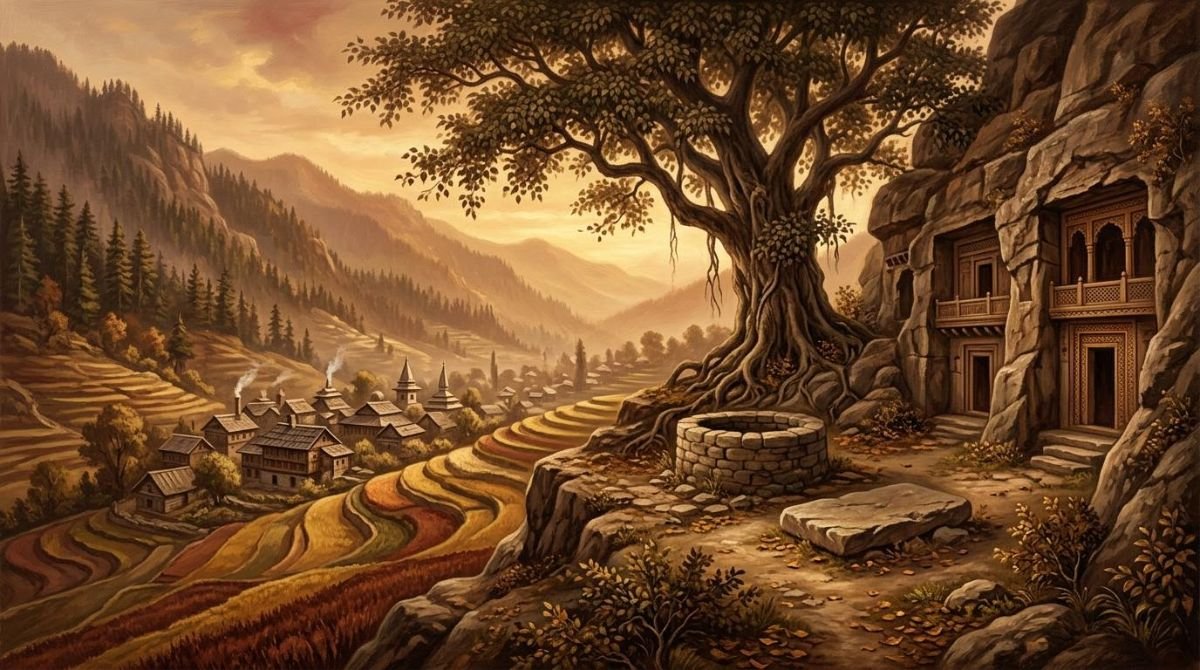
Khui Ratta (also written Khoi Ratta or Khuiratta; کھوئی رٹہ) is the market town of the Banah Valley in Kotli District, Azad Kashmir, and for about four centuries the seat of the Khanka Chib Katoch Rajgan, the chief jagirdars (jagirdaran-e-a’la) of the valley. By family tradition the house was founded in the Mughal era by Khan Muhammad Umar Khan; it held its jagir until land reform abolished the system in the lifetime of its last chief jagirdar, who died in 1966, and remained the valley’s leading family when the 1997 Chib history was written.
At a glance
- Where
- Banah Valley, Tehsil and District Kotli, Azad Jammu and Kashmir
- Family
- The Khanka got of the Chib Katoch Rajputs, descended from Raja Madan Khan of Bhimber
- Founder
- Khan Muhammad Umar Khan, contemporary of Jahangir and Shah Jahan
- Ancestral seat
- Kot Khanan, rock-cut chambers known as the “palaces of the fairies”
- Name
- “The quarrel of the well”
- Headship
- The tikka-e-khangi passed to the eldest son; the head is styled Khan
- Last chief jagirdar
- Subedar Khan Inayatullah Khan (1882/83–1966)
- Head in 1998
- Khan Iqbal Sikandar Khan, former Chairman of the District Council Kotli
Khui Ratta: the town and its name
For more or less the last four hundred years, the book says, the centre of the Khanka Chib Katoch Rajgan has been Khui Ratta, in Tehsil and District Kotli. By the 1990s the old settlement had become a town, with hundreds of shops and shopping centres and transport to Mirpur, Kotli, Seri and all the important places around. It is the commercial and cultural centre of the Banah Valley, with Kot Khanan, the family’s ancestral seat, on one side and the Nala Ban on the other.
The name means “the quarrel of the well”. According to Raja Abdur Rauf Khan of the family, the founder, Khan Muhammad Umar Khan, dug a well beside his first house, near where the High School Khui Ratta now stands. When his second wife, a Mahla Rajput of Rajouri, sent a servant to draw water, his first wife refused to share her well, and the quarrel, ratta in Pahari and Punjabi, gave the settlement its name. A pipal tree grew by the well, and under it lay a great stone slab on which each new Khan received the tikka of headship; well, tree and slab are all gone now.
Before 1947 Hindus outnumbered Muslims in Khui Ratta, and Hindu and Sikh shopkeepers made up most of the bazaar. Three Muslim families were known throughout the valley: those of Khan Sakhi Wilayat Khan, the chief jagirdar, of Baba Sadhu and of Sheikh Kerru (reading uncertain). The valley’s two great Hindu landholding families were those of Chaudhri Sundar Das, with more than ten thousand kanals, and of Lala Faqir Chand, grandfather of the Urdu writer Chiragh Hasan Hasrat.
Kot Khanan, the palaces of the fairies
Kot Khanan, on a height adjoining the town, was the residence of every Khan of Khui Ratta from Umar Khan to Khan Sakhi Wilayat Khan. The book calls it “an astonishing feat of the art of architecture”: houses carved out of the bare rock face, with ornamented doors and roofs decorated with fine carving, and four rooms cut into the mountain with a skill that would be hard to match even today. An ancient well served the site, and because it stood well above the surrounding country it was safe in every respect. Seeing such structures in so inaccessible a place, the book says, ordinary people called them pariyon ke mahallat, “the palaces of the fairies”.
When Khan Inayatullah Khan took over the jagir after his father’s death in 1922, he moved down from Kot Khanan to the site of the family’s stables, the tabela, and that has remained the residence of the Khans ever since. Kot Khanan briefly returned to history in 1947, when a rebel company of the State Forces camped there and promised to defend the town.
Origins: the Khanka Chibs
The Khans of Khui Ratta are a branch of the royal house of Bhimber, and so of the wider Chib Rajputs. Raja Madan Khan of Bhimber, seventh in descent from Baba Shadi Shaheed, had five sons by three Ranis. Two of them, Khan Jiwal Khan and Khan Parda Khan, were the sons of a Rani of the Sudhan tribe. After their father’s death they quarrelled with their brothers over the inheritance, despite the arbitration of the Sufi Shah Daula of Gujrat, and in the fighting Jiwal Khan’s grandson, Khan Sa’id Khan, was killed. The two brothers then left Bhimber for Khui Ratta, and from them, the book says, descend the Khanka and Rika families of Khui Ratta. Sa’id Khan’s posthumous son, Muhammad Umar Khan, became the founder of the Khanka house.
Within the Chib clan the Khanka are one of the four gots of the Bhimber Rajgan: Rajana, Rika, Khanka and Mirzana. The Chibs were also grouped in mandis, the seats of their branch families. The book says the mandi of the Bandala and Khui Ratta families was first fixed at Malot, the oldest mandi of Chibhal Rajana, and that the Khui Ratta family later took a mandi of its own at Khui Ratta in place of Rajal; a later table in the book adds that the mandi system has since largely fallen out of use. See The Mandis of Chibhal and Mandi Malot.
Sources differ
The book’s narrative makes Umar Khan, a great-grandson of Jiwal Khan, the pride of the Khanka got. A genealogical table later in the book (p. 391) labels the line of Sikandar Khan “Raika” and that of Taju Khan, Parda Khan’s son, “Khanka”. The family tree compiled by Raja Abdul Rauf Khan (p. 417) also starts the line a generation earlier, naming Khan Raja Saeed Khan as founder of Khui Ratta.
The line of the Khans
The headship of the house, marked by the tikka-e-khangi, passed from each Khan to his eldest son. Within the family the head of the main line is styled “Khan”, while younger sons and kinsmen generally bear the title Raja. The book gives the succession as follows.
| # | Khan | What the book records |
|---|---|---|
| 1 | Khan Muhammad Umar Khan | Founder and first chief jagirdar; by tradition a Mughal commander under Jahangir and Shah Jahan; seven sons by two Ranis |
| 2 | Khan Sultan Alam Khan | Eldest son; Pir Bakhsh Khan and Amir Ali Khan by his first wife, five more sons by his second |
| 3 | Khan Pir Bakhsh Khan | Three wives; sons Khan Muhammad Khan, Mattu Khan and Sher Khan |
| 4 | Khan Muhammad Khan | Four wives and six sons: Fazal Dad, Feroz, Ghulam Murtaza, Ali Haidar, Painda and Marhatta Khan |
| 5 | Khan Fazal Dad Khan | Two wives; sons Sakhi Wilayat Khan and Bagh Ali Khan; left an inheritance of 76,000 rupees |
| 6 | Khan Sakhi Wilayat Khan | Zaildar and chief jagirdar, famed for generosity; the last Khan to live at Kot Khanan; died 1922 |
| 7 | Subedar Khan Inayatullah Khan | Born 1882–83; soldier, reformer and Muslim Conference patron; the last chief jagirdar; died 1966 |
| 8 | Khan Muhammad Sarwar Khan | Also called Khan Sadiq Khan; managed the estate from 1960 and headed the family 1966–1991; died 13 March 1991, aged 63 |
| 9 | Khan Iqbal Sikandar Khan | Born 1954; head from 1991; Chairman of the District Council Kotli until July 1998 |
Khan Sakhi Wilayat Khan, the open-handed
The most vivid portrait in the chapter is of Khan Sakhi Wilayat Khan, whose name, sakhi, means generous. Devout, abstemious and simple in his ways, he loved hunting above all, keeping horses, dogs and falcons in great numbers with, the book says, fifty servants apiece to look after them. With his hunting train he would set out for Rajouri and Poonch and stay away for six months at a time as the guest of the Raja of Poonch and the Rajas of Rajouri.
At home his langar, the free kitchen, ran twenty-four hours a day all year round, and no one was turned away. In the middle of the sowing season he would give a beggar his own bullock. He gave away the whole income of the jagir and had grain bought on credit for his own household; Hindus and Sikhs who brought him small presents went away with fifty kanals of land each, the transfers recorded by word of mouth before the tehsildar. Once he gave Zaildar Ataullah Khan of Chowki the proprietary rights of the village of Khanpur simply for agreeing to say his prayers.
The one anecdote the book tells in full concerns Mool Singh, a Sikh of Khui Ratta so stout that he went about in nothing but short drawers. Seeing him in the bazaar, the Khan ordered the Khatri cloth-merchant Diwan Chand to give him a suit of clothes at once; a fortnight later Mool Singh was bare again, and received a second suit, and then asked for a third, until Diwan Chand protested that the man never wore clothes at all. Such generosity had its price. Sakhi Wilayat Khan inherited 76,000 rupees and spent it all; by the time he lost his sight in old age he owed 36,000 rupees to Khatri creditors in Mirpur, Seri, Naushehra and Khui Ratta, a debt his son later paid in full. Blind and bedridden, he died in 1922.
Honours at the Jammu Durbar
Under the Dogra Maharajas the Khans of Khui Ratta enjoyed marks of distinction. At the Jammu Durbar they were seated on the right-hand side of the Maharaja’s throne, and while in Jammu they were lodged in the royal guest-house; on leaving, each Khan and each of his attendants received a suit of clothes and a turban. The book also records an annual charge connected with the jagir, the cost of twenty-five soldiers for the Jammu forces together with shawls and fat-tailed rams, and notes that the lords of the jagir were exempt from arms licences.
From soldier to District Council
Subedar Khan Inayatullah Khan (1882/83–1966)
Sakhi Wilayat Khan’s eldest son gave up a promising career in the Jammu and Kashmir State Forces to rescue the family estate from debt, led the Muslim cultivators of the valley against the moneylenders’ practice of seizing harvests at the threshing floor, financed the Muslim Conference at Khui Ratta and, in 1947–49, lost his house to the Dogra troops, served as Superintendent of Police and raised the Banah Battalion. He was the last chief jagirdar of Khui Ratta. His life is told in full in Subedar Khan Inayatullah Khan.
Khan Muhammad Sarwar Khan (died 1991)
Inayatullah’s eldest son, Khan Muhammad Sarwar Khan, also known as Khan Sadiq Khan, ran the estate from 1960 and succeeded as head of the family in 1966, by which time the jagirdari system had ended. The book describes a man of simple, dervish-like temperament with a famously wide table, who spent freely on public welfare and disliked being anyone’s guest. In his time the family’s urban property grew greatly, and the author calls his period the economic golden age of the Khans of Khui Ratta. He was also a seasoned politician, whose influence twice saw his son elected to the District Council. In 1988 he handed the property over to that son and went on the Hajj with his wife, spending his last years in prayer; he died on 13 March 1991, aged sixty-three. As a young man he had been at the centre of a violent clash between the Muslim Conference and the National Conference at Khui Ratta.
Khan Iqbal Sikandar Khan
Khan Iqbal Sikandar Khan, the present Khan when the book was written, was born at Khui Ratta in 1954 and educated at Khui Ratta, Dadyal and the Government Degree College Kotli. A Muslim Conference man “by birth”, he was elected to the District Council Kotli in 1979, 1983 and 1991–92, and after his third victory became Chairman of the District Council, an office he held until July 1998. The book describes him as a trusted associate of Sardar Sikandar Hayat Khan, former Prime Minister and President of Azad Jammu and Kashmir, and he contributed a commendation to the book itself as “a son of the Chibhal family”. His brother Raja Afzal Anwar Khan was a member and chairman of the Union Council of Kotera Khanka, and the family tree continues the main line with his son, Khan Shehryar Sikandar Khan.
Raja Abdul Rauf Khan, the family’s historian
Inayatullah’s younger son, Raja Abdul Rauf Khan, born at Khui Ratta in 1937, joined the Police Department of Azad Kashmir and retired as Inspector of Police, District Kotli. The book calls him a storehouse of knowledge about Chibhal and the Khans of Khui Ratta: he compiled the family tree printed in the book, supplied the accepted tradition of the town’s name, and shared his family’s devotion to Baba Shadi Shaheed and to Raja Sultan Khan, the last ruler of Bhimber, whom the family regarded as a great forefather of their clan.
Branches and kin
The descendants of Umar Khan’s seven sons spread through the villages of the jagir, among them Kotera Khanka, Bhiyal, Dharri, Khanpur and Andah. Inayatullah’s younger brothers, Raja Haidar Ali Khan and Raja Fazal Dad Khan, appear in the story of the Muslim Conference and of 1947. At Kotera Khanka lived Raja Faizullah Khan, who held a share in the jagir, and his son Major Raja Muzaffar Khan, ADC to Maharaja Hari Singh and founder of the Darhal Battalion in 1947, whose only daughter married Khan Muhammad Sarwar Khan.
The book also prints the trees of two Chib families of Battal, within the Khui Ratta jagir. The first, a Chib Katoch family descended from Raja Kala Khan, came from Thotha Rai Bahadur, home of the Rais of Khari Kariali, settling first at Lurri (reading uncertain) and then at Battal. The second, the Chib biradari of Battal, descends from a Sarwar Khan through his sons Gohar Khan and Hayatullah Khan; several of its members bear the title Mirza.
A jagir with a conscience
The author argues that while the jagirdari system has been a byword for oppression in the histories of many nations, “the history of the Khans of Khui Ratta shows exactly the opposite”. He lists the customs of the jagir: no rent was taken from the minor orphans of a dead tenant until they came of age, a rule kept since the time of Umar Khan; disputes were settled by the Khan himself and the police were not allowed to interfere; a pasture was left open for the villagers’ cattle and pine trees were given free when needed; grain was lent in kind and returned in kind, wheat for wheat and maize for maize; and usury was forbidden in the Khan’s house. Hindus, Sikhs and Muslims, the book insists, were treated alike.
Frequently asked questions
What does Khui Ratta mean?
Khui Ratta means the quarrel of the well. Family tradition says the founder, Khan Muhammad Umar Khan, dug a well beside his house, and his first wife refused to let his second wife draw water from it; ratta means a quarrel in Pahari and Punjabi.
Who are the Khans of Khui Ratta?
They are the Khanka Chib Katoch Rajgan, a branch of the royal house of Bhimber descended from Jiwal Khan and Parda Khan, sons of Raja Madan Khan. Founded by Khan Muhammad Umar Khan in the Mughal era, the family were the chief jagirdars of the Banah Valley in Kotli District, Azad Kashmir, for about four centuries.
What is Kot Khanan?
Kot Khanan is the ancestral seat of the Khans of Khui Ratta, a group of houses and rooms carved into the rock on a height beside the town, which local people call the palaces of the fairies. Every Khan lived there from Umar Khan to Sakhi Wilayat Khan, who died in 1922.
Who was the last chief jagirdar of Khui Ratta?
Subedar Khan Inayatullah Khan (1882/83–1966) was the last chief jagirdar, because land reform abolished the jagirdari system in his lifetime. He was a former State Forces officer, a reformer of the valley’s moneylending practices and a patron of the Muslim Conference.
Who headed the Khui Ratta family when the book was written?
In 1997–98 the head of the family was Khan Iqbal Sikandar Khan, born in 1954, who was Chairman of the District Council Kotli until July 1998. He had succeeded his father, Khan Muhammad Sarwar Khan, in 1991.
Sources
- Raja Muhammad Iftikhar Ali Khan, Raja Shadab Khan alias Hazrat Baba Shadi Shaheed (Urdu, Barhang/Karachi, 1997), pp. 121–122, 193–212, 214–215, 224–226, 229–231, 238–253, 257–258, 391, 396, 417–418, 424–425, 433.
- Raja Abdul Rauf Khan, family tree of the Chib Katoch Rajgan and chief jagirdars of Khui Ratta, printed in the same work (p. 417), and his oral account of the town’s name.
- Maulvi Zain-ul-Abidin Kohi Samahnavi, unpublished manuscript history of Chibhal, quoted in the book for the origin of the mandis.
- Thakur Major Singh, Tarikh-e-Chibhal (1983 Bikrami, c. 1926), p. 93, quoted in the book on the Malot families linked with the jagirdars of Khui Ratta.
This article is part of our series based on the 1997 Chib history; see the book, chapter by chapter. Spellings of names follow the book.
