

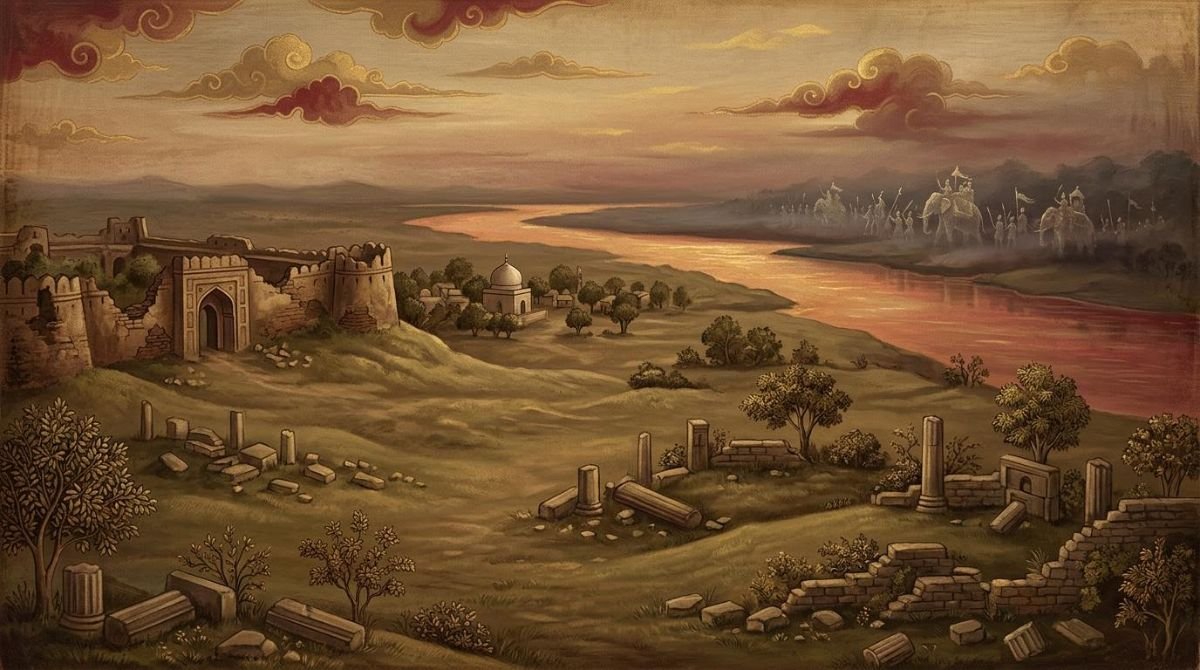
Pani Koti, also called Koti Pani (Urdu پانی کوٹی), is an ancient ruined city beside the village of Bisa in Tehsil Kharian, District Gujrat, in Pakistan’s Punjab, in the old Chib country of Chibhal Rikki. Local tradition and the chroniclers quoted in the 1997 Chib history remember it as the capital of Raja Porpal, identified with King Porus, who fought Alexander the Great on the Jhelum in 326 BC.
At a glance
- Other name
- Koti Pani
- Location
- Beside Mauza Bisa, Tehsil Kharian, District Gujrat, Punjab (Pakistan); placed by some writers near Kariali on the Jhelum
- Region
- Chibhal Rikki, the western division of the Chib country
- Linked with
- Raja Porpal (Porus) and Alexander the Great
- Legendary founder
- Raja Got Pal, son of Raja Pur Chand of Qannauj (Kannauj)
- Ruins
- About 100 acres, with traces of a walled fort and a north gate
- Finds
- Broad stone bricks with metal-lined holes, reused in a mosque floor at Bisa
Where is Pani Koti?
The 1997 Chib history of Raja Muhammad Iftikhar Ali Khan introduces Pani Koti while describing Chibhal, the land of the Chibs. In Chibhal Rikki, the western division that included Khari Kariali, it says, stood Pani Koti, a magnificent city whose ruins still exist beside Mauza Bisa in Tehsil Kharian, District Gujrat, recalling its past greatness (pp. 33–34). Bisa, the book adds, is a famous and well-known village of the Chibhal area (p. 35). Kharian, the tehsil in which it lies, sits between the cities of Gujrat and Jhelum.
The writers the book quotes place the city slightly differently. Mirza Azam Beg puts it near the present town of Kariali on the bank of the Jhelum; the author of Shahan-e-Gujar on the left bank of the Jhelum, at the place called Kariali; and the British archaeologist Alexander Cunningham near the Jaba Nala. The book itself says the ruins cover roughly a hundred acres and that the original city stretched from Bhimber as far as Khohar (pp. 35–36).
Pani Koti and King Porus
For the book, Pani Koti’s fame rests on one name. It was, the author writes, the capital of Raja Porpal, the Porus of the Greek historians, and it was here that Sikandar, Alexander the Great, attacked, and here that Porus, “the renowned son of the motherland”, made the conqueror acknowledge his bravery. In the same hills, the book adds, Porus’s grandson through his daughter (his name is uncertain in the print) and a Raja Malik Pal ruled for centuries, and the country saw great revolutions, bloodshed, ruin and resettlement (pp. 33–34).
The wider story is well known. In 326 BC Alexander crossed the Hydaspes, the river Jhelum, and defeated Porus, whose kingdom lay between the Hydaspes and the Acesines, the Chenab, covering much of the country later called Chibhal. Impressed by his courage, Alexander restored him as ruler of his kingdom. The exact site of the battle is still debated, and the Greek and Roman writers name no capital of Porus that can be located with certainty, so the identification of Pani Koti as his capital rests on local tradition and on the writers the book quotes. For the battle itself see Porus and the Battle of the Hydaspes, and for the hill kingdom to the north, From Abhisara to Chibhal.
Gandhi’s tribute to the Punjab
The book also recalls a tribute to Porus from an unexpected source. After the martial-law excesses in the Punjab in 1919, the year of the Jallianwala Bagh massacre at Amritsar, the Indian National Congress set up its own inquiry committee, whose members were M. K. Gandhi, C. R. Das, Abbas Tyabji and M. R. Jayakar. The book says Gandhi wrote its report, which opens with a chapter on the history and geography of the Punjab (p. 34).
“…the Punjab should be regarded as the most important province of Hindustan.”
— Congress Punjab inquiry report, as quoted by Iftikhar Ali Khan (1997), p. 34
The chapter, as the book translates it, lists the province’s claims to fame: the first home of the Aryans in the Vedic age, where the hymns of the Rig Veda were first sung; the great university of Taxila; the battlefields of the Kauravas and Pandavas; the land where Osiris of Egypt first set foot in India and where Queen Semiramis of Assyria was defeated; the land whose sons met Scythians, Tatars and Iranians with the sword; and the land where Alexander found in Porus an enemy who humbled his ambition to conquer the world (pp. 34–35).
Who founded Pani Koti?
The book gathers four older accounts of the city’s origins (pp. 35–36). Three trace its founding to a king from Qannauj (Kannauj, in the Ganges plain), and two set it after a great flood; they differ over names and over whether the city was already old when Alexander came.
| Source | Founder | What it says |
|---|---|---|
| Lala Ganesh Das, Khulasat-ut-Tawarikh (Persian), as quoted | Raja Got Pal, son of Pur Chand, ruler of Qannauj | He came to the Punjab, took control and founded Pani Koti on the riverbank, handing it to his son, also named Got Pal. Koti Pani became the capital of the Punjab, and his descendants ruled for 270 years. |
| Mirza Azam Beg, as quoted | Raja Korpal (reading uncertain), son of Raja Porpal, ruler of Qannauj | After the Flood he founded a very large city near the present town of Kariali on the Jhelum. In the second generation of his line, Raja Bijan Pal, son of Raja Got Pal, founded Odhe Nagri where the city of Gujrat now stands. Alexander then crossed the Indus and fought Bijan Pal’s son, Raja Khurpal (reading uncertain). |
| Author of Shahan-e-Gujar (“Kings of the Gujars”), as quoted | Raja Got Pal, son of Raja Pur Chand, ruler of Qannauj | After a great flood left much of the Punjab under water for years, he founded an extensive city on the left bank of the Jhelum at Kariali, now known as Pani Koti. Time razed it brick by brick but could not erase its name, and Alexander fought on this soil. |
| Alexander Cunningham, as quoted | Unknown | The ruins of a very old city near the Jaba Nala; local people know nothing of its beginnings, and it was probably an ancient buried city. |
Sources differ
Two accounts name the founder Got Pal, son of Pur Chand. Mirza Azam Beg instead names Korpal, son of Raja Porpal of Qannauj, the same name the book uses for Porus, yet in his version Alexander fights a later king, Khurpal, while the book presents Pani Koti as Porus’s own capital. The book also credits Khulasat-ut-Tawarikh to Lala Ganesh Das; the Persian chronicle of that name is usually attributed to Sujan Rai Bhandari, who completed it in the 1690s, while Ganesh Das is best known for Char Bagh-i-Punjab (1849).
The ruins of Pani Koti
The book describes what remained in its day (p. 36). The ruins spread over roughly a hundred acres. They show an ancient fort built on some two thousand square yards and surrounded by a rampart, with its main gate on the north side. Broad stone bricks pierced by metal-lined holes have been recovered from the site, and the floor of a mosque in Mauza Bisa is laid with these same bricks. Cunningham, as quoted, thought it a very old, long-buried city whose beginnings the local people did not know (p. 35).
The book mentions no excavation of the site. The reused bricks in Bisa’s mosque show how such ruins are slowly absorbed into the villages around them, which makes the descriptions preserved in the book all the more valuable.
Bisa and the Chibs
Bisa lies in the country of the Chibs’ western branch. In the book’s tables of Chib holdings, the section on Chibhal Raika (Khari Kariali) lists Bisa among the four senior dheris, the hereditary holdings of the clan’s chiefs: it was held by the line of Jiwan Khan, whose villages were Bisa Kalan, Bisa Khurd, Kotla and Jagwal (pp. 403, 406). Kariali, the place named in two of the legends, is also the second half of the name Khari Kariali, the Chib state of Raja Mal Khan’s line. A Chib family of Bisa appears as well in Griffin and Massy’s Chiefs of the Punjab; see The Chibs in The Chiefs of the Punjab.
For the Chibs, then, Pani Koti is more than a ruin: it ties the country their ancestors ruled from the fifteenth century to the oldest story told about this land, the meeting of Porus and Alexander on the Jhelum. More on the clan is in our guide to the Chib Rajputs.
Frequently asked questions
What is Pani Koti?
Pani Koti, or Koti Pani, is an ancient ruined city beside the village of Bisa in Tehsil Kharian, Gujrat District, Punjab, Pakistan. Local tradition, recorded in the 1997 Chib history by Raja Muhammad Iftikhar Ali Khan, remembers it as the capital of Raja Porpal, identified with King Porus.
Where are the ruins of Pani Koti?
Next to Mauza Bisa in Tehsil Kharian, District Gujrat, in the area once called Chibhal Rikki. Older writers place the city near Kariali on the Jhelum or near the Jaba Nala, and the 1997 book says the ruins cover about a hundred acres.
Was Pani Koti the capital of King Porus?
Local tradition and the writers quoted in the 1997 book say so. Classical historians record that Porus ruled between the Jhelum and the Chenab and fought Alexander in 326 BC, but they name no capital that has been securely located, so the identification rests on tradition.
Who founded Pani Koti, according to legend?
Two accounts name Raja Got Pal, son of Raja Pur Chand, a ruler of Qannauj (Kannauj), who built the city after a great flood; Mirza Azam Beg names Raja Korpal, son of Raja Porpal of Qannauj. One account says Got Pal’s line ruled the Punjab from Pani Koti for 270 years.
What has been found at Pani Koti?
The 1997 book describes traces of an ancient fort of about two thousand square yards with a rampart and a north gate, and broad stone bricks with metal-lined holes. Some of these bricks were used to lay the floor of a mosque in Bisa.
Sources
- Raja Muhammad Iftikhar Ali Khan, Raja Shadab Khan alias Hazrat Baba Shadi Shaheed (Urdu, Barhang/Karachi, 1997), pp. 33–36; also pp. 403 and 406.
- Report of the Indian National Congress inquiry into the 1919 Punjab disturbances (M. K. Gandhi, C. R. Das, Abbas Tyabji, M. R. Jayakar), chapter 1, as quoted in the book.
- Lala Ganesh Das (as credited in the book), Khulasat-ut-Tawarikh (Persian), as quoted in the book.
- Mirza Azam Beg, as quoted in the book.
- Shahan-e-Gujar, as quoted in the book.
- Alexander Cunningham, as quoted in the book.
This article is part of our series based on the 1997 Chib history; see the book, chapter by chapter. Spellings of names follow the book.
