

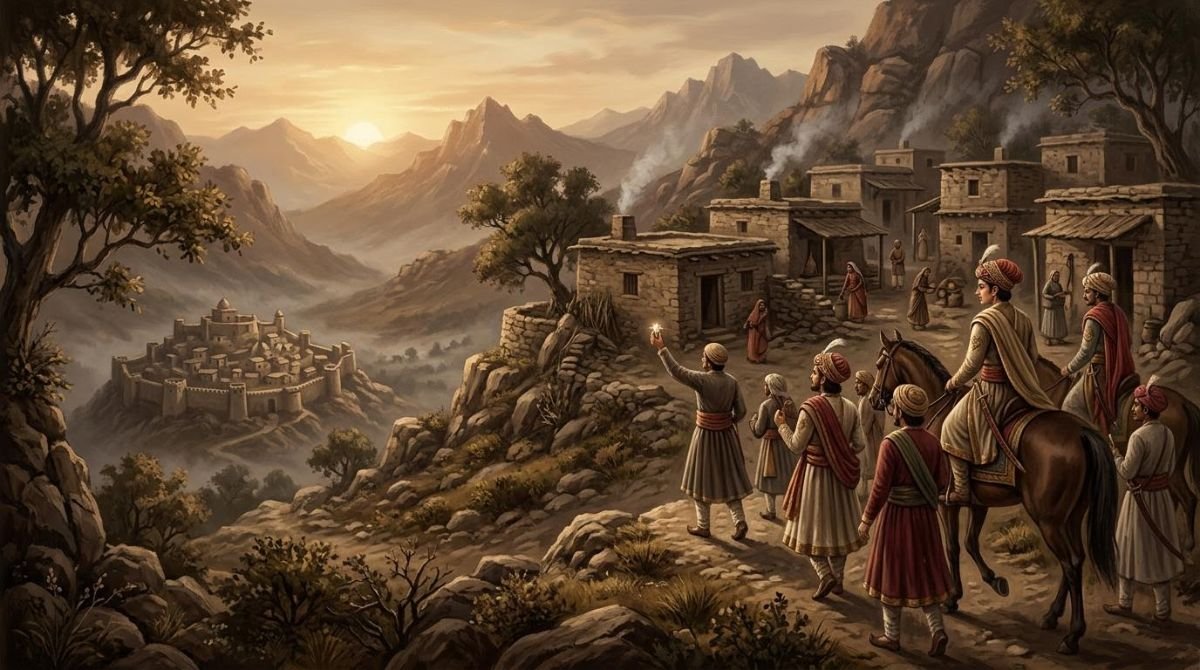
The Chib origin story has one hero and several plots. Every account collected in the 1997 Chib history of Raja Muhammad Iftikhar Ali Khan traces the Chib Rajputs (Urdu چب راجپوت) to Raja Chib Chand, a prince from the royal house of Kangra who settled at Mughlora near Bhimber, in today’s Azad Jammu and Kashmir, married the daughter of its ruler and took the throne. The five main accounts disagree about his ancestry, his brothers and his date, which ranges from about 1230 to the early fifteenth century.
At a glance
- Founder
- Raja Chib Chand, a prince of the Katoch house of Nagarkot Kangra
- Lineage (book’s view)
- Raja Megh Chand → Partab Chand → Narain (Nahar) Chand → Chib Chand
- Brothers
- Dhru Chand, Ambu Chand and Aji Chand (other lists differ)
- First home
- Mughlora (also written Manglora, Maghlora), near Bhimber
- Father-in-law
- Raja Sri Pat of Bhimber, in most accounts the last Thakial raja
- Date
- c. 1230, c. 1350, c. 1400 or the early 15th century, by source; the book favours the first quarter of the 15th century
- Gotra
- Kashyap, through the Katoch (Thakur Kahan Singh Balauria)
Why the question is hard
Who were the Chib Rajputs, where did they come from, and how did they come to rule Mulk Chibhal, the state of Bhimber? The book asks these questions plainly and admits that answering them is difficult, because historical facts and popular stories pull in different directions (p. 19). For centuries the clan’s history lived in the kursi-namas, the genealogical rolls kept by family priests (purohits), mirasis and bhats. They were compiled from memories handed down by word of mouth and, the author warns, were often shaped to please the bard’s patron, so names and dates vary from one roll to the next (p. 23).
The first written history of the clan was Tarikh-e-Chibhal by Thakur Major Singh of Dewa Vatala, completed in 1983 Bikrami (about 1926). The book praises it as a pioneering work that rescued Chib history from mere oral memory, while noting that the works Major Singh cited, among them biographies of Maharaja Gulab Singh and Maharaja Ranjit Singh and Muhammad Salih Kambo’s Shahjahan Nama, mention the Chibs only in passing (pp. 23–24). The author also weighs family genealogies kept by the Rajgan of Khui Ratta (held by the heirs of Maulvi Zain-ul-Abidin of Samahni), by the descendants of Raja Sultan Khan, the last ruler of Bhimber, at Jhelum, and by Rai Sahib Dilawar Khan of Thotha Rai Bahadur; the unpublished history of Raja Wilayat Khan; and British records (pp. 24–25). The writers themselves are profiled in The Historians of Chibhal. Out of this material come five main accounts.
1. The Iranian prince: the Gujrat Settlement of 1868
The revenue settlement of District Gujrat, compiled in 1868, included the Chibs in its record of customary law, because a large part of northern Gujrat district had once belonged to the state of Bhimber (p. 25). Its account, apparently taken down from a few Chib headmen (numbardars), runs as follows (pp. 19–20):
- An Iranian prince, Muhammad Gohar Khan, known as Gohar Shah, left Iran for the Deccan, where Raja Nahar Chand gave him his daughter in marriage.
- Gohar Shah died soon after a son was born. Raja Nahar Chand named the boy Abdar Chand (reading uncertain) and raised him as a Hindu, and he made a name for himself at the court of Alauddin Khilji in Delhi (r. 1296–1316).
- One of Abdar Chand’s descendants, another Raja Nahar Chand, somehow gained the throne of Kangra. His two sons, Odhe Chand and Chib Chand, fell out, and Chib Chand moved to the Bhimber country, settling at Manglora (Mughlora) near the present town.
- Bhimber was then ruled by Raja Sri Pat, a Brahman, who married his daughter to Chib Chand. When Sri Pat died the state passed to Chib Chand, and the descendants of “Chib Chand Katoch” are called Chib.
- The family stayed Hindu for six generations; in the seventh, Raja Shadip Chand became a Muslim in the reign of Humayun. Most of his descendants are Muslim Chibs, though a few remained Hindu.
Iftikhar Ali Khan rejects this as an invented tale (pp. 20–21). In the later Mughal period, he argues, imperial armies favoured soldiers descended from Arab, Iranian and Central Asian families and looked down on Indian Muslims as converts, so some Indian Muslim families of martial stock answered the slight by attaching their lineage to an Iranian or Arab house. By his reckoning some eight centuries passed between Abdar Chand, whom he dates to 965, and the age of Aurangzeb (d. 1707) without anyone knowing of an Iranian ancestor; the “secret” surfaced only in the eighteenth century, and not only among the Chibs. The details, he adds, defy belief: an Iranian prince travels straight to a Hindu raja in the Deccan, who gives his daughter to a stranger whom Hindus of the age would have regarded as ritually unclean (malechh), after which the prince promptly dies. The author likens the story to a tale from the Thousand and One Nights and advises readers to set it aside. The genealogy of Kot Kangra, he notes, gives Nahar Chand four sons, not two.
2. The Kangra genealogy: Thakur Kahan Singh Balauria
The source the book considers most reliable is Tawarikh-e-Rajputan-e-Punjab by Thakur Kahan Singh Balauria, the historian of the Dogra country, read together with the genealogy of the rajas of Kot Kangra (pp. 21–22). Kangra, he writes, is the oldest state of the Punjab and has always belonged to the Katoch family, whose title comes from the old name of the place, Nagarkot or Kot Kangra. In his account:
- The founder, Bhumi Chand, is said to have been born from the earth with a bow and arrow; Kahan Singh rejects the legend and traces the family to the sage Kashyap, hence the Kashyap gotra. Bhumi Chand became raja of Trigart (the book’s text glosses this as Kathiawar, but Trigarta is the old name of the Jalandhar–Kangra country; see Trigarta, kingdom of the Katoch rajas).
- In the 234th generation came Raja Susharm Chand (Susharman), son-in-law of Dhritarashtra and brother-in-law of Duryodhana in the Mahabharata, who was killed by Arjuna with a large army. Tradition credits him with building Kangra Fort.
- Many generations later a raja whose name is uncertain in the print had two sons: Padam Chand, heir to the throne, and Purab Chand, who received Jaswal as a jagir and founded the Jaswal Rajputs.
- Sixteen generations after Padam Chand, Raja Megh Chand ruled Kangra. His four sons were Hari Chand, ancestor of the Guleria Rajputs; Karam Chand, crowned at Kangra after Hari Chand went missing; Partab Chand, ancestor of the rajas of Bhimber, “whose clan is famous as Chib”; and Parag Chand, whose descendants settled in Hoshiarpur district.
- Partab Chand’s son was Raja Narain Chand, also called Nahar Chand, whose four sons were Chib Chand, Dhru Chand, Ambu Chand and Aji Chand. The eldest, Chib Chand, founded the Chib clan.
3. Raja Wilayat Khan’s Tanwar theory
Raja Wilayat Khan of Thotha Rai Bahadur (d. 1948), remembered as “Khadim-e-Qaum”, servant of the clan, completed a history of the Chibs that he did not live to publish. To obtain the genealogy of the rajas of Nagarkot Kangra he spent months at Kot Kangra and then with the family priests at Hardwar, and had both the Katoch genealogy and the Chib family tree certified by them (pp. 24–25). His account (pp. 29–31) begins far from Kangra:
- A prince of the Tanwar (Tomar) Rajputs of Delhi, Sarhandu Dev (reading uncertain), ruled Hoshang Nagar, today’s Hoshiarpur. Defeated by Samudragupta, son of Chandragupta I, he fled to the northern hills; after Samudragupta’s death he founded a small hill state, and his son founded the city of Nagar Koti, later famous as Nagarkot Kangra.
- Sheltered by its mountains from the Huns, the state grew until its territory reached the Chenab. About 570 AD Katoch Dev Chand was born into the ruling family; he built the fort of Kot Kangra, and his descendants called themselves Katoch after him.
- When Mahmud of Ghazni invaded, Partab Chand of Kangra was the right hand of Raja Anandpal; Kangra fell and Partab Chand took refuge in the northern forests.
- In 1135 Raja Udiman Chand (reading uncertain) of Kangra was a trusted tributary of Anang Pal Tanwar of Delhi. His sons died for Prithviraj Chauhan: the crown prince, Sawai Chandar, fell holding back Jai Chand’s warriors when Prithviraj carried off Jai Chand’s daughter Sanjogta, and Gohar Chand was killed beside Prithviraj fighting Shahabuddin Ghori in the battle of Thanesar.
- Udiman’s grandson Nahar Chand Katoch then ruled Kangra. By a Jamwal rani he had Sujan Chand, who succeeded him; by a second rani he had Chib Chand, Pirag Chand and Odiyan Chand. Sujan Chand sent his popular half-brothers to distant jagirs.
- Chib Chand received the land north of Sialkot and south of Jammu as far as the Chenab, the western frontier where invaders struck first, and made Chaprar (now a police-station area of Sialkot) his headquarters. Though only twenty or twenty-two, he managed it so well that his fame spread.
- Raja Sri Pat Wadhan (Badhan) of Bhimber, whose state ran from the Chenab to the Jhelum and from the borders of Rajouri and Poonch to Gujrat and Kharian, had no son, only a daughter, Punja Devi. He married her to Chib Chand and settled him at Mangora, in the plains, to defend the state against invaders from the west. When Sri Pat died, about 1230, Bhimber passed to Chib Chand.
The book respects the labour but finds five errors in it (pp. 31–32). Narain Chand’s grandfather was Raja Megh Chand, number 455 on the Kangra throne list, not Udiman Chand. Narain Chand never ruled Kangra: he left it with his sons and died in Bhimber. Chib Chand’s brothers were Dhru, Ambu and Aji Chand, as Kahan Singh and both histories titled Tarikh-e-Chibhal, by Major Singh (p. 21) and Onkar Singh (p. 34), agree. Chaprar was never part of the Kangra state, and a prince who held such fertile land would hardly have sheltered in an old woman’s house in rocky Mughlora. Finally, the date of 1230 is impossible: when Timur invaded in 1398, Chib Chand’s great-grandfather Megh Chand was still ruling Kangra, and his men skirmished with Timur’s army in the Beas valley.
4. The jewel at Bhimber: Tarikh-e-Chibhal
The fullest story of the migration comes from Tarikh-e-Chibhal by Mian Onkar Singh Chib (2nd edition, Delhi, 1984, pp. 34–39), which built on Thakur Major Singh’s earlier work. The book quotes it at length (pp. 65–67):
- When Hari Chand, the eldest son of Raja Megh Chand, disappeared, the courtiers crowned his younger brother Karam Chand, though the rightful heir was Partab Chand, Megh Chand’s elder son by his second rani and second in age among the brothers. Partab Chand soon died of grief.
- His son Narain Chand, nursing the old grievance, left Kangra for ever at the beginning of the fifteenth century to win a kingdom of his own, as the lines of Hari Chand and Karam Chand had done. With a few servants and his four sons, Chib, Dhru, Ambu and Aji Chand, he crossed the Jammu hills into the state of Bhimber. Chib Chand, the eldest, was the most handsome and dashing of the brothers.
- The party camped like travellers in the house of an old Brahmin woman at Mughlora, east of Bhimber. Narain Chand sent a servant to Bhimber with a valuable jewel to sell for provisions, since each state then had its own coinage and travellers carried jewellery to pay their way. The shopkeepers declared the jewel fit for a king, and it was taken to the raja.
- Bhimber was then ruled by the Thakial Rajputs under Raja Sri Pat. He bought the jewel and guessed that its owner must be of royal blood; meanwhile the old woman, who served in the palace, spoke warmly of Chib Chand to the ranis. Sri Pat invited Narain Chand, learned his story and asked for Chib Chand as husband for his only daughter.
- The wedding was held with great ceremony, and besides the dowry Sri Pat granted several villages east of Bhimber as a jagir. Chib Chand settled there and founded a village east of Mughlora which he named Kangra, after his old home.
- Narain Chand died a few days after the wedding. When Sri Pat also died without a son, his heirs claimed the throne, but Chib Chand outmanoeuvred them, met only slight resistance and became sole master of Bhimber. His opponents fled or submitted, and the rule of the Thakial Rajputs was ended.
- The Thakials’ family priests asked how they would live now that their patrons were gone. Chib Chand adopted them as the purohits of his own clan and promised that his descendants would honour them, and the book notes that Hindu Chibs still recognise these Brahmins as their priests.
Even then, the account says, the Thakials kept stirring up trouble, and Chib Chand secured his rule only with difficulty. His state stretched from the Chenab in the east to the Jhelum in the west, and from the borders of Rajouri and Poonch in the north to Gujrat and Kharian in the south. His reign is told in full in Raja Chib Chand, and the village where he first stayed in Kot Chibban and Mughlora.
5. The British-era records
Two British works, reproduced in the book, give their own versions.
H. A. Rose’s Glossary (1911). Rose describes the Chibs as a Rajput tribe of the lower Jammu hills and northern Gujrat district, after whom the hill tract on the left bank of the Jhelum was named Chibhal. The Chibs, he writes, claim to be a branch of the Katoch of Kangra, at least on the mother’s side; their ancestor Chib Chand left Kangra (the translation in the book says “fourteen centuries” earlier), settled at Maghlora near Bhimber and married the daughter of Raja Sri Pat, who gave him part of his state as dowry (pp. 25–26).
Griffin and Massy’s Chiefs of the Punjab. Its entry on the Chibs of Pothi calls them an ancient Rajput tribe of the low hills between the Beas and the Jhelum, Muslim in Gujrat district, where they held 51 villages, but Hindu in Kangra and Jammu. It reports the family’s claim that an ancestor, Amir or Hamir Chand, married a daughter of the Katoch raja of Kangra and won the throne on his father-in-law’s death, his line ruling Kangra for eight generations until the time of Chib Chand and Ude Chand. The authors doubted this, since no Chib ancestor appears in the long Katoch genealogy of 475 rajas, although the name Hamir Chand occurs in it twice. In their telling Chib Chand, displeased with his brother Ude Chand, left Kangra about 1400, settled at Malaura or Mauj Pura (the present Mughlora) and married the daughter of Raja Sri Patta; not content with his wife’s jagir, he had his father-in-law and family killed at a feast and made himself raja (pp. 156–157). The same work’s entry on the chief family at Jhelum traces the line to Raja Shadi Khan, a tributary of Babur, Humayun and Akbar, whom Akbar styled Shah Dad Khan and made governor of Kashmir after his services at Qandahar (pp. 151–152).
A family history of the Rajgan of Pothi, Kasgumah and Lehri, printed in the book, adds yet another date. Chib Chand, after a quarrel with his elder brother Raja Ude Chand, ruler of Kangra, reached Maghlora with a few loyal companions about 1350; Raja Sri Pat Budhan gave him his only daughter and a third of his state, and when Sri Pat was killed in a skirmish soon afterwards Chib Chand succeeded him. Bhimber was then, it says, a tributary of the Afghan emperors of Delhi and part of the province of Kashmir, and Chib Chand’s line ruled it for five generations before Raja Shadi Chand (pp. 165–167).
The accounts compared
| Account | Chib Chand’s father | His brothers | Date | How Bhimber passed to him |
|---|---|---|---|---|
| Gujrat Settlement (1868) | Nahar Chand, raja of Kangra, descended from an Iranian prince | Odhe Chand | Not given; Shadip Chand turns Muslim under Humayun | Sri Pat, a Brahman, died and the state passed to him |
| Kahan Singh Balauria; Kangra genealogy | Narain (Nahar) Chand, son of Partab Chand, son of Megh Chand | Dhru, Ambu and Aji Chand | Not given | Not described |
| Raja Wilayat Khan (unpublished) | Nahar Chand Katoch, raja of Kangra | Sujan (half-brother), Pirag and Odiyan Chand | c. 1230 | Sri Pat Wadhan died without a son; Chib Chand had married his daughter Punja Devi |
| Tarikh-e-Chibhal (Onkar Singh, after Major Singh) | Narain Chand | Dhru, Ambu and Aji Chand | Early 15th century | Sri Pat died without a son; Chib Chand prevailed over his heirs |
| Rose (1911); Griffin and Massy | Not named | Ude Chand (Griffin) | “Fourteen centuries” earlier (Rose, as translated); c. 1400 (Griffin) | Part of the state as dowry (Rose); father-in-law’s family killed at a feast (Griffin) |
| Pothi–Kasgumah–Lehri family history | Not named | Ude Chand, ruler of Kangra | c. 1350 | A third of the state as jagir; Sri Pat killed in a skirmish |
Sources differ
Beyond the dates, the accounts part company on smaller but telling points. Kahan Singh’s list makes Partab Chand the third son of Megh Chand, while the book’s critique and Tarikh-e-Chibhal make him the second by age, which is why he, not Karam Chand, was the rightful heir once Hari Chand vanished (pp. 22, 31, 65). The Settlement calls Raja Sri Pat a Brahman, whereas Major Singh and Tarikh-e-Chibhal make him the last raja of the Thakial Rajputs (pp. 20, 42, 66). The village where Chib Chand first stayed is written Manglora, Mughlora, Maghlora, Mangora and Malaura. And while the Settlement and the book’s own chart make Raja Shadab Khan the seventh generation after Chib Chand, the Pothi family history makes him the sixth.
Chib origin: the book’s verdict
Iftikhar Ali Khan’s own reconstruction follows the Kangra genealogy and Tarikh-e-Chibhal, pinned to one fixed date. Raja Megh Chand was ruling Kangra when Timur invaded India in 1398. His son Partab Chand was passed over for the throne and died soon after; Partab Chand’s son Narain Chand left Kangra with his four sons at the beginning of the fifteenth century and never returned; and Raja Chib Chand took the throne of Bhimber in about the first quarter of the fifteenth century (pp. 25, 31–32). Bhimber then remained the centre of the Chibs for about four centuries, down to Raja Sultan Khan, the last raja (p. 36).
The book’s genealogical chart (p. 388) carries the line on to the saint-king. Chib Chand was followed, father to son, by Kalas Chand, Roopal Chand, Rajan Chand and Pheri Chand (both readings uncertain) and Shanti Chand, also written Sahi Chand. Next came Raja Goja Chand, also called Gorpal Chand and “Goja Pir”, whose four sons were Raja Shadab Khan, the future Baba Shadi Shaheed (also named Dharam Chand or Shadeb Chand), Raja Dal Khan, Raja Chhel Khan, ancestor of the Chibs of Chahi and Pothi Jang Khan, and Raja Dom Khan, from whom the Domal descend.
- Raja Megh Chand — ruler of Kot Kangra in 1398
- Hari Chand — went missing; the Guleria line
- Karam Chand — crowned at Kangra; the Katoch rajas
- Partab Chand — the rightful heir, passed over
- Raja Narain (Nahar) Chand — left Kangra early in the 15th century
- Raja Chib Chand — founder of the Chibs, raja of Bhimber
- Kalas, Roopal, Rajan, Pheri and Shanti (Sahi) Chand — five generations, father to son
- Raja Goja Chand — also Gorpal Chand, “Goja Pir”
- Raja Shadab Khan — Baba Shadi Shaheed
- Raja Dal Khan
- Raja Chhel Khan — the Chibs of Chahi and Pothi Jang Khan
- Raja Dom Khan — the Domal
- Raja Goja Chand — also Gorpal Chand, “Goja Pir”
- Kalas, Roopal, Rajan, Pheri and Shanti (Sahi) Chand — five generations, father to son
- Dhru, Ambu and Aji Chand — Chib Chand’s brothers
- Raja Chib Chand — founder of the Chibs, raja of Bhimber
- Raja Narain (Nahar) Chand — left Kangra early in the 15th century
- Parag Chand
Whatever the date, the accounts agree on what mattered most to the clan: that the Chibs are Rajputs from the royal house of Kangra, named after Chib Chand, and that their kingdom in the Bhimber hills began with a marriage into the family of its old rulers. How the clan later embraced Islam is told in Forced or Free? How Raja Shadab Khan Embraced Islam.
Frequently asked questions
Where did the Chib Rajputs come from?
According to their genealogies and the 1997 Chib history by Raja Muhammad Iftikhar Ali Khan, the Chibs came from Kangra (Nagarkot), in today’s Himachal Pradesh. They descend from Raja Chib Chand, a prince of the Katoch royal house, who settled near Bhimber in Azad Jammu and Kashmir, married the daughter of its ruler, Raja Sri Pat, and became raja of Bhimber.
Who was Raja Chib Chand?
Raja Chib Chand was the founder of the Chib clan. The Kangra genealogy and Tarikh-e-Chibhal make him the eldest son of Raja Narain Chand, also called Nahar Chand, and a great-grandson of Raja Megh Chand of Kangra. He settled at Mughlora near Bhimber, married Raja Sri Pat’s only daughter and succeeded him as ruler of Bhimber.
When did Raja Chib Chand come to Bhimber?
The sources differ: about 1230 according to Raja Wilayat Khan, about 1350 in a family history of the Pothi Rajgan, about 1400 in Griffin and Massy’s Chiefs of the Punjab, and the beginning of the fifteenth century in Tarikh-e-Chibhal. The 1997 book favours the first quarter of the fifteenth century, because Chib Chand’s great-grandfather Megh Chand was still ruling Kangra when Timur invaded in 1398.
Are the Chibs descended from an Iranian prince?
The Gujrat Settlement of 1868 recorded a tradition tracing the Chibs to an Iranian prince called Gohar Shah, but the 1997 Chib history rejects it as an invented genealogy, of a kind some Indian Muslim families adopted in the eighteenth century to gain standing. All the other accounts trace the Chibs to the Katoch rajas of Kangra.
Why are the Chibs called Chib?
They are named after their founder, Raja Chib Chand. The Gujrat Settlement of 1868 states that the descendants of Chib Chand Katoch are called Chib, and the country they ruled around Bhimber, between the Jhelum and the Chenab, became known as Chibhal.
Sources
- Raja Muhammad Iftikhar Ali Khan, Raja Shadab Khan alias Hazrat Baba Shadi Shaheed (Urdu, Barhang/Karachi, 1997), pp. 19–32, 42, 65–67, 151–152, 156–157, 165–167, 388.
- Settlement of District Gujrat (1868), customary law (riwaj-e-am), as quoted in the book.
- Thakur Kahan Singh Balauria, Tawarikh-e-Rajputan-e-Punjab, and the genealogy of the rajas of Kot Kangra, as quoted in the book.
- Thakur Major Singh of Dewa Vatala, Tarikh-e-Chibhal (1983 Bikrami, c. 1926), p. 21.
- Mian Onkar Singh Chib, Tarikh-e-Chibhal (2nd ed., Delhi, 1984), pp. 34–39.
- Raja Wilayat Khan “Khadim-e-Qaum” of Thotha Rai Bahadur, unpublished history of the Chibs, as summarised in the book.
- H. A. Rose, A Glossary of the Tribes and Castes of the Punjab and North-West Frontier Province, Vol. II (1911), pp. 169–170.
- Lepel Griffin and C. F. Massy, The Chiefs of the Punjab, entries for the Chibs of Jhelum and Pothi, as reproduced in the book.
This article is part of our series based on the 1997 Chib history; see the book, chapter by chapter. Spellings of names follow the book.
