

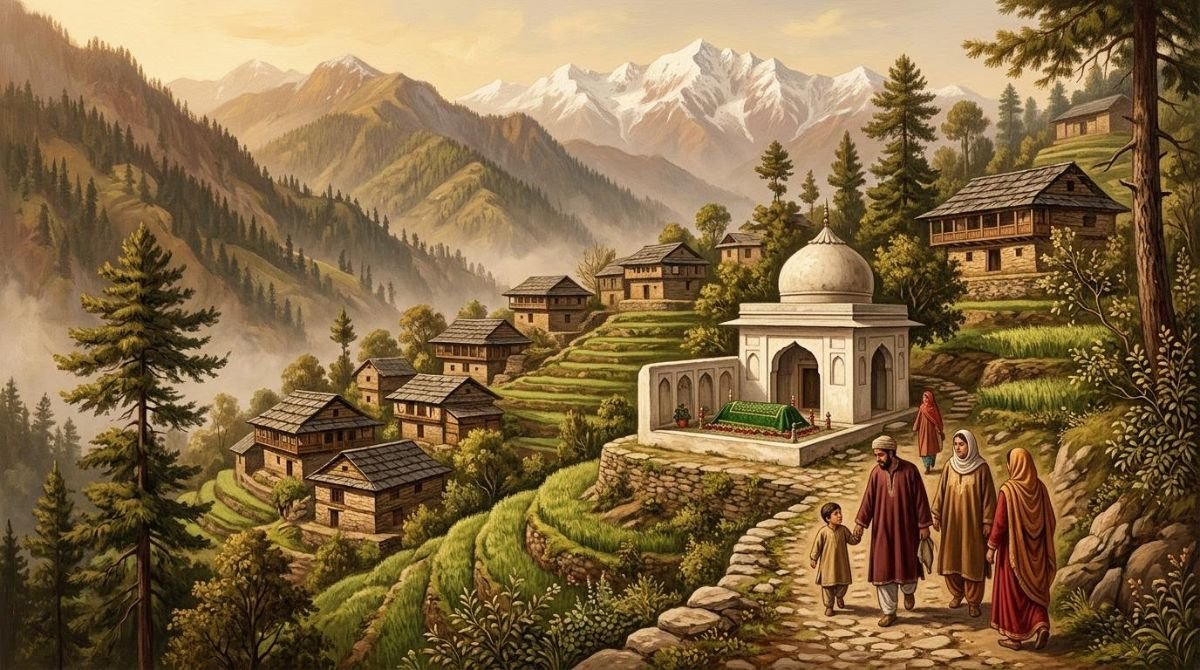
The Domal tribe (ڈومال) of Poonch descends, according to the 1997 Chib history by Raja Muhammad Iftikhar Ali Khan, from Raja Dom Khan, youngest son of Raja Goja Chand of Bhimber and brother of Raja Shadab Khan (Baba Shadi Shaheed). Driven from his share of the Chib kingdom, Dom Khan set up his own small state at Parawa Thakiala in Poonch, accepted Islam and named his seat Rajdhani; his descendants, a branch of the Chib Rajputs with an identity of their own, live in the Poonch country, Sudhnoti and Kotli.
At a glance
- Founder
- Raja Dom Khan, born Thom or Dom Chand
- Parentage
- Youngest son of Raja Goja (Gopal) Chand of Bhimber
- Kinship
- Brother of Raja Shadab Khan (Baba Shadi Shaheed); a branch of the Chib Rajputs
- Homeland
- Parawa Thakiala, Poonch; Dom Khan’s seat was named Rajdhani
- Conversion
- At the hand of the dervish Pir Fazil Shah
- Shrine
- Raja Dom Khan’s tomb at Rajdhani, where Domal children have their first head-shaving
- Leading figures
- Sardar Fateh Muhammad Khan Karelvi; Sardar Sikandar Hayat Khan
The Domal tribe: a Chib branch in Poonch
Describing where the Chib Rajputs live, the book notes that besides the districts of Gujrat, Mirpur, Kotli and Jhelum, the tribe is also found in Poonch, where one branch is settled in the Parawa Thakiala area under the name of the Domal (p. 33). The name comes from the branch’s founder, Raja Dom Khan, and the book speaks of the Domal as a separate tribe (qaum) that sprang from the Chib royal house of Bhimber (p. 70). Their homeland lies in the old Poonch country, which since 1947 has been divided between Azad Jammu and Kashmir and Indian-administered Jammu and Kashmir.
The Domal and the Chibs therefore share their ancestry. Both trace their descent to Raja Goja Chand, the sixth raja of Bhimber after the dynasty’s founder, Raja Chib Chand: the Chibs through his eldest son, Raja Shadab Khan, and the Domal through his youngest, Raja Dom Khan.
Raja Dom Khan, the youngest brother
Dom Khan was born Thom Chand, also called Dom Chand, the youngest of Raja Goja Chand’s four sons. Before he died, Goja Chand told his heir, Shadip Chand, to give each brother a share of the state, and Dom Khan received the country east of Samahni. He was not satisfied with it. His relations with his eldest brother, now Raja Shadab Khan, revered after his death as Baba Shadi Shaheed, grew strained, and after several battles Dom Khan was defeated and forced to leave his homeland. He made his way to Parawa Thakiala in the state of Poonch, where he put down the rebels of two local tribes, named in the book as the Dareda and the Jhabira (readings uncertain), and established a raj of his own (pp. 69–70, 82).
The book’s chapters on Bhimber and on Raja Bhom Khan add a further episode. After Shadab Khan’s death, they relate, Dom Khan, who had long been moving about the hills south of the Pir Panjal, came down to Bhimber and made common cause with the Thakials and Badhans, the families who had ruled Bhimber before Raja Chib Chand, by putting forward a claimant from among them. The quarrel with Shadab Khan’s sons, Raja Bhom Khan and Raja Mal Khan, reached the emperor in Delhi, whom Bhimber then acknowledged as overlord. To spare Shadab Khan’s family further bloodshed, the emperor sent a senior official to hold a darbar at Bhimber. Dom Khan fled towards Poonch, and a council of the brotherhood divided Chibhal: Bhom Khan became raja of the lands east of the Bhimber Nala, and Mal Khan received the lands to the west, the small state of Khari Kariali (pp. 37–38, 119, 145).
Sources differ
The book tells Dom Khan’s story in two ways. In the chapter on Goja Chand’s sons he is defeated by Shadab Khan and leaves for Poonch during his brother’s reign (p. 70). In the chapters on Bhimber, on Raja Bhom Khan and on Khari Kariali he is still contesting the throne after Shadab Khan’s death and flees to Poonch only when the emperor intervenes (pp. 37, 119, 145). In both, his story ends in Poonch, where, the book says, he died at Rajdhani.
Rajdhani and the shrine of Dom Khan
In Poonch, Dom Khan embraced Islam at the hand of a dervish, Pir Fazil Shah. He named his seat of government Rajdhani, “the capital”, and died there (p. 70). His tomb stands in a hamlet of Rajdhani that the book calls Mohra Anarauni in one place and Mohra Narauni in another (reading uncertain), and it is a place of pilgrimage for high and low alike (pp. 70, 82).
The shrine keeps alive a custom the Domal share with their Chib cousins. Just as Chib families take their sons to the shrine of Baba Shadi Shaheed for the mu-tarashi, the first shaving of a child’s head, so the Domal take their children to the tomb of Raja Dom Khan for the same ceremony (pp. 70, 82). The Chib side of the custom is described in Customs and Traditions of the Muslim Chib Rajputs.
The Domal families and their villages
Raja Dom Khan had three sons: Sardar Gama Khan, also called Gaman Khan, Sardar Saroli Khan and Sardar Mauladad Khan. The descendants of the first two settled across a group of villages around Rajdhani, while Mauladad Khan’s line settled at Majhan in the Parawa area. In the fifth generation from Mauladad Khan came Sardar Suraj Khan, whose five sons became well known and founded branches of their own (p. 70). Domal families are also found in various villages of Mendhar tehsil, in Sudhnoti district and in Kotli district (p. 71). The book’s list is set out below.
| Line | Descent | Villages named in the book |
|---|---|---|
| Sardar Gama (Gaman) Khan and Sardar Saroli Khan | Sons of Raja Dom Khan | Rajdhani, Panjgrain, Kagorha (reading uncertain), Rag Kalali, Bijot, Hayatpura, Sarola, Dharli Mohra, Mangal Nar, Barot Patrara and Galhoti; the Galhota branch came from Mangal Nar, Rampur tehsil, Rajouri |
| Sardar Mauladad Khan | Son of Raja Dom Khan | Majhan, Parawa area |
| Sardar Rupal Khan | Son of Sardar Suraj Khan, fifth in descent from Mauladad Khan | Majhan, Khandhar, Palani, Datot |
| Gakhar Khan | Son of Sardar Suraj Khan | Dahroti, Salsota |
| Mako Khan | Son of Sardar Suraj Khan | Warati, Malota |
| Pohru Khan | Son of Sardar Suraj Khan | Bharoti, Panjni, Sohala, Tarkundi |
| Gohar Khan | Son of Sardar Suraj Khan | None listed |
Sardar Fateh Muhammad Khan Karelvi
The book singles out Sardar Fateh Muhammad Khan Karelvi, son of Sardar Feroz Khan, as a history-making figure of the Domal tribe in the twentieth century. He began his career under Dogra rule as a police sergeant, trained at the Police Training College at Phillaur, and soon left the service. When an agitation against the Dogra government spread through the state to Mirpur, Bhimber and Kotli and reached his own Thakiala Parawa, he took a leading part in it. The government brought several cases against him, including three charges of murder, but none could be proved, the book says, and he emerged with his honour intact (p. 71).
He became president of the Anjuman Tahaffuz-e-Zamindaran Poonch, the association for the protection of the landholders of Poonch, and the acknowledged leader of Mendhar tehsil. He is credited with ending a customs toll that had been levied for twenty-seven years on traffic between Thakiala Parawa, Rajouri and Kotli. Of the three seats allotted to Poonch in the Jammu and Kashmir Assembly, two were reserved for Muslims, and the Muslims of Mendhar and Haveli tehsils elected him, so that he spoke in the Assembly for some two hundred thousand people. He was a close companion of Chaudhry Ghulam Abbas, the leader known as Quaid-e-Kashmir, and one of the founders of the All Jammu and Kashmir Muslim Conference, the main political party of the state’s Muslims (pp. 71–72). The book goes on to mention his part at the All-India Muslim League’s Lahore session of 23 March 1940, but a printing fault has lost the rest of that passage. It calls him Rais-e-Azam, the leading notable, of Poonch, and mourns his death as a loss to the Muslims of Kashmir and of Pakistan alike (pp. 72, 82). The wider story is told in Chib Rajputs in Kashmir Politics.
A date to check
The book dates the end of the customs toll to “1889 Bikrami”, which cannot be right for a twentieth-century leader; 1989 Bikrami, about 1932, is probably meant (p. 71).
Sardar Sikandar Hayat Khan
Karelvi’s son and successor, Sardar Sikandar Hayat Khan, had been active in the politics of Azad Jammu and Kashmir from 1970 to the time of writing, which this passage gives as October 1998, and for roughly a quarter of a century he was one of its most powerful figures. He held the offices of Senior Minister, Leader of the House, Prime Minister and finally President of Azad Kashmir, and the book adds that he presided for a time over the Pakistan National Alliance movement against Prime Minister Zulfikar Ali Bhutto, making him a familiar figure in Pakistani politics too. About three years before the book was written, differences with the party’s president, Sardar Muhammad Abdul Qayyum Khan, split the Muslim Conference into two groups, the Muslim Conference (Q) and the Muslim Conference (S), and Sikandar Hayat Khan led the latter (p. 72). The book counts both father and son among the eminent men of the state descended from Raja Dom Khan (p. 82). For the rajas of Bhimber, the house from which Dom Khan sprang, see The Rajas of Bhimber.
Frequently asked questions
Who are the Domal?
The Domal are a tribe of Poonch who, according to the 1997 Chib history, descend from Raja Dom Khan, youngest son of Raja Goja Chand of Bhimber and brother of Baba Shadi Shaheed. The book describes them as a branch of the Chib Rajputs that became a separate tribe after Dom Khan founded his own state at Parawa Thakiala.
Are the Domal related to the Chibs?
Yes, according to the book. Raja Dom Khan was a brother of Raja Shadab Khan, the ancestor of the Chibs, so both peoples descend from Raja Goja Chand and, before him, from Raja Chib Chand. Both also keep the custom of a child’s first head-shaving at an ancestral shrine.
Where do the Domal live?
Their homeland is the Parawa Thakiala area of Poonch, where the book lists villages such as Rajdhani, Panjgrain, Rag Kalali, Bijot, Hayatpura, Sarola, Mangal Nar and Majhan. Domal families are also found in Mendhar tehsil and in the Sudhnoti and Kotli districts.
Who was Raja Dom Khan?
He was the youngest son of Raja Goja Chand of Bhimber, born Thom or Dom Chand. Unhappy with his share of the state and defeated by his eldest brother, he moved to Parawa Thakiala in Poonch, set up his own raj with its seat at Rajdhani, and accepted Islam at the hand of the dervish Pir Fazil Shah. His tomb at Rajdhani is visited by the Domal.
Who are well-known Domal leaders?
The book names Sardar Fateh Muhammad Khan Karelvi, Assembly member for Mendhar and Haveli under Dogra rule and a founder of the All Jammu and Kashmir Muslim Conference, and his son Sardar Sikandar Hayat Khan, who served as Prime Minister and President of Azad Jammu and Kashmir and led the Muslim Conference (S).
Sources
- Raja Muhammad Iftikhar Ali Khan, Raja Shadab Khan alias Hazrat Baba Shadi Shaheed (Urdu, Barhang/Karachi, 1997), pp. 70–72, 82; see also pp. 33, 37–38, 69, 119, 145, 388.
- Chibhal family traditions and genealogies as recorded by the compiler.
This article is part of our series based on the 1997 Chib history; see the book, chapter by chapter. Spellings of names follow the book.
