

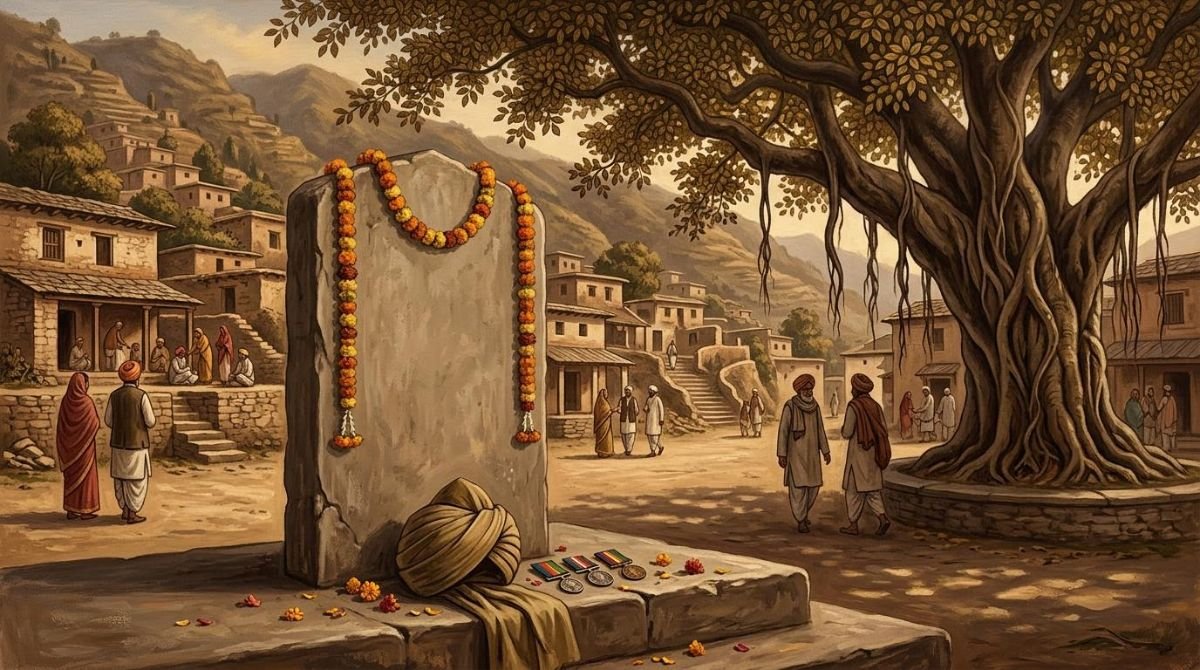
The Chib Rajputs (چب راجپوت) in the First World War (1914–1918) served in their hundreds, in the British Indian Army and in the Jammu and Kashmir State forces. Thakur Major Singh’s Tarikh-e-Chibhal (c. 1926), written a few years after the war, records a War Darbar held at Bhimber on 11 February 1918, copies the memorial stones of Damala, Bisa and Thotha Rai Bahadur, and claims that the Chibs stood first among all castes in war service.
At a glance
- War
- The First World War, 1914–1918; “the European War” in the book
- Darbar
- War Darbar at Bhimber, 11 February 1918, attended by British and State officers
- Memorials copied
- Damala: 250 served, 45 killed; Bisa: 149 and 15; Thotha Rai Bahadur: 134 and 14; a fourth stone at Mirpur
- Famous for service
- The Panjeri area in the Maharaja’s state; Bisa in British India (1926)
- Regiments named
- Risala No. 12 (12th Cavalry), No. 16, No. 25, No. 41 Dogra, No. 40 Pathan, the Guides, the Sappers and Miners and the State Forces
- Officers listed
- 57 officers and sardars and 34 commissioned officers, village by village
- Main source
- Major Singh (c. 1926), pp. 56–57, 89–92, 101–109
“First among all castes”: Chib Rajputs in the First World War
The eighth and last chapter of Thakur Major Singh’s history, headed simply “War services”, opens with a proud claim: in war service, the author writes, the Chib family stands first among all the castes (Major Singh (c. 1926), p. 101). He explains how the Chibs came to the war. In earlier times their young men enlisted almost only in the forces of the State of Jammu and Kashmir, the army of the Dogra Maharajas. As the clan grew and places in the State’s service became scarce, they turned to the army of the British Government, where, he says, they made rapid progress and won a high name.
The claim is the author’s own, and he gives no figures for the clan as a whole. The setting, though, is well known. More than a million Indian soldiers served overseas in the First World War, and the Punjab supplied more recruits than any other province of British India. The Chib country straddled the border between the two worlds of the author’s book: Bisa, Thotha Rai Bahadur and Pothi lay in Kharian tehsil of the Punjab’s Gujrat district, while Bhimber, Panjeri, Kalri and the Hindu Chib villages of Deva and Damala lay in the Jammu province of the Maharaja’s state, which also sent its own troops to the war. Thakur Major Singh was writing about men he knew. Among those he thanks for help with his book are a risaldar of Damala and the head of the Bhimber royal family, who had been honoured for his war services (p. 109; Iftikhar Ali Khan (1997), p. 149).
The War Darbar at Bhimber, 11 February 1918
The chapter’s one exact date belongs to Bhimber. On 11 February 1918, the author records, a very great War Darbar was held in the town, attended by many British officers and officers of the State. It acknowledged the military services of the district, “in which mostly Chib Rajputs live”, and rewards were given to its people (p. 101).
A darbar, in the language of the time, was a formal public assembly at which rulers and officials honoured their subjects. This one came in the last year of the war, nine months before the Armistice of 11 November 1918. Bhimber was then a tehsil of Mirpur district in the Jammu province of the Maharaja’s state (see Bhimber, gateway to Kashmir). The book does not name the officers who presided or the men who were rewarded, and the 1997 Chib history of Raja Muhammad Iftikhar Ali Khan does not mention the Darbar at all, so Tarikh-e-Chibhal is the only record of it that we know.
The village memorials of the European War
Here and there in the area, the author adds, stone inscriptions told of the services rendered in the last war (p. 101). He names four places where such stones had been set up: Damala and Mirpur in the State, and Thotha Rai Bahadur and Bisa in British territory. Under the heading “List of stone inscriptions set up at various places after the European War” he then copies their wording (pp. 102–103):
| Village | Then in | What the stone says | Served | Killed |
|---|---|---|---|---|
| Damala | State of Jammu | Of this village 250 men took part in the war, of whom 45 were killed. | 250 | 45 |
| Mirpur | State of Jammu | Listed without a text of its own | — | — |
| Bisa | Tehsil Kharian, District Gujrat | 149 young men took part in the war; 15 were killed. | 149 | 15 |
| Thotha Rai Bahadur | Tehsil Kharian, District Gujrat | 134 young men took part in the war; 14 were killed. | 134 | 14 |
Together the three stones he copies speak of 533 men who went to the war and 74 who did not return: nearly one in five at Damala, about one in ten at Bisa and at Thotha Rai Bahadur. Damala’s toll stands out. The village lay in Jammu State, and every Damala name in the book’s list of officers is that of a Hindu Rajput, from Risaldar Sadhu Singh of No. 16, whom the author thanks for help with the book, to Jamadar Lakhu Ram (reading uncertain) of No. 40, the only man in the lists marked “killed in the European War” (pp. 105–106, 109).
The book does not say where in each village the stones stood or what else they recorded, and we have not been able to learn whether any of them survives. For the families of Bisa and Thotha Rai Bahadur, now in Pakistan’s Punjab, see The Chibs in The Chiefs of the Punjab and Thotha Rai Bahadur.
Villages of soldiers: Panjeri, Bisa, Vatala and Barhang
The chapter names the two areas the author thought most famous for soldiering: in the Maharaja’s state the Panjeri area, and in British territory Bisa (p. 102). Earlier chapters fill in the picture. At Panjeri, he writes, the Rajputs had made good progress in military service and very many of its sardars were serving in the State and British armies (p. 89; see Panjeri). Bisa stood in the first rank of military service, with several commissioned officers in Risala No. 12, the 12th Cavalry (pp. 89–90).
Vatala, the author’s own Hindu Chib town east of Bhimber, had turned the same way. Fewer of its Rajputs were joining the State forces each year, he notes, and more the British army: in the European War its men enlisted in hundreds, without any urging or inducement from the recruiting officer (pp. 56–57). He names two of its veterans. Charan Das (reading uncertain), the elder son of Nawalu Ajitan, served in the cavalry, spent five years in the war and came home on a pension to take over his father’s work as zaildar and numberdar; and a havildar of the same family, whose name cannot be read, was wounded in the war and pensioned (p. 56; see Deva Vatala in 1926). Not every village followed. At Barhang, near Bhimber, the people were mostly farmers with little inclination for army service, and only one or two sardars drew pensions (p. 92).
Honours and recruiters in the 1997 history
The 1997 Chib history, which reproduces long passages of The Chiefs of the Punjab, fills in individual stories of the war. Some of its Chib soldiers served at the front; others, older officers and landholders, won their honours as recruiters, raising men for the army from their villages.
| Name | Family or village | War service and reward, as recorded | 1997 history |
|---|---|---|---|
| Risaldar-Major and Hon. Lt Ashiq Ali Khan | Bisa | Indian Distinguished Service Medal (1914–15), the Star, British War Medal and Victory Medal, besides the Order of British India | p. 162 |
| Hon. Lt Sardar Bahadur Shamsher Ali Khan | Bisa | Served on the battlefield; 1914–15 Star and Victory Medal; a war reward in 1921; Order of British India in 1924 | p. 164 |
| Mumtaz Ali Khan, zaildar | Bisa | Raised many recruits; three sanads, a silver watch, a pistol, a cash reward and a recruiting badge; died 1919 | pp. 161–162 |
| Risaldar-Major Pahlwan Khan | Bisa | Pensioned in 1914; raised many recruits; recruiting medal, three sanads and two squares of land in Phalia tehsil | p. 163 |
| Subedar Pir Muhammad Khan | Bisa | Helped with recruiting; recruiting medal, a sword, a robe of honour and a square of land | p. 163 |
| Raja Muhammad Khan, jagirdar | Pothi | Important war services and generous gifts to the war fund; twelve squares of land in the Lower Jhelum Canal Colony | p. 175 |
| Raja Sultan Lal Hussain Khan | Pothi | Honorary Assistant Recruiting Officer; a first-class sanad, a sword of honour, the Recruiting Badge and the War Badge | pp. 175–176 |
| Raja Muhammad Akbar Khan | Bhimber royal family, Jhelum | Title of Khan Bahadur for his services in the war; a sword of honour (1917) and the War Medal | pp. 149, 154 |
| Subedar Khan Inayatullah Khan | Khui Ratta | Went to the war with his unit of the State Forces | p. 214 |
Ashiq Ali Khan and Pir Muhammad Khan also appear among the Bisa officers in Thakur Major Singh’s list (p. 103), and Raja Muhammad Akbar Khan of Jhelum is one of the four men he thanks for help with the book (p. 109). For his later life, see Subedar Khan Inayatullah Khan.
The great Chib jagirs in 1926
Between the memorials and the lists of officers the author sets out the clan’s great jagirs, the hereditary grants held by its leading families. Several, he says, had come down from the time of the emperors of Delhi; Maharaja Gulab Singh renewed their grant deeds, and all the jagirdars were loyal to the State and to the British Government (p. 102). His table gives each jagir’s value, without a unit (presumably rupees a year), and the title of its holder:
| No. | Jagir | Value | Title of the jagirdar | Read more |
|---|---|---|---|---|
| 1 | Lehri, District Mirpur | 10,000 | Raja | Pothi and Lehri |
| 2 | Khui Ratta, District Mirpur | 10,000 | Khan Sahib | The Khans of Khui Ratta |
| 3 | Kas Guman (Kasgumah), District Mirpur | 5,000 | Raja | The Rajgan of Kasgumah |
| 4 | Panjeri, District Mirpur | 7,000 | Divided among the brotherhood | Panjeri |
| 5 | Samahni, District Mirpur | 4,000 | Raja | The Samahni Chibs |
| 6 | Da’ora | 500 | Chaudhri | Kalri and Mandi Da’ora |
| 7 | Bandala (Khori) | 1,148 | Mian | Mandi Bandala |
| 8 | Pothi, District Gujrat | 3,000 | Raja | Pothi and Lehri |
The eight values add up to 40,648 a year. Some agree with other sources: Pothi’s 3,000 matches The Chiefs of the Punjab, and the sharing of the Panjeri jagir among the whole brotherhood and the title of Chaudhri at Da’ora match the 1997 history (Iftikhar Ali Khan (1997), pp. 159, 291, 316). Others do not. The author’s own chapter on Khui Ratta puts that jagir at 20,000 (p. 94), and the 1997 history values Bandala with Khori at 1,160 in its text and 1,168 in its tables (pp. 277, 395). For comparison, Ranjit Singh’s settlement of 1810 had granted 4,000 to the house later seated at Lehri and 3,000 each to Pothi and Kasgumah (pp. 169–170).
The officers’ lists
The chapter ends with two rolls printed as tables. The first names 57 “war commissioned officers and sardars” village by village, from Bisa, whose thirteen names are headed by cavalrymen of Risala No. 12, to Thotha Rai Bahadur, Pothi, Damala, Deva, Barhang, Mughlora and Malot. The second, the “List of the military commissioned officers of the Chib qaum”, names 34 men of Kas Guman, Kalri, Panjeri and Sirla, headed by Sardar Bahadur Major General Raja Farman Ali Khan of the Kashmir Army (pp. 103–109; see The Rajgan of Kasgumah). Both lists are given in full, with notes on every uncertain reading, in Chib officers in 1926. For the soldiers of later wars, see Chib soldiers and the wider history of the Chib Rajputs.
Frequently asked questions
Did the Chib Rajputs fight in the First World War?
Yes. Thakur Major Singh’s Tarikh-e-Chibhal (c. 1926) says the Chibs stood first among all castes in war service and that, as State posts grew scarce, they joined the British Indian Army in large numbers. The memorial stones he copied show that 533 men from three villages, Damala, Bisa and Thotha Rai Bahadur, went to the war.
What was the War Darbar at Bhimber in 1918?
It was a great public assembly held at Bhimber on 11 February 1918, attended by many British and Jammu and Kashmir State officers, to acknowledge the war services of the district, where mostly Chib Rajputs lived, and to give rewards. The only record of it we know is Tarikh-e-Chibhal (c. 1926), p. 101.
Where are the Chib First World War memorials?
Tarikh-e-Chibhal lists stone inscriptions set up after the war at Damala and Mirpur in Jammu State and at Bisa and Thotha Rai Bahadur in Gujrat district. It does not say exactly where in each village they stood, and it is not known whether they survive.
How many Chib soldiers died in the First World War?
No total is known. The three memorial texts copied in Tarikh-e-Chibhal record 74 dead out of 533 men who served: 45 of 250 at Damala, 15 of 149 at Bisa and 14 of 134 at Thotha Rai Bahadur.
Which regiments did Chib soldiers serve in?
The 1926 lists in Tarikh-e-Chibhal name Risala No. 12 (the 12th Cavalry), No. 16, No. 25, No. 41 Dogra, No. 40 Pathan, the Guides and the Sappers and Miners in the British Indian Army, as well as the Kashmir State Forces, whose most senior Chib officer was Major General Raja Farman Ali Khan.
Sources
- Thakur Major Singh Chib, Tarikh-e-Rajgan-e-Bhimber wa Qaum-e-Chibhal (Tarikh-e-Chibhal; Urdu, c. 1926), pp. 56–57, 89–94, 101–109.
- Raja Muhammad Iftikhar Ali Khan, Raja Shadab Khan alias Hazrat Baba Shadi Shaheed (Urdu, 1997), pp. 149, 154, 159–164, 169–170, 175–176, 214, 277, 291, 316, 395.
- L. H. Griffin and C. F. Massy, The Chiefs of the Punjab, as reproduced in the 1997 history.
This article is part of our series on the oldest Chib history; see Tarikh-e-Chibhal, chapter by chapter. Spellings of names follow the book; readings marked “uncertain” could not be read with certainty in the old lithograph.
Continue reading
Have a question about this history?
Our AI guide answers from the articles on this site, in English or Urdu.
