

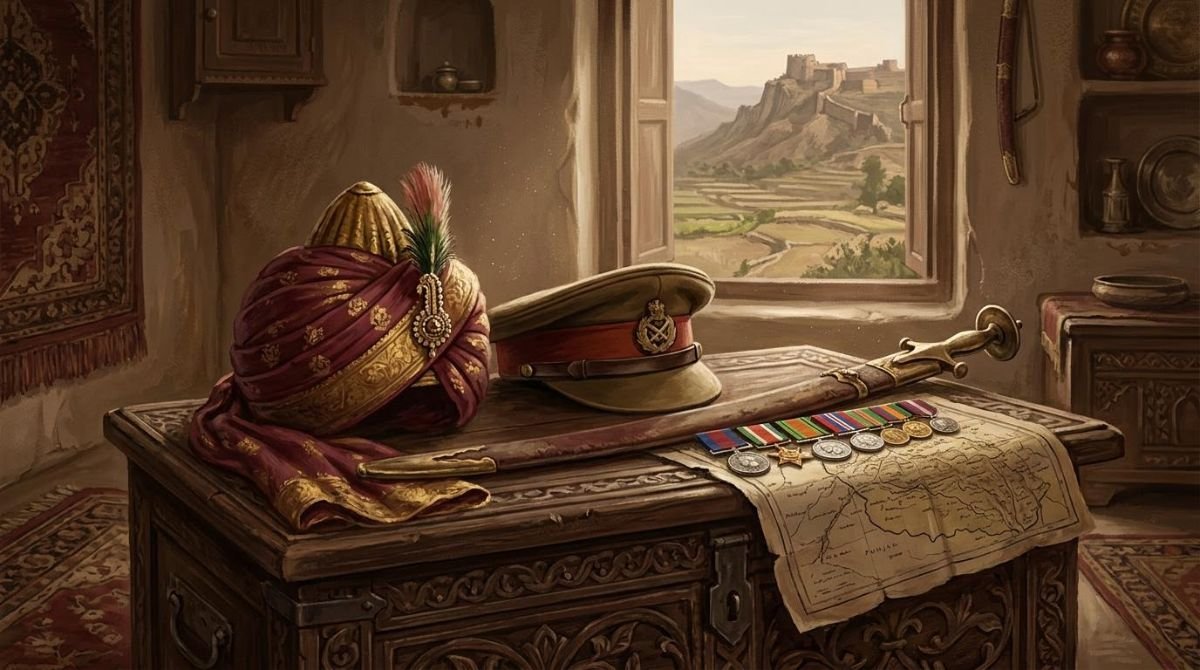
Chib Rajput soldiers (چب راجپوت; the name is also written Chibh or Chhib) appear on almost every page of Raja Muhammad Iftikhar Ali Khan’s 1997 history of the Chibs: risaldars of Punjab cavalry who served in 1857 and Abyssinia, officers of the Jammu and Kashmir State Forces, an Indian National Army brigadier who took Bhimber in 1947, and a lieutenant general who became Deputy Chief of Staff of the Pakistan Army. Their villages, from Panjeri and Kalri near Bhimber to Pothi, Bisa and the Ghanial settlements of Kharian, sent sons to almost every war fought in the region between 1849 and 1971.
At a glance
- Service recorded
- From 1849 (British service in the Punjab) to the India–Pakistan war of 1971
- Campaigns named
- 1857, Abyssinia (1868), Afghanistan (1878–80), both world wars, 1947–48, 1965 and 1971
- Cavalry tradition
- The 12th Cavalry (No. 12 Risala) and its forerunner: Sardar Rahim Dad Khan of Panjeri; Mardan Ali Khan and Pahlwan Khan of Bisa
- Highest rank
- Lt Gen. Raja Muhammad Akbar Khan of Kalri (1922–1978), Deputy Chief of Staff, Pakistan Army
- State Forces
- Maj. Gen. Raja Farman Ali Khan of Kasgumah (d. 1923)
- Indian National Army
- Brig. Raja Habib-ur-Rahman Khan of Panjeri, its Deputy Chief of Staff in 1944
- Honours named
- Order of British India, Indian Distinguished Service Medal, Sardar Bahadur, Sitara-e-Jurat, Tamgha-e-Jurat
A tradition of Chib Rajput soldiers
Soldiering runs through the Chib story long before the British. The book credits the last raja of Bhimber, Raja Sultan Khan, with twice defeating Sikh armies before Chibhal fell (see Raja Sultan Khan and the Sikh wars). In 1926 the first Chib historian, Thakur Major Singh, wrote of Panjeri that “the Rajputs here have made good progress in military service”, and printed a list of seventeen “military commissioned officers of the Chib qaum”, from subedars and risaldars of the Indian Army and the Kashmir Army to a captain. The 1997 book names well over a hundred soldiers; this overview follows them through five eras and links to the family articles where the full rolls appear.
Risaldars and recruiters: the British Indian Army
The first Chib names in British service belong to the former ruling houses. After the loss of Bhimber, Raja Faiz Talab Khan’s son Tikka Raja Fazl Dad Khan became a Risaldar-Major on the Frontier, and another son, Ghulam Qadir Khan, began in 1849 as peshkar (clerk) to Herbert Edwardes at Multan and rose to Risaldar in the 4th Bengal Cavalry. In the Gujrat hills, Khan Bahadur Raja Sultan Khan of Pothi supplied the British with 60 sepoys and 25 horsemen in 1849 and 1857 and fought the mutinous 14th Native Infantry at Jhelum (see The Chibs in The Chiefs of the Punjab). No family had a longer cavalry record than the Chibs of Bisa near Kharian:
| Soldier (Bisa family) | Service and honours, as recorded |
|---|---|
| Sardar Bahadur Mardan Ali Khan (d. 1898) | Joined the Sikhs’ old No. 2 Risala, later the 12th Cavalry, and rose to Risaldar-Major; 30 horsemen in 1857; Abyssinia (1868) and the Kabul war (1878–80); Order of British India |
| Risaldar-Major Pahlwan Khan | 12th Cavalry; pensioned in 1914 with the Order of British India, second class; recruiter in the Great War |
| Risaldar-Major and Hon. Lt Ashiq Ali Khan | Jemadar from 1903, honorary lieutenant in 1930; Order of British India and Indian Distinguished Service Medal (1914–15) |
| Hon. Lt Sardar Bahadur Shamsher Ali Khan | Great War and Frontier service (1923, 1930); Order of British India in 1924, first class in 1935 |
| Subedar Pir Muhammad Khan | 25th Punjabis; Waziristan and the Frontier |
| Jemadar Niaz Ali Khan | First Grenadiers; South Africa and Somaliland |
Near Bhimber, Sardar Rahim Dad Khan of Panjeri (d. 1921) is remembered as one of the builders of the No. 12 Risala, in which he rose to Risaldar, in the book’s words the highest rank then open to an Indian; his grandson was Brigadier Habib-ur-Rahman Khan, and Panjeri’s army roll in the book runs to more than fifty names (see Panjeri). In the First World War the Punjab chiefs were recruiters as much as soldiers: Raja Sultan Lal Hussain Khan of Pothi was an Honorary Assistant Recruiting Officer, and Raja Muhammad Akbar Khan of Jhelum, head of the Bhimber royal family, was made Khan Bahadur for war services; his son Major Raja Muhammad Afzal Khan was commissioned into the British Indian Army and his grandson Raja Muhammad Salim Khan became a brigadier. The Ghanial villages of Tehsil Kharian filled the ranks of subedars, among them Subedar Raja Shahsawar Khan of Sari’ah, Raja Mehtab Ali Khan of Mithana Chak, holder of the Order of British India, and Honorary Captain Raja Sardar Khan of Jaipur, of the Rajputana Rifles (see The Ghanial Chibs of Kharian).
In the Maharaja’s service: the State Forces
Inside the princely state, Chibs served the Dogra Maharajas whose forebears had displaced their own. The most senior was Sardar Bahadur Major General Raja Farman Ali Khan, CIE, of Kasgumah, who died in 1923. Raja Abdul Rahman Khan of Panjeri (1900–1959) began as a captain in the State Army, became a major general in the army of Alwar State and after 1947 served as Pakistan’s Deputy High Commissioner in India. Khan Inayatullah Khan of Khui Ratta rose from jemadar to subedar under Maharaja Partab Singh and served in the First World War; the Maharaja, the book says, meant to make him a colonel after a posting at Gilgit, but he retired to save his family’s jagir. Major Raja Muzaffar Khan of Kotera Khanka was a captain and ADC to Maharaja Hari Singh, so formidable at polo, hockey and football that rival princely teams at a tournament in Alwar protested his selection until the Maharaja threatened a boycott. Kasgumah and Da’ora supplied further ADCs to the Maharajas of Jammu and Kashmir and of Patiala, and a risaldar of Maharaja Partab Singh’s bodyguard.
The world wars and the Indian National Army
The Second World War produced the most dramatic careers. Raja Muhammad Zaman Khan of Pothi Jang Khan, of the Supply Corps, was taken prisoner by the Japanese and held, the book says, for about five years, released only after Hiroshima and Nagasaki. Raja Habib-ur-Rahman Khan of Panjeri, the first Muslim of Jammu and Kashmir, the book says, to win a place through the all-India military examination, received the King’s Commission in 1936 and was in Malaya when it fell to Japan in February 1942. That September he joined the Indian National Army, later led by Subhas Chandra Bose, becoming Commandant of its Officers’ Training College and, in 1944, its Deputy Chief of Staff. He was on Bose’s aircraft when it crashed in Formosa on 18 August 1945, survived, and was held in Delhi’s Red Fort until 22 April 1946 (see Brigadier Raja Habib-ur-Rahman Khan). Three days before the crash he had written to his young son:
Whatever I did, I did solely for the sake of my enslaved country.
— Habib-ur-Rahman Khan to his son, Singapore, 15 August 1945, printed in the book, pp. 299–300
1947–49: the Azad Kashmir forces
In October 1947 ex-servicemen formed the backbone of the volunteer squads that rose against the Dogra State forces (see The Chib Rajputs in 1947). Habib-ur-Rahman led the capture of Bhimber and became the founding Chief of Staff of the Azad Kashmir Regular Forces; Muzaffar Khan raised the Darhal Battalion (later AK 16) and Inayatullah Khan the Banah Battalion (later 25 Haidri Battalion). Kalri alone later gave the Azad Kashmir Regular Forces two colonels, Raja Ali Akbar Khan and Raja Dilawar Khan, and in the next generation a brigadier, Raja Ghaus Muhammad Khan.
In Pakistan’s army, navy and air force
The most senior Chib soldier in the book is Lieutenant General Raja Muhammad Akbar Khan of Kalri (1922–1978), son of Subedar Raja Jalal Khan. Enlisting as a recruit in 1942, he rose to Deputy Chief of Staff of the Pakistan Army and Director General of the ISI, and was GOC Azad Kashmir in the 1971 war. Passed over for the army’s top post when General Tikka Khan retired, he resigned, became Pakistan’s ambassador in London at Zulfiqar Ali Bhutto’s request, and died in office on 22 June 1978. The book calls him the first descendant of Baba Shadi Shaheed, and the first man from Azad Kashmir, to become a lieutenant general.
| Officer | Family or village | Service, as recorded |
|---|---|---|
| Maj. Gen. Raja Farman Ali Khan, CIE (d. 1923) | Kasgumah | Jammu and Kashmir State Forces; Sardar Bahadur |
| Maj. Gen. Raja Abdul Rahman Khan (1900–1959) | Panjeri | State Army; Alwar State Army; Pakistan’s Deputy High Commissioner in India |
| Brig. Raja Habib-ur-Rahman Khan (1913–1978) | Panjeri | INA Deputy Chief of Staff; founding Chief of Staff, Azad Kashmir Regular Forces |
| Lt Gen. Raja Muhammad Akbar Khan (1922–1978) | Kalri | Deputy Chief of Staff, Pakistan Army; DG ISI; GOC Azad Kashmir, 1971 |
| Maj. Gen. Raja Asif Dilawaiz Khan | Thotha Rai Bahadur | Pakistan Army, serving at the time of writing |
| Air Vice Marshal Raja Muhammad Aftab Khan | Thotha Rai Bahadur | Pakistan Air Force |
| Air Commodore Raja Maqsood Khan | Panjeri | Pakistan Air Force |
| Maj. Gen. Abdul Rahman Khan; Maj. Gen. Naseer Ahmad | Mughlora | Listed among Mughlora’s notables; the first is described as a former President of Azad Jammu and Kashmir |
| Brigadiers | Several villages | Raja Muhammad Salim Khan (Bhimber royal family), Raja Gulrez Akhtar Khan (Thotha Rai Bahadur), Raja Ghaus Muhammad Khan (Kalri), Muhammad Saeed Khan and Sajjad Ayub Raja (Panjeri), Hasan Akhtar Khan (Lathori), Raja Zarin Khan (Sari’ah), Raja Muhammad Shabbir Khan (Rajal line) |
The wars of 1965 and 1971 drew in a new generation. Four grandsons of Raja Datta Khan of Pothi Jang Khan fought in them: Raja Abdul Aziz Khan of the EME at Chhamb in 1965, Raja Nazir Ahmad Khan with the Armoured Corps’ Risala No. 5 in 1965 and 1971, Raja Gulzar Ahmad Khan with 3rd Baloch at Chawinda in 1971, and Raja Shabbir Ahmad Khan with 19 Sindh in 1971. Gold medals at the Pakistan Military Academy, Kakul, went to Raja Tariq Siddiq Khan and Raja Shamriz Salik of Mithana Chak, and the Navy and Air Force lists include Chief Petty Officer Raja Muhammad Yunus Khan of Jaipur and Pilot Muhammad Ashiq of Nandwal.
Sources differ
Ranks are not always consistent. The Kasgumah chapter gives the rank of major general to Raja Farman Ali Khan (p. 170, with his photograph and family tree) but once to his brother Raja Mardan Ali Khan (p. 172), and Raja Diwan Ali Khan of Kalri is a subedar on p. 310 and a havildar on p. 311.
Honour roll: soldiers the book remembers as martyrs
| Name | Village | Unit, front and date |
|---|---|---|
| Havildar Raja Sahibdad Khan | Ghawaliyan | No. 6 Jammu and Kashmir Regiment; Skardu front, 1947–48 |
| Maj. Raja Muhammad Afzal Khan, Fakhr-e-Kashmir | Kalri | Killed in 1948; Afzalpur (formerly Gobindpur) bears his name |
| Raja Muhammad Aslam Khan | Panjeri | 12th Cavalry; Khem Karan, 10 September 1965; buried at Kasur |
| Capt. Raja Muhammad Zafar Khan | Kalri | 13 Lancers; Zafarwal sector, Sialkot, 1971; son of Lt Gen. Akbar Khan |
| Pilot Muhammad Ashiq | Nandwal, Kharian | Pakistan Air Force; among its first martyrs |
| Lt Raja Rashid Arshad Khan; Subedar Raja Muhammad Akram Khan; Raja Allah Ditta Khan, Sitara-e-Jurat | Panjeri; Lathori; Thotha Rai Bahadur | Honoured as shaheed; date and place not given |
Sportsmen, bodyguards and villages of soldiers
Soldiering often went with sport and ceremony. Besides Muzaffar Khan’s polo, the book records Jamadar Muhammad Khan of Panjeri as an international hockey player, Captain Raja Allah Ditta Khan of Panjeri as an internationally known pole-vaulter and two Kasgumah brothers as famous tent-peggers. Naib Subedar Raja Fazal Ahmad Khan of Mughlora served as a bodyguard to Queen Victoria and to the Maharaja of Kashmir, and Raja Muhammad Latif Khan of Khair Ghansar, bodyguard to Governor-General Ghulam Muhammad, took part in Queen Elizabeth’s coronation. The rolls show where the soldiers came from: Panjeri and Kalri near Bhimber, Pothi Jang Khan, Thotha Rai Bahadur, Pothi and Bisa, and the Ghanial villages of Kharian, all part of the wider story told in Chib Rajputs: history, origins and clans.
Frequently asked questions
Who was the highest-ranking Chib Rajput soldier?
The 1997 Chib history names Lieutenant General Raja Muhammad Akbar Khan of Kalri (1922–1978), Deputy Chief of Staff of the Pakistan Army and Director General of the ISI, who later served as Pakistan’s ambassador in London. The book calls him the first descendant of Baba Shadi Shaheed, and the first man from Azad Kashmir, to reach that rank.
Did Chib Rajputs serve in the British Indian Army?
Yes. From 1849 the Chib families of Pothi, Bisa, Panjeri and Jhelum served the British, especially in the cavalry. Men of the Bisa family fought in 1857, in Abyssinia in 1868 and in the Afghan war of 1878–80, and several won the Order of British India.
Which Chib officer served in the Indian National Army?
Brigadier Raja Habib-ur-Rahman Khan of Panjeri (1913–1978) received the King’s Commission in 1936, joined the Indian National Army in 1942 and became its Deputy Chief of Staff in 1944, serving under Subhas Chandra Bose. He survived the air crash in Formosa in August 1945 and later led the capture of Bhimber in October 1947.
Which Chib soldiers were killed in Pakistan’s wars?
The book honours Major Raja Muhammad Afzal Khan of Kalri, killed in 1948; Raja Muhammad Aslam Khan of Panjeri, killed at Khem Karan on 10 September 1965; and Captain Raja Muhammad Zafar Khan of Kalri, killed in the Zafarwal sector in 1971, among others.
Sources
- Raja Muhammad Iftikhar Ali Khan, Raja Shadab Khan alias Hazrat Baba Shadi Shaheed (Urdu, Barhang/Karachi, 1997), pp. 41, 75–78, 148–164, 170–176, 184–185, 214–216, 236–237, 254–257, 266–267, 289–315, 318, 324, 337–346, 352.
- Sir Lepel Griffin and later revisers, The Chiefs of the Punjab, as reproduced in the book (pp. 150–164).
- Thakur Major Singh, Tarikh-e-Chibhal (1983 Bikrami, c. 1926), p. 108, list of Chib commissioned officers, quoted in the book (p. 290).
This article is part of our series based on the 1997 Chib history; see the book, chapter by chapter. Spellings of names follow the book.
