

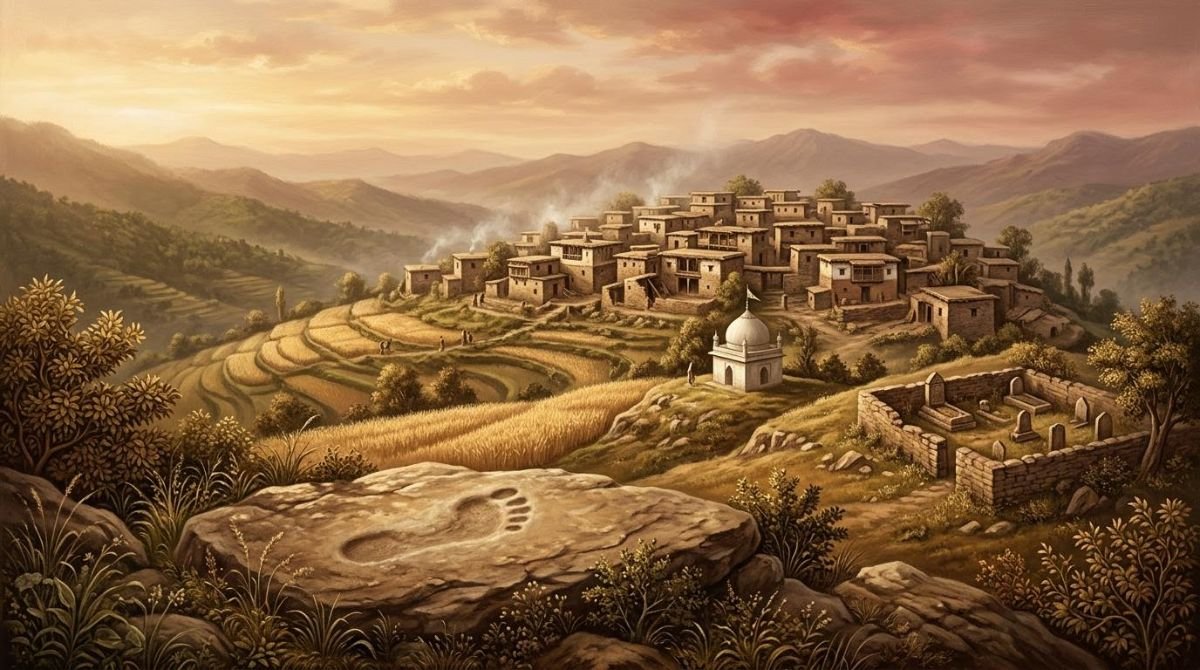
Panjeri (پنجیڑی) is a large Chib Rajput village in Tehsil and District Bhimber, Azad Jammu and Kashmir, and the old mandi (chief seat) of the Jaskal got, descended from Raja Jaisak Khan, a grandson of Baba Shadi Shaheed. Named, tradition says, after a saint’s footprint, Panjeri became home to the Zaildar family of Sardar Rahim Dad Khan (d. 1921), whose descendants include generals, senior officials and the “Conqueror of Bhimber”, Brigadier Habib-ur-Rahman Khan.
At a glance
- Where
- Tehsil and District Bhimber, Azad Jammu and Kashmir
- Clan
- Chib Rajputs, Jaskal got
- Founder
- Raja Jaisak Khan, son of Raja Mal Khan
- Chief’s title
- Rai
- Old holding
- 22 villages, among them Kalri, Sahlar, Bhalwal and the two Tonins
- Patron saint
- Hazrat Pir Taj-ud-Din Shah Bukhari
- Leading family
- The Sardars (Zaildars) of Panjeri, from Sardar Rahim Dad Khan (d. 1921)
- In 1926
- Second most populous place in Tehsil Bhimber, after Watala
Raja Jaisak Khan and the founding of Panjeri
Panjeri belongs to the house of Raja Mal Khan, the son of Raja Shadab Khan — Baba Shadi Shaheed — who inherited Khari Kariali, the western half of the old Chib state of Bhimber. In Chibhal the eldest son of a raja took the title Raja and a younger son the title Rai, so Mal Khan’s descendants became the Rai, or Rekah, branch of the Chib Rajputs. His sons shared out his lands, and each founded a mandi: a chief’s seat with its own dependent villages and its own got, or sub-clan. Panjeri was the mandi of Raja Jaisak Khan, whose descendants are the Jaskal got, one of the fourteen Chib gots in H. A. Rose’s list.
The book quotes two older accounts of the founding. Thakur Major Singh of Dewa Vatala, in his Tarikh-e-Chibhal (printed in 1983 Bikrami, about 1926), says the family’s first mandi stood beside Kariala, and that Mandi Panjeri was founded after their elder was killed there. The unpublished manuscript of Maulvi Zain-ul-Abidin Kohi Samahnavi, whom the book calls the historian of Chibhal, adds that Jaisak Khan moved from Balani, his father’s seat, to Kariala, where a mandi was set up; after a bloody clash there, the family founded Panjeri instead. Its chief bore the government title of Rai and held a ta’alluqadari (dependent holding) of twenty-two villages.
According to the Maulvi, Jaisak Khan’s descendants live in Panjeri, Kalri, Sahlar, Khadorha, Tonin Reki and Tonin Rajani (the “two Tonins”), Pind Rahmanpur, Pind Aziz, Ghazi Gorha, Bhalwal Bala and Bhalwal Zerin (Upper and Lower Bhalwal) and Baoli. The tables of the old divisions at the end of the book add that a branch descended from one Muzaffar Khan held Kalri, Sahlar, Khadorha and the two Tonins as a separate share.
Bhalwal and the lost fourth mandi
Two of Jaisak Khan’s sons, Bahlo (or Bahlol) Khan and Darab Khan — also written Dharab or Darbaro Khan — went to live on their own shares, and Bhalwal takes its name from Bahlo Khan. One tradition counts Khumbi Khanpur as a fourth mandi, whose chief was styled Khan Sahib and held twenty-two villages, until royal displeasure cost the family the mandi and it passed to Bhalwal Bala. The chief of Bhalwal was also a Khan Sahib, with a holding of twelve villages, among them Khumbi, Bahrot, Kastila, Mohri, Saddowal and Bahwanj; Pind Rahman also belonged to the old Bhalwal mandi.
Sources differ
Thakur Major Singh, and the book’s own chapter on Kalri, make Jaisak Khan the third son of Raja Mal Khan; Maulvi Zain-ul-Abidin calls him the second. Some kursi-namas (genealogies) make Darab Khan a son of Mal Khan rather than of Jaisak Khan. The family tree of neighbouring Mandi Da’ora lists Mal Khan’s sons as Ali Ghiyas Khan, Tahwar (Dhaur) Khan, Jaisak Khan and Nadir Khan.
How Panjeri got its name: the saint’s footprint
The best-loved explanation of the name involves Panjeri’s patron saint, Hazrat Pir Taj-ud-Din Shah Bukhari, whom the book calls the greatest spiritual figure of the area. When the founder of the mandi humbly asked the saint where he should build his house, the Pir chose a high spot in present-day Panjeri and pressed into the ground the marks of his panja, the front of the foot, and his eri, the heel. From panja and eri came the name Panjeri. The place where the footprints were left is still held blessed and holy by the villagers; the book gives its local name as the “Dapri wali jagah” (reading uncertain).
Maulvi Zain-ul-Abidin records a second, more down-to-earth derivation. The village was founded by five men — Jaisak Khan’s four sons and his grandson Husain Khan — and so was a place of panj bandi, “five shares”. The Pir’s shrine stands about a mile north of the village, and facing it is the walled graveyard of the Zaildar family, described below. For other saints of the district, see Saints and Shrines of Bhimber.
Chaudhri Qadir Bakhsh Khan, the Rai who shared his jagir
Before the Zaildars rose to prominence, the leading man of Mandi Panjeri was Chaudhri Qadir Bakhsh Khan, whom the book places about a century and a half before its own time, in the early nineteenth century. He is remembered as a just, gentle and Sufi-minded hereditary jagirdar who opposed the exploitative ways of the other landlords of his day. Against strong opposition he divided the Panjeri jagir in equal shares among the whole biradari (clan brotherhood), a decision his descendant, retired DSP Raja Muhammad Ilyas Khan, regards as almost without parallel. The family account calls him “the first Rai (jagirdar) of Mandi Panjeri”, although the older genealogies make Jaisak Khan the founder.
Little more is known of his life, and the author apologises for the gap. The family remembers two later heirs to his ideals: Subedar Abdul Rahman Khan of Siri (Panjeri), his great-grandson, who died before he could carry the work further, and Subedar Ali Shan Khan, Raja Ilyas Khan’s father, who carried out several welfare reforms in the mandi and began, but could not finish, dividing the shamilat, the village common land. Raja Ilyas Khan, who opened a bookshop, Bhimber Kitab Ghar, after retiring from the Azad Kashmir Police, also wrote one of the commendations printed at the end of the book.
The Sardars and Zaildars of Panjeri
For about a century before the book was written, Panjeri’s most distinguished family was that of the Sardars, or Zaildars — a zaildar being the notable who acted for the government over a circle (zail) of villages. A family tree compiled by Raja Ishtiaq Ahmad Khan of Panjeri traces their line through eight generations: Sardar Kalim Khan, Qasim Khan, Gul Muhammad Khan, Fazil Khan, Faiz Bakhsh Khan, Hayatullah Khan, Sher Khan and Rahim Dad Khan.
Sardar Rahim Dad Khan (d. 1921)
Sardar Rahim Dad Khan was, in the book’s phrase, the uncrowned king of Panjeri, a man of standing at the court of Jammu and Kashmir. He served in the British Indian Army in No. 12 Risala, a cavalry regiment which the book says he helped to raise, and rose to Risaldar, among the highest ranks then open to an Indian; Thakur Major Singh’s 1926 list of Chib officers records him as “Rahim Dad Khan, Risaldar, Indian Army”. Retiring to Panjeri in the reign of Maharaja Partab Singh (1885–1925), he was made Zaildar of the Panjeri jagir, and the village’s boys’ school and a seminary for religious learning are remembered as his work. Around 1908 he was among the notables present at Jhelum when Raja Muhammad Akbar Khan was installed as head of the Bhimber royal family. He died on 23 October 1921.
His four sons, and the daughter through whom he became grandfather of the “Conqueror of Bhimber”, were:
- Sardar Rahim Dad Khan — Risaldar, No. 12 Risala; Zaildar of Panjeri; d. 23 October 1921
- Raja Muhammad Sarwar Khan — succeeded as Zaildar; Wazir-e-Wazarat (district officer, the equivalent of a deputy commissioner) under the Dogra government; killed at Udhampur in October 1947
- Col. Muhammad Ayub Khan
- Raja Abdul Khaliq Khan (1927–1990) — Deputy Commissioner, Commissioner and Secretary Revenue, Azad Jammu and Kashmir; Tamgha-e-Quaid-e-Azam
- Raja Iftikhar Ali Khan, “Allah Lok” (1929–1973) — broadcaster
- Maj. Gen. Raja Abdul Rahman Khan (1900–1959) — Captain, Jammu and Kashmir State Army; Major General, Alwar State Army; Pakistan’s Deputy High Commissioner in India
- Raja Saeed Akhtar Khan (d. 1983)
- Capt. Raja Fazal-ur-Rahman Khan (d. 1982) — Zaildar; member of the Jammu and Kashmir legislature; a founder of the All Jammu and Kashmir Muslim Conference
- Raja Naseem Akhtar Khan — Additional Chief Secretary, Azad Jammu and Kashmir (retired)
- Raja Shamim Akhtar Khan — District Councillor from Panjeri
- Col. Dr. Raja Muhammad Sharif Khan (d. 1983) — Army Medical Corps
- Maj. (retd) Raja Naseem
- Dr. Khurshid Raja — gynaecologist; former Medical Superintendent, Cantonment General Hospital, Rawalpindi
- Ghulam Fatima Begum (d. 1970) — wife of Raja Manzoor Ahmad Khan
- Brig. Raja Habib-ur-Rahman Khan (1913–1978)
- Raja Muhammad Sarwar Khan — succeeded as Zaildar; Wazir-e-Wazarat (district officer, the equivalent of a deputy commissioner) under the Dogra government; killed at Udhampur in October 1947
Muhammad Sarwar Khan, the eldest, had his father’s bearing; Panjeri’s Basic Health Centre is named after him. Abdul Rahman Khan settled at Sarai Alamgir after retirement, while Fazal-ur-Rahman Khan and Muhammad Sharif Khan spent their last years in Jhelum. In the next generation Raja Abdul Khaliq Khan rose to the top of the Azad Kashmir revenue service, and his brother Raja Iftikhar Ali Khan became, in the book’s words, famous across the subcontinent as the radio broadcaster “Allah Lok”, before his death at forty-four. Maj. Gen. Abdul Rahman Khan of Panjeri should not be confused with Maj. Gen. Abdul Rahman Khan of Mughlora, a former President of Azad Kashmir, whom the book lists separately.
The Conqueror of Bhimber
Rahim Dad Khan’s daughter’s son, Brigadier Raja Habib-ur-Rahman Khan, was brought up in his grandfather’s house and went to school in Panjeri. He became an officer of the Indian Army, Deputy Chief of Staff of the Indian National Army, a survivor of the air crash in which Subhas Chandra Bose died in 1945 and, in October 1947, the leader of the force that took Bhimber. Like two of his uncles, he lies in the family graveyard.
The Zaildars’ graveyard
The family’s walled graveyard lies about a mile north of the village, directly opposite the shrine of Pir Taj-ud-Din Shah Bukhari. A coloured marble tablet on the gate commemorates Sardar Rahim Dad Khan and carries a couplet from Iqbal’s elegy for his mother. The book transcribes the tombstones inside; the principal graves are these:
| Buried | Relationship | Dates on the tombstone |
|---|---|---|
| Sardar Rahim Dad Khan | Head of the family | d. 23 October 1921 (20 Safar 1340 AH) |
| Wife of the Sardar (two entries) | — | d. 1901; d. 13 December 1921 |
| Capt. Raja Fazal-ur-Rahman Khan | Son | d. 3 March 1982 |
| Col. Muhammad Sharif Khan | Son | d. 20 January 1983 |
| Sarwar Begum | Wife of Raja Muhammad Sarwar Khan | d. 12 September 1978, aged 78 |
| Raja Abdul Khaliq Khan | Grandson | 14 February 1927 – 30 September 1990 |
| Raja Iftikhar Ali Khan, “Allah Lok” | Grandson | 19 June 1929 – 25 June 1973 |
| Ghulam Fatima Begum | Daughter; mother of the Brigadier | d. 18 February 1970 |
| Brig. Raja Habib-ur-Rahman Khan | Daughter’s son | d. 26 September 1978 (as printed) |
| Badshah Begum | Wife of the Brigadier | d. 30 June 1979 |
The wives of Capt. Fazal-ur-Rahman Khan and Col. Muhammad Sharif Khan are also buried here. Maj. Gen. Abdul Rahman Khan (5 June 1900 – 10 October 1959) lies not at Panjeri but in a corner of his own house at Sarai Alamgir, with his wife and his only son, Al-Haj Raja Saeed Akhtar Khan (d. 22 February 1983).
Soldiers, officials and sportsmen of Panjeri
In 1926 Thakur Major Singh noted that Panjeri’s Rajputs had made good progress in military service, with many in the state and British armies, and that the village had a vernacular middle school; by the 1990s, the author adds, it also had a high school and a girls’ intermediate college. The Thakur’s list of commissioned officers of the Chib qaum includes these men of Panjeri:
| Name and rank | Service, as the Thakur gives it |
|---|---|
| Subedar Sattar Muhammad Khan | Indian Army |
| Subedar Gharibullah Khan | Kashmir Army |
| Risaldar Rahim Dad Khan | Indian Army |
| Subedar Allah Dad Khan | Kashmir Army |
| Subedar Fazal Dad Khan | Kashmir Army |
| Risaldar Ali Asghar Khan | Indian Army |
| Jamadar Muhammad Akbar Khan | Indian Army |
| Risaldar Painda Khan | Indian Army |
| Jamadar Lal Khan | Indian Army |
| Jamadar Sanobar Khan | Indian Army |
| Risaldar Farman Ali Khan | Honorary Lieutenant |
| Captain Abdul Rahman Khan | Kashmir Army |
| Lieutenant Murawwat Khan | Kashmir Army |
| Jamadar Muhammad Asif | Kashmir Army |
| Jamadar Allah Ditta Khan | Indian Army |
| Jamadar Wilayat Khan | Indian Army |
| Muhammad Sarwar Khan | Divisional Forest Officer |
“Indian Army” here means the British Indian Army, and “Kashmir Army” the state forces of Jammu and Kashmir. The book’s own survey of the 1990s shows the tradition continuing. Its army list for Panjeri runs to more than fifty names: besides the Major General and the Brigadier, it records Brigadiers Muhammad Saeed Khan and Sajjad Ayub Raja; more than a dozen colonels, among them Col. Raja Muhammad Azam Khan, Col. Raja Murawwat Khan and three brothers, Cols. Muhammad Aslam, Zahoor and Muhammad Arshad Khan, sons of Raja Muhammad Anwar Khan; and many majors, captains, subedars and jamadars. Lt. Raja Rashid Arshad Khan, son of Col. Arshad Khan, is listed as a shaheed, one who fell in service. For the wider story see Chib Soldiers.
Two men of Panjeri won international fame in sport: Jamadar Muhammad Khan, known as “Batti” or “Butti” (reading uncertain), a hockey player of the British Indian Army, and Captain Raja Allah Ditta Khan, a pole-vaulter. Air Commodore Raja Maqsood Khan served in the Pakistan Air Force. Panjeri also gave the police two senior superintendents, Raja Mu’azzam Khan and Raja Abdul Razzaq Khan, and its civil servants and professionals include a former Accountant General of Azad Kashmir, Raja Muhammad Saleem Khan; a Director General of Animal Husbandry, Dr. Raja Muhammad Manzoor Khan; a Registrar of the University of Azad Jammu and Kashmir, Professor Raja Muhammad Azad Khan; and district education officers, engineers, bankers, foresters and doctors.
Politics
Panjeri’s political tradition goes back to Capt. Raja Fazal-ur-Rahman Khan, a founder of the Muslim Conference. The book’s list of later political workers includes Raja Fida Husain Kayani; the former district councillors Raja Shamim Akhtar Khan and Raja Muhammad Ishaq Khan; and Raja Pervez Akhtar Khan and Raja Khadim Husain Khan, former chairmen of Union Council Panjeri. The broader story is told in Chib Rajputs in Kashmir Politics.
The martyr of 1965, and a link with Delhi
The book names one son of Panjeri killed in the India–Pakistan war of 1965: Raja Muhammad Aslam Khan, son of Raja Muhammad Khan, Numberdar, of the Armoured Corps (12th Cavalry), who fell on the Khem Karan front on 10 September 1965 and is buried at Kasur.
It was also a Panjeri officer, the late Major Raja Muhammad Ayub Khan, who brought home one of the book’s favourite pieces of evidence for Baba Shadi Shaheed’s marriage in Delhi: a fellow officer who had come from Delhi at Partition told him that his own family were Chibs, descended from Raja Shadab Khan’s Delhi marriage. The story is told in Mohalla Shadi Khel.
Frequently asked questions
Where is Panjeri?
Panjeri is a village and former Chib mandi in Tehsil and District Bhimber, Azad Jammu and Kashmir, the district that borders Gujrat in Pakistan’s Punjab. In 1926 Thakur Major Singh counted it the second most populous place in Tehsil Bhimber after Watala. Kalri, one of its old dependent villages, lies about five miles to the north-west.
Who founded Panjeri?
The Chib chronicles name Raja Jaisak Khan, a son of Raja Mal Khan and grandson of Raja Shadab Khan (Baba Shadi Shaheed), as founder of Mandi Panjeri. His descendants form the Jaskal got; their chief was styled Rai and held twenty-two villages. One tradition says the village was laid out by Jaisak Khan’s four sons and his grandson Husain Khan.
Why is the village called Panjeri?
Local tradition says the saint Pir Taj-ud-Din Shah Bukhari chose the founder’s house-site and left there the marks of his panja (front of the foot) and eri (heel), and the name grew from panja and eri. Another explanation derives it from panj bandi, the five shares of the village’s five founders.
Who were the Zaildars of Panjeri?
They were the family of Sardar Rahim Dad Khan (d. 1921), a Risaldar of No. 12 Risala who became Zaildar under Maharaja Partab Singh. His sons included Raja Muhammad Sarwar Khan, killed at Udhampur in 1947; Maj. Gen. Raja Abdul Rahman Khan, later Pakistan’s Deputy High Commissioner in India; and Capt. Raja Fazal-ur-Rahman Khan, a founder of the Muslim Conference.
Which famous people come from Panjeri?
The best known is Brigadier Raja Habib-ur-Rahman Khan, the INA officer who led the capture of Bhimber in 1947. Others include Maj. Gen. Raja Abdul Rahman Khan; Raja Abdul Khaliq Khan, Secretary Revenue of Azad Kashmir; and the broadcaster Raja Iftikhar Ali Khan, known as Allah Lok. The 1997 Chib history lists dozens more officers and officials from the village.
Sources
- Raja Muhammad Iftikhar Ali Khan, Raja Shadab Khan alias Hazrat Baba Shadi Shaheed (Urdu, Barhang/Karachi, 1997), pp. 27–28, 93–94, 136, 139–140, 289–309, 352, 404, 406, 412, 444.
- Thakur Major Singh of Dewa Vatala, Tarikh-e-Chibhal (Urdu, printed 1983 Bikrami ≈ 1926), “Mandi Panjeri” and the list of Chib commissioned officers, p. 108, as quoted in the book.
- Maulvi Zain-ul-Abidin Kohi Samahnavi, unpublished manuscript history of Chibhal, as quoted in the book.
- Family tree of the Zaildars of Panjeri, compiled by Raja Ishtiaq Ahmad Khan (book, p. 412), and family account supplied by Raja Muhammad Ilyas Khan, DSP (retd) (book, pp. 291–292).
- H. A. Rose, A Glossary of the Tribes and Castes of the Punjab and North-West Frontier Province (1911), list of Chib gots, as given in the book.
This article is part of our series based on the 1997 Chib history; see the book, chapter by chapter. Spellings of names follow the book.
