

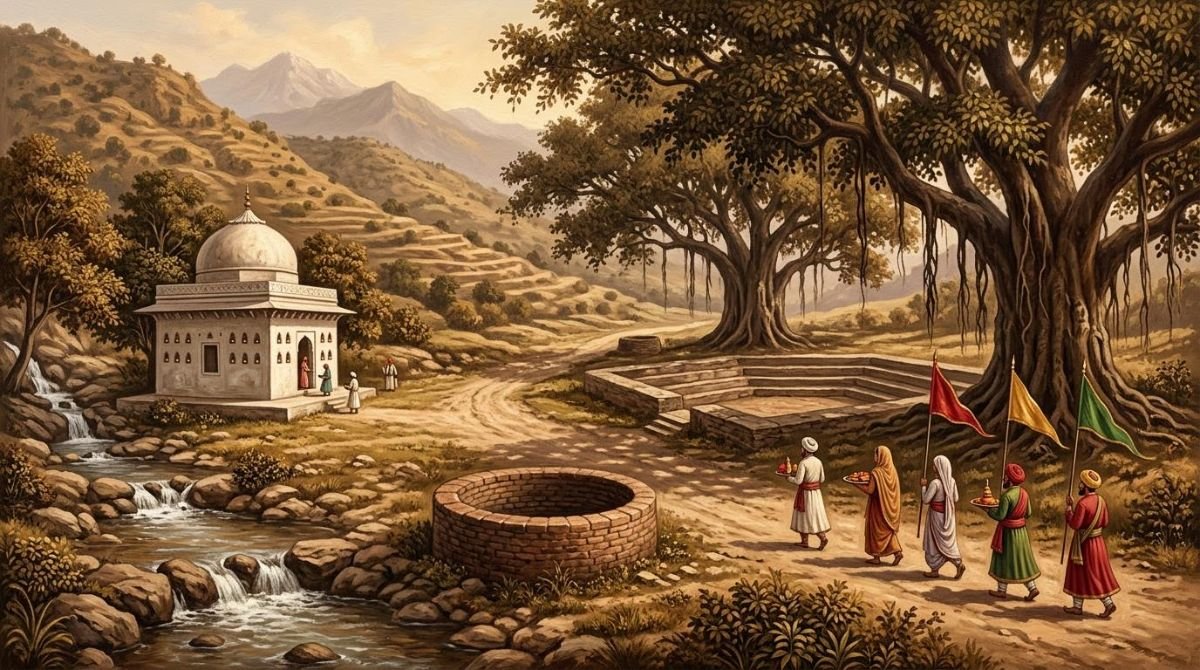
The shrines of Bhimber (بھمبر کے مزارات) form a sacred landscape around the old Chib capital in Azad Jammu and Kashmir: the tomb of Pir Syed Shah Shutar Bukhari on the Bhimber Nala, the sitting-place of Hazrat Panj Pir among the palace ruins, Mitthi Ret where Raja Shadab Khan (Baba Shadi Shaheed) fell, Rani Thakial’s well, and the Sukka Talab on the road to the Baba’s shrine at Aadhi Dhak. This guide follows the photographs and captions of the 1997 Chib history by Raja Muhammad Iftikhar Ali Khan (pp. 56–64, 83), adding, further afield, the tomb of Pir Haibat Khan Qandhari and the sitting-place of Pir Jafar.
At a glance
- Main shrine
- Baba Shadi Shaheed (Raja Shadab Khan), on Aadhi Dhak, north of Bhimber
- Dated tomb
- Pir Syed Shah Shutar Bukhari, died 14 Ramazan 1001 AH (c. June 1593)
- Place of martyrdom
- Mitthi Ret, about three miles from Bhimber on the Samahni road
- Queen’s well
- Rani da Khooh, built by Rani Thakial, about three miles from Bhimber on the Gujrat road
- Sukka Talab
- Rain-water tank of 20 Chet 1937 Bikrami (c. 1880), the gift of a Hindu merchant of Samahni
- Spiritual guide
- Pir Jafar (Miran Syed Jafar Shah), village of Pir Jafar, Tehsil Kharian
A sacred landscape
Bhimber was the capital of Chibhal, the land of the Chib Rajputs, and the holiest place in that land is the shrine of their ancestor, Raja Shadab Khan, revered as Baba Shadi Shaheed. It stands on Aadhi Dhak, the first ridge of the hills on the road from Bhimber to Kashmir. The book explains the name: the spot is 114 miles from both Lahore and Srinagar, and so lies half way (adhi) between them (p. 83). The shrine itself is described in our guide to the shrine of Baba Shadi Shaheed.
Around it, and along the old highway, lies a chain of smaller holy places. Several are bound up with the Baba’s story: the spot where he died, the well of his queen, the tomb of the man who killed him and the seat of his spiritual guide. Others honour different saints. The book’s photographs (pp. 56–64) show them as they stood in the 1990s, and its captions preserve what local tradition says about each.
Pir Syed Shah Shutar Bukhari
North of the present city, right on the bank of the Bhimber Nala, is the shrine of Hazrat Pir Syed Shah Shutar Bukhari. The tablet on the grave gives his death as 14 Ramazan 1001 AH, about June 1593, in the reign of the emperor Akbar. The photograph shows the grave beneath a white sheet and draped cloths, with a dry-stone wall behind it, whitewashed pillars, a lamp-niche at its head and a corrugated-iron roof above (p. 60). The book records nothing more about the saint himself.
The baithak of Hazrat Panj Pir
In Bhimber Rajani, among the ruins of the rajas’ palaces known as Mahallan, stands the baithak (sitting-place) of Hazrat Panj Pir: a small whitewashed structure with an arched central niche between two pillars, each pierced by a column of tiny lamp-niches, among old trees and great boulders (p. 58). Nearby is a small domed tomb that the book thinks may belong to a great man or a member of the royal family (p. 57); both are described with the other monuments of Bhimber.
The name Panj Pir also appears in the story of Baba Shadi Shaheed. In Thakur Major Singh’s Tarikh-e-Chibhal, quoted by the book, a wandering holy man “also called the Panj Pir” took pity on a merchant whose goods the raja had confiscated, had them returned, and left the raja with a gift of healing: the touch of his right big toe would cure kanpera, painful swellings below the ear such as mumps (p. 89). The book’s chapter on miracles likewise credits the gift to an elderly faqir known as Panj Pir (p. 354), and Chib families still practise the healing touch, as described in Customs and Traditions of the Muslim Chib Rajputs. The book does not say whether the baithak at Mahallan is connected with this figure.
Mitthi Ret, where the Baba fell
About three miles from Bhimber, beside the present Bhimber–Samahni road, is a thicket-covered rise with a few dressed stones on its crest. This is Mitthi Ret, or Meethi Ret, “sweet sand”. Here, the caption relates, Raja Shadab Khan and Pir Haibat Khan Qandhari met in battle and each died at the other’s hand. According to the tradition handed down from generation to generation in Chibhal, a black dog buried the Baba’s severed head on this spot. The place is held especially sacred in Chibhal, and people on their way to the fair at the Baba’s shrine stop here to make offerings (p. 63).
Thakur Major Singh adds that when the raja’s servants went to look for the head, the dog went with them and dug it up, and that a shrine was built where it had lain (p. 92). Devotees also tell of words exchanged before the duel. Haibat Khan declared that if he were killed, a fair would be held at his grave every Thursday; the Baba answered that if he fell, fairs would be held at his grave every day. The compiler sees the unbroken stream of pilgrims to Aadhi Dhak as the fulfilment of that answer (pp. 355–356). The full legend, with Rani Thakial and Sajana Teli, is told in Rani Thakial, Sajana Teli and the Black Dog.
Sources differ
The book itself notes two traditions about where the battle was fought: at Mitthi Ret, at the foot of Aadhi Dhak, or at the site of Rani da Khooh on the Bhimber–Gujrat road (p. 354). Thakur Major Singh’s version has Haibat Qandhari overtake the raja only after he had re-entered his own state, whose boundary then lay at Kashmiri Jhangi near Gujrat (p. 91).
Pir Haibat Khan Qandhari
The book honours the Baba’s opponent, too, as a saint. One of its photographs shows the door to the burial place of Hazrat Pir Haibat Khan Qandhari, framed in bold black-and-white chequered tiles with his name painted above it (p. 62). The compiler, following the manuscript of Maulvi Zain-ul-Abidin of Samahni, describes Haibat Khan as an Afghan noble of the Delhi court whose sister the raja married while serving the emperors (pp. 93, 117); Thakur Major Singh says only that the emperor married the raja to the daughter of a nobleman and sent Haibat Qandhari after him when he fled (pp. 90–91).
After the duel, devotees relate, the two horses carried their riders in opposite directions. Haibat Khan’s horse stopped at Mauza Pooran (Puran) in Tehsil Sarai Alamgir, near Jhelum, where he was buried; his tomb stands on a high mound and still draws visitors (pp. 108, 356–357). The Baba’s horse carried his headless body towards his palaces at Kot, and he was buried at Aadhi Dhak.
Sources differ
The book’s own caption and its chapter on miracles place Pir Haibat Khan Qandhari’s tomb at Mauza Pooran, Tehsil Sarai Alamgir (pp. 108, 356). Thakur Major Singh writes that his body fell near Mauza Fatehpur Purani, where his shrine is known simply as “Pir Qandhari” (p. 91).
Rani da Khooh and the Al-Khizar Masjid
Rani da Khooh, the Queen’s Well, is a large, deep, circular brick-lined well built by Rani Thakial, the beloved wife of Raja Shadab Khan. It lies on the ancient highway towards Kashmir, about three miles from Bhimber on the present Bhimber–Gujrat road, in a village the book names as Mohra Sidha (reading uncertain); Thakur Major Singh likewise places the “Rani’s well” three miles south of Bhimber (pp. 56, 59, 88). The caption notes that the village is the ancestral home of two decorated Pakistan Army officers, Brigadier (retd) Chaudhry Sher Ahmad Khan and Lieutenant Colonel Abdul Aziz, both holders of the Sitara-e-Jurat. The account of October 1947 also mentions a “Rani ka Kunwan”, the Urdu form of the same name: the two small tanks sent to support the attack on Bhimber stuck fast in sand near it, delaying the assault by a day (p. 47).
Beside the well stands the Al-Khizar Masjid, an old mosque in the domed style, with three bulbous domes and slender corner minarets. The late Lieutenant Colonel Abdul Aziz rebuilt and extended it at his own expense, for the spiritual benefit (isal-e-sawab) of Mirza Hasan Muhammad and his grandson Khizar Hayat. An inscription on the gate dates the work to 12 October 1985, or 14 Muharram 1406 AH (p. 59).
The Sukka Talab
On the old Bhimber–Kashmir highway, now the Bhimber–Samahni road, in the low ground below Aadhi Dhak, lies the Sukka Talab, the “dry tank”. Springs are scarce here, so a philanthropic Hindu merchant of Samahni, whose name has not survived, built this masonry tank beside the highway to store rain-water. Its inscription dates it to 20 Chet 1937 Bikrami, about 1880 (pp. 40, 61, 83). By the 1990s the tank had almost vanished; two old banyan trees still stood on its bank, which the caption pictures as mourners keeping watch over their master. Writing about 115 years after it was built, the compiler pays tribute to the forgotten builder with a couplet of the Urdu poet Zauq:
If you want a name, create the means of doing good: build a bridge, a well, a mosque, a tank.
— Zauq, quoted in the book, p. 83
The caravans that once halted stage by stage beside the tank are long gone, but the road still passes it. From here the Baba’s shrine can be seen about a mile to a mile and a half to the north-west. Today most pilgrims leave their vehicles at Jandi Chontra, where a platform and an old banyan hung with coloured flags mark the Baba’s own baithak, and follow the road through the pine forest to the shrine (pp. 40, 84).
Pir Jafar of Kharian
The last plate in the book’s series shows a small, squat, domed building in the village of Pir Jafar, Tehsil Kharian, District Gujrat, in Pakistan: the baithak of Hazrat Miran Syed Jafar Shah, known as Pir Jafar, the spiritual guide (murshid) of Baba Shadi Shaheed (p. 64). The compiler holds that the Baba accepted Islam secretly in his father’s lifetime on the advice of his guide Hazrat Piro Shah, declared it when he became raja, and then, at Piro Shah’s bidding, took the pledge of discipleship (bai’at) with Miran Syed Jafar Shah, a question explored in Forced or Free? How Raja Shadab Khan Embraced Islam.
The bond lasted for centuries. According to the book, Jafar Shah’s successors (sajjada-nashins) performed the coronation of every new raja of Bhimber, and they alone still apply the tikka, the mark of succession, to the heirs of the Khari Kariali line at Thotha Rai Bahadur and of Raja Sultan Khan’s line in Jhelum, a duty the Baba is said to have laid on his descendants (p. 114). When Raja Muhammad Akbar Khan succeeded his father in 1965 Bikrami (c. 1908), Pir Lal Nath, the gaddi-nashin of Syed Jafar’s shrine, was among the notables present (p. 136); that family’s story is told in The Bhimber Royal Family.
The shrines of Bhimber at a glance
| Site | Where | Associated with | Date in the book |
|---|---|---|---|
| Shrine of Baba Shadi Shaheed | Aadhi Dhak, reached from Jandi Chontra | Raja Shadab Khan and Rani Thakial | Urs held each year on Shab-e-Meraj (p. 106) |
| Pir Syed Shah Shutar Bukhari | North of Bhimber, on the Bhimber Nala | A saint of Akbar’s time | Died 14 Ramazan 1001 AH, c. 1593 (p. 60) |
| Baithak of Hazrat Panj Pir | Mahallan, Bhimber Rajani | Panj Pir | Not given (p. 58) |
| Mitthi Ret | About 3 miles from Bhimber, Samahni road | Death of Baba Shadi Shaheed; the black dog | Not given (p. 63) |
| Rani da Khooh | About 3 miles from Bhimber, Gujrat road | Rani Thakial | Not given (pp. 56, 59) |
| Al-Khizar Masjid | Beside Rani da Khooh | Lt Col Abdul Aziz, Sitara-e-Jurat | 12 October 1985 (p. 59) |
| Sukka Talab | Below Aadhi Dhak, Samahni road | A Hindu merchant of Samahni | 20 Chet 1937 Bikrami, c. 1880 (p. 61) |
| Tomb of Pir Haibat Khan Qandhari | Mauza Pooran, Sarai Alamgir, near Jhelum | The Baba’s opponent | Not given (pp. 62, 108) |
| Baithak of Pir Jafar | Village of Pir Jafar, Tehsil Kharian | The Baba’s spiritual guide | Not given (p. 64) |
Frequently asked questions
What is the most important shrine near Bhimber?
The shrine of Raja Shadab Khan, revered as Baba Shadi Shaheed and ancestor of the Chib Rajputs, on the hill of Aadhi Dhak north of Bhimber. Pilgrims usually approach it from Jandi Chontra on the Bhimber–Samahni road, and Chib families bring their sons there for the mu-tarashi, the first head-shaving.
Who was Pir Shah Shutar Bukhari?
He was a saint whose shrine stands north of Bhimber on the bank of the Bhimber Nala. The tablet on his grave gives his death as 14 Ramazan 1001 AH, about June 1593, in the reign of Akbar. The 1997 Chib history records no further details about him.
What happened at Mitthi Ret?
Chib tradition holds that Raja Shadab Khan (Baba Shadi Shaheed) and Pir Haibat Khan Qandhari killed each other in a duel at Mitthi Ret, about three miles from Bhimber, and that a black dog buried the Baba’s severed head there. Pilgrims bound for his shrine still make offerings at the spot. Another tradition places the battle at Rani da Khooh.
Who built the Sukka Talab?
A philanthropic Hindu merchant of Samahni, whose name has been lost, built it on 20 Chet 1937 Bikrami (about 1880) to store rain-water beside the old highway to Kashmir. By the 1990s the tank had almost disappeared, leaving two old banyan trees standing on its bank.
Who was Pir Jafar?
Miran Syed Jafar Shah, known as Pir Jafar, was the spiritual guide of Baba Shadi Shaheed. His sitting-place stands in the village of Pir Jafar, Tehsil Kharian, District Gujrat. According to the book, his successors crowned the rajas of Bhimber and still apply the tikka to the heirs of the Chib royal lines.
Sources
- Raja Muhammad Iftikhar Ali Khan, Raja Shadab Khan alias Hazrat Baba Shadi Shaheed (Urdu, Barhang/Karachi, 1997), pp. 56–64, 83; see also pp. 40, 47, 84, 88–93, 106, 108, 114, 117, 136, 354–357.
- Thakur Major Singh of Dewa Vatala, Tarikh-e-Chibhal (1983 Bikrami, c. 1926), pp. 26–34, as quoted in the book.
- Maulvi Zain-ul-Abidin Kohi Samahnavi, unpublished manuscript history of Chibhal, as quoted in the book.
- Inscriptions at the tomb of Pir Syed Shah Shutar Bukhari, the Al-Khizar Masjid and the Sukka Talab, as recorded in the book.
This article is part of our series based on the 1997 Chib history; see the book, chapter by chapter. Spellings of names follow the book.
