

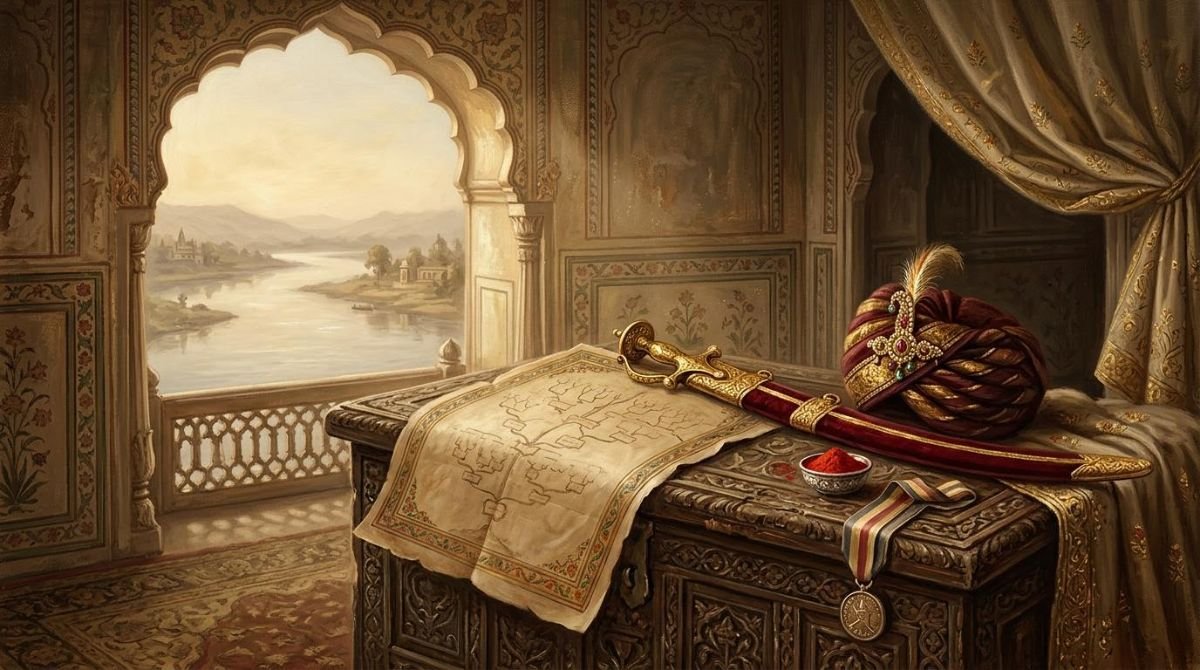
The Bhimber royal family, the Rajgan of Bhimber (راجگان بھمبر), is the house of Raja Sultan Khan, the last Chib ruler of Bhimber in today’s Azad Jammu and Kashmir. After the state passed to Jammu, his son Raja Faiz Talab Khan and his descendants lived in the British Punjab, at Thotha Rai Bahadur, Shahdara, Saidpur and finally Jhelum, on a perpetual pension of 10,000 rupees a year, and each new head of the family still received the tikka of rajaship. Its heads came to be recognised as chiefs of the Chib tribe.
At a glance
- Descended from
- Raja Sultan Khan, last Raja of Bhimber (state ended 1883 Bk, c. 1826)
- Head in exile
- Raja Faiz Talab Khan (d. 1870), Sultan Khan’s son
- Seats
- Thotha Rai Bahadur, Chakori Sher Ghazi, Shahdara, Saidpur, then Jhelum city
- Pension
- 10,000 rupees a year in perpetuity, to one heir at a time (settled 1847)
- Line of heads
- Faiz Talab Khan, Tikka Fazl Dad Khan, Ali Bahadur Khan, Muhammad Akbar Khan, Muhammad Afzal Khan
- Titles
- Hereditary Raja; Khan Bahadur; provincial darbari; Chief of the Chib Tribe, Rais-e-Azam, Jhelum
- Chief today
- Raja Muhammad Yousaf Khan, as listed on this site’s Notable Figures page
- Book pages
- Iftikhar Ali Khan (1997), pp. 114, 135–136, 147–154, 170, 392
Raja Faiz Talab Khan: from ruler’s son to exile
When Raja Sultan Khan was seized at Jammu by the men of Raja Gulab Singh, his son Raja Faiz Talab Khan tried in secret to secure his release, without success. Thakur Major Singh’s chronicle Tarikh-e-Chibhal, quoted in the book, says Gulab Singh then had Faiz Talab Khan exiled and annexed the whole territory to Jammu. In 1906 Bikrami (about 1849), on Gulab Singh’s orders, he left Bhimber and settled at Thotha Rai Bahadur, the seat of his Khari Kariali kinsmen in Kharian tahsil of Gujrat district, where he was granted a pension of 10,000 rupees a year.
The book’s own family account (p. 148) gives more detail. Faiz Talab Khan, Sultan Khan’s eldest son, left Bhimber with his family, his household and his armed retainers, and lived at Thotha Rai Bahadur for about ten years, until Gulab Singh heard that the Chibs were gathering there to win Bhimber back. Gulab Singh complained to the British, who granted Faiz Talab Khan his pension on condition that he leave. He spent two years at Chakori Sher Ghazi and then lived at Shahdara, just outside Lahore. A keen hunter all his life, he moved shortly before his death to Saidpur in Jhelum district, where he died in 1870 and is buried. Tarikh-e-Chibhal adds that the order was to keep away from the Grand Trunk Road, and that at Saidpur, in Chakwal tahsil, the Deputy Commissioner of Jhelum let him lease some game preserves for hunting.
The settlement of 1847
A fuller account comes from Griffin’s The Chiefs of the Punjab, whose Urdu edition the book reproduces (pp. 152–154). According to it, Ranjit Singh was angered by Sultan Khan’s murder and gave Faiz Talab Khan his father’s state, then worth about nine lakh rupees a year. On Ranjit Singh’s death Gulab Singh took it from him, and at the instance of Maharaja Sher Singh he was restored to a part of it. When Jammu and Kashmir passed to Gulab Singh in 1846, the British had to provide for the small hill chiefs whose lands had been included in his state against their will.
In 1847 Sir Henry Lawrence, Agent and Resident at Lahore, and Diwan Jawala Sahae, Gulab Singh’s wazir, agreed that chiefs who chose to live in British territory would receive perpetual pensions totalling 42,800 rupees a year; to pay for them, Gulab Singh gave the British the territory of Sujanpur, part of Pathankot and lands between the Beas and the Chakki. Faiz Talab Khan, whom Lawrence called “Bhimberwala”, was granted 10,000 rupees a year in cash, to pass in perpetuity to one member of the family at a time. Griffin writes that he was not pleased to receive a small pension in place of his hereditary country, but had no hope of anything better from the maharaja; he settled at Shahdara, and Griffin praises the family’s loyalty to the British government from then on. The wider story is told in The End of Chib Rule.
Sources differ
Griffin credits the pension to Sir Henry Lawrence in 1847; the book’s family account credits Sir John Lawrence, as Lieutenant-Governor of the Punjab, in 1849, although John Lawrence became Lieutenant-Governor only in 1859. Faiz Talab Khan’s stay at Thotha Rai Bahadur lasted six or seven years in Tarikh-e-Chibhal and about ten in the family account. Tarikh-e-Chibhal dates his death to 1966 Bikrami (about 1909); the family account and Griffin give 1870. Hutchison and Vogel call him Sultan Khan’s nephew, say he held part of the old lands until Gulab Singh dispossessed him in 1840, and place the family afterwards at Pothi in Gujrat district; the book, its shajra chart and the Chiefs of the Punjab tree all make him Sultan Khan’s son and follow the family to Shahdara, Saidpur and Jhelum. A stay of about ten years at Thotha Rai Bahadur ending in 1849 would fit a departure from Bhimber around 1840.
The heads of the family, 1870–1999
Tikka Raja Fazl Dad Khan
Faiz Talab Khan’s heir, styled Tikka (heir apparent), was his son Raja Fazl Dad Khan. The British gave him the rank of Risaldar-Major and posted him to the Frontier, but after only a few years’ service he fell ill with khafqan (palpitations of the heart) and died of it in 1870, shortly after his father had moved to Saidpur.
Raja Ali Bahadur Khan
The perpetual pension passed to Fazl Dad Khan’s son, Raja Ali Bahadur Khan, the great-grandson of Sultan Khan. He became a Munsif (civil judge) in 1931 Bikrami (about 1874) and rose to be an Extra Assistant Commissioner in Rawalpindi Division, retiring on pension. He was counted among the leading chiefs (ruasa) of the Punjab and held the status of provincial darbari. The book says he lived at Gujrat and died in 1908; Tarikh-e-Chibhal says he died at his house in Jhelum. He lies in the family graveyard in Jhelum city.
Khan Bahadur Raja Muhammad Akbar Khan
Ali Bahadur Khan’s son, Raja Muhammad Akbar Khan, had served as a Naib Tahsildar but resigned to look after his ailing father. On his father’s death in 1908 he received the family pension, a seat in the provincial darbars and the hereditary title of Raja, and the tikka of rajaship was given to him “according to former custom”. Tarikh-e-Chibhal lists the witnesses, a roll-call of the leading Chib houses and of Jhelum district:
- Raja Muhammad Khan, jagirdar of Pothi
- Raja Allah Dad Khan, jagirdar of Lehri
- Diwan Farman Ali Khan, jagirdar of Kasgumah
- Rai Dilawar Khan of Thotha Rai Bahadur
- Pir Lal Nath, gaddi-nashin of the khanqah of Syed Jafar
- Sardar Rahm Dad Khan, zaildar of Panjeri
- Chaudhri Mumtaz Ali Khan, zaildar of Bisa (reading uncertain)
- Khan Sahib Ghulam Hasan Khan of Bisa
- Muhammad Khan, Honorary Magistrate of Sanghoi, with other officials of Jhelum district and Kharian tahsil
Muhammad Akbar Khan became one of the best-known men of Jhelum. He received the Delhi Darbar medal (the book prints the year as 1917; the Delhi Durbar was held in 1911) and, four years later, the title of Khan Bahadur for his services in the First World War. He was given a sword of honour in 1917, the War Medal two years later and afterwards the Jubilee Medal. He sat for many years on the Jhelum Municipality and was its president until 1934, and he was an Honorary Magistrate at Jhelum. Tarikh-e-Chibhal, written in the 1920s, adds that he was a first-class kursi-nashin (entitled to a chair in durbar) of the Lieutenant-Governor, drew a pension of 12,000 rupees a year from the State and held ten squares of canal land granted by the British government. The Chiefs of the Punjab heads his family’s entry “Khan Bahadur Raja Muhammad Akbar Khan, Chief of the Chib Tribe, Rais-e-Azam, Jhelum”. His house stood in the north of Jhelum city, near the district courts, on the western bank of the river. He died in 1956 and was buried in the family graveyard.
Major Raja Muhammad Afzal Khan
On 7 September 1956, by custom, Muhammad Akbar Khan’s eldest son, Raja Muhammad Afzal Khan, received the qashqa of rajaship before the notables of the Chib tribe and of Jhelum district. He had begun as a zilladar in the Punjab Canal Department, then took a commission as a Lieutenant in the British Indian Army and rose to Major, the rank at which he retired. He was also a skilled physician who treated people free of charge and never made medicine his living. He lived in Jhelum, died early in 1999 and lies in the family graveyard. His younger brother, Raja Muhammad Asghar Khan, lived in Lahore. Major Afzal Khan left three sons: Brigadier (retired) Raja Muhammad Salim Khan, Muhammad Asif Khan and Muhammad Nasim Khan.
Other branches of the family
The book’s shajra chart (p. 392) and a tree reproduced from The Chiefs of the Punjab (p. 151) show several collateral lines, though they do not always agree.
Ghulam Qadir Khan, a younger son of Faiz Talab Khan, made his name as a soldier. His service began in 1849 as peshkar (assistant) to Herbert Edwardes at Multan; for several years he was Risaldar of the 4th Bengal Cavalry and fought in many of the Frontier battles of his time. In 1882 he received a military pension of 600 rupees a year and 800 bighas of land in a rakh in Shahpur district. He died in 1905 and his land was divided equally among his three sons, Muhammad Nawaz Khan, Amin-ul-Mulk Khan and Gohar Ali Khan; two sold their shares and moved to Gujranwala and Gujrat, while Amin-ul-Mulk Khan kept his and became the village lambardar.
Faiz Talab Khan’s other sons are given as Mian Hashmat Khan on the book’s chart and, on the Chiefs of the Punjab tree, as Mian Fateh Khan, who died childless, and Karam Dad Khan. Sultan Khan’s other son, Ali Mardan Khan, died childless according to the same tree. The book’s chart gives Sultan Khan two brothers, Mian Asalat Khan, father of Mian Muhammad Khan, Mian Himmat Khan and Mian Naurang Khan, and Mian Nawab Khan, father of Mian Mahboob Khan, Mian Huzoor Ali Khan and a third son whose name is uncertain. The Chiefs of the Punjab tree names the brothers Mian Saadat Khan and Mian Nawab Khan instead, with a note that both vanished in the nineteenth century and were never traced.
Family tree of the Bhimber royal family
- Raja Sultan Khan — last Raja of Bhimber
- Ali Mardan Khan — died childless
- Raja Faiz Talab Khan (d. 1870) — pensioned; Thotha Rai Bahadur, Shahdara, Saidpur
- Tikka Raja Fazl Dad Khan (d. 1870) — Risaldar-Major
- Raja Ali Bahadur Khan (d. 1908) — Extra Assistant Commissioner
- Khan Bahadur Raja Muhammad Akbar Khan (d. 1956) — Chief of the Chib Tribe, Jhelum
- Major Raja Muhammad Afzal Khan (d. 1999) — tikka 7 September 1956
- Brigadier (retd.) Raja Muhammad Salim Khan
- Muhammad Asif Khan
- Muhammad Nasim Khan
- Raja Muhammad Asghar Khan — Lahore
- Major Raja Muhammad Afzal Khan (d. 1999) — tikka 7 September 1956
- Khan Bahadur Raja Muhammad Akbar Khan (d. 1956) — Chief of the Chib Tribe, Jhelum
- Raja Ali Bahadur Khan (d. 1908) — Extra Assistant Commissioner
- Mian Hashmat Khan
- Mian Ghulam Qadir Khan (d. 1905) — Risaldar, 4th Bengal Cavalry
- Muhammad Nawaz Khan
- Amin-ul-Mulk Khan — lambardar
- Gohar Ali Khan
- Tikka Raja Fazl Dad Khan (d. 1870) — Risaldar-Major
The tikka of rajaship
What kept the family a royal house after it had lost its kingdom was ceremony. The qashqa or tikka of rajaship that had once crowned the Rajas of Bhimber went on being given to each new head of the family in exile: to Muhammad Akbar Khan in 1908 and to Muhammad Afzal Khan in 1956. According to the author, the tikka is applied to Raja Sultan Khan’s descendants in Jhelum city, as to the Khari Kariali line at Thotha Rai Bahadur, by the sajjada-nashin of Miran Syed Jafar Shah, the spiritual guide to whom Baba Shadi Shaheed gave his allegiance, and by no one else. The custom, he says, goes back to the Baba’s own instruction (p. 114); Pir Lal Nath of Syed Jafar’s khanqah was among the witnesses in 1908. Other family customs are described in Customs and Traditions of the Muslim Chib Rajputs.
The Chief of the Chib tribe today
The 1997 history, in an edition that records Major Afzal Khan’s death in 1999, ends its chart of the Bhimber line with his three sons. This site’s Notable Figures page records the chiefship of the Chib tribe passing from Raja Ali Bahadur Khan through Khan Bahadur Raja Muhammad Akbar Khan and Major Raja Muhammad Afzal Khan, and names the present Chief of the Chib Tribe as Raja Muhammad Yousaf Khan, whom the International Chib Rajput Forum honours as the tribe’s chief. For the wider clan, its branches and its people today, see Chib Rajputs, and for the other Chib houses that appear in the British records, The Chibs in The Chiefs of the Punjab.
Frequently asked questions
Who are the Bhimber royal family?
They are the descendants of Raja Sultan Khan, the last Chib Rajput ruler of Bhimber. After the state passed to Jammu, his son Raja Faiz Talab Khan settled in the British Punjab on a perpetual pension, and his successors at Jhelum continued to receive the tikka of rajaship. The heads of the family came to be recognised as chiefs of the Chib tribe.
Where does the Bhimber royal family live?
Since the late nineteenth century the family’s seat has been Jhelum city, where Khan Bahadur Raja Muhammad Akbar Khan lived near the district courts on the western bank of the river and where the family graveyard is. Earlier, Raja Faiz Talab Khan lived at Thotha Rai Bahadur, Chakori Sher Ghazi, Shahdara near Lahore and Saidpur in Jhelum district.
What pension did the Bhimber family receive from the British?
Under the settlement made in 1847 by Sir Henry Lawrence and Gulab Singh’s wazir, Diwan Jawala Sahae, Raja Faiz Talab Khan received 10,000 rupees a year in cash, payable in perpetuity to one member of the family at a time. Tarikh-e-Chibhal says that by the 1920s Raja Muhammad Akbar Khan drew 12,000 rupees a year from the State and held ten squares of canal land.
Who is the present Chief of the Chib tribe?
According to this site’s Notable Figures page, the present Chief of the Chib Tribe is Raja Muhammad Yousaf Khan. The past chiefs it lists are Raja Ali Bahadur Khan, Khan Bahadur Raja Muhammad Akbar Khan and Major Raja Muhammad Afzal Khan, all of the Bhimber royal line at Jhelum.
Sources
- Raja Muhammad Iftikhar Ali Khan, Raja Shadab Khan alias Hazrat Baba Shadi Shaheed (Urdu, Barhang/Karachi, 1997), pp. 114, 135–136, 147–154, 170, 392.
- Thakur Major Singh (printed Mehjar or Majhar Singh) of Dewa Vatala, Tarikh-e-Chibhal (1983 Bikrami, about 1926), pp. 69–80, as quoted in the book.
- Lepel Griffin and C. F. Massy, The Chiefs of the Punjab, Urdu edition Tazkira-e-Ruasa-e-Punjab, pp. 238–245 and 325–328, as reproduced in the book, pp. 150–154.
- J. Hutchison and J. Ph. Vogel, History of the Panjab Hill States, vol. II (Lahore, 1933), “Bhimbar and Khari-Khariyali”, pp. 725–729.
- Royal Chib Katoch, Notable Figures (chiefs of the Chib tribe).
This article is part of our series based on the 1997 Chib history; see the book, chapter by chapter. Spellings of names follow the book.
