

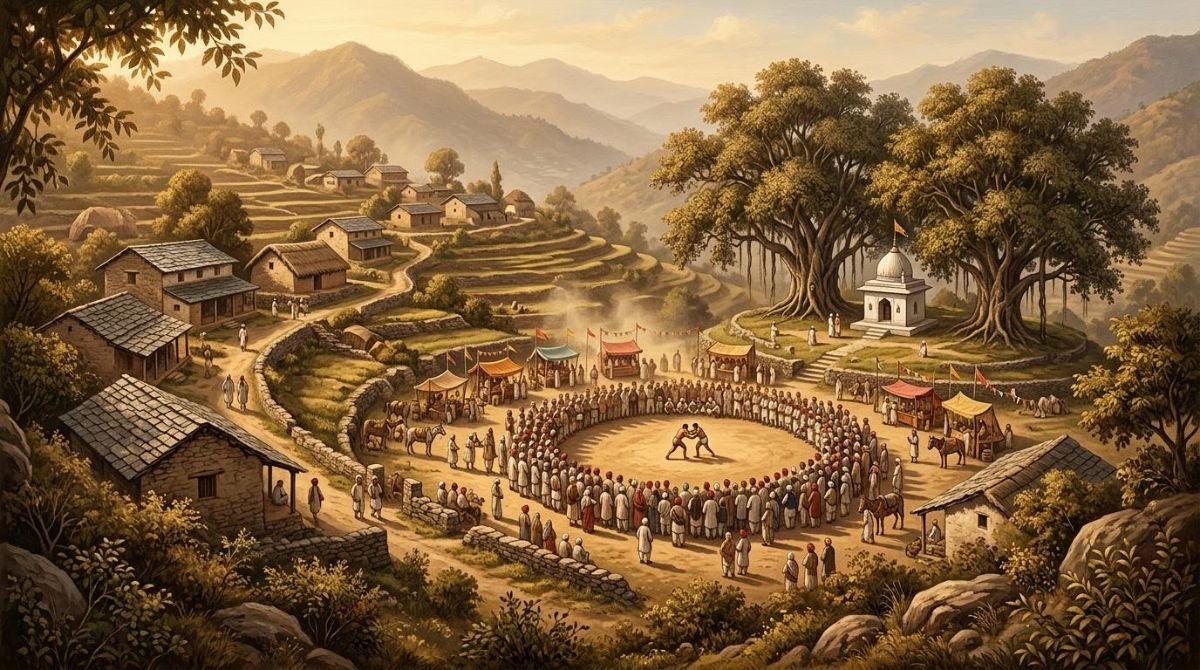
Deva Vatala (also Dewa Vatala or Watala; دیوا وٹالہ), two neighbouring villages in the Kandi foothills east of Bhimber, was the home of the Hindu branch of the Chib Rajputs. One of its sons, Thakur Major Singh, described it in about 1926 in Tarikh-e-Chibhal: a town of six or seven thousand people divided into family bands, with a deified ancestor, a shrine fair shared by Hindus and Muslims, and men who had served the Maharajas of Jammu since the days of Gulab Singh.
At a glance
- Also written
- Dewa Vatala, Deva Batala, Watala
- Families
- Vatala: the line of Sahali son of Sikandar; Deva: the line of Hira son of Sikandar; Anbaryala: the line of Piru son of Ghaggi
- Bands of Vatala
- Five, among them the Thakari, Dhangrani and Madrani
- Population
- Six to seven thousand (c. 1926)
- Village headmen
- Fifteen numberdars, reduced from nineteen (readings uncertain)
- Land revenue
- 12,000 a year, presumably rupees
- Shrines
- The shrines of the deified Bawa Tabali; the khanqah of Pir Songa or Bawa Sahaj Nath
- Source
- Major Singh (c. 1926), pp. 39–43, 52–60, 82
The founders of Deva Vatala: Sikandar’s seven sons
The Hindu Chibs of Deva Vatala trace themselves to Dasu Khan, the posthumous heir of the branch of the Chib Rajputs that refused Islam when the rajas of Bhimber converted (see how the Chibs divided). Thakur Major Singh, the author of the oldest Chib history, was born into this branch, and Chapter Six of his book, “Account of the Deva Vatala family”, follows the seven sons of Dasu Khan’s eldest son, Sikandar (Major Singh (c. 1926), pp. 40, 42; repeated on p. 82). The 1997 Chib history tells the same family’s story in The Hindu Chibs of Dewa Vatala.
| Son of Sikandar | Line, as the book gives it |
|---|---|
| Sahali (eldest) | The Vatala families |
| Hira | The Deva family (called the youngest son on p. 40, the second on pp. 58 and 82) |
| Abal | The Bartala family (reading uncertain) |
| Jitu | The Jatwana family |
| Ladam, Lakha and Bahara (readings uncertain) | A village in Gurdaspur District; p. 82 names the three as Lakha, Jira and Bahara |
The Gurdaspur branch had once lived at Vatala too, the author explains, but its elders moved away during a famine. By his day it numbered about thirty households with good land, and its numberdar was Thakur Najib Singh (reading uncertain) (p. 82). Dasu Khan’s other three sons founded the families of Nah in the Naushera area, of Pandoriyan and of Kotli (p. 39).
Bawa Tabali, the deified ancestor
Sahali had three sons: Kahan Chand, Ogam Chand (reading uncertain) and the youngest, Abdali, now called Bawa Abdali or Tabali (p. 40). Family tradition, as the author records it, remembers Tabali as a simple-hearted young man whose clever elder brothers would not take him with a wedding party. He insisted, grew angry and threw himself down from a high mound, though another account says he was pushed. When the wedding party came home without him his grieving mother was deceived about his fate, but he appeared to her in a dream and told her what had happened. His body was found under a slab of rock and cremated with due rites (pp. 40–41).
Misfortune then fell on the family, the story goes, because the killing of a kinsman is the gravest of sins, until those responsible admitted their fault and began to worship him. A sand (apparently a shrine-platform) was built on the hill where he fell, near Mauza Dhan (reading uncertain), and when the family left the hills and settled at Vatala another was built on a hill there. In the author’s day people brought milk, curds and grain to it every Tuesday (reading uncertain) and at full moon. Before a Hindu Chib wedding party set out, the bridegroom had to perform a set rite there, and the birth of a son was marked with a fixed offering. Kahan Chand’s descendants worshipped Tabali as their devta, but he was never reconciled with Ogam Chand’s line, who might not go there. Beside his shrine stood another, of a Brahmin named Sakh Hekin (reading uncertain), about whom a similar story was told (p. 41).
Sources differ
The 1997 history of Raja Muhammad Iftikhar Ali Khan gives Sahali four sons, counting Tabali and Bawa Abdali as two men, and says that Bawa Abdali never married; its chart adds that he became a sadhu. It assigns the Pare Vatala families to Kahan Chand and the Vatala Khas families to Ogan (Ogam) Chand, and it does not tell Tabali’s story (Iftikhar Ali Khan (1997), pp. 137–138, 394).
The five bands and the author’s own line
Kahan Chand’s five sons divided Vatala among them. The chart on p. 43 names them as Saheshar Chand (reading uncertain; Somesh in the 1997 book), Dhangar, Madan, Ghoghar, whose descendants settled in the Naushera area, and Malak Singh, whose line lived at Kaliyan (reading uncertain). Vatala, the author writes, was divided into five parts or bands; his first mention of them must have stood on pages 44–45, which are missing from the copy used, but three bands and their leading men are named on p. 53:
| Band | Ancestor (as given in the 1997 book) | Men named about 1926 |
|---|---|---|
| Thakari | Somesh (Saheshar) Chand | Piru Khan and Bishambar Das (readings uncertain), Prithu Kumedan, Piyara Khan; Zaildar Sadhu Ram, “the acknowledged leader of the village” |
| Dhangrani | Dhangar Chand | Risaldar Sadhu Singh, “a lover of the qaum” |
| Madrani | Madan Chand | Rura Shah (reading uncertain), a man of presence and wisdom |
| Ghagharani and Malaki | Ghoghar Chand and Malik Singh | Not named on the surviving pages; the 1997 book adds that all of Malik Singh’s descendants are Muslims, settled at Kalyan (Iftikhar Ali Khan (1997), p. 138) |
The same chart is the author’s own pedigree. Several names are unclear and the joining strokes are wavy, but read with care it runs:
- Saheshar (Somesh) Chand, son of Kahan Chand — the Thakari band
- Gaje Chand, called Kaki
- Gyan Chand
- Dasan (reading uncertain)
- Aju (reading uncertain)
- Labna (reading uncertain) — father of seven brothers: Piyara, Gopi, Prithu Kumedan, Kishora, Bhola, Farangi and Sundar (several readings uncertain)
- Bhola — sons Daman (reading uncertain), a numberdar, and Major (Mehjar) Singh, marked on the chart as “the author”, below whom is written “Onkar Singh etc.”
- Labna (reading uncertain) — father of seven brothers: Piyara, Gopi, Prithu Kumedan, Kishora, Bhola, Farangi and Sundar (several readings uncertain)
- Aju (reading uncertain)
- Dasan (reading uncertain)
- Gyan Chand
- Gaje Chand, called Kaki
Counting from Saheshar, the author stands in the eighth generation, exactly as the 1997 history records (Iftikhar Ali Khan (1997), p. 394). In his text he calls his father Bachola (reading uncertain), evidently the Bhola of the chart (p. 56). The Onkar Singh entered below him shares his name with the author of a later Tarikh-e-Chibhal, but the chart does not say that they are the same man. His life is told in Thakur Major Singh Chib.
In the service of the Maharajas of Jammu
Chapter Eight is devoted to “the notable men of Vatala and their services to Jammu State” (p. 52). After the reconciliation with Maharaja Gulab Singh told in Vatala against Ranjit Singh, Vatala’s men gave up fighting for farming, and Maharaja Ranbir Singh enlisted many of them in the Jammu army, where their devotion, the author writes, removed every old suspicion (p. 52). One of them, Bija Jamadar (reading uncertain), a forebear of Zaildar Sadhu Ram, was so trusted by Ranbir Singh that the night guard of the royal bedchamber was left to him alone (p. 52). The best-known family was that of the author’s father and uncles, seven brothers of the Thakari band (pp. 53–56). The names in the text do not all match those on the chart:
| Name | Service | Pages |
|---|---|---|
| Piyara (Pyara) Khan, the eldest | Enlisted as a Jamadar in 1848 (reading uncertain); served long in the Bijli Paltan (“Lightning Battalion”) of the Maharaja of Jammu; later an officer of a State department; built masonry cisterns at a tank near Manawar | 53 |
| Prithu Kumedan | From the Maharaja’s private musketeers to Subedar, then Ajitan (adjutant) of the household (see below) | 53–55 |
| Dewal (reading uncertain) | Contractor for the State customs (jagat) | 55 |
| Bachola (reading uncertain) | Jamadar in a regiment; died in service; the author’s father | 55–56 |
| Qarnidar (reading uncertain) | Customs officer | 55 |
| Sundar (reading uncertain) | Farmed at home; still living, in old age, about 1926 | 55 |
| Nawalu Ajitan, Piyara Khan’s eldest son | Adjutant in the Private Department; numberdar of Vatala and zaildar of Bhangali (reading uncertain) | 55–56 |
Piyara Khan’s title reflects an old usage: the author explains in a note that “Khan” was once used by Hindu Rajputs just as “Mian” was (p. 53).
Prithu Kumedan and the boar
Prithu rose fast, the author says, through loyalty and ability, and the Maharaja kept him always at his side. Once, near Jammu, the Maharaja was shooting from a bher, a pit in which hunters sat in wait, when a wounded boar ran into the pit. Its walls were too high for the Maharaja to climb out; Prithu jumped in, lifted him out and cut the boar in two with his sword. Delighted, the Maharaja made him Ajitan that very day and put him in charge of a string of household departments: the water-carriers, the couriers, the State livestock, the public kitchens, the store of valuables and the palanquin-bearers (pp. 53–54). When a Viceroy visited Jammu and Kashmir, Prithu served under Diwan Gobind Sahai in the arrangements and received a certificate and a telescope from the Viceroy’s secretary; the year (189-) and the Viceroy’s name, read as Ripon, are both uncertain and do not agree with each other (p. 54).
Two of his services touched every Chib in the State. By the Maharaja’s order he had a “correct” genealogy of the clan drawn up, and on his petition all Chib employees of the State were granted about twenty-five days’ leave (reading uncertain) for the Panj Pir occasion. Raja Farman Ali Khan later had this leave entered in the Standing Gazette, and in the author’s day the State’s military employees still received it every year (p. 54). Prithu, a man of firm religious views and much loved by his people, was honoured by Maharaja Partap Singh as he had been by Ranbir Singh, retired on a pension after about fifty years’ service and died about Samvat 1962 (c. 1905) (pp. 54–55).
Nawalu Ajitan and the boat
Piyara Khan’s eldest son Nawalu served in the Private Department. At Srinagar, when Maharaja Partap Singh was being taken by boat towards the Residency (reading uncertain), the party met with danger on the water, and Nawalu brought the Maharaja safely into a shikara. The author copies the certificate from the Private Secretary’s office that rewarded him with a rise in pay, dated 3 Harh 1957 Bikrami (about June 1900; the day is uncertain) (pp. 55–56). Nawalu became numberdar of Vatala and zaildar of Bhangali (reading uncertain), managing the zaildari through an agent while he was in service. After his death his elder son Charan Das (reading uncertain), a cavalryman who had served five years in the First World War and come home on a pension, took over both offices; the younger, Bakht Singh (reading uncertain), was a Jamadar in the Maharaja’s private establishment. A son of another of the seven brothers, a Havildar wounded in the same war, had also come home on a pension (p. 56).
Vatala about 1926
Under the heading “The present condition of the town of Vatala”, the author gives a rare snapshot (pp. 56–57). The town was divided into quarters: the largest was Jakhar, and the others were Wandik, Upar Vatala, Par Vatala, Sanghar, Kaliyan and Rudi (all readings uncertain). It had six or seven thousand inhabitants. There had once been nineteen numberdars (village headmen), now reduced to fifteen (readings uncertain), and the annual land revenue was 12,000, presumably rupees.
The author was worried for his town. Discord (nifaq), he wrote, had long been dragging it down; the rest of the sentence is lost at the foot of the page in our copy (p. 56). Fewer of its men now joined the State forces, preferring the army of the British government, and in the last European War, he noted with pride, the men of the family had enlisted in their hundreds without any urging from the recruiting officers (p. 57). The book’s list of war memorials opens with Damala in Jammu State, where a stone recorded 250 men of the village in the war and 45 killed, and a Risaldar Sadhu Singh, the name the author gives to a leading man of Vatala’s Dhangrani band, appears in the officers’ list and in his thanks as Sadhu Singh of Damala (pp. 53, 103, 105, 109). See the Chibs in the First World War.
Pir Songa, or Bawa Sahaj Nath
Every year Vatala held the fair of Pir Songa (reading uncertain). Its origin, as the author tells it, lay in a vow. An elder of the family, held in confinement far away, called on Pir Songa, and that night a stranger carried him home and set him down in his own country. Asked his name, the stranger said he was Pir Songa and asked that a chhinj, a wrestling match, be held every year in his name; then he vanished. The family kept the vow, and the chhinj was still held in the author’s day (p. 57).
Where the confined man had been set down, a shrine (khanqah) stands between two trees. Once of earth, it had been rebuilt in masonry, and Hindus and Muslims alike venerated it (p. 57). The author, a Hindu, argued that Pir Songa’s real name was Bawa Sahaj Nath and that he had been a Hindu Jogi. “Pir”, he explains, is a title among the Jogis and for whoever sits at a deity’s shrine, and since Jogis are buried and given a samadh, his samadh had in time come to be taken for a Muslim saint’s tomb. His proof was the victory cry at the fair, “Mahadev ki jai” (reading partly uncertain) (pp. 57–58). The shrine held some revenue-free land, in the hands of its pujaris (reading uncertain); the State granted its employees from Vatala fifteen days’ leave for the fair; and the author credited the wrestling with the many strong, healthy men of the town (p. 58).
Sources differ
The 1997 Chib history does not mention Pir Songa. The shrine it associates with Vatala is a samadh of Raja Goja Chand, the “Goja Pir”, built at Watala (Iftikhar Ali Khan (1997), p. 68); see Raja Goja Chand.
The Deva family
Chapter Nine turns to Deva, the line of Sikandar’s son Hira (pp. 58–59). Hira had three sons: Puro (reading uncertain), whose descendants live in Tehsil Nurpur of Kangra District; Ratan, the ancestor of Deva; and Hamir, who died childless. Ratan’s five sons founded Deva’s families:
- Ratan — Deva
- Sahdev — Purana Deva (Old Deva)
- Sarwar (reading uncertain) — married three wives, of the Maliya, Langar and Sanbas families (readings uncertain)
- Sujan — sons Tara, Bakhta and Taja, whose line lives at Mauza Khokhra
- Bakhta — sons Mahipat (the family of Subedar Diya Ram), Ghana and Kirat
- Ghana → Sajawa (reading uncertain) → Mahan Singh, “a very famous man” → Partab Singh, numberdar of Deva about 1926
- Bakhta — sons Mahipat (the family of Subedar Diya Ram), Ghana and Kirat
- Khar, whose line is the family of Jai Singh and Jamla (reading uncertain), and Nahotu
- Bhika, Jagta and Rupa (Rupa died childless)
- Sujan — sons Tara, Bakhta and Taja, whose line lives at Mauza Khokhra
- Man — Garh, near Dehli (reading uncertain)
- Basu — the Baswana family (reading uncertain)
- Jitu — died a martyr’s death; a shrine (mandh, reading uncertain) stands to him
Deva paid dearly after 1857, when it refused to hand over Brahmin fugitives who had sought its protection; that story is told in Vatala against Ranjit Singh (pp. 59–60).
Sources differ
The 1997 history gives the same line with small differences: Mahir for Hamir, Masrur for Sarwar, the family of Bije Singh for that of Jai Singh, and Jattu (Jitu) dying childless rather than as a martyr. It calls Mahan Singh’s son “Thakur Partap Singh, Zaildar” (Iftikhar Ali Khan (1997), pp. 137, 393–394). In Tarikh-e-Chibhal that Partab Singh is numberdar of Deva, and the zaildar is a different man, Thakur Partab Singh of Sahara (reading uncertain), of the Anbaryala family (pp. 59–60); the later book may have merged the two.
The Anbaryala family
The last family in Part One of the book is that of Anbaryala, descended from Ghaggi’s younger son Piru (p. 60). Piru had three sons, whose lines settled at Sahara (or Sanhara), at Dhamoli and Katira, and at Anbaryala and Barala (all readings uncertain). Balgar Zaildar (reading uncertain) had been a famous man of Anbaryala; about 1926 Thakur Partab Singh of Sahara was zaildar, and Indar Singh (reading uncertain) was numberdar of Barala (p. 60). The 1997 history’s chart likewise makes Piru, there called Pir Singh, the founder of the Ambarhiala family, with branches at Sahara and Katra (Iftikhar Ali Khan (1997), p. 393).
Frequently asked questions
Where is Deva Vatala?
Deva Vatala (Dewa Vatala) is the name for two neighbouring villages, Deva and Vatala, in the Kandi foothills east of Bhimber, in what was then the State of Jammu. Thakur Major Singh’s Tarikh-e-Chibhal (c. 1926) describes them as the home of the Hindu Chib Rajputs descended from Dasu Khan.
What were the bands of Vatala?
The bands were sub-branches descended from the five sons of Kahan Chand: the Thakari, Dhangrani and Madrani, and, according to the 1997 Chib history, the Ghagharani and Malaki. The author belonged to the Thakari band, whose leading man in 1926 was Zaildar Sadhu Ram.
Who was Bawa Tabali?
Bawa Tabali, also called Bawa Abdali, was a son of Sahali who, family tradition says, died in a fall at the time of a family wedding and was afterwards worshipped as a deity by the descendants of his brother Kahan Chand. His shrines stood near Mauza Dhan and at Vatala, where a bridegroom performed a rite before his wedding party set out.
What is the Pir Songa fair?
It is an annual fair at Vatala with a chhinj, a wrestling match, held at a shrine between two trees that Hindus and Muslims both venerated. Thakur Major Singh argued that Pir Songa was a Hindu Jogi named Bawa Sahaj Nath, and the State gave its employees from Vatala fifteen days’ leave for the fair.
How did Vatala men serve Jammu?
From the reign of Maharaja Ranbir Singh many Vatala Chibs joined the Jammu army and household. Prithu Kumedan became adjutant of the Maharaja’s household after saving him from a boar, and his nephew Nawalu Ajitan rescued Maharaja Partap Singh in a boat accident at Srinagar in about 1900.
Sources
- Thakur Major Singh Chib, Tarikh-e-Rajgan-e-Bhimber wa Qaum-e-Chibhal (Tarikh-e-Chibhal; Urdu, c. 1926), pp. 39–43, 52–60, 82, 103, 105, 109.
- Raja Muhammad Iftikhar Ali Khan, Raja Shadab Khan alias Hazrat Baba Shadi Shaheed (Urdu, 1997), pp. 68, 137–138, 393–394.
This article is part of our series on the oldest Chib history; see Tarikh-e-Chibhal, chapter by chapter. Spellings of names follow the book; readings marked “uncertain” could not be read with certainty in the old lithograph.
Continue reading
Have a question about this history?
Our AI guide answers from the articles on this site, in English or Urdu.
