

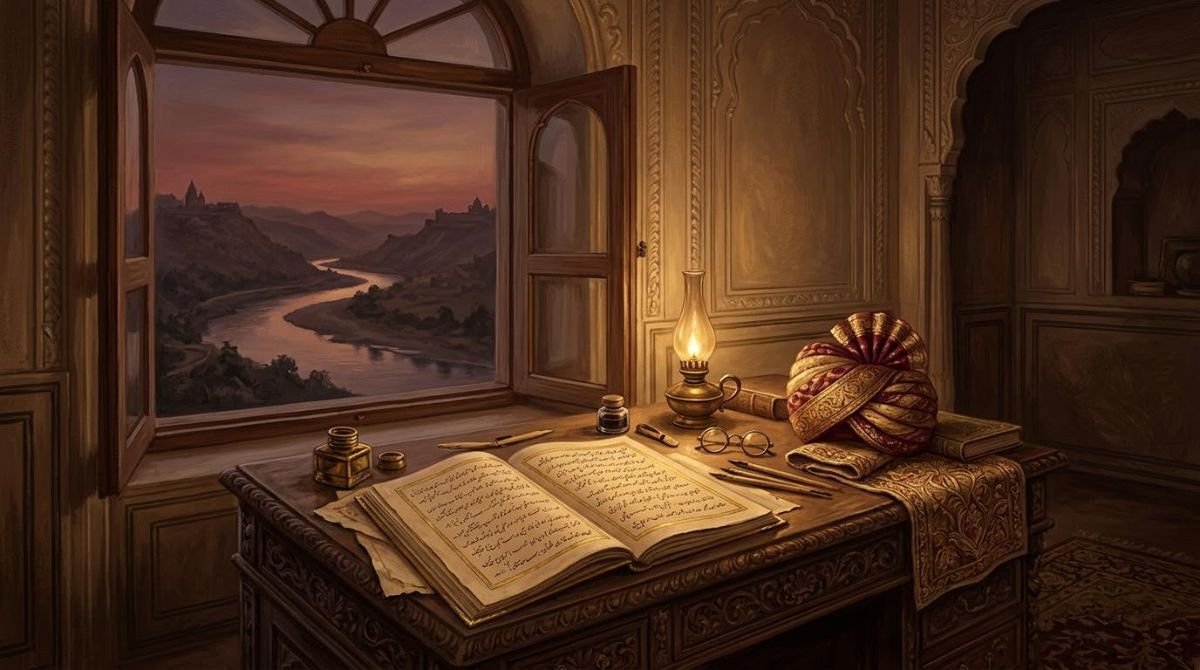
Thakur Major Singh Chib (ٹھاکر میجر سنگھ چب) was a Hindu Chib Rajput of Deva Vatala, in the foothills east of Bhimber, who wrote the first history of the Chib Rajputs, Tarikh-e-Chibhal, printed in Urdu in 1983 Bikrami, about 1926. He died in 1938. What we know of him comes mostly from his own book, whose 113 pages include his family tree, his uncles’ careers at the Jammu court, his reasons for writing and his parting words to the clan.
At a glance
- Name
- Major Singh Chib; the calligraphy can also be read Mehjar, he once spells himself Majar, and later writers also use Majhar and Mahjar
- Title
- Thakur, used in his own signatures to his closing poems (pp. 112–113)
- Home
- Deva Vatala (Dewa Vatala), then in Jammu State; he also lived for a time in Jammu (p. 28)
- Family
- The Thakari band of the Vatala Chibs; younger son of Bhola, called Bachola in the text (pp. 43, 56)
- Faith
- Hindu; he signed himself Qaum ka sevak, “servant of the nation”
- Book
- Tarikh-e-Rajgan-e-Bhimber wa Qaum-e-Chibhal, known as Tarikh-e-Chibhal: 113 pages, printed 1983 Bikrami (c. 1926)
- Died
- 3 Asauj 1995 Bikrami, about September 1938 (Iftikhar Ali Khan, 1997, p. 394)
Who was Thakur Major Singh?
The title page of his book names him simply “Major Singh Chib”, in a calligraphic form that can just as well be read Mehjar. In the text he calls himself “the humble author” and once spells his name Majar (p. 56), and his closing poems are signed “Thakur Mehjar Singh” and “Mehjar Singh (Thakur)” (pp. 112–113). Later writers vary between Major, Majhar, Mehjar and Mahjar (Iftikhar Ali Khan, 1997, pp. 23, 88, 394). Thakur was a title of standing among the Hindu Chibs; the book itself notes that in the author’s day it was replacing the older Mian (p. 96).
He belonged to Deva Vatala, the neighbouring villages of Deva and Vatala in the foothills east of Bhimber, whose Chibs remained Hindus when most of the Chib Rajputs became Muslims (p. 97). He describes Vatala in about 1926 as a town of six or seven thousand people in several quarters, the most populous place in Tehsil Bhimber (pp. 56, 89). For a time he lived in Jammu, where, he says in a rare personal aside, women brought children to him every day for the Chib toe-cure for kanpera, swellings below the ear, a gift the Chibs trace to Raja Dharam Chand; he was not sure at first that it helped, but experience, he writes, proved it beneficial (p. 28).
He wrote as a Hindu. His Urdu is full of Hindi words such as dharam, Parmatma and sandesh, and he holds up Ram, Krishna and Bhishma as models. Yet he speaks of the Muslim Chibs as brothers (p. 4), thanks Muslim chiefs who helped him (pp. 109–110) and addresses his last poem to the nation “whether Hindu or Muslim” (p. 113). The Hindu Chibs of his home are the subject of The Hindu Chibs of Dewa Vatala.
His family and the Jammu court
Two charts in the book trace his own line (pp. 42–43). It runs from Raja Dharam Chand, the raja remembered by Muslim Chibs as Baba Shadi Shaheed, through Ghaggi, who refused the throne rather than accept Islam, and Dasu Khan, the posthumous son from whom the Hindu Chibs descend (pp. 35–39), to the Vatala branch of Sahali and Kahan Chand:
- Raja Dharam Chand (Shadab Khan) → Bhup Chand → Ghaggi → Kandu → Takhti Chand, killed in a feud with the Muslim rajas
- Dasu Khan, born after his father’s death, “ancestor of the Hindu Rajputs” → Sikandar → Sahali → Kahan Chand
- Saheshar Chand (Sohesh or Somesh in the 1997 history), head of the Thakari band → Gaje Chand alias Kaki → Gyan Chand → Dasan → Aju → Labna (the last three readings uncertain)
- Seven brothers, as the chart names them: Piyara (Pyara Khan), Gopi, Prithu Kumedan, Kishora, Bhola, Farangi and Sundar
- Bhola (Bachola in the text), a Jamadar → an elder son, a numberdar, and Major Singh, “the author”
- Seven brothers, as the chart names them: Piyara (Pyara Khan), Gopi, Prithu Kumedan, Kishora, Bhola, Farangi and Sundar
- Saheshar Chand (Sohesh or Somesh in the 1997 history), head of the Thakari band → Gaje Chand alias Kaki → Gyan Chand → Dasan → Aju → Labna (the last three readings uncertain)
- Dasu Khan, born after his father’s death, “ancestor of the Hindu Rajputs” → Sikandar → Sahali → Kahan Chand
Counting Saheshar Chand as the first generation, the author is the eighth, exactly as the 1997 history’s chart of the Vatala Chibs says (Iftikhar Ali Khan, 1997, p. 394), and his branch is the Thakari, one of the five bands, or sub-branches, of Vatala (p. 53). Below his name the chart writes “Onkar Singh etc.”, a son or descendant; whether this is the Mian Onkar Singh Chib who later wrote a second Tarikh-e-Chibhal (2nd edition, Delhi, 1984) the book does not say (p. 43).
His father’s generation served the Dogra maharajas of Jammu, and he tells their stories with pride (pp. 53–56). The eldest brother, Piyara Khan, enlisted as a Jamadar in 1848 (reading uncertain), served long in the Maharaja’s Bijli Paltan, the “Lightning Battalion”, rose to be an officer and built masonry cisterns at a tank near Manawar; a footnote explains that Hindu Rajputs, too, once bore the name Khan, as they bore Mian (p. 53). His younger brother Prithu rose from the Maharaja’s private musketeers to Subedar. When a wounded boar ran into the hunting pit where the Maharaja sat near Jammu, Prithu jumped in, lifted the Maharaja out and cut the boar in two with his sword; made Adjutant (Ajitan), he was put in charge of the State’s water-carriers, couriers, livestock, public kitchens, store of valuables and palanquin-bearers, and his work during a Viceroy’s visit earned him a certificate and a telescope (pp. 53–54).
Two of Prithu’s services touch the book directly. By the Maharaja’s order he had a “correct” genealogy of the Chibs drawn up, and he won leave for every Chib in the State’s service on the occasion of the Panj Pir (reading uncertain), the holy man of the Baba Shadi Shaheed legend; Raja Farman Ali Khan later had the leave entered in the State’s Standing Gazette, and the State’s soldiers still received it every year (p. 54). Prithu died without a son in about 1905 (Samvat 1962, reading uncertain). Of the other brothers, one held a customs contract, one was a customs officer and the youngest farmed at home; the author’s father, Bachola, was a Jamadar who died in service, and the author was the younger of his two sons (pp. 55–56). A cousin, Piyara Khan’s son Nawalu, saved Maharaja Partap Singh when his boat got into danger at Srinagar, and the author copies the Private Secretary’s certificate of Harh 1957 Bikrami (c. June 1900) that raised his pay (pp. 55–56). These pages are summarised in Deva Vatala in 1926.
Why he wrote the first Chib history
In his preface he says he had long wished to write the history of the rajas of Bhimber and the Chib nation, and knew how hard it would be (pp. 3–5). The past of most peoples of Hindustan survived only as tradition handed down “from breast to breast”, without records or dates, and religious books were either coloured by faith or written in metaphors that modern reason rejects. A warlike people like the Rajputs needed its history to keep its honour (aan) and mettle (jauhar), all the more when every community was claiming Rajput descent, while the pedigrees (kursi-namas) lay with bards (bhats) and genealogists (mirasis) who lived by them, kept a few names and dropped or invented the rest. If nothing were done, he feared, no one would be able to name his ancestors beyond ten generations (pp. 3–4).
A second reason was the division of the clan. Most Chibs had become Muslims, and among them, he writes, a belief had been planted that their ancestor came from Iran. He traces it to the settlement officers’ record of the Gujrat tribes, the Tarikh-e-Aqwam-e-Zila Gujrat, which also said that Raja Shadi Khan went to Delhi under Humayun and became a Muslim at his own request. He blames the village headmen who gave evidence, influenced, he suggests, by maulvis, and answers that firmness in religion rests on belief while the nation (qaum) is another thing; leading Muslim Chibs, he adds, had admitted that the record was wrong (pp. 4–5). The 1997 history rejects the Iranian story too, though it explains it differently: see Where did the Chibs come from?
How he worked
He lists his sources without naming a single author: the Hari Vansh (the Harivamsha), Tarikh-e-Rajputan-e-Punjab, lives of Maharaja Gulab Singh and of Maharaja Ranjit Singh “in English and Urdu”, the Shahjahan Nama and a Tarikh-e-Kohliyan, besides a few handwritten documents and oral information (p. 5). In the body of the book he rarely cites a printed source: he cites the Shahjahan Nama for an imperial order (p. 100) and argues with the Gujrat record (pp. 97–99). Most of what he tells comes from family tradition, the statements of shrine attendants (p. 33), the accounts of bards (p. 92), government papers (p. 91), copies of certificates (pp. 55–56) and the stone memorials of the First World War (pp. 102–103).
He is often a sceptic. He reads the birth of the Katoch founder from a goddess’s sweat as a metaphor (pp. 6–7), explains why a crying child fell silent at the sight of a sword (p. 51), argues that the Vatala saint Pir Songa was really a Hindu Jogi (pp. 57–58), weighs three explanations of the name Bhimber (p. 62) and doubts the descent claimed for the Samahni family (p. 92). Elsewhere he defends hard deeds as raj-niti, statecraft (pp. 22–23, 76). On the question that most divides Chib historians, he holds that Raja Dharam Chand was made a Muslim against his will and gives six arguments for it, while insisting that the answer would neither harm the Hindu Chibs nor touch the faith of the Muslim Chibs (pp. 97–101).
Sources differ
Raja Muhammad Iftikhar Ali Khan, whose 1997 history quotes Major Singh more than any other writer, calls Tarikh-e-Chibhal “the first attempt to compile the history of the Chib qaum” and says every Chib will always be proud of it, but suspects that the general books in its source list, which mention the Chibs only in passing, were cited so that it would be accepted as reliable (pp. 23–24). He also disagrees with it on several points: he holds that Baba Shadi Shaheed embraced Islam freely, gives Ghaggi four or five sons where Major Singh gives two, and explains the name Rikki as “Rai-ki” rather than “of the subjects” (pp. 38, 113–115, 137, 145). The debate is set out in Forced or free?
The book he left
Tarikh-e-Chibhal is a lithograph of 113 pages, written out by a scribe, and every page is summarised in Tarikh-e-Chibhal, chapter by chapter. After the preface, Part 1 (pp. 6–60) tells the Katoch origin of the Chibs, numbers 481 rulers from the legendary Bhum Chand to Raja Sultan Khan, follows Raja Chib Chand and Raja Dharam Chand, and then traces the split of the family into Muslim rajas and the Hindu Chibs of Deva Vatala, whose story, from Dasu Khan to Ranjit Singh’s attack on Vatala and the burning of Deva after 1857, is the author’s own family history: see How the Chibs divided and Vatala against Ranjit Singh. Part 2 (pp. 61–82) is the history of the rajas of Bhimber down to Raja Sultan Khan and his heirs. Part 3 (pp. 83–109) covers Khari Kariali and the mandis, Chib customs, the spread of Islam and the clan’s war services, with lists of Chib officers (see The Chibs in the First World War).
He knew it was incomplete. In his “final request” he calls it a short history in a small book: the family trees of most families were left out lest it grow too large, because the first need was for the early history and the main shajra, written “from beginning to end”, and families treated briefly or not at all were still being investigated and would be added in a second edition (p. 109). We know of no second edition.
Thanks, a complaint and an apology
He thanks four men by name: Thakur Sadhu Singh, a Risaldar of Damala, who appears in his list of officers with regiment No. 16 (p. 105); Rai Dilawar Khan, the chief notable (Ra’is-e-A’zam) of Thotha Rai Bahadur; Raja Muhammad Akbar Khan of Bhimber, then living at Jhelum, head of the Bhimber royal family; and Thakur Dayal Singh (reading uncertain) of Sheikhpur, District Gujrat (pp. 109–110). Two were Hindu Thakurs, two Muslim chiefs. In the same breath he complains that the Muslim Rajputs of Jammu State had not lent a hand, despite repeated requests (p. 110).
He then asks pardon for his mistakes, since this was the “first occasion”, and states his creed as a historian: the history of a nation is a true photograph that favours no one, so he has set down the real events without any religious admixture, and he begs his readers to take off the spectacles of prejudice, read with care and give him encouragement. He signs, as in the preface, “the servant of the nation” (p. 110). A short note on the Hindu Chibs of Machhlian, in the Jammu district, follows the signature (pp. 110–111).
Two poems to the nation
The book ends in verse. “Sandesh Thakur”, “the Thakur’s message”, is addressed “to the young ones of the nation” (pp. 111–112). In eleven rhyming couplets it urges young Chibs to show courage and rebuild the nation’s fallen state, to drive out malice, envy and ignorance, to stop waiting for others’ help and save their own boat from the storm, to do what they say and never step back, and to keep the Kshatriya’s duty of taking a blow on one’s own breast to save others. It holds up Ram, Krishna, Bikram, Partap and Bhishma as examples and ends by sending its message to every house of the nation: this is the time of freedom, and if the young do not wake now, the Thakur’s song will have been in vain.
An unnumbered last page carries a second poem, “Qaum se prarthana”, “a prayer to the nation” (p. 113). It greets the nation’s awakening after long neglect, recalls an age when the kingdoms of the world were under its seal and when brothers like Ram and Lachhman and heroes like Bhim were its models, and says that though wealth and splendour have gone, honour and self-respect remain. It asks the nation, “whether Hindu or Muslim”, to carry its broken boat across, and tells the Thakurs that the whole of Bharat is waiting for them. The page is badly speckled and a few lines cannot be read. It is signed “Mehjar Singh (Thakur)”.
In his own words
Four sentences, given here in close English paraphrase of the Urdu, sum up his outlook.
Firmness in religion rests on belief, while the nation is another thing.
— Major Singh (c. 1926), p. 5
What I could do, I have written and offer in the service of the nation; it is now for the nation to value it.
— Major Singh (c. 1926), p. 5
The work of history is to clear the dust from past events and set them before the nation; to judge them is the duty of every thinking person.
— Major Singh (c. 1926), p. 97
The history of a nation is a true photograph, which shows favour to no one.
— Major Singh (c. 1926), p. 110
The scribe, the date and his death
Nothing in the book gives a date, a press or a price. Its only colophon, set beside the closing ornament on p. 112, names the scribe who wrote out the pages for the lithograph: Muhammad Shafi’ (a first name, perhaps Mahmud, is uncertain), katib of the Lahore Urdu newspaper Milap, which was founded in 1923. The date comes from the 1997 history, which cites the book as “printed 1983 Bikrami”, about 1926 (pp. 23, 88, 259, 290), and the text fits it: among the latest events it mentions are the War Darbar held at Bhimber on 11 February 1918 (p. 101) and the death of General Raja Farman Ali Khan of Kasgumah (pp. 90–91), who died in 1923 according to the 1997 history (pp. 170–172).
The 1997 history’s chart of the Vatala Chibs records that Thakur Major Singh died on 3 Asauj 1995 Bikrami, about September 1938, some twelve years after his book appeared (p. 394). Its verdict is generous: he showed later researchers a path hidden from them until then, and without his book the history of the Chibs might still be only oral memory (pp. 23–24). Every later history of the clan builds on his work; see The historians of Chibhal.
Frequently asked questions
Who was Thakur Major Singh Chib?
Thakur Major Singh Chib was a Hindu Chib Rajput of Deva Vatala, east of Bhimber, and the author of Tarikh-e-Chibhal, the first history of the Chib Rajputs, printed in about 1926. His own charts place him in the Thakari branch of the Vatala Chibs, eighth in descent from Saheshar (Sohesh) Chand.
When was Tarikh-e-Chibhal written?
The book carries no date, but the 1997 Chib history of Raja Muhammad Iftikhar Ali Khan cites it as printed in 1983 Bikrami, about 1926. The text mentions events up to the early 1920s, such as the War Darbar at Bhimber in 1918 and the death of General Raja Farman Ali Khan, which fits that date.
Was Thakur Major Singh a Hindu or a Muslim?
He was a Hindu, from the Chib families of Deva Vatala that did not embrace Islam. He wrote in Urdu for a clan that was mostly Muslim, spoke of the Muslim Chibs as brothers and addressed his last poem to the nation whether Hindu or Muslim.
When did Thakur Major Singh die?
According to the chart of the Vatala Chibs in the 1997 Chib history, he died on 3 Asauj 1995 Bikrami, about September 1938.
Is Thakur Major Singh the same person as Mian Onkar Singh Chib?
No. Mian Onkar Singh Chib wrote a later book of the same title, Tarikh-e-Chibhal, whose second edition appeared in Delhi in 1984. Major Singh’s own family chart names an Onkar Singh below him, but it does not say whether he is the later historian.
Sources
- Thakur Major Singh Chib, Tarikh-e-Rajgan-e-Bhimber wa Qaum-e-Chibhal (Tarikh-e-Chibhal; Urdu, c. 1926), pp. 3–6, 22–23, 28, 35–43, 51–58, 62, 76, 89–92, 96–113.
- Raja Muhammad Iftikhar Ali Khan, Raja Shadab Khan alias Hazrat Baba Shadi Shaheed (Urdu, Barhang/Karachi, 1997), pp. 23–24, 38, 88, 113–115, 137–138, 145, 170–172, 259, 290, 393–394.
This article is part of our series on the oldest Chib history; see Tarikh-e-Chibhal, chapter by chapter. Spellings of names follow the book; readings marked “uncertain” could not be read with certainty in the old lithograph.
Continue reading
Have a question about this history?
Our AI guide answers from the articles on this site, in English or Urdu.
