

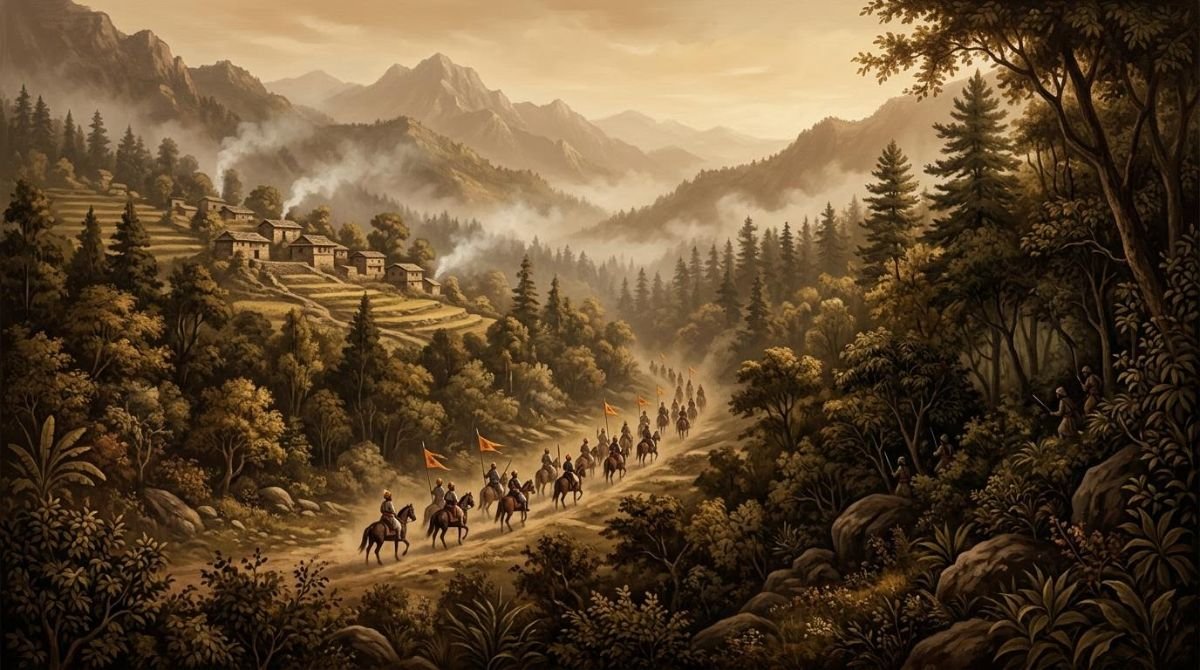
Vatala (also written Watala; وٹالہ), the chief village of the Hindu Chibs of Deva Vatala in the foothills east of Bhimber, defied the Sikh army of Maharaja Ranjit Singh in the early nineteenth century. The oldest Chib history, Thakur Major Singh’s Tarikh-e-Chibhal (c. 1926), tells how a Sikh force built the hasty fort of Shatab Garh, how Ranjit Singh marched in person and then settled for eight annas a plough, and how Vatala and Deva were burned again in the Dogra years.
At a glance
- Place
- Vatala and its neighbour Deva (Deva Vatala), Hindu Chib villages in the Kandi foothills east of Bhimber
- Defenders
- The Chibs of Vatala, led by their panchayat (village council)
- Sikh commanders
- Sardar Nihal Singh and Mian Mohar Singh (reading uncertain), then Maharaja Ranjit Singh in person
- Date
- Samvat 1871 Bikrami (reading uncertain), about 1814
- Settlement
- Land revenue of eight annas (half a rupee) per plough; robes of honour for the panches
- Trophies
- Two Sikh kettledrums, given to the shrines of Baba Shadi Shaheed and of Mahadev near Nah
- Later burnings
- Vatala by Diwan Hari Chand, Samvat 1901 (reading uncertain, about 1844); Deva after 1857
- Source
- Major Singh (c. 1926), pp. 46–52, 59–60; pages 44–45 are missing from the copy used
Vatala and its villages before the Sikhs
Vatala was the stronghold of the Hindu Chibs of Dewa Vatala, the branch of the Chib Rajputs that kept the old faith when the rajas of Bhimber became Muslims (see how the Chibs divided). Its historian, Thakur Major Singh, was born into one of its leading families, and his book is the only detailed account of its wars. Unfortunately the story opens in mid-sentence: pages 44–45 are missing from the copy used, and with them the beginning of the passage on Vatala’s panchayat.
What survives shows a confident community of kinsmen. Before Sikh rule, Vatala’s panchayat held a number of surrounding villages, which every few months paid it a fixed sum called sangti (reading uncertain). As the Sikhs extended their rule over the whole Punjab, these villages slowly slipped out of Vatala’s hands. Some of its young men took to raiding them, though, the author insists, that was never the panchayat’s intention; in one brawl several men and women of a village were wounded, and they went to Lahore to complain to Maharaja Ranjit Singh (Major Singh (c. 1926), p. 46).
The author is anxious to be fair to his people. Good and bad men are found everywhere, he observes; even great empires are plagued by dacoits and robbers, and the panchayat had known nothing of what “a few scoundrels” were doing (p. 46).
Shatab Garh, the hasty fort
Ranjit Singh sent an army under Sardar Nihal Singh and Mian Mohar Singh (reading uncertain). It camped three kos (about six miles) south of Vatala and threw up a fort of unbaked earth in such haste that it was named Shatab Garh, “the hasty fort”. In the author’s day the site was marked by an earthen tank known as Tabu (reading uncertain) (p. 46).
Vatala was taken by surprise, but resistance had become a matter of self-defence. A small band of Rajputs went out to fight, and in the firing Mian Mohar Singh was shot from his horse. With a commander dead and evening falling, the army fell back to Shatab Garh, the villagers went home, and for a few days the troops stayed inside the new fort (p. 46).
Ranjit Singh marches on Vatala
Ranjit Singh was then in the Gujrat country. When the news reached him he marched himself and called up a detachment stationed in the Bhimber area. The author dates these events to Samvat 1871 Bikrami, about 1814; the third digit is unclear in the lithograph, and 1861 (about 1804) is possible (p. 47). In 1814 Ranjit Singh did lead an army towards Kashmir by way of Bhimber, which would suit the first reading.
Against armies coming from two directions, a handful of Rajputs with little war material could not stand in the open. But Vatala was then ringed by jungle so dense that only those who knew the paths could enter, and the council decided to send the women and children to a safe place and to scatter the men in small bands. The Sikh army entered an empty village and set it on fire, and an elephant battered down the gatehouse (deorhi) of Sardar Lakha (reading uncertain). When the troops pushed into the jungle, a hail of bullets met them from marksmen they could not see. The mahout of the Maharaja’s own elephant was killed and the elephant turned back, and the soldiers, men of the plains, lost heart among the trees; many were killed (p. 47).
Ranjit Singh then changed course. “These are village people,” he reasoned in the author’s telling, and it was not proper to fight them; conciliation should be tried (p. 47). The next day he called the chosen men of Vatala, with Sardar Lakha, to his camp and assured them that the government had no wish to fight. When the panchayat came before him, he told them that the raja is the protector of his subjects and asked them to accept the laws of the state, in return for a land revenue of only eight annas per plough. The panchayat agreed, every panch received a robe of honour (khil’at), and Sardar Nihal Singh was appointed officer of the area (p. 47).
Sources differ
The 1997 Chib history of Raja Muhammad Iftikhar Ali Khan does not use these pages. In its own words it describes Dewa Vatala as a tract whose history is full of rebellions, which submitted to no one, not even to its Muslim kinsmen; it cites Sir Lepel Griffin’s view that the area was notorious for plunder, and notes that in the Sikh period the Kandi from Khari Kariali to Manawar, Vatala included, was long the jagir of Prince Kharak Singh, Ranjit Singh’s son (Iftikhar Ali Khan (1997), p. 138). Thakur Major Singh, a Vatala man, tells the same history from the inside: the raids were the work of a few young men, and the Sikh campaign ended in a negotiated peace.
The two kettledrums
As the Sikh army withdrew, two very large kettledrums (naqqaras) fell from an elephant, and the panchayat took possession of them. One was sent to the shrine of Bawa Shadi Shaheed on Aadhi Dhak, the ancestor revered by Hindu and Muslim Chibs alike (see the Baba Shadi Shaheed shrine); the other went to the sthan (shrine) of Mahadev (reading uncertain) beside Mauza Nah, home of another branch of the Hindu Chibs. Both were still there when the author wrote, though the Shadi Shaheed drum had become useless and lay in Bhimber at the shrine of Shah Shutar (pp. 47–48). That is evidently the shrine of Pir Syed Shah Shutar Bukhari, which the 1997 history places north of the town on the bank of the Bhimber Nala (Iftikhar Ali Khan (1997), p. 60; see the saints and shrines of Bhimber).
The sacrifices of Rajput women
Chapter Seven of the book, headed “The sacrifices of Rajput women”, returns to the day of Ranjit Singh’s attack. The author opens with praise of the courage of Rajput women in Indian history and offers a few examples “for the interest of the brave men of the qaum” (p. 48). The three stories he records are summarised here as he gives them. They are painful to read: they come from the terror of villagers fleeing an army, and from a code of honour in which falling into enemy hands was feared more than death.
- Mian Rura’s wife. As a party of villagers made for the jungle, a sick and weakened woman could not keep up, and her husband, named as Mian Rura, waited for her. Fearing that his waiting would doom the whole family and that capture would bring dishonour, she asked him to end her life with his own hand, and he did so (pp. 49–50).
- A wife who chose to fight. That evening another woman, too weak to walk, told her husband that he might leave her if he was afraid, but must not kill her: she would rather die fighting and take one or two of the enemy with her. Her words, the author says, put new heart into him, and he promised that no one would touch her while he lived; together they set off for the jungle (p. 50).
- The child in the ravine. Old and sick villagers had hidden in a ravine as the army passed above them when a small child began to cry. An old man said the child would betray them all, and a Rajput stepped forward with a sword. At the sight of the glittering blade the child fell silent, the sword went back into its scabbard, and everyone gave thanks to God (Parmatma) that the child had been spared. The author adds in a note that small children often fall quiet at the sight of something shiny (p. 51).
For the author, these episodes showed that the Rajputs of Vatala cared nothing for home, goods or family when set against the honour of the qaum (p. 51). The book gives no further details of the people involved, and the 1997 history does not mention these events.
Diwan Hari Chand burns Vatala
A generation later Vatala clashed with a new power. In Samvat 1901 Bikrami (reading uncertain; about 1844) its people again tried to assert their hold over the neighbouring villages, which had paid them a fixed annual sum before the boundary of the State was settled. When the report reached the Maharaja he sent Diwan Hari Chand with an army, and Hari Chand burned Vatala (p. 51).
The quarrel ended in reconciliation. When Maharaja Gulab Singh came to Vatala in person, the villagers received him with great hospitality, and he became convinced, the author writes, that this brave and spirited community had been the victim of a misunderstanding; from that day its men served the State’s armies loyally (p. 51). Once Gulab Singh’s rule was secure, the Chibs of Vatala gave up fighting and took to farming. Touring the area, the Maharaja found them loyal, and his successor, Maharaja Ranbir Singh, enlisted many of them in the Jammu army (p. 52). Their careers are followed in Deva Vatala in 1926, and the Dogra take-over of the wider Chib country in the end of Chib rule.
Uncertain dates
Both dates in these chapters are hard to read. The year of Ranjit Singh’s march may be Samvat 1871 or 1861 (about 1814 or 1804). For the burning of Vatala the digits 1901 (about 1844) are written small above the line; at that date Gulab Singh was Raja of Jammu under the Sikh state, and he became Maharaja of Jammu and Kashmir only in 1846, so the author may be giving him his later title.
The burning of Deva after 1857
The neighbouring Hindu Chib village of Deva suffered the same fate in a later reign (pp. 59–60). When the boundary of Jammu State was fixed, the author writes, the tracts once held by the Rajputs of Deva Batala passed into British territory, and only lands near the border remained in their hands. The zamindars there grew restive, a riot broke out at Mauza Dalhota (reading uncertain), and the State government turned against the people of Deva.
A second cause followed the uprising of 1857. Many Purbiya Brahmins, men from the east of India, fled into these hills, and orders came for their arrest. Every hill community handed them over except Deva and Batala. They held back, the author insists, not because they thought it right to shelter the government’s enemies, but because handing over Brahmins who had come to them for sharan (refuge) was against Rajput dharma; in his view the fugitives were innocent men whose only fault was that they came from the east. At the same time many Rajputs of the family were serving in the State army and had themselves fought the rebels at Delhi (pp. 59–60).
An officer of the State army who bore an old grudge against the village seized the pretext. By a false report, the author says, he obtained an order to march on Deva, and a detachment came from the direction of Naushera. Although the people of Deva had no thought of fighting, the village was burned, and the officer satisfied an old grudge against people who had long been trying to protect their rights (p. 60). Neither his name nor the year is given, and several words of this page are unclear in the lithograph.
Vatala and Deva: a timeline
- Before Sikh rule Vatala’s panchayat collects a fixed levy (sangti, reading uncertain) from neighbouring villages (p. 46).
- Samvat 1871 (c. 1814; reading uncertain) A Sikh force under Sardar Nihal Singh builds Shatab Garh and Mian Mohar Singh is killed; Ranjit Singh marches in person, Vatala is burned, and the panchayat accepts a revenue of eight annas a plough (pp. 46–47).
- The same campaign Two captured kettledrums are given to the shrines of Baba Shadi Shaheed and of Mahadev near Nah (pp. 47–48).
- Samvat 1901 (c. 1844; reading uncertain) Diwan Hari Chand burns Vatala; Gulab Singh visits and is reconciled with its people (p. 51).
- Reign of Ranbir Singh (died 1885) Many Vatala men join the Jammu army (p. 52).
- 1857 and after Deva and Batala shelter Purbiya Brahmin fugitives; a State detachment from the Naushera side burns Deva (pp. 59–60).
- c. 1926 Thakur Major Singh records these events in Tarikh-e-Chibhal.
Frequently asked questions
Where is Vatala?
Vatala (Watala) was the chief village of the Hindu Chibs of Deva Vatala, in the Kandi foothills east of Bhimber, in what became the State of Jammu and Kashmir. With its neighbour Deva it gave its name to the Deva Vatala branch of the Chib Rajputs.
Why did Ranjit Singh attack Vatala?
According to Thakur Major Singh’s Tarikh-e-Chibhal (c. 1926), villagers wounded in a brawl with young men of Vatala complained to Ranjit Singh at Lahore. He sent a force that built the fort of Shatab Garh, and after its commander Mian Mohar Singh was shot he marched in person, in about 1814.
What was Shatab Garh?
Shatab Garh was a fort of unbaked earth built in great haste by a Sikh army three kos south of Vatala; its name means the hasty fort. By about 1926 only an earthen tank called Tabu (reading uncertain) marked the site.
How did the fighting with Ranjit Singh end?
After his troops suffered in the jungle, Ranjit Singh chose conciliation. He received Vatala’s panchayat, gave every panch a robe of honour, fixed the land revenue at eight annas per plough and made Sardar Nihal Singh officer of the area.
Why was Deva burned?
After 1857 Deva and Batala refused to hand over Purbiya Brahmin fugitives who had sought refuge with them, which the author calls a duty of Rajput dharma. A State army officer with an old grudge obtained an order against Deva, and a detachment from the Naushera side burned the village.
Sources
- Thakur Major Singh Chib, Tarikh-e-Rajgan-e-Bhimber wa Qaum-e-Chibhal (Tarikh-e-Chibhal; Urdu, c. 1926), pp. 46–52, 59–60.
- Raja Muhammad Iftikhar Ali Khan, Raja Shadab Khan alias Hazrat Baba Shadi Shaheed (Urdu, 1997), pp. 60, 138.
- L. H. Griffin and C. F. Massy, The Chiefs of the Punjab, as quoted in the 1997 book, p. 138.
This article is part of our series on the oldest Chib history; see Tarikh-e-Chibhal, chapter by chapter. Spellings of names follow the book; readings marked “uncertain” could not be read with certainty in the old lithograph.
Continue reading
Have a question about this history?
Our AI guide answers from the articles on this site, in English or Urdu.
