

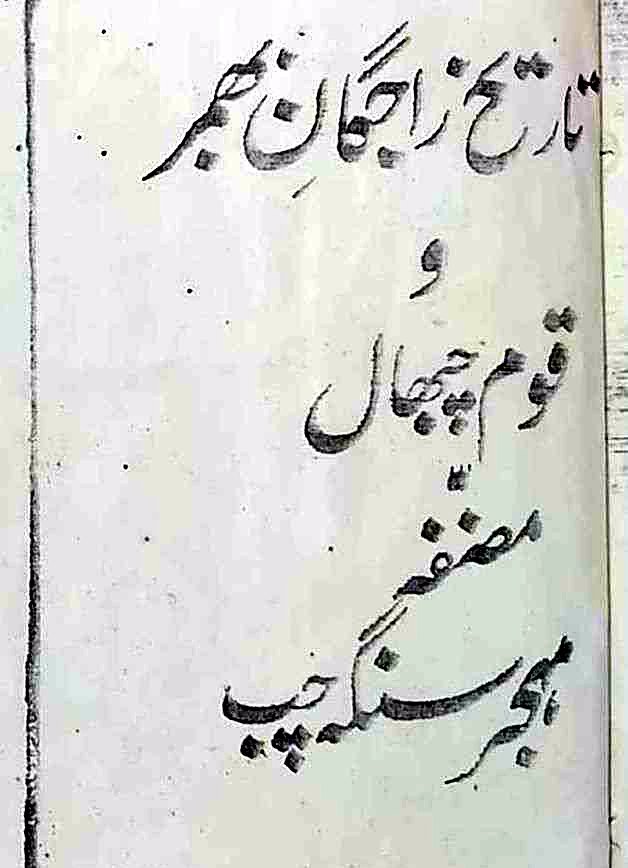
Tarikh-e-Chibhal (تاریخ چبھال, “History of Chibhal”) is the oldest written history of the Chib Rajputs, the clan whose rajas ruled Bhimber in today’s Azad Jammu and Kashmir. Thakur Major Singh Chib, a Hindu Chib of Deva Vatala, wrote it in Urdu, and it was printed in 1983 Bikrami, about 1926. All 113 printed pages have now been scanned, and this guide summarises the whole book chapter by chapter, from the Katoch origins of the clan to the rajas of Bhimber, the Hindu Chibs of Vatala and the Chib soldiers of the author’s day.
At a glance
- Full title
- Tarikh-e-Rajgan-e-Bhimber wa Qaum-e-Chibhal (تاریخ راجگانِ بھمبر و قوم چبھال): “History of the Rajas of Bhimber and of the Chibhal nation”
- Short title
- Tarikh-e-Chibhal, the heading of the text (p. 6)
- Author
- Thakur Major Singh Chib of Deva Vatala (the name can also be read Mehjar or Majhar)
- Language and form
- Urdu, lithographed in a scribe’s hand, in chapters (fasl)
- Date
- 1983 Bikrami, c. 1926 (per Iftikhar Ali Khan, 1997); the book itself prints no date
- Author died
- 3 Asauj 1995 Bikrami, c. September 1938
- Pages online
- The whole book: title page and printed pp. 3–113 (p. 2 is blank; pp. 44–45 are missing from the copy used)
- Structure
- Preface; Part 1, chapters 1–9 (pp. 6–60): origins, the shajra and the Hindu Chibs of Deva Vatala; Part 2, chapters 1–5 (pp. 61–82): the rajas of Bhimber; Part 3, chapters 1–8 (pp. 83–109): Khari Kariali, the mandis, customs, Islam and war services; closing pages (pp. 109–113)
- Scribe
- Muhammad Shafi’ (first name uncertain), katib of the Lahore newspaper Milap (p. 112)
About Tarikh-e-Chibhal
The calligraphed title page reads Tarikh-e-Rajgan-e-Bhimber wa Qaum-e-Chibhal, “composed by Major Singh Chib”; the text opens on p. 6 under the heading Tarikh-e-Chibhal, the name later writers use. Raja Muhammad Iftikhar Ali Khan’s 1997 history of the Chib Rajputs once quotes the long title too (p. 316), so the two are one work. It is a lithograph written out by a scribe (katib), and many of the dots that distinguish Urdu letters have faded, so some names below are marked “reading uncertain”. No date or press is printed anywhere in the book; its only colophon names the scribe, a katib of the Lahore newspaper Milap (p. 112). The 1997 history cites the book as “printed 1983 Bikrami”, that is 1926 (pp. 23, 88, 143, 259, 290), and the author’s hope of a “second edition” (pp. 5, 109) marks this as the first.
Iftikhar Ali Khan calls it “the first attempt to compile the history of the Chib qaum” (p. 23). The books it cites, he judges, mention the Chibs only in passing and were perhaps named to make it seem reliable, yet he credits Major Singh with rescuing Chib history from oral memory, an achievement every Chib can be proud of (pp. 23–24). By the late 1970s the book “had long been unobtainable” (p. 433). A second Tarikh-e-Chibhal, by Mian Onkar Singh Chib (2nd edition, Delhi, 1984), follows Major Singh’s chapter on Chib Chand closely in the passages quoted in 1997, adding details and a later date (pp. 65–67).
Read: The first Chib history comes online · The historians of Chibhal · The 1997 book, chapter by chapter
How the book is organised
After the title page and a three-page preface, the book runs to 113 printed pages in three Parts (bab), each divided into chapters (fasl), and ends with a closing request, an addendum and two poems. The sections of this guide follow the same order.
| Pages | Section | Subject |
|---|---|---|
| 1–5 | Title page and preface | Why the author wrote; the Iranian-prince story rejected; his sources |
| 6–34 | Part 1, chapters 1–3 | The Katoch origin; the shajra of 481 rulers (pp. 10–20); Raja Chib Chand; Raja Dharam Chand, Baba Shadi Shaheed |
| 35–60 | Part 1, chapters 4–9 | The division of the family; Dasu Khan; the Hindu Chibs of Deva Vatala, their clashes with the Sikhs and their service in Jammu |
| 61–82 | Part 2, chapters 1–5 | The rajas of Bhimber: the town, the Mehtas, Raja Sultan Khan, his successors, the Sheikhpur family |
| 83–109 | Part 3, chapters 1–8 | Khari Kariali, Thotha Rai Bahadur and the mandis; Barhang and Samahni; customs; the Chibs and Islam; war services |
| 109–113 | The close | Thanks and apology; the Machhlian family; two poems; the scribe’s colophon |
The author: Thakur Major Singh Chib
The title page has only “Major Singh Chib”, in a form that can also be read Mehjar, hence the 1997 history’s Majhar, Mehjar, Mahjar and Major (pp. 23, 88, 259, 289); the title Thakur, absent there, appears in his own signatures to the poems that close the book (pp. 112–113). He wrote as a Hindu Chib, signed himself Qaum ka sevak, “servant of the nation” (p. 5), and lived for a time in Jammu, where he often performed the Chib toe-cure for kanpera, swellings below the ear, on children brought to him daily; unsure at first whether it helped, he says experience proved it beneficial (p. 28). The 1997 history places him at Deva Vatala (p. 88); its chart of the Watala Chibs, descendants of Raja Ghaggi Khan, puts him in the eighth generation from Sohesh Chand (reading uncertain), founder of the Thakri branch, and dates his death to 3 Asauj 1995 Bikrami, about September 1938 (pp. 393–394). His own charts confirm it: they run from Raja Dharam Chand, the hero of his third chapter, through Ghaggi and Dasu Khan to his father Bhola (Bachola in the text) and to “Major Singh, the author”, eighth in descent from Saheshar (Sohesh) Chand, and a later chapter tells the careers of his uncles Piyara Khan and Prithu Kumedan at the Jammu court (pp. 42–43, 53–56). His life is told in Thakur Major Singh Chib: life of the first Chib historian.
Members’ Library
Continue reading in the Members’ Library
You have read the summary of this guide. Members read every guide in full and ask the Chib History Guide without limits.
The full guide continues with 16 sections (about 10,300 words):
- The preface (pp. 3–5)
- Chapter 1: the origin of the Chib Rajputs (pp. 6–9)
- The shajra and the king-list (pp. 10–20)
- Chapter 2: Raja Chib Chand (pp. 21–25)
- Chapter 3: Raja Dharam Chand, Baba Shadi Shaheed (pp. 26–34)
- Chapter 4: the throne divided (pp. 35–36)
- and 10 more sections
Also included: unlimited questions to the Chib History Guide, our AI expert on Chib history, and an article about your own family, published on this site and kept on record in the guide.
Rs 10,000 a year about Rs 833 a month · pay by EasyPaisa or JazzCash
Members of the International Chib Rajput Forum join free with the forum’s code.
Sources
- Thakur Major Singh Chib, Tarikh-e-Rajgan-e-Bhimber wa Qaum-e-Chibhal (Tarikh-e-Chibhal; Urdu, c. 1926), title page and pp. 3–113.
- Raja Muhammad Iftikhar Ali Khan, Raja Shadab Khan alias Hazrat Baba Shadi Shaheed (Urdu, Barhang/Karachi, 1997), pp. 19–44, 60, 65–69, 88–93, 108, 111, 113–145, 156–157, 165, 167, 170–173, 201, 258–265, 289–291, 316, 331, 336, 355, 393–394, 433.
- Mian Onkar Singh Chib, Tarikh-e-Chibhal, 2nd ed. (Khwaja Press, Delhi, 1984), pp. 34–39, as quoted in the 1997 book.
- Thakur Kahan Singh Balauria, Tawarikh-e-Rajputan-e-Punjab, as quoted in the 1997 book, pp. 21–22.
- Lepel Griffin and C. F. Massy, The Chiefs of the Punjab, as reproduced in the 1997 book, pp. 150–164.
This page is the hub of our series on the oldest Chib history. Spellings of names follow the book; readings marked “uncertain” could not be read with certainty in the old lithograph.