

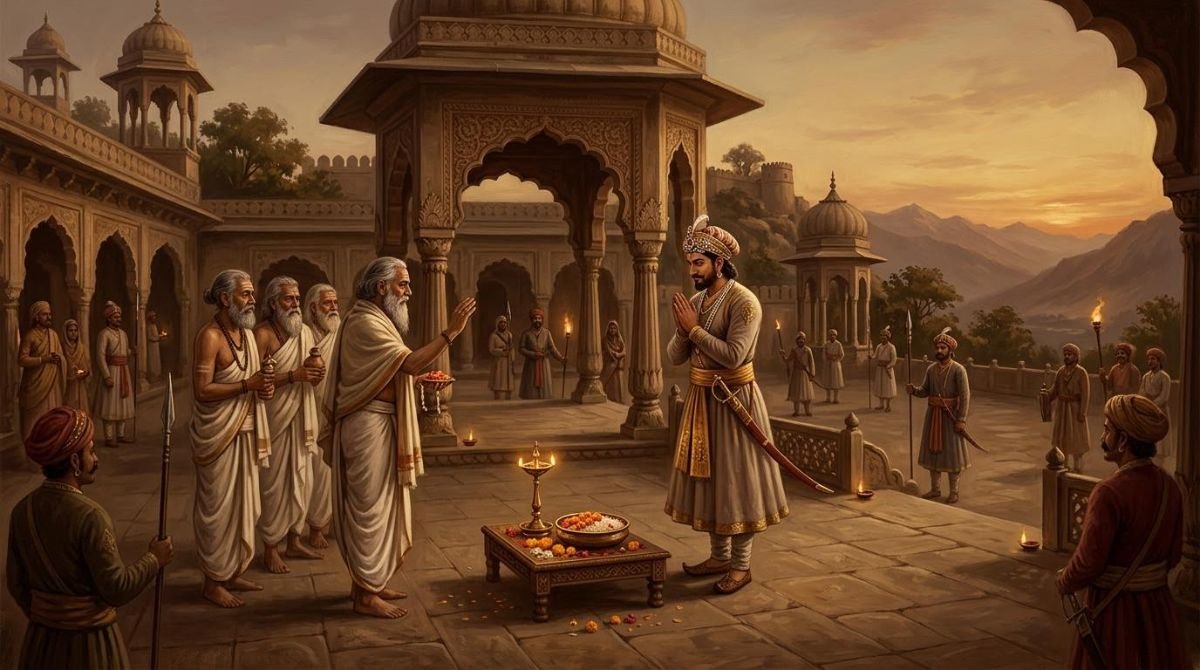
How did the Brahmins of the Verha caste become Chib Rajput purohits, family priests to the Hindu Chibs? Thakur Major Singh’s Tarikh-e-Chibhal (c. 1926), the oldest written history of the Chibs, says that when Raja Chib Chand took Bhimber from the Thakial Rajputs, he promised the Thakials’ court priests that he and all his descendants would honour them as their own, and that the Hindu Chibs were still keeping that promise at their weddings centuries later.
At a glance
- The vow
- Raja Chib Chand’s promise to the court priests (raj-purohits) of the Thakial rajas of Bhimber
- The priests
- Brahmins of the Verha caste (ویڑا; also read Vedra; reading uncertain)
- The promise
- To honour them as the purohits of his own lineage, a duty binding on his descendants
- The custom
- Equal dues for Verha Brahmins at Hindu Chib weddings, still given about 1926
- The parallel
- Bhishma’s vow in the Mahabharata
- Sources
- Major Singh (c. 1926), pp. 22–25; Mian Onkar Singh, quoted in Iftikhar Ali Khan (1997), p. 67
A wedding without its lagis
Among the Rajputs of the hills, a family’s ceremonies needed hereditary specialists, the lagis: above all the purohit, the family priest who performed the rites, and the bhat, the bard who kept and recited the pedigree, each entitled to customary dues. Major Singh, a Hindu Chib of Dewa Vatala, had little patience with the bards: in his preface he complains that the bhats and mirasis who held the Rajputs’ genealogical rolls had turned them into a livelihood and let names drop out (p. 4).
Raja Chib Chand, the Katoch prince from Kangra who founded the dynasty of the Chib Rajputs, came to Bhimber as a traveller. When Raja Sri Pat, the Thakial ruler, married his only daughter to him, “it is also said”, Major Singh writes, that Chib Chand did not have all his lagis with him, so his brothers did the work of purohit and bhat for the occasion (p. 22). It is a small detail, but it sets the scene for what followed: the founder of the Chib house had arrived in Bhimber without the priests who would normally have served his family.
The Thakial priests’ petition
When Sri Pat died without a son, Chib Chand took the throne from Sri Pat’s kinsmen, a story told in The Thakial Rajputs. The Thakial rajas’ court priests, the raj-purohits, were left without patrons. They came before the new raja and put their case: the rajas who had maintained them, and through whom they had filled their bellies, were no longer in the world; how were they now to make a living (Major Singh (c. 1926), p. 23)?
Chib Chand’s answer
Major Singh gives Chib Chand a reply in the language of Kshatriya duty (p. 24). Between Kshatriya and Brahmin, the raja says, the bond is that of the choli and the daman, the bodice and the skirt, which are never parted. A true Kshatriya may sacrifice body, mind and wealth (tan, man, dhan) for the sake of a kingdom, but while there is life in him he cannot see a Brahmin in distress. Protecting the people of every other varna is the duty of a Kshatriya and a true Rajput, for Brahma created the Rajput from his chest to guard cows and Brahmins, to take arrows on his own chest rather than let harm come to the weak.
Brahman-devta, if your patron rajas are no more, then we too are your jajmans.
— Raja Chib Chand, in Major Singh (c. 1926), p. 24
A jajman is the patron family that a priest serves and from whom he receives his dues, and Brahman-devta is a respectful form of address to a Brahmin. Chib Chand promised to honour the Thakial priests just as a family honours the purohits of its own kul, or lineage, and he did not limit the promise to himself: his descendants, he said, would never extinguish their rights (p. 24).
The Chib Rajput purohits: the Verha Brahmins
Major Singh names the caste of these Brahmins as ویڑا, which can be read Vedra or Verha; Mian Onkar Singh’s later Tarikh-e-Chibhal, quoted in the 1997 history of Raja Muhammad Iftikhar Ali Khan, spells it ویڑہ, Verha (Iftikhar Ali Khan (1997), p. 67). “From that time to this day”, Major Singh writes, the Brahmins of this caste receive “equal rights” at Hindu Chib weddings (p. 24): a share of the wedding dues on the same footing, it seems, as the clan’s own family priests, just as the promise required.
The custom belonged to the Hindu Chibs, the branch that kept the old faith when most of the clan followed Baba Shadi Shaheed into Islam, and the author was describing his own community as it was in the 1920s; the line of Ghaghi, Baba Shadi Shaheed’s grandson, is placed at Dewa Vatala on his genealogical chart (p. 19; see The Hindu Chibs of Dewa Vatala). Like many families of every community in the region, the Hindu Chibs of Vatala later lost their ancestral homes, in the upheavals of 1947 and 1971 (Iftikhar Ali Khan (1997), p. 138), and the sources used here do not say whether the Verha Brahmins are still remembered at Chib weddings today. Chib weddings honoured other old debts in the same spirit, such as bread for a Teli in memory of Baba Shadi Shaheed’s faithful servant (Iftikhar Ali Khan (1997), pp. 88, 92–93; see Chib customs and traditions).
Pran: a vow kept for centuries
For Major Singh the story proves how strong the Rajput sense of pran, the binding vow, had been. Rajput history, he writes, offers thousands of examples of men who gave up throne and kingdom, home and property, and life itself to keep their word (p. 24). He sets Chib Chand beside Bhishma, the great elder of the Mahabharata. When Bhishma vowed that he would never rule and that the children of Satyavati would inherit the throne, her father objected that Bhishma’s own descendants might one day dispute it. A man can answer for himself, Major Singh observes, but not easily for his descendants, so Bhishma tied “one more tight knot” to his vow and swore never to marry at all (pp. 24–25).
Chib Chand, by contrast, had complete trust that his descendants would honour his word, and in Major Singh’s view that trust was justified: “after hundreds of years” the whole Hindu Chib family regarded keeping the word (bachan) of its revered elder as a sacred duty (p. 25). He closes the chapter with a couplet whose sense is that those who are true to their word live absorbed in their vow and do what they say, even at the cost of their lives, and below it a printed spray of roses (p. 25). His first chapter had ended on the same note, praising those who do what they say and say what they do (p. 9).
How the other histories tell it
The story is not Major Singh’s alone. Mian Onkar Singh’s Tarikh-e-Chibhal (2nd ed., Delhi, 1984), quoted in the 1997 history, has the Thakial priests’ petition and Chib Chand’s promise almost word for word, and likewise says that the Hindu Chibs still acknowledged the Brahmins of the Verha caste as their purohits and gave them equal rights (Iftikhar Ali Khan (1997), p. 67). Major Singh’s version is the older and the fuller: of the two, only he records the absent lagis, the speech on Kshatriya duty and the comparison with Bhishma.
The founder’s wider story is told in Raja Chib Chand, the Rajput ideal of keeping one’s word in Rajput history and the code of honour, and the book itself in Tarikh-e-Chibhal, chapter by chapter.
Frequently asked questions
Who were the Verha Brahmins?
According to Thakur Major Singh’s Tarikh-e-Chibhal (c. 1926), the Verha (or Vedra) Brahmins were the court priests of the Thakial Rajputs, who ruled Bhimber before the Chibs. When Raja Chib Chand took Bhimber, he promised to honour them as his own family priests, and the Hindu Chibs kept them as their purohits.
What did Raja Chib Chand promise the Thakial purohits?
He told them that a true Kshatriya must protect Brahmins and the weak, and that since their patrons were gone he would be their patron. He promised to honour them as the purohits of his own lineage and bound his descendants never to extinguish their rights.
Do the Chibs still give dues to the Verha Brahmins?
Major Singh wrote about 1926 that Brahmins of the Verha caste still received equal dues at Hindu Chib weddings, and Mian Onkar Singh’s later history says the Hindu Chibs still acknowledged them as purohits. The sources used here do not say whether the custom survives today.
What is a lagi?
Lagis are the hereditary functionaries, such as the family priest (purohit) and the bard (bhat), who serve at a family’s ceremonies and receive customary dues at its weddings. Major Singh notes that Chib Chand’s lagis were absent at his wedding in Bhimber, so his brothers took their place.
Why does Major Singh compare Chib Chand with Bhishma?
Both made vows that bound future generations. Bhishma, in the Mahabharata, could guarantee his promise only by vowing never to marry; Chib Chand, Major Singh says, trusted his descendants to keep his word, and the Hindu Chibs were still keeping it centuries later.
Sources
- Thakur Major Singh Chib, Tarikh-e-Rajgan-e-Bhimber wa Qaum-e-Chibhal (Tarikh-e-Chibhal; Urdu, c. 1926), pp. 4, 9, 19, 22–25.
- Raja Muhammad Iftikhar Ali Khan, Raja Shadab Khan alias Hazrat Baba Shadi Shaheed (Urdu, Barhang/Karachi, 1997), pp. 67, 88, 92–93, 138.
- Mian Onkar Singh Chib, Tarikh-e-Chibhal, 2nd ed. (Delhi, 1984), pp. 34–39, as quoted in Iftikhar Ali Khan (1997), pp. 65–67.
This article is part of our series on the oldest Chib history; see Tarikh-e-Chibhal, chapter by chapter. Spellings of names follow the book; readings marked “uncertain” could not be read with certainty in the old lithograph.
Continue reading
Have a question about this history?
Our AI guide answers from the articles on this site, in English or Urdu.
