

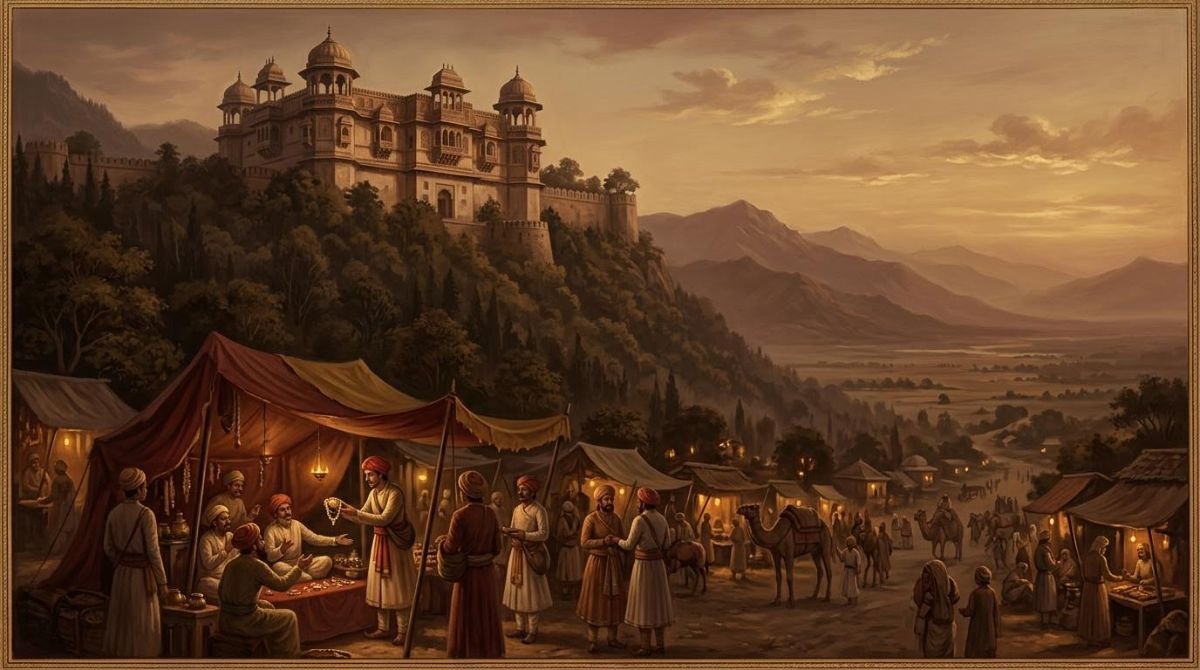
The Thakial Rajputs (تھکیال راجپوت) were, according to Chib tradition, the ruling house of Bhimber, in today’s Azad Jammu and Kashmir, before the Chibs. Thakur Major Singh’s Tarikh-e-Chibhal (c. 1926), the oldest written history of the Chib Rajputs, names their last raja as Sri Pat, whose only daughter married Raja Chib Chand and whose throne passed to the Chibs; seven reigns later a Thakial bride became Rani Thakial, queen of Baba Shadi Shaheed.
At a glance
- Name
- Thakial (also written Thakyal), a Rajput qaum or clan
- Rule
- Bhimber, from ancient times until Raja Chib Chand came from Kangra
- Last raja
- Raja Sri Pat; other accounts call him Sri Pat Wadhan or Budhan
- Seat
- Palaces on Aadhi Dhak, where the shrine of Baba Shadi Shaheed now stands; the town was Jhangar
- Ties with the Chibs
- Sri Pat’s daughter married Chib Chand; Rani Thakial married Raja Dharam Chand (Baba Shadi Shaheed)
- End of rule
- After Sri Pat died without a son: a feast, “stratagems” or a skirmish, by source
- In the 1920s
- Wholly Muslim, at Mauza Thakiala (reading uncertain), Jammu State, on the Poonch border
- Main source
- Major Singh (c. 1926), pp. 21–23, 26, 29–30
Who were the Thakial Rajputs?
For some four centuries Bhimber, where the old road to Kashmir leaves the Punjab plains for the hills, was the capital of the Chib Rajputs. Yet every Chib chronicle agrees that the Chibs were newcomers. When Raja Chib Chand arrived from the Katoch kingdom of Kangra, Bhimber already had a ruling house, and in the oldest Chib history, as in Mian Onkar Singh’s later one, that house is the Thakial Rajputs.
Thakur Major Singh Chib of Dewa Vatala, a Hindu Chib whose Tarikh-e-Chibhal was printed in 1983 Bikrami (about 1926), says it plainly: “Bhimber was ruled by the Thakial Rajputs, and Raja Sri Pat was the ruler” (Major Singh (c. 1926), p. 22). In a later chapter, quoted in Raja Muhammad Iftikhar Ali Khan’s history of 1997, he adds that the raj had belonged to the Thakials from ancient times, that Sri Pat was the last of their rajas, and that in Sri Pat’s day the palaces stood on Aadhi Dhak, where the shrine of Baba Shadi Shaheed is now, with the town of Jhangar two or three miles to the north (Major Singh, pp. 61–64, in Iftikhar Ali Khan (1997), p. 42).
Little more is known. No Thakial genealogy survives in these sources. The manuscript of Maulvi Zain-ul-Abidin of Samahni pairs the Thakials with the Badhans as the rulers Chib Chand displaced (Iftikhar Ali Khan (1997), p. 119), and the 1997 compiler writes that the Budhan, Sudhan and Thakial tribes long held the Dewa Vatala country east of Bhimber (p. 138).
Raja Sri Pat and the jewel
Major Singh’s second chapter tells how the two houses met. At the end of the thirteenth century Bikrami, he says, Raja Narain Chand, a grandson of Raja Megh Chand of Kangra, set out to win a kingdom with his four sons, Chib Chand, Dhru Chand, Ambu Chand and Aji Chand. Passing below the hills of Jammu with few men left, they camped like travellers at Mughlora, four miles east of Bhimber (pp. 9, 21); the date is weighed in When did the Chibs come to Bhimber?
Needing provisions, Narain Chand sent a servant to sell a valuable jewel in the town, for there were no banknotes then, the author explains, and travelling rajas carried their wealth as jewels or gold mohurs. The shopkeepers declared it fit for a raja, and Raja Sri Pat bought it and asked about its owner, reasoning that such a man must belong to some royal house. He invited Narain Chand, enquired into his family and proposed that his only daughter should marry Chib Chand. There was no question of refusing, and the wedding was celebrated with great pomp (pp. 21–22).
A marriage and a dowry
Chib Chand, it is also said, did not have all his lagis with him, the hereditary functionaries who serve at a family’s ceremonies, so his brothers stood in as family priest (purohit) and bard (bhat). Besides the dowry, Sri Pat gave his son-in-law several villages east of Bhimber. Narain Chand, already old, died a few days later, and Chib Chand settled for good, founding east of Mughlora a village he named Kangra after his old homeland, a name it still bore in Major Singh’s day (p. 22; see Kot Chibban and Mughlora).
Later accounts, quoted in the 1997 book, vary the terms. Rose’s Glossary (1911) says Sri Pat gave part of his state as dowry (p. 26); the family history of the Pothi, Kasgumah and Lehri Rajgan says a third of it (p. 165); Raja Wilayat Khan names the bride Punja Devi and says Sri Pat wanted a son-in-law to guard the country against invaders from the west (pp. 30–31); and Mian Onkar Singh’s later Tarikh-e-Chibhal adds an old Brahmin woman, who praised Chib Chand to the queens (p. 66).
How Thakial rule in Bhimber ended
Some time later Sri Pat died without a son. His near kinsmen expected the throne, but Chib Chand seized his chance and took possession of the raj (Major Singh (c. 1926), p. 22). Asking how a newcomer succeeded so quickly, Major Singh answers with a reflection on raj-niti, statecraft: throughout history, he writes, sons have imprisoned fathers and brothers shed each other’s blood for a throne, the shastra-writers call such methods niti, and no people has ever handed its rule to another willingly (pp. 22–23).
He then records what “is said” to have happened. At a wedding or some such occasion, Chib Chand gave a lavish feast for the whole Thakial biradari (kin-group) of Sri Pat; soldiers hidden nearby attacked, and many leading men were killed, while some held that the food was also poisoned. The survivors could not resist: some fled, the rest submitted, and Chib Chand became master of Bhimber (p. 23). For the Thakials it meant the loss of a kingdom and of many of their men. Major Singh presents the story as tradition, framed by his argument about statecraft; later histories tell it differently, and some omit it.
Sources differ
Major Singh (c. 1926) describes a feast at which the Thakial kin-group was attacked after Sri Pat’s death, with a rumour of poison (pp. 22–23). Mian Onkar Singh says only that Chib Chand “used several political stratagems”, met slight resistance and saw his rivals flee (Iftikhar Ali Khan (1997), p. 67). Griffin and Massy’s Chiefs of the Punjab has Chib Chand invite his father-in-law and his whole family to a feast and have them killed (p. 157). The Pothi, Kasgumah and Lehri family history says Sri Pat Budhan fell in a skirmish soon after the wedding (p. 165); Raja Wilayat Khan says only that Sri Pat Wadhan (Badhan) died about 1230 and the state passed to Chib Chand (pp. 30–31). The 1868 Gujrat Settlement calls Sri Pat a Brahman (p. 20).
The Thakial purohits
The Thakial rajas’ court priests (raj-purohits) then asked Chib Chand how they were to live. He answered that a true Kshatriya must protect Brahmins and all the weak, and promised that he and his descendants would honour them as their own priests. These Brahmins, of the Verha caste (also read Vedra; reading uncertain), still received equal dues at Hindu Chib weddings in Major Singh’s day (pp. 23–25); see Chib Chand’s Vow.
Rani Thakial: a second Thakial bride
The two families were joined again. Major Singh counts seven rajas after Chib Chand, the seventh being Raja Dharam Chand, remembered as Raja Shadab Khan and Baba Shadi Shaheed, who “too” married among the Thakial Rajputs (p. 26). His queen is known only as Rani Thakial because, the author explains, Rajput custom, above all among rajas, kept a queen’s name private and called her by her clan. He calls her very wise and a pativrata, wholly devoted to her husband, and credits her with Rani ke Kunwan, the queen’s well, three miles south of Bhimber (p. 26), the Rani da Khooh pictured in the 1997 book (p. 56).
In his account she is the raja’s counsellor when Sultan Ibrahim Lodi’s summons arrives, and it is she who, harassed by kinsmen in his absence, sends the letter that brings him home from Delhi (pp. 29–30). Her legends are told in Rani Thakial, Sajana Teli and the Black Dog, and her husband’s life in Baba Shadi Shaheed.
The Thakials after the Chibs
The Thakials did not simply vanish. Onkar Singh writes that the old rulers kept stirring up trouble (Iftikhar Ali Khan (1997), p. 67), and Maulvi Zain-ul-Abidin records a later bid for a return: after Baba Shadi Shaheed’s death his brother Raja Dom Khan conspired with the Thakials and Badhans, setting up a claimant from among them, until the emperor intervened and Dom Khan withdrew towards Poonch (p. 119), the country of his descendants, the Domal.
By Major Singh’s time the clan had changed its faith: “the whole of it has come into the fold of Islam”, he writes, and its people lived at Mauza Thakiala (reading uncertain; the 1997 quotation has Thakial), in Jammu State on the border of Poonch State (p. 26). The 1997 history also names an area of Poonch called Parawa Thakiala, where Dom Khan established his rule (pp. 33, 70); neither book says whether the two are connected.
So the Chibs remember the Thakials three times over: as the dynasty they replaced, as the family of the bride who brought Chib Chand his first lands, and as the clan of the queen who lies beside Baba Shadi Shaheed on Aadhi Dhak. The book itself is introduced in Tarikh-e-Chibhal, chapter by chapter.
Frequently asked questions
Who were the Thakial Rajputs?
The Thakials were a Rajput clan who, according to the Chib chronicles, ruled Bhimber, in today’s Azad Kashmir, before the Chibs. Thakur Major Singh’s Tarikh-e-Chibhal (c. 1926), the oldest written Chib history, names their last raja as Sri Pat, whose only daughter married Raja Chib Chand, founder of the Chib dynasty.
Who was Raja Sri Pat of Bhimber?
In Chib tradition Raja Sri Pat was the last Thakial ruler of Bhimber. He bought a jewel offered for sale by the servant of the Kangra prince Narain Chand, married his only daughter to Narain Chand’s son Chib Chand and gave the couple villages east of Bhimber. Other accounts call him Sri Pat Wadhan or Budhan, and the 1868 Gujrat Settlement calls him a Brahman.
How did the Thakials lose Bhimber?
When Sri Pat died without a son, Chib Chand took the throne instead of Sri Pat’s kinsmen. Major Singh records a tradition that the Thakial kin-group was attacked at a feast, with a rumour of poison; Onkar Singh speaks only of political stratagems, Griffin and Massy of a feast at which Sri Pat’s family died, and a Pothi family history of a skirmish.
Was Rani Thakial a Thakial Rajput?
Yes. Major Singh writes that Raja Dharam Chand, remembered as Baba Shadi Shaheed, also married among the Thakials, and that his queen was known by her clan name, Rani Thakial, because Rajput queens’ own names were kept private. She built the Rani’s well three miles south of Bhimber.
Where did the Thakials live later?
In Major Singh’s day, about 1926, the Thakials had all become Muslims and lived at a village he calls Thakiala (reading uncertain), in Jammu State on the border of Poonch. Earlier, according to the 1997 Chib history, Thakials had joined Raja Dom Khan in a failed attempt to regain Bhimber after Baba Shadi Shaheed’s death.
Sources
- Thakur Major Singh Chib, Tarikh-e-Rajgan-e-Bhimber wa Qaum-e-Chibhal (Tarikh-e-Chibhal; Urdu, c. 1926), pp. 9, 21–26, 29–30; pp. 61–64 as quoted in Iftikhar Ali Khan (1997), p. 42.
- Raja Muhammad Iftikhar Ali Khan, Raja Shadab Khan alias Hazrat Baba Shadi Shaheed (Urdu, Barhang/Karachi, 1997), pp. 20, 26, 30–31, 33, 42, 56, 65–67, 70, 119, 138, 157, 165.
- Mian Onkar Singh Chib, Tarikh-e-Chibhal, 2nd ed. (Delhi, 1984), pp. 34–39, as quoted in Iftikhar Ali Khan (1997), pp. 65–67.
- Maulvi Zain-ul-Abidin Kohi Samahnavi, unpublished manuscript history of Chibhal, as quoted in Iftikhar Ali Khan (1997), p. 119.
- L. Griffin and C. F. Massy, The Chiefs of the Punjab (Urdu translation); H. A. Rose, A Glossary of the Tribes and Castes of the Punjab and North-West Frontier Province, vol. II (1911); Settlement of District Gujrat (1868); Raja Wilayat Khan of Thotha Rai Bahadur, unpublished research; all as quoted in Iftikhar Ali Khan (1997).
This article is part of our series on the oldest Chib history; see Tarikh-e-Chibhal, chapter by chapter. Spellings of names follow the book; readings marked “uncertain” could not be read with certainty in the old lithograph.
Continue reading
Have a question about this history?
Our AI guide answers from the articles on this site, in English or Urdu.
