

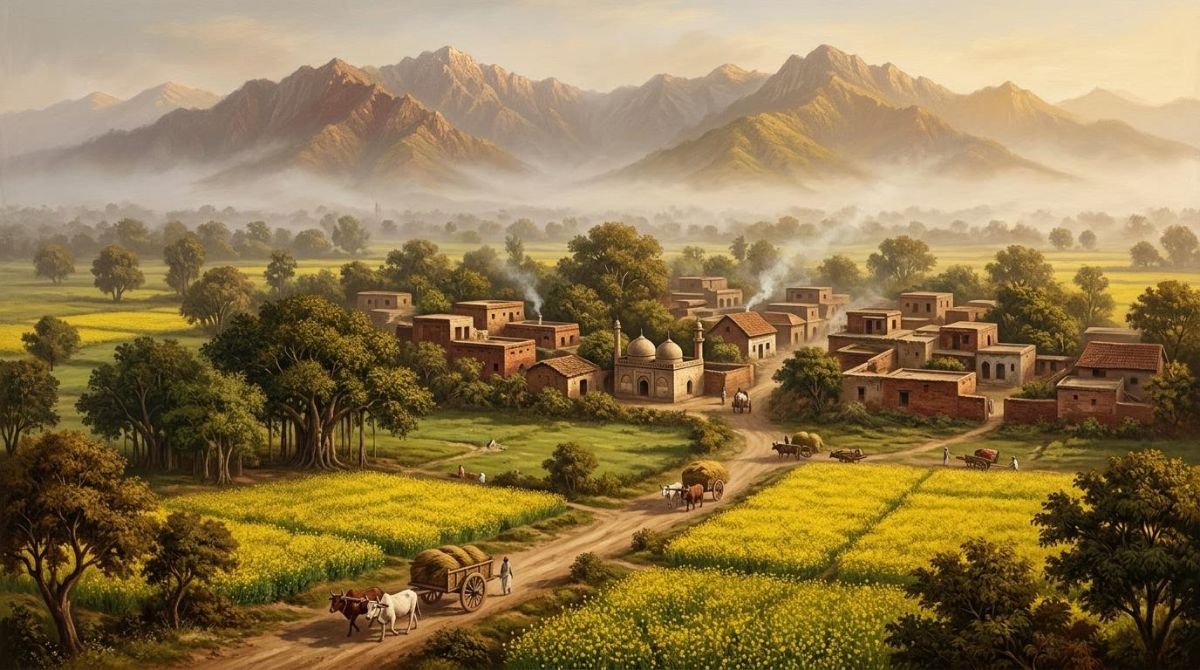
Barhang (برھنگ) is a village near Bhimber, in today’s Bhimber District of Azad Jammu and Kashmir, and the home of the Rupyal Chibs, descendants of Rup Chand, a son of Raja Dharam Chand (Baba Shadi Shaheed). Thakur Major Singh’s Tarikh-e-Chibhal (c. 1926) gives Barhang a chapter of its own, with a story of its name and of its Hindu and Muslim halves. The village is also the home of Raja Muhammad Iftikhar Ali Khan, author of the 1997 Chib history.
At a glance
- Location
- Near Bhimber, Tehsil and District Bhimber, Azad Jammu and Kashmir; in the State of Jammu in 1926
- Also written
- Urdu also بڑھنگ, with a retroflex r
- Got
- Rupyal (Rupial)
- Ancestor
- Rup Chand, also called Rupo Khan or Rup Khan, son of Raja Dharam Chand alias Raja Shadab Khan, Baba Shadi Shaheed
- Rupyal villages (1926)
- Barhang, Bhattiyan (reading uncertain), Chak Sardan (reading uncertain) and Chak Bhagu
- The name
- From two men, Bahar and Hangu (readings uncertain), servants of the Sudhan and Budhan Rajputs
- Known for
- The home of the 1997 Chib historian; the Barhang squad in the fight for Bhimber, October 1947
Where is Barhang?
Barhang lies close to the town of Bhimber, the old capital of the Chib Rajputs, in a group of villages near the border with Pakistan’s Punjab. Thakur Major Singh, writing in about 1926, places it “in the State of Jammu, near Bhimber” (Major Singh (c. 1926), p. 91). The 1997 history of Raja Muhammad Iftikhar Ali Khan places it first in Tehsil Bhimber of Mirpur district and then in Tehsil and District Bhimber, Azad Kashmir, and in 1947 a road ran from Bhimber to Barhang (Iftikhar Ali Khan (1997), pp. 46, 433, 435). The name is spelled in two ways in Urdu, with a plain r and with a retroflex one.
The Rupyal Chibs of Barhang: Rup Chand’s line
The Chib histories agree that Barhang belongs to the line of Rup Chand, a son of the Chib ruler of Bhimber whom Muslims remember as Raja Shadab Khan and Baba Shadi Shaheed. Thakur Major Singh, who calls the ruler Raja Dharam Chand, gives him four sons: Bhup Chand, Rup Chand, Mal Khan and Gul Muhammad Khan. Mal Khan and Gul Muhammad Khan became Muslims; Bhup Chand, whom Muslims called Bhum Khan, kept the throne of Bhimber and stayed a Hindu; and Rup Chand took his share of land from Bhup Chand. “His descendants,” the author writes, “are settled in Barhang” (pp. 19, 35). A later chart in the book labels his line simply “the Barhang family” (p. 42).
In the chapter he gives the family, the author calls Rup Chand the second son of Raja Dharam Chand “alias Shadi Khan”, and explains that his descendants are therefore of the Rupyal got. In his day Rupyal Rajputs lived in four villages, Barhang, Bhattiyan (reading uncertain), Chak Sardan (reading uncertain) and Chak Bhagu, most of them in Barhang itself (p. 91). The same four villages appear on a family chart in the 1997 history, which reads the second name as Bhaniyan (Iftikhar Ali Khan (1997), p. 389). The British ethnographer H. A. Rose, as translated in the same book, put the Rupial first in his list of the fourteen gots descended from Raja Shadi Khan (p. 27; see The Fourteen Septs of the Chib Clan).
| Topic | Tarikh-e-Chibhal (c. 1926) | 1997 Chib history |
|---|---|---|
| Ancestor | Rup Chand, second son of Raja Dharam Chand (pp. 35, 91) | Rupo Khan, the only son of Raja Shadab Khan’s second wife (p. 119) |
| How Barhang came to the line | Rup Chand took his share from his brother Bhup Chand (p. 35) | Raja Bhum Khan gave Rupo Khan a single village from his own share, Barhang (p. 119) |
| Got | Rupyal (p. 91) | Rupial, first of Rose’s fourteen gots (p. 27) |
| Villages | Barhang, Bhattiyan?, Chak Sardan?, Chak Bhagu (p. 91) | Barhang, Bhaniyan?, Chak Sardan?, Chak Bhagu (p. 389) |
| Faith | One section Hindu, one Muslim until shortly before the book was written (p. 91) | Not discussed |
| The name | From Bahar and Hangu, servants of the Sudhans and Budhans (pp. 91–92) | Not given |
Sources differ
Thakur Major Singh, a Hindu Chib, keeps Rup Chand’s Hindu name and records a Hindu section at Barhang until shortly before he wrote; in his account only two of the four brothers, Mal Khan and Gul Muhammad Khan, became Muslims. The 1997 history, which holds that Raja Shadab Khan embraced Islam of his own free will, knows Rup Chand only as Rupo Khan, the son of a second wife (Iftikhar Ali Khan (1997), pp. 113–115, 119). On the division itself the two books agree: Barhang came to Rup Chand out of his brother’s eastern share of the state. See How the Chibs divided into Hindu and Muslim lines.
How Barhang got its name
Thakur Major Singh records a story of the name that the later histories do not repeat. Long ago, he writes, when Rajputs of the Sudhan and Budhan tribes ruled this country, two men named Bahar and Hangu lived at the spot as servants of the Sudhans and Budhans, and the village was named after them: Bahar and Hangu became Barhang (pp. 91–92). Both names are hard to read in the old lithograph, and the second could also be Sangu.
The story fits what the 1997 history says of the country before the Chibs. It names the Budhans, Sudhans and Thakials as old rulers of the foothills around Vatala, and the Thakials and Budhans as the clans who held Bhimber before Raja Chib Chand came (Iftikhar Ali Khan (1997), pp. 119, 138; see The Thakial Rajputs). If Thakur Major Singh’s Sudhans and Budhans are those early rulers, the name of Barhang is older than its Chib families.
Two bands, one village: Hindu and Muslim Barhang
Barhang’s chapter holds a detail found nowhere else. The village, the author explains, was divided into two bands, or sections. Formerly one band belonged to Hindus and the other to Muslims; a short while ago, he writes, all of them accepted Islam, but the government records still called the old Hindu section Band Hinduwal, “the Hindus’ band” (reading uncertain) (p. 91). He uses the same word when he derives the name of the Chib mandi of Bandala from Band-e-A’la, “the upper band” (p. 93; see Mandi Bandala).
The note matters for the history of the whole clan. In Thakur Major Singh’s account the Chibs did not divide into Hindu and Muslim lines at a single moment. Of Raja Dharam Chand’s four sons only Mal Khan and Gul Muhammad Khan became Muslims; the senior line at Bhimber stayed Hindu for another generation; and Rup Chand’s village kept a Hindu section until shortly before the book was written (pp. 35–36, 91). The author does not say why or how Barhang’s Hindu families embraced Islam. He records only that they did, and that the old name of their section survived in the revenue papers. For the Chibs who remained Hindu, see The Hindu Chibs of Dewa Vatala.
Barhang in 1926: farmers rather than soldiers
The author’s portrait of the village in his own day is brief. Its people lived mostly by farming; their inclination towards military service, he notes, was very small, and only one or two of its sardars drew army pensions (p. 92). That set Barhang apart from the Chib villages he praises for soldiering, such as Panjeri and Bisa (see The Chibs in the First World War). His list of Chib officers bears him out: under Barhang it names only Subedar Sher Khan and Jamadar Abdul Rahman, in a block shared with Mughlora and Malot (p. 106; see Chib officers in 1926).
Barhang in October 1947
Two decades later Barhang was at the centre of the fight for Bhimber. According to the 1997 history, on 20 October 1947 the tehsildar of Bhimber came to Barhang and ordered its people, and those of four neighbouring villages, to leave their homes for the northern hills; instead they took their families across the border into Pakistan. Many of the local men were former soldiers. Arms were obtained from across the border, and ten rifles went to Subedar Major Abdullah Khan and Lieutenant Inayat Khan “Mujahid Haidari”, both of Barhang (Iftikhar Ali Khan (1997), pp. 44–45).
Subedar Major Raja Abdullah Khan led the Barhang squad and held the joint command of the volunteer squads from the old customs post at Bhimber, while Naib Subedar Raja Wilayat Khan of Barhang laid an ambush beside the Bhimber–Barhang road. On 22 October Abdullah Khan led the first assault on the town. It was driven back by heavy fire from machine guns and rooftops, and by one estimate fifteen volunteers from Barhang were killed; a second attempt by twenty-five men under Inayat Khan of Barhang was also beaten back. Bhimber fell on 26 October under the command of Brigadier Raja Habib-ur-Rahman Khan of Panjeri (pp. 46–47). The 1997 history records only the volunteers’ losses; the conflict of 1947 cost lives in every community of the region. The full account is in The Liberation of Bhimber, October 1947.
The historian’s village
Barhang is best known to readers of this site as the home of Raja Muhammad Iftikhar Ali Khan, the Karachi advocate who compiled the 1997 Chib history on which most of our articles are based. He signed its preface at Barhang in January 1997, thanked several men of the village for funds, transport and help with photography, and listed among his own writings a survey of the village’s past and present, Sarzamin-e-Barhang: Mazi wa Hal ka ek Tarikhi Ja’iza (Iftikhar Ali Khan (1997), pp. 13–16, 436). He was also the founding chairman of the Hazrat Baba Shadi Shaheed Academy at Barhang (p. 449; see Raja Muhammad Iftikhar Ali Khan of Barhang).
The village’s ties to its ancestor’s shrine run through the book. Master Raja Khan Malik Khan of Barhang, a companion of Chaudhry Ghulam Abbas of the Muslim Conference, was secretary of the Chibhal committee that ran the shrine of Baba Shadi Shaheed before 1947, and in 1962 Maulvi Raja Wilayat Ali Khan of Barhang became the first official of the Azad Kashmir Auqaf Department to take charge of it, serving there for about twenty-three years (pp. 190, 379–381; see From mujawirs to Auqaf). Men of Barhang also sat on the shrine’s advisory committee, among them two former chairmen of the Bhimber Rajani union council, and the book lists two tobacco companies at Barhang run by a family of Kot Chibban (pp. 187, 347–351; see Kot Chibban and Mughlora).
Frequently asked questions
Where is Barhang?
Barhang is a village near the town of Bhimber in Azad Jammu and Kashmir. In about 1926 it lay in the Maharaja’s State of Jammu, and the 1997 Chib history places it in Tehsil and District Bhimber.
Who are the Rupyal Chibs?
The Rupyal, or Rupial, Chibs are the descendants of Rup Chand, called Rupo Khan in the 1997 history, a son of the Chib ruler Raja Dharam Chand, remembered as Raja Shadab Khan or Baba Shadi Shaheed. According to Tarikh-e-Chibhal (c. 1926) they lived at Barhang, Bhattiyan, Chak Sardan and Chak Bhagu, most of them at Barhang.
How did Barhang get its name?
Tarikh-e-Chibhal (c. 1926) says that when Rajputs of the Sudhan and Budhan tribes ruled the area, two of their servants, Bahar and Hangu, lived at the spot, and the village was named Barhang after them. Both names are uncertain readings in the old lithograph.
Were there Hindu Chibs at Barhang?
Yes, according to Thakur Major Singh. He writes that Barhang was once divided into a Hindu and a Muslim section, or band, that the Hindu families had accepted Islam a short while before he wrote in about 1926, and that the revenue records still called their section Band Hinduwal.
What part did Barhang play in 1947?
According to the 1997 Chib history, men of Barhang, many of them former soldiers, formed one of the volunteer squads that fought for Bhimber in October 1947. Subedar Major Raja Abdullah Khan of Barhang led the first assault on 22 October, in which about fifteen Barhang volunteers were killed, and Bhimber was taken on 26 October.
Sources
- Thakur Major Singh Chib, Tarikh-e-Rajgan-e-Bhimber wa Qaum-e-Chibhal (Tarikh-e-Chibhal; Urdu, c. 1926), pp. 19, 35–36, 42, 91–93, 106.
- Raja Muhammad Iftikhar Ali Khan, Raja Shadab Khan alias Hazrat Baba Shadi Shaheed (Urdu, Barhang/Karachi, 1997), pp. 13–16, 27, 44–47, 113–115, 119, 138, 187, 190, 347–351, 379–381, 389, 433–436, 449.
- H. A. Rose, A Glossary of the Tribes and Castes of the Punjab and North-West Frontier Province (1911), in the 1997 history’s Urdu translation, p. 27.
This article is part of our series on the oldest Chib history; see Tarikh-e-Chibhal, chapter by chapter. Spellings of names follow the book; readings marked “uncertain” could not be read with certainty in the old lithograph.
Continue reading
Have a question about this history?
Our AI guide answers from the articles on this site, in English or Urdu.
