

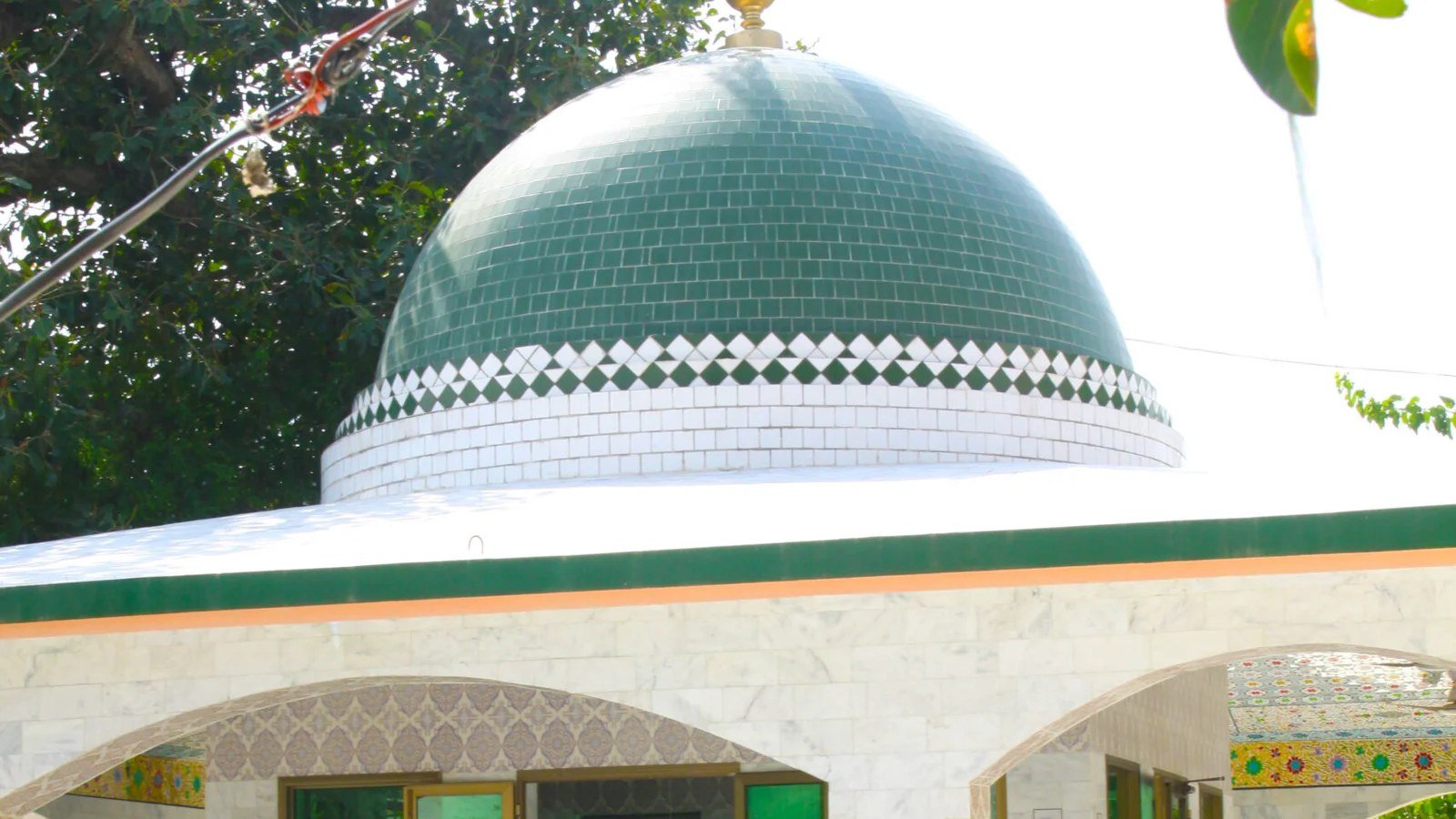
For four or five centuries the Baba Shadi Shaheed darbar (دربار عالیہ حضرت بابا شادی شہید), the hilltop shrine of the Chibs’ ancestor on Aadhi Dhak near Bhimber in Azad Kashmir, was kept by hereditary mujawirs (attendants). In early 1961 the Auqaf (religious endowments) Department of the Azad Jammu and Kashmir Government took it over, and since then salaried managers, advised by a committee of Chib notables, have run the shrine and greatly enlarged its facilities.
At a glance
- Shrine
- Darbar-e-Aliya Hazrat Baba Shadi Shaheed, Aadhi Dhak, District Bhimber, Azad Jammu and Kashmir
- Before 1961
- Hereditary mujawirs, Khokhar Rajputs by their own account; 40–45 of them in 1961
- Chibhal committee (before 1947)
- President Rai Abdullah Khan of Thotha Rai Bahadur; secretary Master Raja Khan Malik Khan of Barhang
- Takeover
- Early 1961; charge taken on 20 March 1961 by the patwari Raja Bashir Ahmad Khan
- First Auqaf official
- Maulvi Raja Wilayat Ali Khan of Barhang, July 1962 to 1984
- Manager with the most postings
- Sardar Muhammad Fazil Nadeem, four postings between 1984 and 1997
- Manager in 1997
- Raja Muhammad Saleem Khan of Dhirkot
- Advisory Committee
- About 25 notables from the Chib villages
The hereditary mujawirs of the Baba Shadi Shaheed darbar
The darbar is the tomb of Raja Shadab Khan, the Chib ruler of Bhimber revered as Baba Shadi Shaheed and regarded as the progenitor of the Chib Rajputs of Chibhal. A mujawir is a hereditary attendant who lives beside a shrine and keeps it. When Thakur Major Singh of Dewa Vatala wrote his Tarikh-e-Chibhal (1983 Bikrami, c. 1926), the mujawirs of Aadhi Dhak lived in houses built for them near the tomb. They told him they were Khokhar Rajputs: Raja Dharam Chand, as the Thakur calls Shadab Khan, had a Khokhar wazir (minister) who fled after the Raja was killed, came back some time later, became a Muslim and stayed as keeper of the tomb. His descendants became its mujawirs, or in the Thakur’s word its pujaris. The Thakur added that the Khokhars are a Chandravanshi Rajput clan, all of whom had by then accepted Islam.
The mujawirs shaped the shrine as earlier visitors knew it. The Thakur noted that the Raja’s resting place had once been a completely flat, square platform of stones and unbaked bricks under a cloth, and that the mujawirs had lately set two mounds on it, which they called the graves of the Raja and the Rani. They received a share of the goats sacrificed at the first-haircut ceremonies, and they fetched water from the neighbouring springs for pilgrims. The graves of their own forebears lie to the west of the darbar.
Not every devotee was content with them. Maulvi Raja Wilayat Ali Khan of Barhang, who came in 1957 to fulfil a vow made for the birth of a nephew, felt that the mujawirs paid too little regard to the sanctity of the place, and he prayed at the tomb for a chance to serve it himself.
The Chibhal committee and the domed mosque
Before the creation of Pakistan in 1947, the Chib brotherhood (biradari) made its own attempt to put the shrine’s affairs on a proper footing. According to Master Raja Khan Malik Khan of Barhang, a close companion of Chaudhry Ghulam Abbas, the leader of the All Jammu and Kashmir Muslim Conference (see the Chibs in Kashmir politics), a gathering of the whole Chibhal brotherhood unanimously formed a Management Committee (Intizamiya Committee) for the darbar. Rai Abdullah Khan of Thotha Rai Bahadur, Tehsil Kharian, District Gujrat, was elected president and Khan Malik Khan secretary.
The committee’s best-remembered work was on the old mosque beside the tomb, which was in a dilapidated state. It was repaired and given a new wooden roof, which soon fell in; this happened three or four times. Khan Malik Khan related that the Baba then appeared to him in a dream and told him to roof the mosque with a dome rather than timber. The committee did so, and the domed roof, he said, had stood for more than half a century. The book confirms that the present domed structure of the ancient mosque was completed during Rai Abdullah Khan’s presidency.
Rai Abdullah Khan, head of the Rai family of Thotha Rai Bahadur in the line of Raja Mal Khan of Khari Kariali, had served as Naib Tahsildar in Phalia and Chakwal and as Office Superintendent to the Deputy Commissioner of Mianwali, and retired as a Tahsildar. The book calls him deeply devoted to his great ancestor. He died on 23 December 1959 and is buried in the family graveyard at Thotha Rai Bahadur, where his tombstone names him “Rai Bahadur Abdullah Khan, Pensioner Tehsildar, Wali of Thotha Rai Bahadur”.
1961: the Auqaf takes charge
In early 1961 the Azad Kashmir Government brought the shrine under its Auqaf Department; Maulvi Wilayat Ali Khan dated the change to January 1961. The man who carried it out was Raja Bashir Ahmad Khan of Pothi Jang Khan, grandson of the Pothi numberdar Raja Datta Khan and then a patwari (village revenue official) of the Revenue Department in Tehsil Bhimber. His signed account is printed in the book.
He was ordered to take charge of the darbar from the mujawirs within two days, and the book dates his taking charge to 20 March 1961. Knowing that the 40 to 45 hereditary mujawirs, who had held the shrine for four or five centuries, would not easily give it up, he used what he called practical wisdom. He gathered them together, reminded them that he belonged to the Baba’s family, and asked them to repair the shrine’s dislodged platforms, since large parties of pilgrims were due on Friday from Barhang, Mohri and Thotha Rai Bahadur. Then he took three of them, Munshi Khan, Baz Khan and Maula Khan, aside and explained that the tehsil wanted the old equipment listed so that new equipment could be issued. The inventory was drawn up that day and signed or thumb-printed by every mujawir. Only then did he show the government order to a literate mujawir, Muhammad Shafi, and announce that he had taken charge.
“You have served my great ancestor for centuries. The possession of the Darbar Sharif is your right.”
— Raja Bashir Ahmad Khan to the mujawirs, 1961, in Iftikhar Ali Khan (1997), p. 189
The mujawirs wept aloud, and some clung to the graves of their parents west of the darbar. Bashir Ahmad Khan consoled them and advised them to put their case to the senior officers at Bhimber and Mirpur. Four or five went to Bhimber but came back empty-handed after four or five days, and he kept one or two of them on for work. He stayed at the shrine for a month and found conditions very basic: blankets had to be borrowed from village houses, fallen chir-pine needles served as bedding for pilgrims, and donations from visiting parties paid for mats. On 22 April 1961 he handed charge to another patwari, Syed Sarwar Shah, and returned to his own circle at Panjeri. Looking back, he judged that government custody had been a blessing for pilgrims. He later retired as a Girdawar (revenue inspector).
Sources differ
The book gives the start of Auqaf control as early 1961 and Maulvi Wilayat Ali Khan as January 1961, while Bashir Ahmad Khan took charge on 20 March 1961. His handover date is printed as 22.4.1991 in his account but 22-4-61 in the quoted order; 1961 is clearly meant. He is called an Office Qanungo in one place and a Girdawar in others.
Maulvi Raja Wilayat Ali Khan, 1962–1984
The first Auqaf official to take charge of the darbar was Maulvi Raja Wilayat Ali Khan of Barhang, a descendant of the Baba, strict in the shari’a and respected on the Sufi path. He had worked for 31 years with Pakistan Railways in Lahore. After his visit of 1957 he took early retirement in 1959, and he was still living in Lahore when Master Raja Khan Malik Khan wrote to say that the Auqaf needed staff at the shrine.
His appointment, as he told it, took persistence. With Muhammad Nazir Katoch, Advocate, of Bhimber, he called on the Tehsildar of Bhimber, who said there was no such post; Wilayat Ali Khan replied that he did not need a job, only the chance to serve the Baba’s pilgrims. Next morning he returned with an application written by Khan Malik Khan and, at the Tehsildar’s request, with Raja Sohbat Ali Khan of Malot, a pleader of Bhimber, along with Khan Malik Khan, Nazir Katoch and Raja Abdul Aziz, a numberdar (village headman). The shrine committee lacked a quorum that day, but at its next meeting the members signed in his favour. The Tehsildar posted him subject to approval, Sohbat Ali Khan took the papers to the Deputy Commissioner at Mirpur, who had them sent to Muzaffarabad for approval, and after a week’s delay the posting orders arrived.
In July 1962 he took charge from the Revenue Department’s patwari. He started as a clerk, was promoted to Supervisor, and served the darbar for about 23 years, until 1984, living in the nearby village of Narah. Under him the graves of the Baba and Rani Thakial, which he had found as a heap of earth, were rebuilt in masonry in 1968, together with the Auqaf manager of the day, Sultan Butt, and the tomb received its dome. Soon after he took charge, he related, a tall, radiant figure of royal bearing told him in a dream: “Go, son! I have made you my gaddi-nashin.” A Rawalpindi journal later printed his name as the shrine’s sajjada-nashin (spiritual successor), and around Bhimber he was widely known by that title, although he was only a government employee. He was in his eighty-fifth year when the author interviewed him.
Sources differ
One passage of the book says Wilayat Ali Khan spent 31 years in the shrine’s service; the staff list and his own account give about 23 years (1962–1984). Thirty-one years was the length of his railway career.
Managers of the darbar, 1961–1997
The book lists the officials posted at the darbar after the takeover. Besides the manager, the staff in the 1990s included an accountant, an accounts clerk, the khatib (preacher) of the shrine mosque, a qari (Qur’an reciter) and several khadims (attendants).
| Official | From | Post and period |
|---|---|---|
| Raja Bashir Ahmad Khan | Pothi Jang Khan, Tehsil Bhimber | Patwari, Revenue Department; took charge for the Auqaf, 20 March to 22 April 1961 |
| Syed Sarwar Shah | Not stated | Patwari; received charge on 22 April 1961 |
| Maulvi Raja Wilayat Ali Khan | Barhang, Tehsil Bhimber | First Auqaf official; clerk, then Supervisor, July 1962 to 1984 |
| Sultan Butt | Not stated | Manager Auqaf for the shrine in 1968 |
| Babu Abdul Khaliq | Not stated | Supervisor of construction, about 1985 |
| Sardar Muhammad Fazil Nadeem | Sarsawa, District Kotli | Manager Auqaf: September 1984 to April 1985; June 1989 to July 1991; January 1992 to February 1993; December 1995 to May 1997 |
| Muhammad Shafiq Dar | District Kotli | Manager; predecessor of Raja Muhammad Saleem Khan |
| Raja Muhammad Saleem Khan | Dhirkot, District Bagh | Manager in 1997, having served there as manager before |
Sardar Muhammad Fazil Nadeem, a member of the Sudhan (Sadozai) family, is described in the book as a man strict in the shari’a and devoted to the Sufis, and his service at the darbar as the longest of any Auqaf officer (Wilayat Ali Khan’s longer service was as clerk and supervisor). In March 1997 he was ordered to Muzaffarabad and his replacement had already arrived, but within days the orders were cancelled, an episode he attributed to the Baba (see the devotees’ testimonies).
What changed under the Auqaf
- The graves and the tomb. The earthen graves were rebuilt in masonry in 1968, a lattice was set round them and a dome built over the tomb; in about 1985 a devotee from Jhelum rebuilt the two graves again over the old ones.
- The road. The Azad Kashmir Government built a metalled road of one and a half to two miles from Jandi Chontra, on the Bhimber–Samahni road, and the Auqaf maintained it with a supervisor and labourers, so that cars, buses and trucks could reach the shrine.
- Lodgings. The old three-tiered verandahs were partitioned into rooms, and a stone guest-house with a cement roof was added in the 1990s.
- Water and light. Attendants first carried water from a spring half a mile away in canisters on donkeys. Maulvi Wilayat Ali Khan told the author that the cost of an electricity connection had been deposited with WAPDA, and by 1997 electricity and a proper water supply had both been completed.
- Staff. A manager, accountant, clerk, khatib, qari and khadims replaced the hereditary attendants.
Private generosity continued too. On 9 December 1986 the tank built in 1886 by Raja Mahmud Khan of Samahni was rebuilt at the expense of Raja Muhammad Razzaq Raza of Khori, under the supervision of Raja Muhammad Iqbal Khan Inqilabi. For a guide to the buildings, see Baba Shadi Shaheed Shrine at Aadhi Dhak.
The Advisory Committee of the darbar
By the 1990s the Chib villages were represented through an Advisory Committee (mashawarti committee) of the Darbar-e-Aliya with about 25 members. The book singles out Raja Fazal-ur-Rehman Khan of Pothi Jang Khan, president of the Tehsil Bhimber Muslim Conference, as its most active member, constantly pressing the Auqaf Department and the Bhimber district administration for better facilities for pilgrims. The members listed in the book were as follows; several village names are uncertain readings of the print.
| Member | Village | Office noted in the book |
|---|---|---|
| Raja Feroz Khan | Thotha Rai Bahadur | Former Chairman, Union Council Thotha Rai Bahadur |
| Raja Muhammad Latif Khan | Samahni valley | Political and social worker |
| Raja Rahmatullah Khan | Samahni valley | Social worker |
| Raja Khizar Hayat Khan | Sandoa (uncertain) | – |
| Raja Sardar Khan | Dab (uncertain) | – |
| Raja Muhammad Afzal | Haddi (uncertain) | – |
| Raja Muhammad Ashraf Khan | Dalli, Sagra area (uncertain) | – |
| Raja Fazal-ur-Rahman | Pothi Jang Khan | President, Tehsil Bhimber Muslim Conference |
| Raja Mazhar Iqbal | Da’ora | Advocate |
| Raja Parvez Khan | Da’ora | – |
| Raja Muhammad Ishaq Khan | Panjeri | Former District Councillor |
| Raja Khadim Hussain Khan | Panjeri | Former Chairman, Union Council Panjeri |
| Raja Buta Khan | Samhal (uncertain) | Numberdar |
| Raja Fazal Dad Khan | Barhang | – |
| Raja Tajammul Hussain Khan | Kalri | Former Chairman, Union Council Kalri |
| Raja Sawar Khan | Barhang | Former Chairman, Union Council Bhimber Rajani |
| Raja Muhammad Latif Khan | Barhang | Former Chairman, Union Council Bhimber Rajani |
| Raja Muhammad Rafiq Khan | Kot Chibban | Chairman, Sultan Tobacco Industries, Bhimber |
| Raja Muhammad Asif Khan | Salawan | Former District Councillor, Mirpur |
| Raja Muhammad Irshad Khan | Mughlora | – |
| Raja Walid Khan | Kasgumah Jagir | – |
| Raja Muhammad Azam Khan | Gigan (uncertain) | – |
| Raja Muhammad Asghar Khan | Barwah (uncertain) | – |
| Colonel (Retd) Raja Manzoor Hussain Khan | Randyam (uncertain) | Retired army officer |
| Raja Khurshid Ahmad Khan | Malot | Muslim Conference worker, Bhimber city |
| Raja Muhammad Azam Khan | Rajal Mandi (across the Line of Control), living in Bhimber | – |
The list reads as a cross-section of Chibhal in the 1990s: union-council chairmen and district councillors, a lawyer, a retired colonel, an industrialist and village headmen from the Bhimber, Samahni, Mirpur and Kharian areas.
Frequently asked questions
Who manages the Baba Shadi Shaheed darbar?
Since 1961 the shrine has been run by the Auqaf Department of the Government of Azad Jammu and Kashmir, which posts a manager with an accountant, a clerk, a khatib, a qari and attendants. An Advisory Committee of about 25 notables from the Chib villages advises it.
Who were the mujawirs of Baba Shadi Shaheed’s shrine?
They were hereditary attendants who kept the shrine for four or five centuries. They told Thakur Major Singh that they were Khokhar Rajputs descended from the Raja’s wazir, who returned after the Raja’s death, became a Muslim and settled at the tomb. There were 40 to 45 of them in 1961.
When did the Auqaf Department take over the shrine?
In early 1961. The patwari Raja Bashir Ahmad Khan took charge from the mujawirs on 20 March 1961 and handed over on 22 April 1961. The first Auqaf official, Maulvi Raja Wilayat Ali Khan of Barhang, took charge in July 1962 and served until 1984.
Who gave the shrine mosque its domed roof?
A management committee of the Chibhal brotherhood, formed before 1947 under Rai Abdullah Khan of Thotha Rai Bahadur, with Master Raja Khan Malik Khan as secretary. Khan Malik Khan said the Baba told him in a dream to build a dome after wooden roofs had collapsed several times.
What is the Advisory Committee of the darbar?
It is a body of about 25 notables from the Chib villages, listed in the 1997 Chib history, which advises the Auqaf Department on the shrine. Its most active member, according to the book, was Raja Fazal-ur-Rehman Khan of Pothi Jang Khan, who pressed for better facilities for pilgrims.
Sources
- Raja Muhammad Iftikhar Ali Khan, Raja Shadab Khan alias Hazrat Baba Shadi Shaheed (Urdu, Barhang/Karachi, 1997), pp. 77–79, 84–87, 92–93, 142–143, 184–192, 261, 322, 334, 359–360, 376–386.
- Raja Bashir Ahmad Khan, signed account of the 1961 takeover, with copies of the orders of 20.3.61 and 22-4-61, printed in the book, pp. 188–189.
- Thakur Major Singh (printed “Mehjar Singh”) of Dewa Vatala, Tarikh-e-Chibhal (1983 Bikrami, c. 1926), pp. 26–34, as quoted in the book.
- Oral accounts of Maulvi Raja Wilayat Ali Khan, Master Raja Khan Malik Khan and Sardar Muhammad Fazil Nadeem, recorded by the author.
This article is part of our series based on the 1997 Chib history; see the book, chapter by chapter. Spellings of names follow the book.
Continue reading
Have a question about this history?
Our AI guide answers from the articles on this site, in English or Urdu.
