

The Mehtas of Bhimber (مہتوں کا خاندان, “the family of the Mehtas”) were a Kohli Khatri family from Sialkot who, according to Thakur Major Singh’s Tarikh-e-Chibhal (c. 1926), received the title Mehta from the emperor Akbar and then served Bhimber, the Chib Rajput state in today’s Azad Jammu and Kashmir, as its revenue officials, its agents at other courts and finally its wazirs (chief ministers). Their quarrels with the Chib rajas, two murders, a seized fortune and a warrant from Jammu, run through the story of how Bhimber came under Jammu and then fell to the Sikhs. The 1997 Chib history quotes his chapters almost word for word, and Chibhal Nama (c. 2023) retells part of the story.
At a glance
- Who
- A Kohli Khatri family from Sialkot, in the Punjab
- Title
- Mehta, granted by Akbar to the brothers Uttam Chand and Parmanand
- Lands
- Revenue-free land at Bhimber and at Naushera
- Offices
- Qanungo and kardar of the Bhimber country; vakil at Jammu; wazir of Bhimber
- Named by Major Singh
- Uttam Chand, Parmanand, Gulab Rai, Satil Das, Bahadur Singh, Rajkor and Sujan Singh
- Period
- From Akbar’s reign (1556–1605) to the Sikh conquest of Chibhal in the early 19th century
- Another Mehta
- A Brahmin kardar of Dhan with the title Mehta, patron of Dasu Khan of the Hindu Chibs (Major Singh, pp. 38–39)
- Main source
- Major Singh (c. 1926), pp. 38–39, 62–74, 80; quoted in Iftikhar Ali Khan (1997), pp. 43–44, 123–132; partly retold in Chibhal Nama (c. 2023), pp. 32, 72–75, 84–88, 238–239
Who were the Mehtas of Bhimber?
Bhimber stands where the plains of the Punjab meet the first hills on the old road to Kashmir. For some four centuries it was the capital of the Rajas of Bhimber, the senior house of the Chib Rajputs. The Mehtas were neither Chibs nor Rajputs. Thakur Major Singh of Deva Vatala, the Hindu Chib who wrote the first history of the clan, traces them to two brothers of the Kohli section of the Khatri caste from Sialkot, Uttam Chand and his younger brother Parmanand, who went to Delhi in Akbar’s reign and entered the emperor’s service (Major Singh (c. 1926), p. 63).
When Diwan Todar Mal, the finance minister who carried out Akbar’s great revenue settlement, came towards Chibhal after settling the Punjab, the two brothers were with him. The Raja of Bhimber would not let the settlement be completed (Chibhal Nama names him as Raja Jamshed Khan, p. 32), and Todar Mal moved on to Gujrat; but through the efforts of the brothers, still plain “Lala” Uttam Chand and Parmanand in the author’s text, the settlement of the area was made. On Todar Mal’s report the emperor granted Uttam Chand revenue-free (ma’afi) land at Bhimber and Parmanand land at Naushera, and gave them the title of Mehta (p. 63), a title long used in northern India for men of the pen, such as accountants and revenue officials.
Uttam Chand built himself a palace at Bhimber, on the spot where a few households of ordinary subjects lived. This was west of the Bhimber Nala, in the quarter the author calls Bhimber Riki, “the settlement of the subjects”, across the stream from the hill palaces of the rajas (p. 62). As Akbar prepared to conquer Kashmir, which his armies annexed in 1586, he ordered houses to be built around the Mehta’s palace, half their cost paid from the royal treasury, with a masonry sarai in the middle, and named the town Akbarabad (p. 63). In Major Singh’s account, then, the present town of Bhimber grew up around a Mehta’s house, and the arched gateway of Uttam Chand’s palace was still standing on the south side of the town in his day. The sarai and the other Mughal buildings are described in Bhimber’s Monuments.
Qanungos, kardars, vakils and wazirs
The chronicle says the family served continuously at the court of the kings of Delhi, and that men of the Mehta family alone were appointed qanungo and kardar of the Bhimber country (p. 65). They held, in other words, the records and the collection of the land revenue in a raja’s country while serving the emperor. For a time, the author writes, the Mehtas and the Rajgan of Bhimber stayed on good terms, but later “some tension arose” (p. 65). The offices the family held, as the book records them, were these:
| Office | What it meant | Mehtas who held it |
|---|---|---|
| Qanungo | In the Mughal system, the hereditary keeper of a district’s land and revenue records | Men of the family, by the author’s account the only ones appointed (p. 65) |
| Kardar | A revenue agent who collected the state’s share of the harvest in a district | Likewise (p. 65) |
| Vakil | An agent or envoy who represented a ruler at another court | Bahadur Singh, for Raja Naeem Khan at the Jammu court (p. 67) |
| Wazir | Chief minister of the state | Sujan Singh, appointed by a parwana (warrant) of Maharaja Ranjit Dev of Jammu (p. 68) |
| Hakim | Governor of a territory | Sujan Singh, ruler of Chibhal for the Sikh government (p. 74) |
The Mehtas named in the chronicle
Major Singh names seven members of the family, from Akbar’s reign to the Sikh conquest. He does not say how the early Mehtas were related to the later ones, except for one line of three generations: Satil Das, his son Bahadur Singh and Bahadur Singh’s son Sujan Singh, whose chacha (paternal uncle) was Mehta Rajkor.
| Mehta | Reign (as the book dates it) | Role | What the book records | Pages |
|---|---|---|---|---|
| Uttam Chand | Akbar | Imperial servant; first to bear the title Mehta | Completed Todar Mal’s settlement; land at Bhimber; built the palace around which Akbarabad grew | 63 |
| Parmanand | Akbar | Imperial servant; title Mehta | Uttam Chand’s younger brother; land at Naushera | 63 |
| Gulab Rai | Aurangzeb, under Raja Ismail Khan | In service at Delhi | Killed on the road to Bhimber at the instance of Naurang Rai Wadhera of Gujrat | 65–66 |
| Satil Das (reading uncertain) | Muhammad Shah | In service at Delhi | His goods seized by the Raja of Bhimber, who ignored an imperial order to return them | 66 |
| Bahadur Singh, son of Satil Das | 1791–1817 Bk (c. 1734–1760) | Imperial servant; in Kashmir under Raja Sukh Jiwan; vakil of Raja Naeem Khan at Jammu | Killed on the road at Bhimber on the raja’s orders, 1817 Bk | 66–68 |
| Rajkor | Raja Naeem Khan to Raja Sultan Khan | Sujan Singh’s paternal uncle | Went with Sujan Singh to seek justice at Jammu; a Mehta Rajkor, “a relative” of the wazir, was later killed at Ghaddala (reading uncertain) | 68, 71 |
| Sujan Singh, son of Bahadur Singh | Raja Sulaiman Khan to the Sikh conquest | Wazir of Bhimber; later ruler of Chibhal for the Sikhs | Imprisoned through Hayat Begum; went to Lahore and returned with the Sikh armies | 68–74 |
Chibhal Nama names only four of them: Uttam Chand and Parmanand (p. 32), and Sujan Singh and Mehta Rajkor, whom it calls a close relative of the wazir (pp. 84–85). It leaves out Gulab Rai, Satil Das and Bahadur Singh, and with them the quarrels below (p. 80).
The Mehtas and the rajas: three quarrels
The chronicle tells the family’s quarrel with the Chib rajas in three episodes, each a step in Bhimber’s slide from Delhi’s orbit into Jammu’s. They are retold in full in How Bhimber Came Under Jammu; here they are seen from the Mehtas’ side.
Mehta Gulab Rai and Aurangzeb
In Aurangzeb’s reign, while Raja Ismail Khan, in the seventh generation from Raja Ghanni Chand, ruled Bhimber, Mehta Gulab Rai came home on leave from Delhi and was killed on the road at the instance of Naurang Rai Wadhera of Gujrat. The raja, who had a hand in the murder himself, ignored the emperor’s order to send the killer to Delhi, and troops were sent to arrest them both. Warned by his informers at court, Ismail Khan rode to Delhi with Naurang Rai and was pardoned; Naurang Rai was put to death with blows of an adze (pp. 65–66).
The goods of Mehta Satil Das
Under Muhammad Shah, when, the author says, province after province was breaking away from Delhi, an unnamed Raja of Bhimber first entertained the visiting Mehta Satil Das as a royal official, then seized all his goods and ignored an imperial order to return them. The emperor took the Mehta’s son, Bahadur Singh, into his own service and in 1791 Bikrami (c. 1734) sent him to carry out government business for Raja Sukh Jiwan, the governor of Kashmir (pp. 66–67).
Mehta Bahadur Singh and the game of chaupar
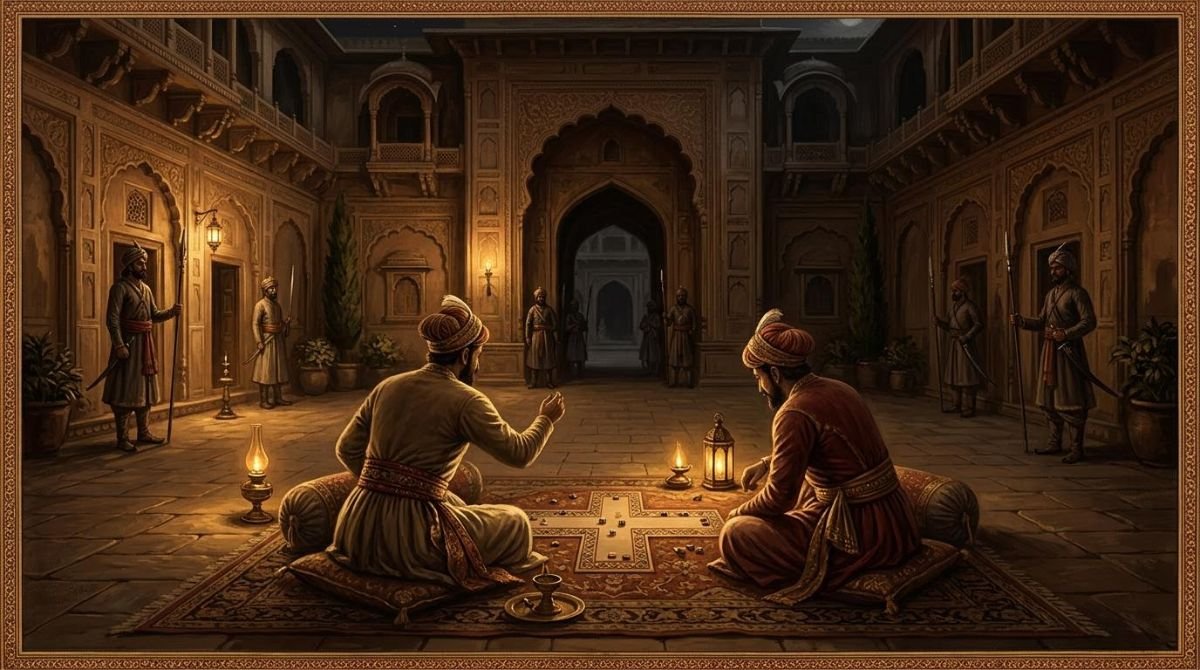
Once, in the chronicle’s account, Chibhal had been granted to Maharaja Ranjit Dev of Jammu, Raja Naeem Khan (Munim Khan) made Bahadur Singh, now home from Kashmir, his vakil at the Jammu court, where he won a good name. The raja, the author says, was outwardly pleased with him but inwardly displeased. In 1817 Bikrami (c. 1760), during a visit to Bhimber, Bahadur Singh played chaupar, the cross-shaped board game, with the raja every day; one night men posted on the road killed him on his way home. His children were not harmed (pp. 67–68).
Bahadur Singh’s son, Sujan Singh, went to Jammu with his uncle, Mehta Rajkor, and petitioned Ranjit Dev for justice. Naeem Khan died before he could answer. His son, Raja Sulaiman Khan, told the Jammu court that the murder had happened in his father’s time and that he knew nothing of it. Ranjit Dev pardoned him, but made Sujan Singh wazir of Bhimber and wrote him a parwana for the post (p. 68). Bhimber’s chief minister now held office by a warrant from Jammu.
Wazir Sujan Singh: from Bhimber to Lahore
With Sujan Singh the Mehtas reached the top of the state. The chronicle is warm about him: raja and wazir came back from Jammu and governed in peace and security, and
Wazir Sujan Singh worked with such excellence and honesty that within a short time he became beloved among the subjects.
— Major Singh (c. 1926), p. 68
When Sulaiman Khan died after five years on the throne, his young son, Raja Sultan Khan, kept Sujan Singh as his own wazir (pp. 68–69). The break came through the palace. Hayatu (Hayat Begum), a woman Sultan Khan had taken into the palace and on whose word he came to act, was hostile to Sujan Singh and to the commander-in-chief, Burhan Khan. She had the wazir’s relative Mehta Rajkor killed at Ghaddala (reading uncertain), and when Sujan Singh arrested the killers she turned the raja against him and had him imprisoned. Pandit Karam Chand became wazir in his place (p. 71). The older histories describe Hayat Begum as a woman of the bazaar; Chibhal Nama calls her the raja’s second Rani, an educated girl of eighteen from a family of musicians of Gujrat, and says only that she turned him against the wazir in connection with Rajkor’s murder, which it places at Kadhala (pp. 84–85, 238–239).
Released, Sujan Singh went to Lahore and laid his case before Maharaja Ranjit Singh, who already resented Sultan Khan’s seizure of villages belonging to Sahib Singh, the ruler of Gujrat, in 1847 Bikrami (c. 1790). From then on the former wazir marched with the Sikh armies sent against his old master (pp. 71–74):
- First expedition Diwan Mohkam Chand marches to Naushera, where Ikhtiyar Khan, of the royal family, is given the raj-tilak in the sarai, and Sujan Singh comes with the new raja to Bhimber. When the Sikh troops leave in the snow, Sujan Singh asks in vain for five thousand men to hold the country, and urges Ikhtiyar Khan not to go back to Naushera (pp. 71–72).
- Captive at Rajouri Ikhtiyar Khan is captured at Chahi and killed; Sujan Singh is held at Rajouri for some months, gets free and reaches Lahore again (p. 73).
- Second expedition He returns with Diwan Kishan Saha and eight thousand men. After defeats at Pir Badesar and Pothi, the army is routed at Chhachhu Pir, and both men are captured (pp. 73–74).
- Ruler of Chibhal Sultan Khan sends them on to Sardar Ram Singh at Akhnur, who promises Sujan Singh the government of Chibhal (spelt Chhibal in these pages). After Sultan Khan’s surrender, Sujan Singh remains its ruler on behalf of the Sikh government (p. 74).
Whether the Mehtas’ story ends there, the book does not say. In a later chapter it names a “Wazir Sujan Singh” again, with Mian Mehtab Singh (reading uncertain), as a governor of Chibhal under Raja Jawahir Singh, son of Raja Dhian Singh, after the country had passed to the Dogras of Jammu (p. 80). If this is the same man he would by then have been very old, and the author does not explain. Chibhal Nama dates Jawahir Singh’s rule over Bhimber from 1846 (p. 43), which would make him older still; it also has Sardar Ram Singh send both prisoners from Chhachhu Pir on to Lahore, and says nothing of Sujan Singh’s government of Chibhal (p. 88). The Sikh campaigns are told in Raja Sultan Khan and the Sikh Wars, and the fall of the Chib state in The End of Chib Rule.
Another Mehta: the kardar of Dhan
Major Singh tells of a second Mehta, in another part of the Chib country and of another caste. In his chapter on Dasu Khan, the posthumous founder of the Hindu Chibs of Dewa Vatala, the boy comes to Mauza Dhan, where the kardar of the hill country was a Brahmin “who had the title of Mehta” (Major Singh (c. 1926), p. 38). None of the histories links him to the Kohli Khatri Mehtas of Bhimber; the title was evidently given to revenue men of more than one family. The later books remember his family differently.
What the three histories say
Major Singh, Tarikh-e-Chibhal (c. 1926) · the original
The old, childless Mehta taught Dasu, treated him as a son and trusted him to carry the revenue, twenty-five rupees and a hawk each harvest, to Bahlolpur on the Chenab. When the Mehta died Dasu claimed the kardari, and although the Mehta’s close relatives struggled hard against him, nothing availed them: the post went to Dasu (pp. 38–39).
Iftikhar Ali Khan (1997)
Does not tell this story. Its account of Dasu Khan, quoted from Major Singh, gives only his birth and his sons (p. 137).
Chibhal Nama (c. 2023)
Retells Major Singh’s story closely, placing Dhan eight miles north of Deva Vatala and calling it the seat of the kardar, under a qanungo of a tehsildar’s rank. But here Dasu, grateful to the family that had helped him, laid on his descendants a duty to give the Mehta’s heirs grain at every harvest. The custom ended only in 1947, when the Mehta households moved to Weri Pattan, Dheri and Mankot in Tehsil Naushera and the Hindu Chibs left Deva Vatala (pp. 73–75).
Where this leaves us
All agree that a childless Brahmin Mehta, kardar at Dhan, raised Dasu and that Dasu succeeded him. They part on what followed: Major Singh, the oldest and himself a descendant of Dasu, remembers the Mehta’s kin as rivals, while Chibhal Nama remembers a debt repaid for centuries. Its grain-gift and the families’ move in 1947 appear in no older book, and it gives no source for them.
What the original pages add
The 1997 history of Raja Muhammad Iftikhar Ali Khan quotes these chapters almost word for word (Iftikhar Ali Khan (1997), pp. 43–44, 123–132), and our earlier articles followed its text. Major Singh’s own pages, now online in our guide to Tarikh-e-Chibhal, chapter by chapter, settle several details:
- Wadhera, not Dhudhera. The surname of Gulab Rai’s killer is written clearly, twice, as Wadhera (وڈھیرا), a Khatri surname; the 1997 text was read as “Dhudhera”. The author himself writes the first name as Naurang and, once, Narang (p. 65).
- Satil Das. The name is spelt ستیل داس without vowel marks, so Satil or Satel; earlier readings gave “Satail” (p. 66).
- 1822 or 1824 Bikrami. For Raja Sulaiman Khan’s death the 1997 book prints 1824 Bikrami (c. 1767). In the lithograph the last two digits are cramped and look more like 1822 (c. 1765), which also fits the story: a murder in 1817, Naeem Khan’s death soon after, then five years of Sulaiman Khan’s rule (p. 68).
- Two Rajkors, or one? Sujan Singh’s uncle who went with him to Jammu (p. 68) and the relative killed at Ghaddala (p. 71) bear the same name, Mehta Rajkor. The author does not say whether they are the same man.
- Ghaddala or Kadhala. The place where Mehta Rajkor was killed reads Ghaddala or Khaddala in the lithograph (p. 71); Chibhal Nama prints Kadhala (p. 85), the name of one of the Ghaggial garhs near Bhimber, which may well be the place meant. The same book prints the wazir’s name Subhan Singh in its chapter on Hayat Begum (p. 239), evidently a misprint for Sujan.
Sources differ
Major Singh’s dates for the late Mughal period do not match the standard chronology. He puts Muhammad Shah’s accession in 1772 Bikrami (c. 1715), but Muhammad Shah came to the throne in 1719. His “Ahmad Shah”, who seizes the throne of Delhi in 1802 Bikrami (c. 1745) and uses Ranjit Dev of Jammu against Sukh Jiwan, seems to merge two rulers: the Mughal emperor Ahmad Shah, who succeeded Muhammad Shah on his death in 1748, and the Afghan king Ahmad Shah Durrani, under whom Sukh Jiwan governed Kashmir until 1762. The Sikh episodes are compressed too: Diwan Mohkam Chand entered Ranjit Singh’s service only about 1806, a generation after the death of Ranjit Dev in 1838 Bikrami (c. 1781), with which the author opens that part of the story. The 1997 history adds a difference of its own: its manuscript source, Maulvi Zain-ul-Abidin, places the grant of Chibhal to Jammu under Raja Ismail Khan, while Major Singh places it under Raja Naeem Khan (Iftikhar Ali Khan (1997), pp. 123, 126). Chibhal Nama converts Major Singh’s year to 1745 and keeps Naeem Khan (pp. 39–40, 80), but in another chapter calls the giver of Chibhal Ahmad Shah Abdali (p. 231), which points to the Afghan king.
Frequently asked questions
Who were the Mehtas of Bhimber?
They were a Kohli Khatri family from Sialkot. According to Thakur Major Singh’s Tarikh-e-Chibhal (c. 1926), the brothers Uttam Chand and Parmanand helped Todar Mal complete the revenue settlement of the Bhimber country under Akbar and received the title Mehta and revenue-free land at Bhimber and Naushera. Their descendants were the area’s revenue officials and, later, wazirs of Bhimber.
What offices did the Mehtas hold in Bhimber?
The book says that men of the Mehta family alone were appointed qanungo (keeper of the revenue records) and kardar (revenue agent) of the area, while also serving the Delhi court. Mehta Bahadur Singh was Raja Naeem Khan’s vakil at the Jammu court, and his son Sujan Singh became wazir of Bhimber by a warrant of Maharaja Ranjit Dev and later ruled Chibhal for the Sikh government.
Who killed Mehta Gulab Rai?
Tarikh-e-Chibhal says Naurang Rai Wadhera of Gujrat had him killed on the road to Bhimber in Aurangzeb’s reign, and that Raja Ismail Khan of Bhimber also had a hand in it. The raja went to Delhi, begged forgiveness and was pardoned, but Naurang Rai was put to death. The 1997 history’s text was read as Dhudhera; the original lithograph clearly reads Wadhera.
Why was Mehta Bahadur Singh killed?
The chronicle says only that Raja Naeem Khan, also called Munim Khan, was outwardly pleased with his vakil but inwardly displeased. In 1817 Bikrami (about 1760), after days of playing chaupar with him at Bhimber, the raja had him killed on the road at night. Maharaja Ranjit Dev of Jammu then made the Mehta’s son, Sujan Singh, wazir of Bhimber.
What happened to Wazir Sujan Singh?
He served Raja Sulaiman Khan and Raja Sultan Khan as wazir until Hayat Begum had him imprisoned. He then went to Lahore, joined two Sikh expeditions against Sultan Khan, was held captive at Rajouri and later captured at Chhachhu Pir, and after Sultan Khan’s surrender remained ruler of Chibhal on behalf of the Sikh government, according to Tarikh-e-Chibhal. Chibhal Nama (c. 2023) instead has both prisoners sent on to Lahore and does not mention his government of Chibhal.
Was the Mehta who helped Dasu Khan one of the Mehtas of Bhimber?
Not as far as the books say. Thakur Major Singh’s Mehta of Dhan was a Brahmin kardar of the hills who held the title Mehta, whereas the Mehtas of Bhimber were Kohli Khatris. Neither he nor Chibhal Nama (c. 2023), which says Dasu Khan’s descendants gave the Mehta’s family grain every harvest until 1947, links the two families.
Sources
- Thakur Major Singh Chib, Tarikh-e-Rajgan-e-Bhimber wa Qaum-e-Chibhal (Tarikh-e-Chibhal; Urdu, c. 1926), pp. 37–39, 62–74, 80.
- Raja Muhammad Iftikhar Ali Khan, Raja Shadab Khan alias Hazrat Baba Shadi Shaheed (Urdu, Barhang/Karachi, 1997), pp. 43–44, 123–132, 137.
- Captain (Retd) Muhammad Nadeem Khan, Chibhal Nama (Urdu, Dua Publications, no date [c. 2023]), pp. 32, 39–40, 43, 72–75, 80, 84–85, 88, 231, 238–239.
- Maulvi Zain-ul-Abidin Kohi Samahnavi, unpublished manuscript history of Chibhal, as quoted in Iftikhar Ali Khan (1997), p. 123.
This article draws on all three Chib histories: Major Singh’s Tarikh-e-Chibhal (c. 1926, the original), the 1997 history and Chibhal Nama (c. 2023). Readings marked “uncertain” could not be read with certainty in the old lithograph.
Continue reading
Have a question about this history?
Our AI guide answers from the articles on this site, in English or Urdu.
