

A turning point in Bhimber state history came in the eighteenth century, when the Chib kingdom of Bhimber (ریاست بھمبر), in today’s Azad Jammu and Kashmir, came to be counted as subordinate to the Raja of Jammu. According to Thakur Major Singh’s Tarikh-e-Chibhal, quoted in the 1997 Chib history, Chibhal was granted to Maharaja Ranjit Dev of Jammu in 1802 Bikrami (about 1745), and the murder of Mehta Bahadur Singh in 1817 Bikrami (about 1760) allowed Jammu to install his son as wazir of Bhimber.
At a glance
- What happened
- Bhimber, the state of the Chib rajas, passed from loose dependence on Delhi to dependence on Jammu
- When
- 1802 Bikrami (c. 1745), according to Tarikh-e-Chibhal
- Granted by
- Ahmad Shah, ruler of Delhi in the chronicle, to Maharaja Ranjit Dev of Jammu
- Raja of Bhimber
- Raja Naeem Khan (Munim Khan)
- The Mehtas
- A Kohli Khatri family of Bhimber, given the title Mehta by Akbar
- The murder
- Mehta Bahadur Singh, killed at Bhimber in 1817 Bk (c. 1760)
- Outcome
- His son Sujan Singh made wazir of Bhimber by a Jammu parwana
- Book pages
- Iftikhar Ali Khan (1997), pp. 43–44, 122–129
A semi-independent state under Delhi
For most of its history Bhimber was neither fully free nor fully ruled from outside. The town stands at the foot of the hills on the old road from Lahore to Kashmir, and the Rajas of Bhimber, the Chib Rajput dynasty founded by Raja Chib Chand, governed it for some four centuries. The book describes their state in the Mughal period as semi-independent under the kings of Delhi (p. 37), and Thakur Major Singh writes that many of the Muslim rajas, from Raja Ghani Khan down to Raja Sultan Khan, remained subordinate to Delhi (p. 123).
In practice that meant the rajas collected their own revenue, kept their own forts and settled their own quarrels, but an emperor could confirm a succession, send an official to hold a darbar, or march troops into the hills when a raja defied him. This article follows how that loose dependence on Delhi became, in the eighteenth century, dependence on Jammu. The story is told almost entirely through one Bhimber family, the Mehtas, as Thakur Major Singh recorded it in Tarikh-e-Chibhal (pp. 61–68 of his book), and as the 1997 history of the Chib Rajputs reproduces it.
The Mehtas of Bhimber
Thakur Major Singh traces the Mehtas to the reign of Akbar. Two brothers of the Kohli Khatri caste from Sialkot, Uttam Chand and the younger Parmanand, went to Delhi and entered the emperor’s service. They were with Todar Mal, Akbar’s revenue minister, when he came towards Chibhal after settling the revenue of the Punjab. The Raja of Bhimber would not allow the settlement to be made, and Todar Mal moved on to Gujrat, but through the brothers’ efforts the settlement of the area was completed. On Todar Mal’s report the emperor granted Uttam Chand revenue-free land at Bhimber and Parmanand land at Naushera, and gave them both the title of Mehta.
Uttam Chand built himself a mansion at Bhimber, on the spot where a few families of ordinary subjects lived, and its arched gateway stood to the south of the town. As Akbar was preparing to conquer Kashmir, he ordered that houses be built around the mansion, with half the cost of each paid from the royal treasury, and a masonry sarai in the middle; the new town was to be called Akbarabad. The name did not long survive Akbar, but the sarai did, and the Mughal emperors halted there on every journey to Kashmir. The town’s Mughal buildings are described in Bhimber’s Monuments and Bhimber: Gateway on the Mughal Road to Kashmir.
Raja Ismail Khan and the murder of Mehta Gulab Rai
The Mehtas prospered. Thakur Major Singh says the family stayed in continuous service at the Delhi court and supplied the qanungos (keepers of the revenue records) and kardars (revenue agents) of the Bhimber country. For a time they and the rajas were on good terms; then relations soured.
In the reign of Aurangzeb, while Raja Ismail Khan ruled Bhimber, Mehta Gulab Rai, then serving at Delhi, took leave to visit Bhimber and was murdered on the way at the instigation of Naurang Rai Dhudhera (reading uncertain), a man of Gujrat. Aurangzeb ordered the raja to arrest Naurang Rai and send him to Delhi. The raja did not, and when the emperor learnt that the raja himself had a hand in the murder, he sent troops to seize them both. Ismail Khan had his own informers at court and was warned in time. Before the troops arrived he set off for Delhi, taking Naurang Rai with him, presented himself before the emperor and begged forgiveness. The raja was pardoned and returned safely to Bhimber; Naurang Rai was put to death with blows of an adze.
Bhimber state history: how Chibhal passed to Jammu
After Aurangzeb’s death, the chronicle says, the sun of the Mughal Empire began to set; princes were raised to the throne and deposed in quick succession, though the Mehtas never left the service of the Delhi court. It dates the accession of Muhammad Shah to 1772 Bikrami (about 1715) and describes an emperor more interested in pleasure than in government, under whom province after province broke away.
In Muhammad Shah’s reign a Mehta named Satail Das (reading uncertain), in service at Delhi, visited Bhimber. The raja welcomed him lavishly as a royal official, but when news spread of how little the emperor’s authority now counted, he seized all the Mehta’s goods. Muhammad Shah ordered them returned; the raja ignored the order. By way of amends, the emperor took the Mehta’s son, Bahadur Singh, into his own service and in 1791 Bikrami (about 1734) sent him to Kashmir to carry out government business for its governor, Raja Sukh Jiwan. Bahadur Singh worked there for some years.
Then, the chronicle continues, in 1802 Bikrami (about 1745) Ahmad Shah took the throne of Delhi and sent an army to recover Kashmir, where Sukh Jiwan had made himself independent. The first army was beaten. Before the second campaign, astrologers told Ahmad Shah that the conquest of Kashmir was written in the name of the Raja of Jammu. He summoned Maharaja Ranjit Dev of Jammu, gave him an army and promised him the territory of Chibhal as his reward. Ranjit Dev marched on Kashmir and Sukh Jiwan submitted. Ahmad Shah kept his word.
From that day Bhimber State came to be regarded as subordinate to Jammu.
— Thakur Major Singh, Tarikh-e-Chibhal, quoted in Iftikhar Ali Khan (1997), p. 126
Sources differ
The chronicle’s dates for these events are probably approximate. Standard histories date Muhammad Shah’s accession to 1719 and that of the Mughal emperor Ahmad Shah to 1748, and place Sukh Jiwan’s rule over Kashmir, under the Afghan Durrani empire, in the 1750s until his fall in 1762. The Ahmad Shah of this story was therefore probably the Afghan king Ahmad Shah Durrani (Abdali) rather than the Mughal emperor of the same name.
The book’s own sources also disagree about which raja lost Bhimber’s independence. Maulvi Zain-ul-Abidin’s manuscript (pp. 122–123) places the grant to Ranjit Dev, around 1802 Bikrami, under Raja Ismail Khan, while Tarikh-e-Chibhal puts Raja Naeem Khan on the throne at the time. Since Ismail Khan was a contemporary of Aurangzeb, Naeem Khan fits the date far better. A third account in the book (p. 167) says that both Chib states, Bhimber and Khari Kariali, became fully independent in Muhammad Shah’s weak reign and enlarged their territories.
The murder of Mehta Bahadur Singh
The raja at Bhimber when Chibhal passed to Jammu was, in the chronicle’s account, Raja Naeem Khan, also called Munim Khan, the twenty-second ruler in the book’s list. Mehta Bahadur Singh had by then left Kashmir and come home, and Naeem Khan made him his vakil (agent) at the Jammu court, where he earned a good name. For several years the Mehta lived at Jammu. Outwardly the raja was pleased with him; inwardly, the chronicle says, he was always displeased.
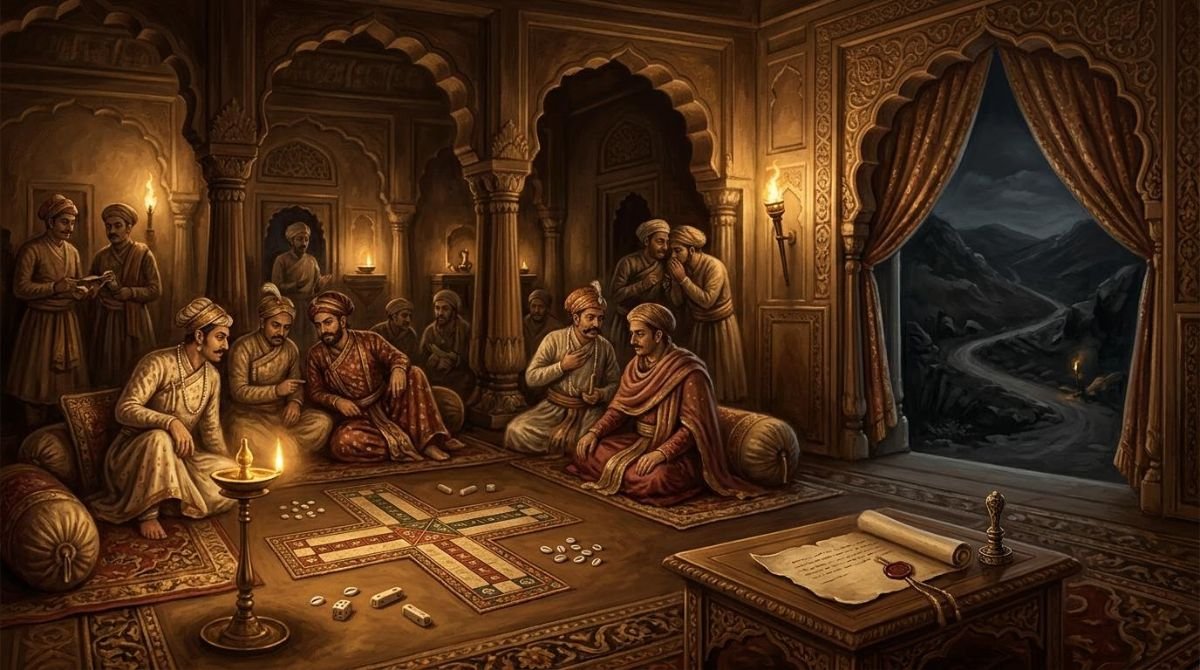
In 1817 Bikrami (about 1760) Bahadur Singh took leave and came to Bhimber, where he stayed with the raja for a few days. Every day Naeem Khan sent for him to play chaupar, the board game played on a cross-shaped cloth. One night the raja posted men on the road with orders to kill the Mehta as he went home, and in the morning his body was found lying there. His house was searched, but his children were not harmed.
A wazir from Jammu
Bahadur Singh’s son, Sujan Singh (the book also writes Sajan), grew up with the wish to avenge his father smouldering in his heart. Taking his chance, he went with his uncle, Mehta Rajkor (reading uncertain), to Jammu, laid the whole affair before Maharaja Ranjit Dev and petitioned for justice. Ranjit Dev summoned the Raja of Bhimber to answer for it. But Naeem Khan died while the case was pending, and his son, Raja Suleman Khan, had to appear at the Jammu court in his place.
Suleman Khan declared that he knew nothing of the murder, which had happened in his father’s time. Ranjit Dev pardoned him, but appointed Sujan Singh wazir of Bhimber and wrote him a parwana (warrant) for the post. It was an arrangement imposed from Jammu, yet the chronicle says it worked well: raja and wazir returned to Bhimber and governed in peace, and Sujan Singh was so able and honest that he was soon loved by all the subjects. Suleman Khan died in 1824 Bikrami (about 1767), after five years on the throne, and his young son, Raja Sultan Khan, kept Sujan Singh on as his own wazir.
What followed
Jammu’s hold on Bhimber did not last. When Ranjit Dev died in 1838 Bikrami (about 1781), his successors, in the chronicle’s words, were not able enough to keep a brave and spirited young raja in check, and Sultan Khan made himself independent. Under him Bhimber reached its greatest extent, from Barnala in the east to much of Kharian and Gujrat in the south, with Naushera, Mirpur and Kotli to the north.
The Mehta connection then became the thread that drew Bhimber into the wars of the Punjab. Sultan Khan’s consort Hayatu, known as Hayat Begum, disliked Sujan Singh. She had his kinsman Mehta Rajkor killed at Ghaddala (reading uncertain), and when the wazir arrested the killers she turned the raja against him and had him imprisoned; Pandit Karam Chand became wazir in his place. Once released, Sujan Singh went to Lahore and laid his grievances before Maharaja Ranjit Singh, who already held it against Sultan Khan that he had seized villages belonging to Sahib Singh, the ruler of Gujrat, in 1847 Bikrami (about 1790). The Sikh expeditions that followed are told in Raja Sultan Khan and the Sikh Wars. When they were over, Sujan Singh governed Chibhal on behalf of the Sikh government.
Key dates
- Akbar’s reign (1556–1605) Uttam Chand and Parmanand receive the title of Mehta; Bhimber is rebuilt around a royal sarai as Akbarabad.
- Aurangzeb’s reign (1658–1707) Mehta Gulab Rai is murdered; Raja Ismail Khan is pardoned at Delhi.
- 1772 Bk (c. 1715) Muhammad Shah on the throne of Delhi, by the chronicle’s reckoning; the raja seizes the goods of Mehta Satail Das.
- 1791 Bk (c. 1734) Mehta Bahadur Singh is sent to Raja Sukh Jiwan in Kashmir.
- 1802 Bk (c. 1745) Chibhal is granted to Maharaja Ranjit Dev of Jammu.
- 1817 Bk (c. 1760) Raja Naeem Khan has Mehta Bahadur Singh killed.
- 1824 Bk (c. 1767) Raja Suleman Khan dies; Raja Sultan Khan succeeds and keeps Sujan Singh as wazir.
- 1838 Bk (c. 1781) Ranjit Dev dies; Bhimber becomes independent.
- 1847 Bk (c. 1790) Sultan Khan seizes villages of Sahib Singh of Gujrat, a grievance later remembered at Lahore.
Frequently asked questions
When did Bhimber come under Jammu?
According to Thakur Major Singh’s Tarikh-e-Chibhal, in 1802 Bikrami (about 1745), when a ruler of Delhi named Ahmad Shah granted Chibhal to Maharaja Ranjit Dev of Jammu as a reward for subduing Kashmir. From then on Bhimber was regarded as subordinate to Jammu, until Ranjit Dev’s death in about 1781 allowed Raja Sultan Khan to make himself independent.
Who were the Mehtas of Bhimber?
The Mehtas were a Kohli Khatri family from Sialkot. According to Tarikh-e-Chibhal, the brothers Uttam Chand and Parmanand helped Todar Mal settle the revenue of the Bhimber country under Akbar and were rewarded with revenue-free land at Bhimber and Naushera and the title of Mehta. Their descendants served the Delhi court as revenue officials.
Who murdered Mehta Bahadur Singh?
The chronicle says Raja Naeem Khan, also called Munim Khan, had him killed in 1817 Bikrami (about 1760). During a visit to Bhimber the raja played chaupar with him every day, then posted men on the road who killed him on his way home. Maharaja Ranjit Dev of Jammu later made the Mehta’s son, Sujan Singh, wazir of Bhimber.
Who was Wazir Sujan Singh of Bhimber?
Sujan (or Sajan) Singh was the son of the murdered Mehta Bahadur Singh. After he petitioned Ranjit Dev of Jammu, he was appointed wazir of Bhimber under Raja Suleman Khan and kept the post under Raja Sultan Khan until a quarrel with Hayat Begum led to his imprisonment. He then went to Lahore, and after the Sikh conquest he governed Chibhal for the Sikh government.
Sources
- Raja Muhammad Iftikhar Ali Khan, Raja Shadab Khan alias Hazrat Baba Shadi Shaheed (Urdu, Barhang/Karachi, 1997), pp. 37–38, 43–44, 119–132, 167.
- Thakur Major Singh (printed Mehjar or Majhar Singh) of Dewa Vatala, Tarikh-e-Chibhal (1983 Bikrami, about 1926), pp. 61–68, as quoted in the book.
- Maulvi Zain-ul-Abidin Kohi Samahnavi, unpublished manuscript history of Chibhal, as quoted in the book, pp. 122–123.
This article is part of our series based on the 1997 Chib history; see the book, chapter by chapter. Spellings of names follow the book.
Continue reading
Have a question about this history?
Our AI guide answers from the articles on this site, in English or Urdu.
