

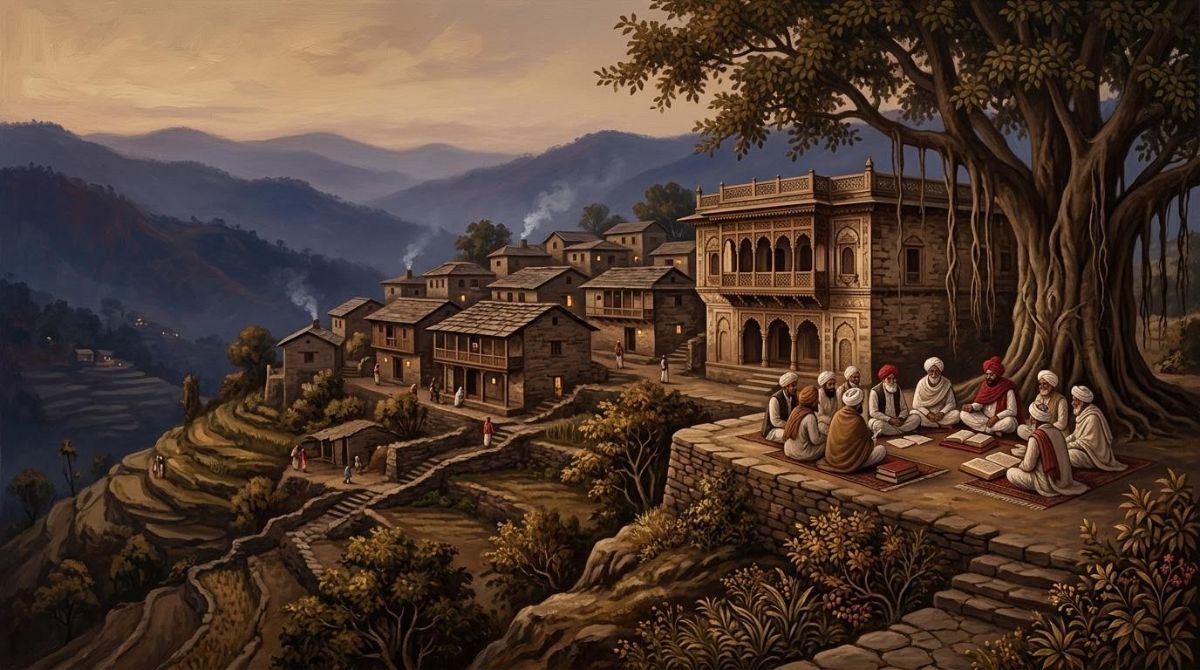
Mandi Malot (منڈی ملوٹ) was the first of the mandis of Chibhal Rajana, the hereditary estates of the Chib royal house of Bhimber in today’s Azad Jammu and Kashmir, and it was founded by Raja Darya Khan, son of Raja Madan Khan of Bhimber. The 1997 Chib history traces its two divisions, Wand Bala and Wand Payin, and the families that made Malot’s name: the wealthy Raja Raj Ali Khan, the zaildars Raja Allah Ditta Khan and Raja Suhbat Ali Khan, and the educationist Raja Nur-us-Samad Khan.
At a glance
- Mandi of
- Chibhal Rajana (Chibhal Khas), the eastern half of the old Chib state of Bhimber, held by Raja Bhom Khan’s line
- Founder
- Raja Darya Khan, son of Raja Madan Khan of Bhimber by his first rani
- Standing
- The first mandi of Chibhal Rajana, according to Maulvi Zain-ul-Abidin’s manuscript
- Divisions
- Wand Bala (descendants of Darya Khan) and Wand Payin (a Khanka family connected with Khui Ratta)
- Got and titles
- Khan, Raika, Khanka, Mirzana and Rajana (mandi table)
- Leading house
- Raja Raj Ali Khan and his descendants
- Namesake
- Niaz Muhammad Khan College of Education, Bhimber
- Main source
- Iftikhar Ali Khan (1997), pp. 258–263, 396, 410
Mandi Malot, the first mandi of Chibhal Rajana
The mandis of Chibhal were the estates of the junior branches of the Chib Rajputs‘ ruling house. According to the manuscript history of Maulvi Zain-ul-Abidin Kohi Samahnavi, quoted in the book, they began with the five sons of Raja Madad Khan, better known as Raja Madan Khan, one of the rajas of Bhimber. His eldest son, Raja Ismail Khan, took the throne by the custom of royal succession. The four younger sons quarrelled over their ranks and inheritance until the Sufi saint Hazrat Shah Daula of Gujrat settled the dispute, after which they built four forts beside the lake at Baghsar, and the mandis grew from there.
Raja Darya Khan was the second son of Madan Khan’s first, high-born rani, and so the full brother of the new raja. His descendants spread out: those of Malahim Khan settled at Malot, those of Yar Beg at Pathorani (reading uncertain) and those of Sultan Khan at Bandala. The mandi of these families, the chronicle says, was established at Malot, together with that of the people of Khui Ratta, and this, the book concludes, makes Malot the first mandi of Chibhal Khas, or Chibhal Rajana (p. 258).
The book’s table of mandis (p. 396) gives Malot’s founder as Darya Khan and lists its got and titles as Khan, Raika, Khanka, Mirzana and Rajana. Under Malot it places the villages of Malot and Pathorani, a branch at Bandala, and Khui Ratta with a string of villages of its own. Its note records that Khui Ratta was for a time recognised as a mandi in place of Rajal, and that the mandi system has since fallen out of use.
Two families, two wands
Thakur Major Singh, whose Tarikh-e-Chibhal was printed in 1983 Bikrami (about 1926), found two families at Malot. One, he wrote, descended from Raja Ismail Khan, ruler of Bhimber; the other was connected with the jagirdars of Khui Ratta. Of the second he singled out Raj Ali Khan as a famous and fortunate man (p. 259, citing Tarikh-e-Chibhal, p. 93).
The 1997 book describes the same two families with an old word for a share of land, wand. Wand Payin, “the lower share”, is “the family of the Khanka Rajgan of Khui Ratta resident at Malot”, that is, kinsmen of the Khanka house founded by the sons of Raja Madan Khan’s Sudhan rani; Raj Ali Khan’s line belongs here. Wand Bala, “the upper share”, is the line of Raja Darya Khan himself.
Sources differ
Thakur Major Singh traces one Malot family to Raja Ismail Khan, the ruler, whereas the book’s own chapter calls Wand Bala the descendants of Darya Khan, Ismail Khan’s full brother, and places Raj Ali Khan’s house among the Khanka of Khui Ratta. Every account in the book agrees that the mandi itself was founded by Darya Khan.
Wand Payin: the house of Raj Ali Khan
From Pir Bakhsh Khan to Raj Ali Khan
The book names Raja Pir Bakhsh Khan, Raja Muhammad Bakhsh Khan and Raja Niaz Muhammad Khan as the great men of Wand Payin in former times. The family tree contributed by Raja Nur-us-Samad Khan (p. 410) gives the line as Pir Bakhsh Khan, his son Umar Bakhsh Khan and his grandson Niaz Muhammad Khan, whose sons were Raj Ali Khan, Fazal Dad Khan, Aziz Bakhsh, who left no children, and Mir Ali Khan, named Mehr Ali Khan in the text.
Raja Raj Ali Khan was, the author writes, probably the most fortunate man in the history of Malot Mandi. He was so prosperous that stories of his wealth were on everyone’s lips, high and low, and it was said that he could have bought the whole of Malot Mandi had he wished. His brothers, too, were remembered as notable men of their day.
Raja Allah Ditta Khan, head zaildar
Raj Ali Khan’s son, Raja Muhammad Khan, had three sons, all of whom the book counts among the leading men of modern Malot. The eldest, Raja Allah Ditta Khan, was numbardar and head (sarbarah) zaildar of Malot: worldly-wise, learned and forbearing, trusted not only by his own brotherhood but by every community of the area, and more than once, the book says, the man who guided them safely through delicate and dangerous moments. His sons were Raja Ghulam Muhammad Khan (Ghulam Ahmad Khan in the family tree); Raja Ghulam Haider Khan, a girdawar (field revenue officer) in the Revenue Department of Azad Jammu and Kashmir; and Raja Abdul Rahman Khan, chairman of Union Council Malot, who is buried in the family graveyard at Malot. Ghulam Muhammad Khan’s son, Professor Raja Iftikhar Ahmad Khan, took a gold medal in his M.A. in Kashmir Studies at the University of the Punjab and was teaching at Government Degree College Kotli when the book was written.
Raja Suhbat Ali Khan, vakil and zaildar
The second son, Raja Suhbat Ali Khan (not to be confused with his namesake, the police officer Raja Suhbat Ali Khan Shaheed of Ghawaliyan), had in the book’s words a forceful, fearless personality that paid no heed to consequences. In the reign of Maharaja Hari Singh he went to law in Jammu against Mian Onkar Singh, zaildar of Ghawaliyan, whom the book describes as the Maharaja’s maternal uncle, and so became zaildar of Malot Mandi himself. After October 1947 and the founding of the Azad Kashmir government he settled in Bhimber and practised law there as a vakil until his death. His four sons were Raja Gulzar Ahmad Khan; Raja Khizar Hayat Khan, a B.A., LL.B. who practised for a time in Bhimber; Raja Khurshid Ahmad Khan, a leading figure in the social and cultural life of Bhimber, a Muslim Conference worker and a member of the advisory committee of the shrine of Baba Shadi Shaheed; and Raja Aftab Ahmad Khan, a Bhimber businessman.
Raja Ashiq Ali Khan and the college at Bhimber
The youngest brother, Raja Ashiq Ali Khan, was still alive at about eighty-eight when the book was written, and the author praises his gentleness, humility, hospitality and loyalty to kin. His eldest son, Raja Nur-us-Samad Khan, matriculated from Government High School Bhimber in 1954 and went on to an M.A. and a B.Ed. He made teaching his life’s work: headmaster of Government High School Bandala, then, by promotion, Deputy Director of Education in the Azad Kashmir government, from which post he retired. He then founded the Niaz Muhammad Khan College of Education in Bhimber to train teachers, naming it after his ancestor Raja Niaz Muhammad Khan of Malot. The college was barely a year old when he died in July 1998. The book, which calls him a true nation-builder, also prints the Malot family tree he supplied, where he is described as a retired District Education Officer.
- Raja Pir Bakhsh Khan
- Raja Umar Bakhsh Khan
- Raja Niaz Muhammad Khan, namesake of the college of education at Bhimber
- Raja Raj Ali Khan, the wealthiest man of Malot in his day
- Raja Muhammad Khan
- Raja Allah Ditta Khan, numbardar and head zaildar of Malot
- Raja Ghulam Muhammad (or Ghulam Ahmad) Khan, father of Prof. Raja Iftikhar Ahmad Khan
- Raja Ghulam Haider Khan, girdawar
- Raja Abdul Rahman Khan, chairman of Union Council Malot
- Raja Suhbat Ali Khan, vakil and zaildar of Malot
- Raja Gulzar Ahmad Khan, Raja Khizar Hayat Khan, Raja Khurshid Ahmad Khan and Raja Aftab Ahmad Khan
- Raja Ashiq Ali Khan
- Raja Nur-us-Samad Khan, educationist (d. 1998), and his brothers Nur Ahmad Khan, Naeem Arshad Khan and Muhammad Azam Khan
- Raja Allah Ditta Khan, numbardar and head zaildar of Malot
- Raja Ali Bahadur Khan, Raja Amir Muhammad Khan and Raja Shah Muhammad Khan, Raj Ali Khan’s other sons
- Raja Muhammad Khan
- Raja Fazal Dad Khan, father of Hashim Khan and Qasim Khan
- Aziz Bakhsh, without issue
- Raja Mir Ali Khan (Mehr Ali Khan), father of Mardan Ali Khan and Nasib Ali Khan
- Raja Raj Ali Khan, the wealthiest man of Malot in his day
- Raja Niaz Muhammad Khan, namesake of the college of education at Bhimber
- Raja Umar Bakhsh Khan
Wand Bala: the line of Darya Khan
For Wand Bala, the descendants of Raja Darya Khan, the book gives a list of notable men rather than a full tree (p. 263). Most of the older names are those of numbardars, the village headmen, and patwaris, the village revenue accountants who kept the land records:
- Raja Madad Khan, numbardar, whose sons were Raja Shah Muhammad Khan, Raja Hans Khan, Raja Safdar Ali Khan and Raja Fateh Khan; Fateh Khan’s sons included Raja Amanat Khan and Raja Asif Khan.
- Raja Bandu Khan, numbardar, father of Raja Feroz Khan, Raja Mardan Ali Khan, Raja Ashiq Ali Khan and Raja Taja Khan.
- Raja Mahmud Khan, numbardar, father of Raja Hasan Khan, and Raja Rahm Ali Khan, numbardar.
- The patwaris Raja Asif Khan, Raja Rahmatullah Khan and Raja Muhammad Zaman Khan, and Raja Muhammad Yaqub Khan, a patwari of the Dogra era.
- Raja Abdul Rauf Khan, son of the patwari Rahmatullah Khan, librarian of Government Degree College Bhimber.
- Raja Abdul Rahman Khan, a daughter’s son of Raja Bandu Khan, an industrialist and proprietor of Atiq Overseas Corporation of Rawalpindi and the Ghazi Ghee and Vegetable Mills at Mangla.
Malot in 1947 and after
Malot shared in the upheaval of 1947, a year in which families of every community in Jammu and Kashmir suffered. The book credits Raja Allah Ditta Khan, although he was a zaildar and a government functionary, with leading the Muslim volunteers of the area against the State’s Dogra forces in October 1947, and the family tree marks one member of the house, Bota, son of Farzand Ali, as martyred (shaheed) in 1947. The wider story is told in The Chib Rajputs in 1947.
After the founding of the Azad Kashmir government, much of the family’s public life moved to the town of Bhimber. Raja Suhbat Ali Khan practised law there, Raja Nur-us-Samad Khan built his career in the education department and founded his college there, and Raja Khurshid Ahmad Khan served on the advisory committee of the shrine of Baba Shadi Shaheed, whom every branch of Malot, like all the Chibs of Chibhal, honours as its common ancestor.
Frequently asked questions
Who founded Mandi Malot?
According to the 1997 Chib history, Mandi Malot was founded by Raja Darya Khan, a son of Raja Madan Khan, ruler of Bhimber, by his first rani. The descendants of Darya Khan’s descendant Malahim Khan settled at Malot, and the book calls it the first mandi of Chibhal Rajana.
What are Wand Bala and Wand Payin in Malot?
They are the two divisions, or shares, of Mandi Malot. Wand Bala, the upper share, is the line of Raja Darya Khan; Wand Payin, the lower share, is a Khanka family connected with Khui Ratta and resident at Malot, to which the house of Raja Raj Ali Khan belongs.
Where is Mandi Malot?
Malot lies in Chibhal Rajana, the eastern half of the old Chib state of Bhimber, in what is now Azad Jammu and Kashmir. It had its own union council, and several of its leading men later lived and worked in the town of Bhimber.
Who was Raja Nur-us-Samad Khan of Malot?
Raja Nur-us-Samad Khan was an educationist from Malot who matriculated at Bhimber in 1954, took an M.A. and B.Ed., served as headmaster at Bandala and retired as a Deputy Director of Education in Azad Kashmir. He founded the Niaz Muhammad Khan College of Education in Bhimber and died in July 1998.
Sources
- Raja Muhammad Iftikhar Ali Khan, Raja Shadab Khan alias Hazrat Baba Shadi Shaheed (Urdu, Barhang/Karachi, 1997), pp. 121–122, 200–201, 258–263, 396, 410.
- Maulvi Zain-ul-Abidin Kohi Samahnavi, manuscript history of Chibhal (unpublished), as quoted in the book, p. 258.
- Thakur Major Singh (printed “Mehjar Singh”), Tarikh-e-Chibhal (1983 Bikrami, about 1926), p. 93, as quoted in the book, p. 259.
- Genealogy of the Rajgan of Malot Mandi, Wand Payin, contributed by Raja Nur-us-Samad Khan, printed in the book, p. 410.
This article is part of our series based on the 1997 Chib history; see the book, chapter by chapter. Spellings of names follow the book.
