

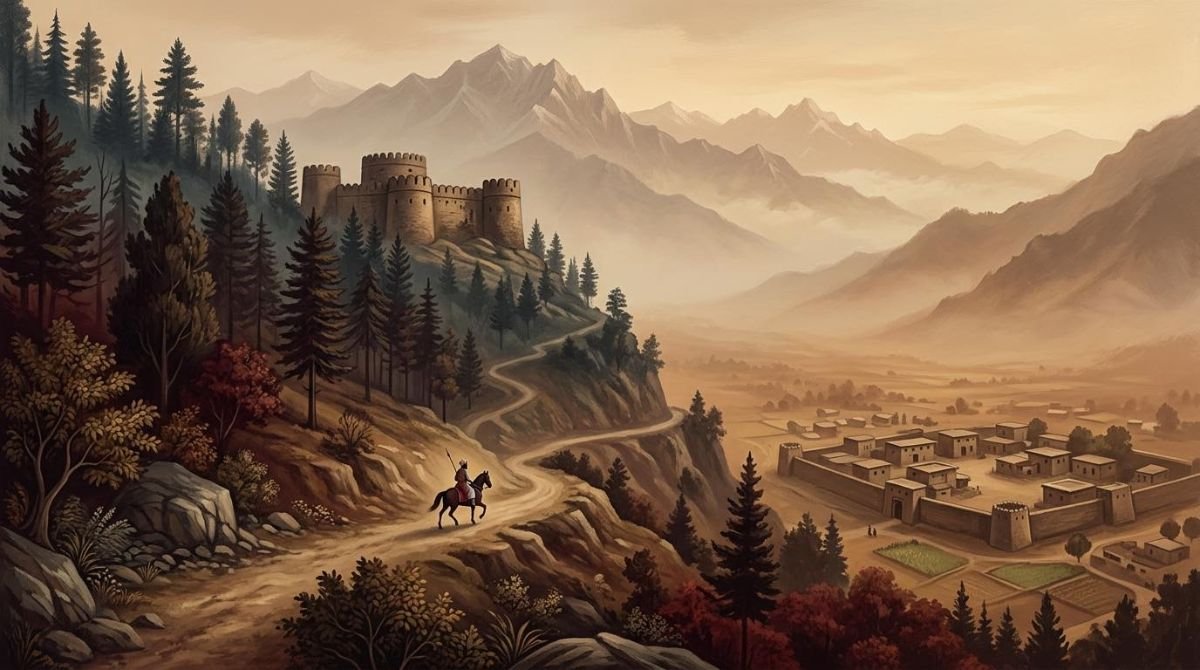
Mandi Rajal (راجل منڈی) was the mandi of the Mirzana branch of the Chib Rajputs of Bhimber, founded by Mirza Izar Beg Khan, son of Raja Madan Khan of Bhimber by his third rani, with seats at Rajal, Rajpur and Kamila Kot. Rajal itself now lies in Tehsil Naushera, on the Indian-administered side of the Line of Control. After 1947, the 1997 Chib history records, its families resettled in Bhimber, Lala Musa, Kharian, Rawalpindi and Lahore, and its sons included a judge of the Supreme Court of Pakistan, a brigadier and a line of lawyers.
At a glance
- Founder
- Mirza Izar Beg Khan (also printed Azar Beg), son of Raja Madan Khan by his third rani
- Seats
- Rajal; Rajpur in winter and Kamila Kot in summer
- Titles
- Raja and Mirza; got or title Mirzana
- Location today
- Rajal is in Tehsil Naushera, across the Line of Control
- Standing
- Replaced by Khui Ratta as a mandi for a time, then “once again regarded” as one
- Leading families
- The houses of Raja Sultan Ali Khan, Raja Najib Khan, Raja Ali Sher Khan, Raja Amanullah Khan, Raja Hast Khan and Raja Niaz Muhammad Khan
- Notable descendants
- Justice Raja Afrasiab Khan; Major Raja Qurban Hussain Khan; Brigadier Raja Muhammad Shabbir Khan
- Main source
- Iftikhar Ali Khan (1997), pp. 121–122, 200–201, 282–288, 396–397
Mandi Rajal and its founder, Mirza Izar Beg Khan
Raja Madan Khan, also called Madad Khan, sat on the throne of Bhimber after Raja Shah Khan and is one of the rajas of Bhimber in the main line of the Chib Rajputs. He had three ranis. The first bore Raja Ismail Khan, called Sahmal Khan, and Darya Khan; the second, a woman of the Sudhan tribe, bore Khan Jewal Khan and Khan Parda Khan, ancestors of the Khanka house of Khui Ratta; and the third bore Izar Beg Khan, from whom the families of Rajal and Rajpur Kamila descend (p. 282).
When Madan Khan died, his eldest son Ismail Khan took the throne by the custom of rulership, and the other four brothers fell out over the inheritance. Hazrat Shah Daula Wali of Gujrat settled the dispute, and the brothers built four forts beside Baghsar lake, from which the four mandis of Chibhal took shape. Izar Beg’s descendants spread through Rajal and Rajpur Kamila. Those of Raj Muhammad Khan and Faulad Beg Khan settled at Rajal, while Kapur Beg Khan and Qaim Khan founded Kamila Kot and Rajpur. These jagirdars spent the winter at Rajpur and the summer in the cool air of Kamila Kot. Their titles were Raja and Mirza, and the founder of Rajal Mandi, the book says, was Mirza Izar Beg Khan (pp. 200, 282).
The book’s table of mandis (p. 397) gives the same picture: Mirza Azar Beg Khan as founder; the title Mirzana, with the personal titles Raja and Mirza; Raj Muhammad Khan and Faulad Beg Khan at Rajal; and Qaim Khan at Kamila and Rajpur.
Rajal, Khui Ratta and a contested mandi
Rajal’s place among the mandis was contested from the start. Shah Daula’s award did not end the brothers’ quarrel, which grew into a battle in which Khan Saeed Khan, grandson of Jewal Khan, was killed. The sons of the Sudhan rani then moved to Khui Ratta, and later, after a further dispute, they took the mandi at Khui Ratta in place of Rajal, although, the chronicle adds, Izar Beg’s mandi was generally reckoned to be Rajal and Rajpur Kamila (pp. 122, 201, 258). The mandi table records the sequence in two notes: for a time Khui Ratta became the mandi instead of Rajal, and “after Khui Ratta, Rajal is once again regarded, in a personal capacity, as the mandi” (pp. 396–397).
The leading families of Rajal
The book describes the leading families of Rajal Mandi one by one (pp. 282–288). Most of them left Rajal after 1947, and the lists record where each branch settled.
The house of Raja Sultan Ali Khan
One of the foremost families of Rajal in the past was that of Raja Sultan Ali Khan and his brothers, Raja Najib Khan and Raja Gulab Khan. Sultan Ali Khan’s son was Raja Hayat Ali Khan, whose only son, Raja Fateh Sher Khan, had five sons: Raja Ali Akbar Khan, Raja Ghulam Murtaza Khan, Raja Muhammad Hafeez Khan, Raja Muhammad Akbar Khan and Raja Inayatullah Khan.
Ali Akbar Khan’s five sons rose high. The eldest, Raja Muhammad Shafi Khan, settled in Bhimber and, the book says, devoted himself to his younger brothers’ education, to which it credits their success. The second, Raja Abdul Khaliq Khan, made his home at Lala Musa in District Gujrat. The third, Justice Raja Afrasiab Khan, matriculated from Islamia High School, Lala Musa, probably in 1951, took his B.A. at Zamindar College, Gujrat, and his LL.B. at University Law College, Lahore. He practised in Lahore, was elected president of the Lahore High Court Bar and vice-chairman of the Punjab Bar Council, became a judge of the Lahore High Court and, when the book was written, was a judge of the Supreme Court of Pakistan. The fourth, Major Raja Qurban Hussain Khan, retired from the army as a major, served as a D.I.G. in the Home Department and died in office as Director of the Kashmir Cell. The youngest was Raja Zubair.
- Raja Sultan Ali Khan
- Raja Hayat Ali Khan
- Raja Fateh Sher Khan
- Raja Ali Akbar Khan
- Raja Muhammad Shafi Khan, father of Raja Shahid Iqbal Khan, advocate in Lahore
- Raja Abdul Khaliq Khan, father of Dr Raja Ijaz Khaliq Khan and three other sons
- Justice Raja Afrasiab Khan, judge of the Supreme Court of Pakistan, father of Raja Farrukh Afrasiab Khan
- Major Raja Qurban Hussain Khan, Director of the Kashmir Cell, father of Captain Raja Abdul Rauf Qurban
- Raja Zubair
- Raja Ghulam Murtaza Khan, Raja Muhammad Hafeez Khan, Raja Muhammad Akbar Khan and Raja Inayatullah Khan
- Raja Ali Akbar Khan
- Raja Fateh Sher Khan
- Raja Hayat Ali Khan
Raja Najib Khan and the railwaymen of Africa
Another leading family was that of Raja Najib Khan. His son, Raja Hayat Muhammad Khan, went to Africa, became a loco inspector on the railways there and made a good name for himself; he brought many young men of his family out to Africa and settled them in work. During what the book calls “the war of the English and the Japanese in Africa”, when a contingent of the Jammu and Kashmir State forces arrived, he invited the whole contingent to a meal. His only son, Raja Taj Muhammad Khan, migrated to Pakistan at Partition in 1947 and died in Karachi in 1961. Taj Muhammad Khan’s sons were Raja Muhammad Afzal Khan, Raja Muhammad Azam Khan, Raja Azmatullah Khan and Raja Zulfiqar Khan; Raja Muhammad Azam Khan became a well-known political and social figure in Bhimber, several times a member of its Municipal Committee and a member of the committee of the shrine of Baba Shadi Shaheed.
Raja Sultan Ali Khan’s third brother, Raja Gulab Khan, had two sons: Raja Arif Khan, who stayed on at Rajal in employment, and Raja Muhammad Khan, who went to Africa and settled there.
Raja Ali Sher Khan’s family
The second leading family, the book says, was that of Raja Ali Sher Khan, whose sons were Raja Ataullah Khan, a numbardar, and Raja Rahim Dad Khan. Rahim Dad Khan’s son, Raja Muhammad Afzal Khan, left Rajal after 1947 and settled and died at Lala Musa. Ataullah Khan’s sons, Raja Abdul Rahman Khan, also a numbardar, and Raja Muhammad Yaqub Khan, likewise settled and died at Lala Musa. A grandson of Muhammad Yaqub Khan, Raja Saeed Akram Khan, became an Assistant Advocate General of the Punjab at the Rawalpindi Bench of the Lahore High Court.
Raja Amanullah Khan’s family
Raja Amanullah Khan’s sons were Raja Zaidullah Khan and Raja Faqirullah Khan. Zaidullah Khan’s only son, Raja Sarandaz Khan, had two sons, Raja Muhammad Latif Khan and Raja Muhammad Iqbal Khan, whose descendants live in Bhimber, at Bhagwal in Tehsil Kharian and in Rawalpindi. Faqirullah Khan’s sons, Raja Muhammad Khan and Raja Muhammad Hafeez Khan, have descendants at Kharian and in Bhimber.
Raja Hast Khan’s family and Brigadier Shabbir Khan
The fourth leading family is that of Raja Hast Khan, whose sons were Raja Nawab Khan and Raja Habib Khan. Nawab Khan’s sons, Raja Ghulam Nabi Khan, Raja Muhammad Yaqub Khan and Raja Fateh Sher Khan, have descendants in Rawalpindi and Bhimber; one of Ghulam Nabi Khan’s sons was Major Raja Muhammad Hanif Khan. Habib Khan’s only son, Raja Dil Muhammad Khan, lived at Naushera Virkan in District Gujranwala, and his son Raja Muhammad Shabbir Khan rose to the rank of brigadier in the Pakistan Army, retiring shortly before the book was written. For other Chib officers, see Chib Soldiers.
Raja Niaz Muhammad Khan’s family
Another leading family was that of Raja Niaz Muhammad Khan, who had two wives. By the elder he had Raja Muhammad Zaman Khan, a retired sub-inspector of the Azad Kashmir Police; by the second, Raja Ata Muhammad Khan and Colonel Raja Muhammad Ghaus Khan, both since deceased, and Raja Muhammad Ramzan Khan. His elder brothers were Raja Khan Muhammad Khan and Raja Sakhi Muhammad Khan, whose descendants live in Rawalpindi and Lala Musa.
Sources differ
Raja Najib Khan is called a brother of Raja Sultan Ali Khan on p. 282 but a paternal cousin of Raja Hayat Ali Khan on p. 284. Najib Khan is given only two sons, Hayat Muhammad Khan and Niaz Muhammad Khan (p. 284), yet the Raja Niaz Muhammad Khan described on p. 286 has two elder brothers, so either the first list is incomplete or two men share the name. The mandi table spells the founder’s name Azar Beg and seems to write Kapur Beg as “Kaiku Beg” (reading uncertain).
Lawyers and the sardari wand
The book closes its chapter on Rajal with the mandi’s lawyers. Raja Muhammad Yaqub Khan, B.A., LL.B., an advocate of the Supreme Court of Pakistan, had practised in Lahore for some four decades and was a senior member of the Lahore High Court Bar, counted among its distinguished jurists. His son-in-law, Raja Muhammad Asad Khan, B.A., LL.B., son of the late Subedar Raja Muhammad Iqbal Khan of Rajal Mandi, was an advocate of the High Court of Azad Jammu and Kashmir and a member of the Bhimber District Bar.
The author also insists on remembering another Raja Muhammad Yaqub Khan, son of the late Raja Feroz Khan. His grandfather, Raja Barkat Ali Khan, was in his day a learned man of Rajal Mandi; his father, Raja Feroz Khan, was a seasoned fighter and a renowned strongman. After the creation of Pakistan the family left Rajal and settled in Tehsil Kharian, District Gujrat. Raja Yaqub, the book says, belongs to the sardari wand, the chief’s share of Rajal Mandi. Partition had turned the sardar, the sardari and the sardari wand into a tale of the past, but he remained devoted to Baba Shadi Shaheed and to the memory of Raja Sultan Khan, and still regarded Bhimber as Sultan Khan’s capital. He accompanied the author step by step while he gathered material for his first book, Khandan-e-Chib Rajput; see Raja Muhammad Iftikhar Ali Khan of Barhang.
Rajal after 1947
Partition and the fighting of 1947–48 left Rajal on the far side of the ceasefire line, in Tehsil Naushera. The book’s family lists read like a map of the resettlement that followed: branches of Rajal Mandi settled in Bhimber; at Lala Musa, Kharian, Bhagwal and Buzurgwal in District Gujrat; at Naushera Virkan in District Gujranwala; and in Rawalpindi, Lahore, Karachi and Mirpur, while the railwaymen of the Najib Khan family had already carried the name to Africa. Many kept their ties with Bhimber and its shrine. The wider story of that year is told in The Chib Rajputs in 1947.
Frequently asked questions
Where is Rajal?
Rajal, the seat of Mandi Rajal, lies in Tehsil Naushera, on the Indian-administered side of the Line of Control in Jammu and Kashmir. The mandi’s other seats were Rajpur, used in winter, and Kamila Kot, used in summer.
Who founded Mandi Rajal?
According to the 1997 Chib history, Mandi Rajal was founded by Mirza Izar Beg Khan, son of Raja Madan Khan of Bhimber by his third rani. His descendants Raj Muhammad Khan and Faulad Beg Khan settled at Rajal, while Kapur Beg Khan and Qaim Khan founded Kamila Kot and Rajpur.
What titles did the Rajal family use?
The jagirdars of Rajal used the titles Raja and Mirza, and the book’s table of mandis gives the branch’s got or title as Mirzana. Beg also appears in the names of the early generations, such as Izar Beg, Faulad Beg and Kapur Beg.
Who are the notable descendants of Mandi Rajal?
The 1997 Chib history names Justice Raja Afrasiab Khan, then a judge of the Supreme Court of Pakistan; Major Raja Qurban Hussain Khan, Director of the Kashmir Cell; Brigadier Raja Muhammad Shabbir Khan; Raja Hayat Muhammad Khan, a railway loco inspector in Africa; and several advocates in Lahore and Bhimber.
Sources
- Raja Muhammad Iftikhar Ali Khan, Raja Shadab Khan alias Hazrat Baba Shadi Shaheed (Urdu, Barhang/Karachi, 1997), pp. 121–122, 200–201, 258, 282–288, 396–397.
- Maulvi Zain-ul-Abidin Kohi Samahnavi, manuscript history of Chibhal (unpublished), as quoted in the book, pp. 121–122, 258.
This article is part of our series based on the 1997 Chib history; see the book, chapter by chapter. Spellings of names follow the book.
