

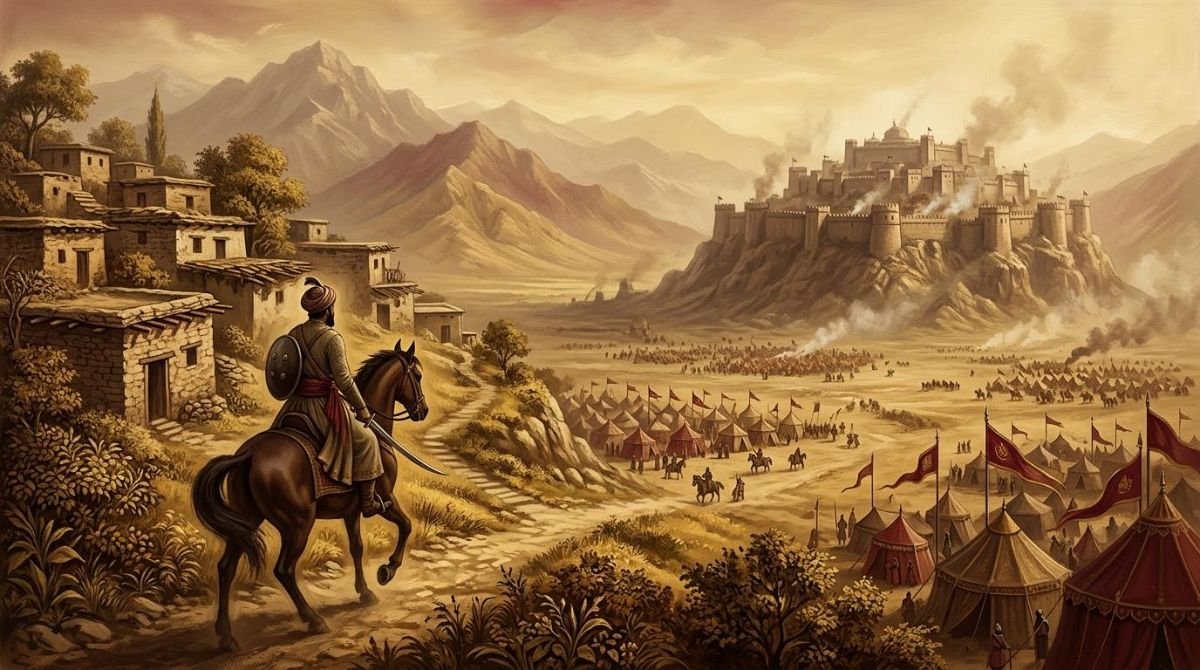
Khan Muhammad Umar Khan (خان محمد عمر خاں) is honoured as the founder of the Khanka Chib Katoch house of Khui Ratta, the chief jagirdars of the Banah Valley in Kotli, Azad Kashmir. Family tradition, recorded in the 1997 Chib history, makes him the posthumous son of a murdered Chib chief: exchanged at birth to save his life and raised by a Mangral Rajput elder, he went on to serve the Mughal emperors Jahangir and Shah Jahan and was rewarded with the title Khan and a jagir of thirty-six villages.
At a glance
- Remembered as
- Founder (jadd-e-amjad) of the Khanka Chibs and first chief jagirdar of Khui Ratta
- Descent
- Son of Khan Sa’id Khan, son of Khan Sikandar Khan, son of Khan Jiwal Khan, son of Raja Madan Khan of Bhimber
- Era
- Contemporary of the Mughal emperors Jahangir (r. 1605–1627) and Shah Jahan (r. 1628–1658)
- Career
- By tradition a soldier of Jahangir and a commander under Shah Jahan, victorious at Qandahar
- Rewards
- Title of Khan, 12,000 rupees a year and a jagir of 75,000 kanals in 36 villages
- Seats
- Kot Kotera, then Khui Ratta, then the rock-cut Kot Khanan
- Wives
- A Khakhrel Rajput of Manjwal and a Mahla Rajput of Rajouri
- Successor
- Khan Sultan Alam Khan, eldest of his seven sons
A feud in the house of Bhimber
The story begins in Bhimber, the principality of the Chib Rajputs on the old road from the Punjab into Kashmir. According to the book, Raja Madan Khan (also called Madad Khan or Madd Khan), fourteenth in descent from Raja Chib Chand and seventh from Raja Shadab Khan, the saint-king remembered as Baba Shadi Shaheed, had three Ranis and five sons. When he died, his eldest son, Raja Ismail Khan, took the throne in accordance with the raj-niti, the law of royal succession, and the four younger brothers fell out over their shares of the inheritance.
- Raja Madan Khan (Madad Khan), ruler of Bhimber: three Ranis, five sons
- Raja Ismail Khan, by the first Rani: heir to the throne of Bhimber (the Rajana line)
- Darya Khan, by the first Rani: ancestor of the Malot and Bandala families
- Khan Jiwal Khan, by the Sudhan Rani
- Khan Sikandar Khan
- Khan Sa’id Khan: killed in the brothers’ war
- Khan Muhammad Umar Khan: founder of the Khanka house of Khui Ratta
- Khan Sa’id Khan: killed in the brothers’ war
- Khan Sikandar Khan
- Khan Parda Khan, by the Sudhan Rani: father of Taju Khan
- Mirza Aizaz Beg Khan, by the third Rani: ancestor of the Rajal and Rajpur Kamila families
The celebrated Sufi of Gujrat, Hazrat Shah Daula Wali Daryai, was called in to arbitrate. On his award the four brothers, Darya Khan, Jiwal Khan, Parda Khan and Mirza Aizaz Beg, built four forts, the “Char Kot”, on the shore of the lake at Baghsar near Samahni, and from them grew the four mandis (branch seats) of Chibhal Rajana and the four gots (sub-clans) of the Bhimber Chibs: Rajana, Rika, Khanka and Mirzana. The first mandi was Malot. The full story is told in The Mandis of Chibhal.
Arbitration failed. The quarrel, the book says, “grew and grew until it took the form of a battle”, and in that fighting Khan Sa’id Khan, son of Khan Sikandar Khan and grandson of Jiwal Khan, was killed. Peace came only when Jiwal Khan and Parda Khan left the Bhimber country for Khui Ratta, in the Banah Valley south-east of Kotli, where their descendants spread through Khui Ratta, Kotera Khanka, Andah, Khajurla and the neighbouring villages.
A child exchanged at birth
When Sa’id Khan was killed his widow was expecting a child, and his enemies, whom the book describes as his own brothers, now hoped to become masters of the whole mandi without a sharer. They shadowed the widow constantly, meaning to kill the baby the moment it was born, “so that there would be neither bamboo nor flute”, as the Urdu proverb has it. Knowing the danger, she fled and hid near Kot Kotera.
Here the tradition of the Khanka Rajgan, handed down from generation to generation, takes a dramatic turn. At the very time her son was born, a woman of the Jat community gave birth to a daughter, and the mother exchanged her newborn son for the Jat woman’s baby girl. When the killers arrived and learned that the widow had borne a daughter, they went away satisfied that Sa’id Khan had left no male heir. The boy, Muhammad Umar, grew up as the Jat woman’s son, in a village of the Sehnsa area according to one version and at Barali according to another, until he was seven or eight years old.
The Mangral elder
One day, while grazing cattle with the other village boys, the child caught the eye of an old and experienced elder of the Mangral Rajputs, a clan long established in the Kotli hills. Something in his bearing, the way he sat and stood and spoke, convinced the elder that this was no ordinary village boy but “the light of the eyes of some very great and noble family”. He questioned the boy, then went to the woman who claimed to be his mother. When he told her flatly that the child could not be hers, she froze with fear, believing that the enemies had found him at last. The Mangral elder promised to protect the boy at any cost, and she told him the truth.
The elder took Umar Khan into his own house, brought him up as his own son and gave special care to his education and training. When the young man came of age he returned, with his guardian’s blessing, to his mother at Kot Kotera, accompanied by a considerable band of supporters. He took control of the area and made his first marriage, to a woman of the Khakhrel Rajputs of Manjwal.
In the service of Jahangir and Shah Jahan
His enemies had not gone away, and Umar Khan, the book says, faced “a war for personal and family survival”. To escape the danger he set out for Delhi, where the Mughal emperor Jahangir (r. 1605–1627) was on the throne. Tall, handsome and powerfully built, he was enrolled in the imperial army on the emperor’s order and rose steadily through ability, courage and good judgement. Under Jahangir’s successor, Shah Jahan (r. 1628–1658), he reached what the book calls the rank of jarnail, general. The Mughal army ranked its officers by mansab rather than by modern titles, so “general” is best read as the family’s way of describing a senior commander.
The Qandahar campaign and its reward
The high point of the story is a war at Qandahar, the great fortress city on the road between India and Persia. When a rebellion broke out in the province of Qandahar, the book says, Shah Jahan chose Umar Khan to crush it. The campaign was long and exhausting: after three years of fighting the rebels were shut up inside the fort, and after a six-month siege they laid down their arms. Umar Khan returned to Delhi and was received in audience by the emperor, who, delighted with the victory, granted him:
- the title of Khan;
- a cash grant of 12,000 rupees a year; and
- a jagir of 75,000 kanals made up of thirty-six villages, among them Khui Ratta, Bhiyal, Kotera Khanka, Khanpur, Andah and Khajurla.
According to the book, his heirs remained the rulers of this jagir for about three and a half centuries.
Sources differ
The book cites no document for the Qandahar story, which comes from Khanka family tradition. Mughal histories record that Qandahar passed to Shah Jahan in 1638, when its Persian governor Ali Mardan Khan surrendered it, and that it was lost to Persia in 1649 and never retaken despite three Mughal sieges; a three-year war ending in a successful six-month siege cannot be matched exactly to those events. The family tree printed in the book (p. 417), compiled by Raja Abdul Rauf Khan, tells it differently again: its caption names Khan Raja Saeed Khan as the founder of Khui Ratta and the man rewarded by Shah Jahan for the conquest of Qandahar, with Muhammad Umar Khan as his son and successor.
A note on dates
The generations are hard to fit to the calendar. The book makes Umar Khan a great-grandson of Raja Madan Khan and a servant of Jahangir, yet elsewhere, quoting Thakur Major Singh’s Tarikh-e-Chibhal, it places Madan Khan’s eldest son, Raja Ismail Khan, on the throne of Bhimber in the reign of Aurangzeb (1658–1707). Both cannot be exactly right, and the generations are best read as family tradition rather than fixed dates.
Founding Khui Ratta
After receiving the jagir, Umar Khan built his first houses at the spot in Khui Ratta where the house of Iqbal Zargar stood in the 1990s, and had a well dug close by, between the present High School Khui Ratta and its primary section. Beside the well grew a pipal tree, and beneath it lay a great stone slab, the taraar, on which each new chief of the family received the tikka, the mark of succession. The well has since been closed, the tree cut down and the slab lost: all three, the book says, have “become a tale of the past”.
That well gave the town its name. Umar Khan’s second wife came from the Mahla Rajput family of Rajouri. When she sent a servant to draw water, his first wife refused to let her take any from her well, and the quarrel that followed made the settlement Khui Ratta, “the quarrel of the well”: in Pahari and Punjabi a quarrel is a ratta. This explanation, related by Raja Abdur Rauf Khan of the family, is the one generally accepted in the Banah Valley.
Later Umar Khan moved to Kot Khanan, a high place adjoining the town. There, the book says, four rooms were carved into the mountainside with a skill hard to match even today, with an ancient well beside them; standing above all the surrounding country, it was safe in every respect. Kot Khanan remained the home of every Khan of Khui Ratta down to Khan Sakhi Wilayat Khan, who died in 1922.
Wives, sons and successors
Umar Khan had two Ranis. The first, a Khakhrel Rajput of Manjwal, bore four sons: Khan Sultan Alam Khan, Nawab Khan, Sarwar Khan and Sher Ali Khan. The second, Rani Mahli of the Mahla Rajputs of Rajouri, bore three: Mardan Ali Khan, Sikandar Khan and Sarang Khan. On his death the tikka passed to his eldest son, Khan Sultan Alam Khan, and thereafter, generation after generation, to the eldest son of each chief.
In the 1990s his descendants were living in Khui Ratta, Kotera Khanka, Bhiyal, Dharri, Khanpur and Andah. The family tree on p. 417 marks where some of the younger sons’ branches settled, linking Sarwar Khan with Battal (reading uncertain); the book’s separate tree of the Chib biradari of Battal, within the Khui Ratta jagir (pp. 424–425), also begins with a Sarwar Khan.
The legacy of Khan Muhammad Umar Khan
The book calls Umar Khan “the light of the eyes” of the Khanka got, and his line held the jagir until land reform abolished it in the lifetime of the last chief jagirdar, Subedar Khan Inayatullah Khan, who died in 1966. It also credits him with the jagir’s most humane custom: from his day onward no Khan of Khui Ratta took rent from the minor orphans of a dead tenant until they came of age.
The founder’s name mattered in 1947. When Inayatullah Khan was accused of being a mere creature of the Dogra rulers, he answered that his jagir dated from the reigns of Jahangir and Shah Jahan, long before Gulab Singh, founder of the Dogra state, was born. For the full history of the family, from Umar Khan to the District Council of Kotli, see The Khans of Khui Ratta, and for the wider dynasty The Rajas of Bhimber.
Frequently asked questions
Who was Khan Muhammad Umar Khan?
Khan Muhammad Umar Khan was the founder of the Khanka Chib Katoch family of Khui Ratta in the Banah Valley, Kotli District, Azad Kashmir, and its first chief jagirdar. Family tradition recorded in the 1997 Chib history says he served the Mughal emperors Jahangir and Shah Jahan and received the title Khan and a jagir of thirty-six villages.
Why was Khan Muhammad Umar Khan exchanged at birth?
His father, Khan Sa’id Khan, had been killed in a feud among the descendants of Raja Madan Khan of Bhimber, and the killers meant to kill any son born to his widow. According to family tradition she exchanged her newborn son for the baby daughter of a Jat woman, and the killers went away believing that no male heir had been born.
What reward did Shah Jahan give Khan Muhammad Umar Khan?
According to the book, after a campaign at Qandahar Shah Jahan gave him the title Khan, 12,000 rupees a year and a jagir of 75,000 kanals in thirty-six villages, including Khui Ratta and Kotera Khanka. The story is family tradition, and the book cites no Mughal document for it.
How did Khui Ratta get its name?
Khui Ratta means the quarrel of the well. According to Raja Abdur Rauf Khan, Umar Khan’s first wife refused to let his second wife, a Mahla Rajput of Rajouri, draw water from the well he had dug, and the quarrel gave the settlement its name.
Who succeeded Khan Muhammad Umar Khan?
His eldest son, Khan Sultan Alam Khan, the son of his Khakhrel Rajput wife from Manjwal. The headship then passed from eldest son to eldest son down to Subedar Khan Inayatullah Khan, the last chief jagirdar, who died in 1966.
Sources
- Raja Muhammad Iftikhar Ali Khan, Raja Shadab Khan alias Hazrat Baba Shadi Shaheed (Urdu, Barhang/Karachi, 1997), pp. 121–124, 198–208, 233–234, 238–241, 258, 417, 424.
- Maulvi Zain-ul-Abidin Kohi Samahnavi, unpublished manuscript history of Chibhal, quoted in the book for Raja Madan Khan’s sons.
- Thakur Major Singh, Tarikh-e-Chibhal (1983 Bikrami, c. 1926), quoted in the book for Raja Ismail Khan.
- Family tradition of the Khanka Rajgan of Khui Ratta, and the family tree compiled by Raja Abdul Rauf Khan of Khui Ratta.
This article is part of our series based on the 1997 Chib history; see the book, chapter by chapter. Spellings of names follow the book.
Continue reading
Have a question about this history?
Our AI guide answers from the articles on this site, in English or Urdu.
