

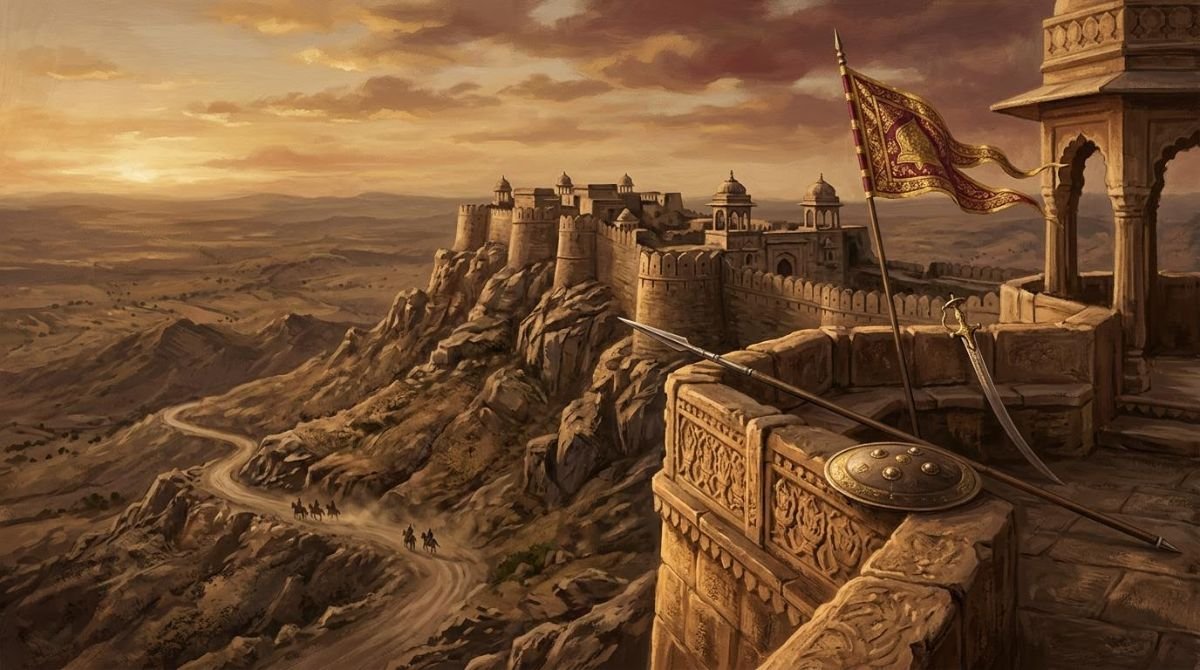
Rajput history is the story of the warrior and ruling clans of northern India and today’s Pakistan, whose name comes from the Sanskrit rajaputra, “son of a king”. From the early medieval centuries Rajput houses ruled kingdoms from Rajasthan to the Himalayan foothills, and in the Punjab and Kashmir many of them, among them the Chib Rajputs of Bhimber, later embraced Islam while keeping their clan names, titles and genealogies.
At a glance
- Name
- From Sanskrit rajaputra, “son of a king”
- Traditional order
- Kshatriya, the warrior and ruling order of ancient Indian society
- Great lineages
- Suryavanshi (solar), Chandravanshi (lunar) and Agnivanshi (fire-born)
- Royal clans
- Traditionally “thirty-six”, though the lists differ
- Heartlands
- Rajasthan, Gujarat, the Punjab and the hill states of Kangra and Jammu
- Faiths
- Mostly Hindu; many clans of the Punjab and Kashmir are Muslim
- The Chibs
- Rajputs of Bhimber, traced to the Katoch royal house of Kangra
What the word Rajput means
Rajput is the everyday form of the Sanskrit rajaputra, “son of a king”. In early inscriptions the word simply meant a prince or a noble. Over the following centuries it came to name a whole family of land-holding, sword-bearing lineages that claimed the rank of the Kshatriya, the warrior and ruling order of ancient Indian society. Historians usually date the rise of the Rajput clans as ruling houses to the early medieval period, roughly the seventh to the twelfth centuries AD, when dynasties such as the Pratiharas, Chauhans, Paramaras and Chandelas held power across northern and central India.
The 1997 Chib history on which this series is based, Raja Muhammad Iftikhar Ali Khan’s life of Raja Shadab Khan (Hazrat Baba Shadi Shaheed), opens with a short essay on the Rajputs before it turns to the Chibs. The author explains why: the saint-king left two great legacies, the Chib clan and its country, Mulk Chibhal or the state of Bhimber, and neither can be understood without some idea of the Rajput world to which they belonged (Iftikhar Ali Khan (1997), p. 17).
Rajput history: theories of origin
Where did the Rajputs come from? The book sets out the two answers that long dominated the debate (pp. 17–18).
- Heirs of the ancient Aryans. Hindu historians held that the Rajputs descend from the solar and lunar royal houses (Suraj-bansi and Chandar-bansi) of the Vedic age. They pointed to the physique and features the Rajputs shared with the ancient Aryans, to the Rajput sense of duty in protecting the Hindu dharma, and to the high place that caste-conscious Hindu society gave them. Foreign newcomers, they argued, would never have been admitted so high.
- Descendants of foreign invaders. The opposing school held that invaders who conquered parts of India soon adopted Hinduism. The book explains how this could happen: the newcomers brought no women with them and married local wives bound by their own rites and customs; their children, raised by Hindu mothers while the fathers were away at work or war, grew up Hindu, and in time the fathers too were drawn into the faith of their wives, children and neighbours.
Iftikhar Ali Khan grants that both views carry weight but comes down on the first. In the old caste order, he notes, the Rajputs (Kshatriyas) stood second only to the Brahmins and their right to rule was acknowledged; the Aryans, jealous guardians of their lineage, would hardly have given such a place to the descendants of invaders, or admitted them to the caste system at all. His conclusion is that the Rajputs were that part of the ancient Aryan peoples whose duty was to govern and to protect both the land and the dharma.
What modern historians say
Most historians today see the Rajputs as a status group that formed over several centuries from varied roots: older ruling families, local chiefs and, in some cases, groups that had entered India from Central Asia. Court bards then gave these houses genealogies reaching back to the solar and lunar dynasties of the epics. The book’s two theories are best read as the two poles of a long debate rather than as a settled answer.
Solar, lunar and fire-born lineages
Rajput genealogies place almost every clan in one of three great lines, or vansh:
| Lineage | Claimed ancestor | Examples of clans |
|---|---|---|
| Suryavanshi (solar) | The Sun, through Ikshvaku and Rama of Ayodhya | Sisodias of Mewar, Rathores of Marwar, Kachhwahas of Amber |
| Chandravanshi (lunar) | The Moon, through the royal lines of the Mahabharata | Bhatis of Jaisalmer, Tomars of Delhi, Katoch of Kangra |
| Agnivanshi (fire-born) | Heroes born from a sacrificial fire on Mount Abu | Chauhans, Paramaras, Chaulukyas (Solankis) and Pratiharas |
The book records both kinds of claim for the Katoch rajas of Kangra, the house from which the Chibs descend. The family is “generally called Chandar-bansi”, yet Thakur Kahan Singh Balauria, the historian of the Dogra country whom the book quotes, rejects the legend that its founder Bhumi Chand sprang from the earth with a bow and arrow, just as he rejects the fire-birth legend of the Agnikula clans. He traces the Katoch instead to the sage Kashyap, which is why their gotra is Kashyap (p. 22).
The thirty-six royal clans
Bards and genealogists also speak of “thirty-six royal clans”. The number is traditional and the lists never quite agree; Colonel James Tod’s Annals and Antiquities of Rajasthan (1829–32) made the idea familiar to English readers. Each great clan in turn branched into sub-clans, usually named after a founding ancestor. The Chibs followed the same pattern: H. A. Rose’s Glossary (1911), translated in the book, lists fourteen Chib gots descended from Baba Shadi Shaheed, such as the Ghanial, Jaskal and Malkal (see the fourteen septs of the Chib clan).
The Rajput code of honour
Much of Rajput history is a history of ideals. The book’s portrait of the classic Rajput (pp. 18–19) lists the qualities that the ballads and chronicles celebrate:
- self-denial and love of the homeland, with life itself offered for the country and the clan;
- truthfulness, and loyalty to one’s word, one’s faith and one’s friends;
- kindness to all, and a hatred of flattery and outward show;
- strict personal morals;
- courage that found its fulfilment on the battlefield, so that the sight of death held no terror;
- respect for the brave, and a refusal to be anyone’s subordinate.
“Laying down their lives for honour was their special quality.”
— Iftikhar Ali Khan (1997), p. 18
The word the book uses for that honour is aan. It adds that Rajput women were as bold as the men and gave up their lives for their chastity and their husbands’ names, a reference to the jauhar and sati of the old ballads, remembered above all from the sieges of Chittorgarh in Mewar.
The failings the book does not hide
The portrait is not uncritical. The author names the weaknesses that, in his view, kept the Rajputs from founding an empire across Hindustan: a habit of opium, bitter feuds within and between clans, and a pride so fierce that they counted it a disgrace to accept a place under any sultanate (p. 19). General history bears out part of the point. The Rajput kingdoms usually fought as separate houses rather than as one power; some, like the Kachhwahas of Amber, rose high as allies and generals of the Mughals, while others, like Rana Pratap of Mewar, chose long resistance.
Muslim Rajputs of the Punjab and Kashmir
Rajput identity has never belonged to one religion. In the Punjab, Jammu and Kashmir many clans embraced Islam during the Sultanate and Mughal centuries, often one family at a time, through the influence of Sufi saints, service at the imperial court or local circumstance. They kept their clan names, their genealogies and much of their custom. Muslim Rajput clans of the region include the Janjuas of the Salt Range, Bhattis, Manhas, the Jarrals of Rajouri and the Chibs of Bhimber, and in several of them Hindu and Muslim branches lived side by side.
The hill country south of the Pir Panjal range, in the Jammu province of the old Kashmir state, held so many Rajput clans and families that the book calls it, without exaggeration, “a second Rajputana” (p. 33). Titles there kept the old Rajput sense of rank. Among the Chibs, the book explains, the eldest son of a ruler bore the title Raja and a younger son the title Rai (p. 38); later branches used Mian, Mirza and Khan, while the Hindu Chibs kept Thakur and Mian.
Where the Chibs fit
The Chib Rajputs (also written Chibh or Chhib; Urdu چب راجپوت) belong squarely to this hill-Rajput world. Their genealogists trace them to the Katoch rajas of Nagarkot (Kangra), one of the oldest royal houses of the Punjab hills, whose story is told in From Kangra to Bhimber: The Katoch Origins. According to the book, Raja Chib Chand, a great-grandson of Raja Megh Chand of Kangra, came to Bhimber, in today’s Azad Jammu and Kashmir near the Pakistani Punjab border, and took its throne in about the first quarter of the fifteenth century; the competing versions of how and when are compared in Five Accounts of Chib Origins.
- Rajputs — the Kshatriya clans of northern India
- Chandravanshi (lunar) line — to which the Katoch are usually assigned
- Katoch rajas of Nagarkot Kangra — gotra Kashyap
- Raja Megh Chand — ruler of Kangra; another son founded the Guleria house
- Partab Chand — passed over for the Kangra throne
- Raja Narain (Nahar) Chand — left Kangra for Bhimber
- Raja Chib Chand — founder of the Chibs and ruler of Bhimber
- Raja Narain (Nahar) Chand — left Kangra for Bhimber
- Partab Chand — passed over for the Kangra throne
- Raja Megh Chand — ruler of Kangra; another son founded the Guleria house
- Katoch rajas of Nagarkot Kangra — gotra Kashyap
- Chandravanshi (lunar) line — to which the Katoch are usually assigned
Chib Chand’s descendants ruled Chibhal, the land of the Chibs, for some four centuries. In the sixteenth century Raja Shadab Khan, revered as Hazrat Baba Shadi Shaheed, embraced Islam, and most Chibs have been Muslims since, while a Hindu branch continued in the line of Raja Ghaggi Khan at Dewa Vatala. Rose’s Glossary recorded a custom that bound the clan to its saint: Muslim Chibs brought their sons to his shrine for the first cutting of the top-knot (mu-tarashi), and until it was done a boy was not counted a true Chib, nor might his mother eat meat (p. 26). The Chibs thus carry both inheritances, the Rajput pride in lineage and the devotion of a Muslim people, which is why their history begins, as the book does, with the Rajputs.
Frequently asked questions
What does the word Rajput mean?
Rajput comes from the Sanskrit rajaputra, meaning “son of a king”. It first described princes and nobles and later came to name the warrior and ruling clans of northern India and present-day Pakistan, who claimed the rank of the ancient Kshatriya order.
What are the three Rajput lineages?
Rajput genealogies place clans in three great lines: the Suryavanshi or solar line, claiming descent from the Sun through Rama; the Chandravanshi or lunar line, claiming descent from the Moon through the royal lines of the Mahabharata; and the Agnivanshi or fire-born line, whose four clans are said to have sprung from a sacrificial fire on Mount Abu.
Were the Rajputs descended from foreign invaders?
That was one of two old theories. The 1997 Chib history by Raja Muhammad Iftikhar Ali Khan favours the other view, that the Rajputs were the Kshatriya branch of the ancient Aryans. Most modern historians see the Rajputs as a group that formed over several centuries from varied origins, including some Central Asian newcomers.
Are there Muslim Rajputs?
Yes. Many Rajput clans of the Punjab, Jammu and Kashmir embraced Islam during the Sultanate and Mughal periods while keeping their clan names and genealogies. Examples include the Janjuas, Bhattis, Manhas, the Jarrals of Rajouri and the Chibs of Bhimber.
Are the Chibs Rajputs?
Yes. The Chib Rajputs of Bhimber, in Azad Jammu and Kashmir, trace their descent to Raja Chib Chand, a prince of the Katoch royal house of Kangra. Most Chibs became Muslims after their ruler Raja Shadab Khan, revered as Baba Shadi Shaheed, embraced Islam in the sixteenth century.
Sources
- Raja Muhammad Iftikhar Ali Khan, Raja Shadab Khan alias Hazrat Baba Shadi Shaheed (Urdu, Barhang/Karachi, 1997), pp. 17–19; also pp. 22, 26, 33 and 38.
- Thakur Kahan Singh Balauria, Tawarikh-e-Rajputan-e-Punjab, as quoted in the book (p. 22).
- H. A. Rose, A Glossary of the Tribes and Castes of the Punjab and North-West Frontier Province, Vol. II (1911), pp. 169–170, as translated in the book.
- General background: James Tod, Annals and Antiquities of Rajasthan (1829–32).
This article is part of our series based on the 1997 Chib history; see the book, chapter by chapter. Spellings of names follow the book.
Continue reading
Have a question about this history?
Our AI guide answers from the articles on this site, in English or Urdu.
