

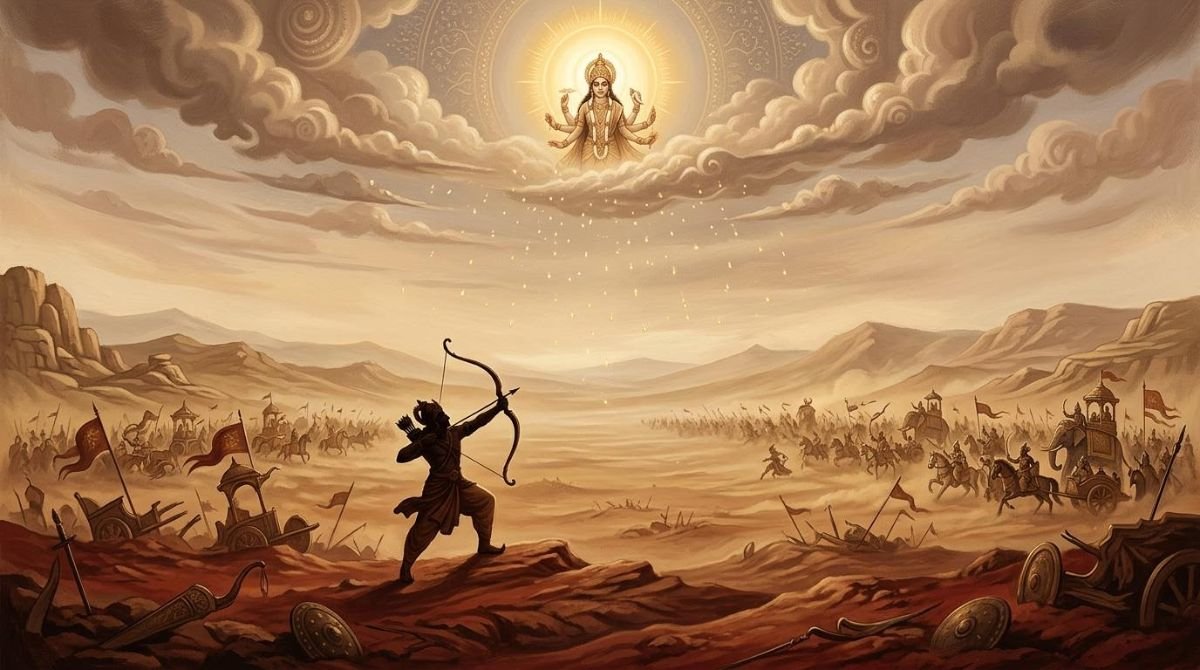
Bhumi Chand (بھومی چند), also written Bhum Chand, is the legendary founder of the Katoch royal house of Kangra, from which the Chib Rajputs of Bhimber trace their descent. Thakur Major Singh’s Tarikh-e-Chibhal (c. 1926), the oldest written history of the Chibs, records the tradition that he was born from drops of a goddess’s sweat that fell to earth in a war between gods and demons, and then explains the story as a figure of speech.
At a glance
- Name
- Bhum Chand or Bhumi Chand; also Parse Chand (reading uncertain); “Raja Bhum Asur” on the book’s chart
- Meaning
- Bhumi, “the earth”
- Founder of
- The Katoch house of Kangra (Nagarkot), of which the Chibs are a branch
- The legend
- Born of a Shakti’s sweat in the war of the Devtas and the Dait rajas
- The author’s view
- A metaphor for a Kshatriya hero who appeared suddenly
- Descent given
- Kashyapa, Hiranyakashipu, Prahlad, Bali, Chandarman (reading uncertain), Bhumi Chand
- Kingdom
- Trigart Desh (Trigarta)
- Source
- Major Singh (c. 1926), pp. 6–10
Bhumi Chand and the Katoch of Kangra
The main text of Tarikh-e-Chibhal opens on page 6 with an account of the origin of the Chib Rajput family, and its first sentence is a claim of kinship. The Chibs, it says, are a branch of the Katoch, whose ancient capital was Kangra, in the hills of today’s Himachal Pradesh in India. Kangra is also called Nagarkot, the author explains, and from this the family took the name Katoch; and even now the estate of Lamba Gaon, today’s Lambagraon, is held by the same family (Major Singh (c. 1926), p. 6). For the wider story of that kinship, see From Kangra to Bhimber: the Katoch origins of the Chib Rajputs, and for the clan as a whole, Chib Rajputs.
Before he tells the legend of the founder, the author warns his readers how to take it. Several traditions are told about the origin of the family, he writes, just as there are about the Agni-kul Rajputs, the clans said to have sprung from a sacrificial fire. Some are coloured by religion, and some are told by way of alankar, poetic figure, in such a way that in this age they are hard even to understand, or present-day historians will not accept them (p. 6). The solar, lunar and fire-born lineages of the Rajputs are explained in Rajput History: Origins, Clans and the Code of Honour.
The legend of the goddess’s sweat
The founder of the family, the book says, was Bhum Chand or Bhumi Chand, and it was well known that he had been born from bhumi, the earth. The saying ran like this. When war broke out between the Devtas, the gods, and the Dait rajas, the demon kings, a war in which the pairs Kumbh and Nikumbh and Sundh and Nisundh also took part, Parmatma, the Supreme Being, sent a Shakti, a goddess of divine power, to protect dharm and the Devtas. The fiercest fighting raged in the country between the south of Multan and Gujarat-Kathiawar, in western India (not the Punjab district of Gujrat). Drops of sweat appeared on the Shakti’s forehead, and a few fell to the earth. From them sprang a Kshatriya hero who, by the strength of his arm, utterly defeated the Dait rajas (pp. 6–7).
Because he was born from sweat, the book continues, some called him Parse Chand (reading uncertain; the word may come from a Hindi word for sweat), and some Bhumi Chand, “of the earth”. The family chart on page 10 gives him a third name, “Raja Bhum Asur, known as Bhum Chand”.
The author’s reading: a hero who appeared suddenly
Having told the story, Major Singh refuses to take it literally.
“This whole story is mere talk, for the birth of a human being from sweat, and then at once from the earth, is against the law of nature.”
— Major Singh (c. 1926), p. 7 (translated)
In its place he offers a reading of his own. The family, he says, descends from Maharaja Kashp, the sage Kashyapa, a grandson of Brahma. Among Kashyapa’s descendants were two brothers, Harniakash and Harniakashp, the Hiranyaksha and Hiranyakashipu of the Puranas. They were heroic and powerful men who worshipped the Devi, the Goddess, and for that reason they were given the title of Daityas; later, because of their courage and great stature, poets went so far as to write them down as Rakshasas, demons. But they were not horned monsters, as they are often shown in the Ram Lila and the Prahlad Lila, the popular religious plays; they were very brave human beings (p. 7).
When these men began to act against nature and against dharm, the author goes on, the Devtas, “that is, the good people”, complained together to Brahma and prayed for protection. By the direction of Parmatma a Shakti came into being, and a great war began. At its height a Kshatriya hero appeared and gave the Devtas such help that the Dait rajas were defeated. Because he appeared all of a sudden, it was said by way of metaphor that he had come out of the earth, and so he became famous as Bhumi Chand. In fact, the author insists, Bhum Chand already existed; only a wave of new thoughts rose suddenly in his heart, and he fought with heart and soul on the side of the Devtas. Sund and Nisund both fell in that battle, fighting bravely (p. 7).
The author keeps the frame of the old story, a war of right against wrong with the gods on one side, but he turns the miracle into metaphor and the demons into men. It is the method he promises in his preface, where he says he has tried to present the improbable events of oral tradition “in their true colours” (p. 5).
From Kashyapa to Bhumi Chand
Major Singh then gives Bhumi Chand a pedigree. From the same family, he writes, came Maharaja Prahlad, very virtuous and a devotee of Parmatma: the Prahlad of the Puranic story, the devoted son of Hiranyakashipu. Prahlad’s grandson was Raja Bali, a great dharmatma, or righteous soul, who had many sons. One of them was Chandarman (reading uncertain; the name means the Moon), and his son was Bhumi Chand (p. 8). The chart on page 10 draws the same descent through Prahlad’s son Parochan (Virochana) to Bali, lists eight sons of Bali, and enters Chandarman’s son as “Raja Bhum Asur, known as Bhum Chand”. The whole chart, and the numbered roll that follows it, are given in The Chib Shajra: 481 Generations in Tarikh-e-Chibhal.
From this descent the author draws a conclusion about the family’s place among the Rajput races. Because Bhumi Chand was the son of Chandarman, the Moon, the family is called Chandar-bansi, of the lunar race; in reality, he argues, it is Suraj-bansi, of the solar race, because the lunar line proper descends from the sage Atri (p. 8). The chart makes a related point, with a note in the margin beside Kashyapa’s son “Suraj”, the Sun: “from him came the Suraj-bansis” (p. 10).
One detail the author leaves without comment is the chart’s label “Bhum Asur”. It recalls Bhaumasura, the demon king of the Puranas whose name means “son of the earth”, and shows how closely the legend of the earth-born founder is bound up with the old Puranic genealogies.
Trigart Desh and the 234th generation
Bhumi Chand’s descendants, the book continues, ruled for a long time in Trigart Desh, the Trigarta of Sanskrit literature, which the author places in “the eastern part of Gujarat-Kathiawar” (p. 8). Most historians identify Trigarta instead with the Jalandhar–Kangra country between the Ravi, the Beas and the Sutlej, as described in Trigarta: the Katoch kingdom in the Mahabharata. The author was not alone in his placing: Thakur Kahan Singh Balauria, quoted in the 1997 Chib history, also glosses Trigart as Kathiawar (Iftikhar Ali Khan (1997), p. 22).
In the 234th generation of the family, the book says, came Raja Susharm Chand, or Susharman, a very brave raja who sided with the Kauravas in the Mahabharata. When the Kauravas took counsel to kill Abhimanyu, the son of Arjun, they decided it could be done only while Arjun was away from the field, so Susharm Chand was given the task of fighting Arjun; he drew him far from the battle and in the end was killed at his hands. The author calls Susharm Chand the behnoi, or sister’s husband, of Duryodhan, and adds that the fort of Kangra is said to date from his time, which suggests to him that in the age of the Mahabharata the clan was slowly moving from Trigart Desh towards Kangra (p. 8). In the epic as it is usually told, Duryodhana’s only sister, Duhsala, was married to Jayadratha, king of Sindhu, so that kinship belongs to the family tradition rather than to the epic. The fort is described in Kangra Fort: ancestral stronghold of the Katoch rajas.
In the book’s numbered roll Susharm Chand duly appears at No. 234, with a note that he “was killed in the Mahabharat at the hands of Arjun” and a brother, Satya Karan (reading uncertain), who “was killed without issue” (p. 14). From him the line runs on. In the 204th generation after him came Raja Lachhman or Phaman Chand (reading uncertain), whose second son, Purab Chand, was the ancestor of the Jaswal Rajputs, and sixteen generations after his elder son, Padam Chand, came Raja Megh Chand of Kangra, whose third son, Partab Chand, was the ancestor of the Chibs (pp. 8–9). Megh Chand’s four sons and their houses are described in Guler and Kangra: the brother houses of the Chibs, and the book itself in Tarikh-e-Chibhal, chapter by chapter.
Other tellings of the Bhumi Chand legend
The founder appears in other Chib and Katoch sources, with differences:
Sources differ
- Kahan Singh. Thakur Kahan Singh Balauria’s Tawarikh-e-Rajputan-e-Punjab, quoted in the 1997 Chib history, says Bhumi Chand was born out of the earth “with a bow and arrow”, and rejects the story, as Major Singh does, by comparison with the Agni-kul legend. He gives the family the gotra Kashyap and says it is generally called Chandar-bansi. He makes Susharm Chand the son-in-law of Dhritarashtra as well as Duryodhan’s brother-in-law, killed with a large force by Arjun as told in the Virata and Drona books of the Mahabharata, and the builder of Kangra Fort (Iftikhar Ali Khan (1997), p. 22). He has no sweat legend, no descent from Prahlad and Bali, and no Abhimanyu episode.
- The Malot shajra. The shajra of the Chibs of Malot, on our Lineage / Family Tree page, calls the founder Rajanaka Bhumi Chandra and places him about 4300 BC.
- Raja Wilayat Khan. The unpublished research of Raja Wilayat Khan of Thotha Rai Bahadur, summarised in the 1997 history, leaves Bhumi Chand out altogether. It derives the house of Kangra from a Tanwar (Tomar) prince who ruled at Hoshiarpur, and names a Katoch Dev Chand, born about 570, as the builder of Kangra fort and the source of the name Katoch (Iftikhar Ali Khan (1997), p. 29).
The other accounts of where the Chibs came from, including the Iranian-prince story that Major Singh rejects in his preface, are compared in Where Did the Chibs Come From? Five Accounts of Chib Origins.
Frequently asked questions
Who was Bhumi Chand?
Bhumi Chand, or Bhum Chand, is the legendary founder of the Katoch royal house of Kangra, from which the Chib Rajputs of Bhimber descend. In Thakur Major Singh’s Tarikh-e-Chibhal (c. 1926) he heads a numbered roll of rulers that ends at No. 481 with Raja Sultan Khan, the last Raja of Bhimber. Tradition says he was born from the earth, which is what his name means.
Why is he called Bhumi Chand?
Bhumi means the earth. According to the legend recorded in Tarikh-e-Chibhal, drops of sweat fell from the forehead of a goddess, a Shakti, onto the earth during a war between the gods and the demon kings, and a Kshatriya hero sprang from them. Some called him Parse Chand, from the sweat, and others Bhumi Chand, from the earth.
Did the author of Tarikh-e-Chibhal believe the legend?
No. Thakur Major Singh called it mere talk, because birth from sweat and from the earth is against the law of nature. He read it as a metaphor: Bhum Chand was a real Kshatriya who appeared suddenly on the side of the gods, and the demon kings he fought were brave human beings, not horned monsters.
Are the Katoch and the Chibs of the lunar or the solar race?
Tarikh-e-Chibhal says the family is called Chandar-bansi, of the lunar race, because Bhumi Chand was the son of Chandarman, the Moon, but argues that it is really Suraj-bansi, of the solar race, because the true lunar line descends from the sage Atri. Thakur Kahan Singh, quoted in the 1997 Chib history, says only that the family is generally called Chandar-bansi.
Where was Trigart Desh?
Tarikh-e-Chibhal says Bhumi Chand’s descendants ruled Trigart Desh and places it in the eastern part of Gujarat-Kathiawar, in western India. Most historians identify Trigarta with the Jalandhar and Kangra country of the Punjab hills. The book makes Raja Susharm Chand, the Trigarta king of the Mahabharata, the 234th ruler of the line and dates Kangra Fort to his time.
Sources
- Thakur Major Singh Chib, Tarikh-e-Rajgan-e-Bhimber wa Qaum-e-Chibhal (Tarikh-e-Chibhal; Urdu, c. 1926), pp. 5–10, 14.
- Raja Muhammad Iftikhar Ali Khan, Raja Shadab Khan alias Hazrat Baba Shadi Shaheed (Urdu, Barhang/Karachi, 1997), pp. 21–22, 29.
- Thakur Kahan Singh Balauria, Tawarikh-e-Rajputan-e-Punjab, as quoted in Iftikhar Ali Khan (1997), pp. 21–22.
- Shajra-e-Nasab (family tree) of the Chib Rajputs of Malot, Azad Kashmir, as shown on our Lineage / Family Tree page.
This article is part of our series on the oldest Chib history; see Tarikh-e-Chibhal, chapter by chapter. Spellings of names follow the book; readings marked “uncertain” could not be read with certainty in the old lithograph.
Continue reading
Have a question about this history?
Our AI guide answers from the articles on this site, in English or Urdu.
