

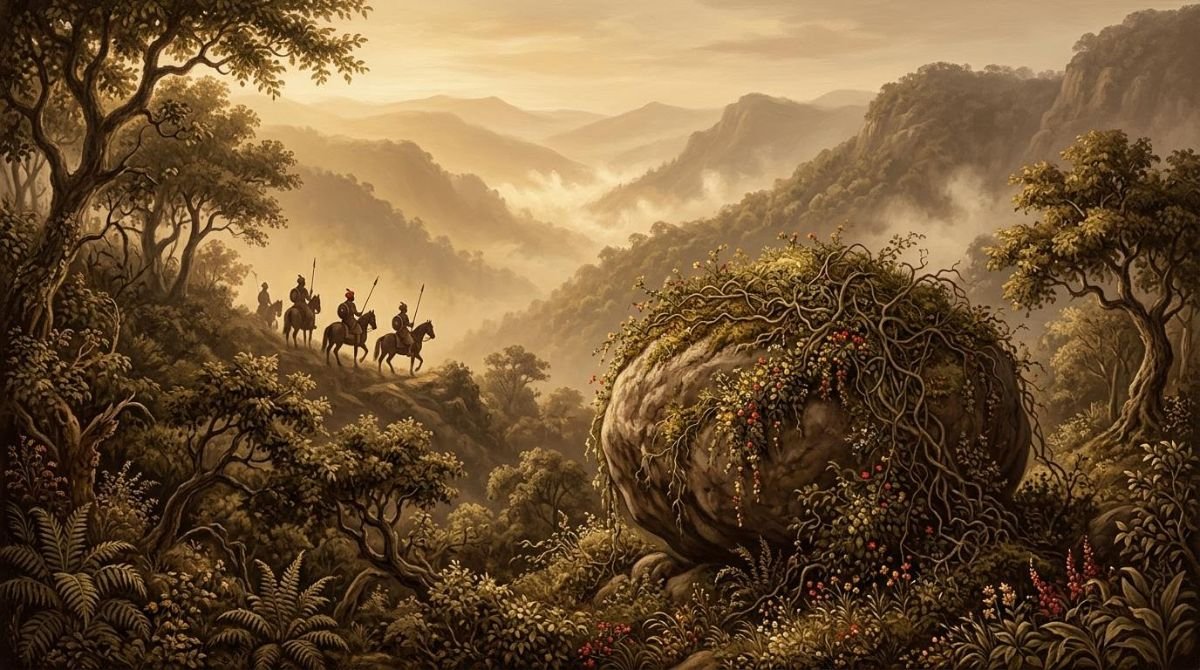
Thal Pir (ٹھل پیر) is a great boulder at Ralwah, near Samahni in Bhimber District of Azad Kashmir, venerated as the place where Raja Dal Khan was killed by his elder brother, Raja Shadab Khan, the Chib raja of Bhimber revered as Baba Shadi Shaheed. Chib tradition remembers it as the end of a sixteenth-century war between the two brothers, fought, the compiler of the 1997 Chib history argues, over the raja’s acceptance of Islam.
At a glance
- Place
- Mauza Ralwah (also read Raloh or Raluh), Tehsil Samahni, District Bhimber, on the Samahni–Mirpur road
- Name
- Thal is the local Pahari word for a very large rock; pir marks a holy person or place
- Who died there
- Raja Dal Khan (Bel Chand or Dal Chand), second son of Raja Goja Chand
- Killed by
- His elder brother, Raja Shadab Khan (Baba Shadi Shaheed)
- Cause
- Strained relations, or, in the compiler’s and Ralwah’s telling, Dal Khan’s opposition to his brother’s conversion
- Memorials
- The rock of Thal Pir, and Dal Khan’s chhani, a cremation memorial, at Ralwah
- Legend
- The raja’s sentence on the man who betrayed his brother’s hiding place
Four sons of Raja Goja Chand
Raja Goja Chand, one of the rajas of Bhimber, ruled from Chowki Bandi in the Samahni valley and had four sons: Shadip Chand, later Raja Shadab Khan and revered as Baba Shadi Shaheed; Bel Chand, known as Dal Chand or Raja Dal Khan; Chhel Chand or Chhel Khan; and Thom Chand, known as Dom Khan. Before he died he told his heir to give each brother a share of the state, and Shadip Chand did so. Dal Khan, the second son, received Beri Pattan and the country around it as his jagir; Chhel Khan received Chahi and Pothi, and Dom Khan the land east of Samahni.
Peace did not last. The book’s genealogical chapter says that relations between the eldest brother and Dal Khan stayed strained and worsened day by day until open war broke out. Dom Khan, too, fought his eldest brother and was driven into Poonch, where he founded the Domal; only Chhel Khan, ancestor of the Chibs of Pothi Jang Khan, kept on good terms with him.
A war over faith?
The genealogical chapter gives no cause beyond ill feeling. The compiler of the 1997 history, Raja Muhammad Iftikhar Ali Khan, and the people of Ralwah are clear that it was religion. When Raja Shadab Khan gave up his ancestral Hinduism and declared himself a Muslim, Dal Khan, a devoted Hindu, was bitterly offended: once the raja had become a Muslim, the state of his forefathers was sure to become a Muslim state, as later events proved. Dal Khan resolved to kill his brother, take the throne and keep Bhimber a Hindu state, and when nothing else worked he declared war.
For the compiler the war is evidence in a larger argument. If the Sultan of Delhi had forced Islam on the raja, as Thakur Major Singh’s Tarikh-e-Chibhal claimed, why would his own brother have taken up arms against him? The rebellion shows, he argues, that the conversion was the raja’s own choice; the debate is set out in Forced or free? How Baba Shadi Shaheed embraced Islam.
The battle and the hiding place
According to the tradition of Ralwah, the brothers’ armies met at Ralwah, a village near Samahni some ten or twelve miles north of Bhimber, and after a fierce fight Dal Khan was beaten. He fled for his life and hid beneath a huge rock near the village. In those days the hills here were covered in dense forest, with few people and many wild animals, and the hiding place was so hard to reach that, without an informer, it would never have been found. The raja’s soldiers searched every corner in vain, until a detachment, guided by a man of the area, reached the rock. There Dal Khan was killed at the hands of his elder brother.
The raja’s sentence
What followed is told in Ralwah as one of the Baba’s miracles. Seeing his brother’s body before him, Raja Shadab Khan was overcome with grief and asked who had revealed the hiding place. The villagers named the man, and he was brought before the raja, who said:
“O man, go. I have forgiven you my brother’s blood.”
— Ralwah tradition, in Iftikhar Ali Khan (1997), p. 374
But, the raja added, as long as the world lasted no young man of the informer’s family as handsome and strong as his slain brother would live beyond the age at which Dal Khan had died. The story was told to the compiler by Raja Shafqat Khan of Ralwah, grandson of Raja Alif Khan, a respected elder of the Samahni valley, who said that the informer was one of his own forebears and that his family believes the words have held true down the generations. Three other men of Ralwah, Chaudhry Muhammad Akbar, a schoolteacher, Chaudhry Muhammad Yasin and Chaudhry Muhammad Azam, confirmed the account in the compiler’s presence. As he does after many of the testimonies in his book, the compiler closes it with a line of Rumi: the saints have power from God.
Thal Pir today
The rock stands beside the Samahni–Mirpur road within the lands of Ralwah, in Tehsil Samahni. The book’s photograph shows a huge rounded boulder overgrown with plants, among trees and tall grass. The people of the Samahni valley, ordinary folk and notables alike, treat the spot as a sacred shrine, and wild, evergreen, sweet-smelling flowers, they say, are always in bloom there, keeping the place of killing fragrant. The compiler visited the rock with Raja Ghazanfar Ali Khan, an advocate of the Samahni court.
Dal Khan himself is remembered at Ralwah by a chhani (also written chihani), a cremation memorial known as Dal Khan’s Chihani: fittingly for a man who died a Hindu, a place of cremation rather than a grave. He left no children, and his jagir of Beri Pattan was taken back into the state of Bhimber. In the old Chib land tables printed in the book, Ralwah appears among the villages of the Samahni jagir of Raja Hakim Khan’s family, a branch of Raja Mal Khan’s line (see the Samahni Chibs).
Thal Pir belongs to a pattern in Chibhal. The samadh of Dal Khan’s father at Chowki is called Goja Pir, and the tomb of the Baba’s last opponent, Haibat Khan Qandhari, is Pir Qandhari: across the old divides of faith, the people of the region have honoured the resting places of their great dead as holy ground. The wider history of the clan is told in our guide to the Chib Rajputs.
What the sources say about Thal Pir
| Source in the book | Cause of the war | Place and memorial |
|---|---|---|
| Genealogical chapter (pp. 69, 82) | Strained relations | Killed at Ralwah near Samahni; his samadh, “Dal Khan’s Chihani”, stands there; died childless |
| Maulvi Zain-ul-Abidin’s manuscript (p. 118) | Not stated | Dal Khan’s chhani is at Ralwah |
| The compiler’s argument (p. 115) | The raja’s conversion | Killed at Ralwah, 10–12 miles north of Bhimber; his cremation ground remains |
| Photograph caption (p. 112) | Not stated | Killed at Thal Pir on the Samahni–Mirpur road; the spot is held sacred |
| Ralwah tradition (pp. 372–375) | The raja’s conversion | Battle at Ralwah; killed at the rock; the informer’s family; evergreen flowers |
Sources differ
The village’s name, written رلوہ in Urdu, is read Ralwah, Raloh or Raluh, and the brother appears as Dal Khan, Dal Chand and Bel Chand. Even the Ralwah account wavers on whether Dal Khan hid beneath the rock or behind it. Thakur Major Singh’s Tarikh-e-Chibhal, the chief Hindu source on the Baba’s life, does not mention Dal Khan in the passages the book quotes.
Frequently asked questions about Thal Pir
What is Thal Pir?
Thal Pir is a large boulder at Ralwah near Samahni, in Bhimber District of Azad Kashmir, venerated as the place where Raja Dal Khan was killed by his elder brother, Raja Shadab Khan (Baba Shadi Shaheed). The name comes from thal, the local word for a very large rock, and pir, a holy person or place.
Who was Raja Dal Khan?
Raja Dal Khan, also called Bel Chand or Dal Chand, was the second son of Raja Goja Chand of Bhimber and the younger brother of Baba Shadi Shaheed. He held Beri Pattan as a jagir, remained a Hindu, fought his brother and was killed at Ralwah, leaving no children.
Why did Baba Shadi Shaheed fight his brother?
The Chib genealogies speak only of strained relations, but the 1997 history and the tradition of Ralwah say Dal Khan rebelled because his brother had accepted Islam, and wanted to keep Bhimber a Hindu state. He was defeated at Ralwah and killed at the rock of Thal Pir.
Where is Thal Pir?
Thal Pir lies beside the Samahni–Mirpur road within the lands of Mauza Ralwah (also written Raloh or Raluh), Tehsil Samahni, District Bhimber, about ten or twelve miles north of Bhimber town.
What is the legend of Thal Pir?
Tradition says the raja forgave the man who betrayed his brother’s hiding place, but declared that no young man of his family as handsome as Dal Khan would outlive Dal Khan’s age. The people of the Samahni valley treat the spot as a shrine, where wild sweet-smelling flowers are said to bloom all year.
Sources
- Raja Muhammad Iftikhar Ali Khan, Raja Shadab Khan alias Hazrat Baba Shadi Shaheed (Urdu, Barhang/Karachi, 1997), pp. 68–70, 81–82, 91, 97, 112, 114–118, 372–375, 388, 403, 406.
- Maulvi Zain-ul-Abidin Kohi Samahnavi, unpublished manuscript history of Chibhal, as quoted in the above.
- Oral testimony of Raja Shafqat Khan and other residents of Ralwah, recorded in the above.
This article is part of our series based on the 1997 Chib history; see the book, chapter by chapter. Spellings of names follow the book.
