

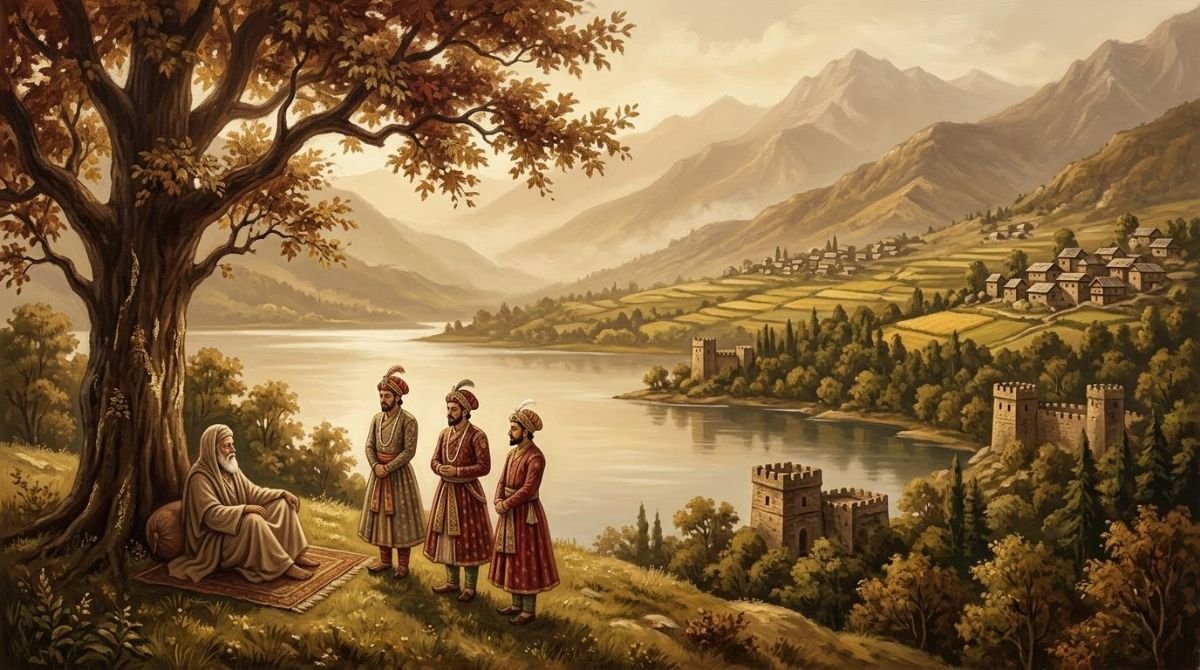
The Chib mandis (منڈی, mandi) were the hereditary estates, and the branch families that held them, into which the Chib Rajputs of Bhimber divided their old kingdom of Chibhal, in today’s Azad Jammu and Kashmir. According to the 1997 Chib history of Raja Muhammad Iftikhar Ali Khan, the system began when the younger sons of Raja Madan Khan, ruler of Bhimber, quarrelled over their inheritance: the Sufi saint Shah Daula of Gujrat arbitrated, four forts rose beside Baghsar lake, and from them grew the mandis of Malot, Khui Ratta and Rajal, later joined by Ghawaliyan and Bandala.
At a glance
- What
- Hereditary estates of the junior branches of the Chib ruling house, and the families that held them
- Where
- Chibhal Rajana, east of the Bhimber Nala, and Chibhal Raika (Khari Kariali), west of it; mostly in today’s Bhimber District, Azad Kashmir
- Began with
- The sons of Raja Madan Khan (Madad Khan), seventh in descent from Baba Shadi Shaheed
- Arbiter
- Hazrat Shah Daula Wali of Gujrat
- Mandis of Chibhal Rajana
- Malot (the first), Ghawaliyan, Bandala and Rajal; Khui Ratta for a time
- Mandis of Chibhal Raika
- Thotha Rai Bahadur, Panjeri, Da’ora and Bahlwal (formerly Khambi)
- Status
- Described as obsolete in the book’s own mandi tables
- Main source
- Iftikhar Ali Khan (1997), pp. 116–123, 200–201, 258–282, 395–406
What was a mandi?
In everyday Urdu and Punjabi a mandi is a market town. In the history of the Chib Rajputs the word means something else: the seat of a junior branch of the ruling house, the fort from which that branch governed and the cluster of villages it held. The same word names the family itself, which is why the family trees printed in the book carry headings such as “Rajgan of Malot Mandi” and “Malikan of Bandala Mandi”.
The colonial ethnographer H. A. Rose, whose 1911 Glossary of the Tribes and Castes of the Punjab the book translates into Urdu, found the arrangement strange and interesting. The throne of Bhimber belonged to the raja’s eldest son, but the younger sons also had a right to authority in parts of the state. Each great jagir was owned by a prince of the royal family while the eldest prince reigned as raja. The mandis stayed loyal to the Bhimber Raj, Rose noted, yet they ran their own affairs and collected their own land revenue.
The book sets the whole system out in three hand-drawn tables (pp. 395–406): Table No. 1 for Chibhal Rajana, Table No. 2 for Chibhal Raika or Khari Kariali, and Table No. 3 for the senior dheri-holders. For each mandi they record the area, the chief (sardar) who founded it, its got (sub-clan) and titles, the ancestor whose descendants held most of its land, and the villages where those descendants lived. A mandi, in other words, was a lineage, a title and a stretch of country all at once. The tables do not name their source.
Two Chibhals: Rajana and Raika
The mandis grew inside an older division of the land. After the death of Raja Shadab Khan, revered as Baba Shadi Shaheed, his brother Raja Dom Khan disputed the succession. The Mughal emperor sent an official from Delhi, and a panchayat (council) of the brotherhood split Chibhal along the Bhimber Nala. The eldest son, Raja Bhom Khan, kept the throne and the land to the east, which became Chibhal Rajana, also called Chibhal Khas (“Chibhal proper”). The second son, Raja Mal Khan, received the land to the west as far as the Jhelum, including the plain of Khari Kariali; this became Chibhal Raika, also written Rikki or Reka. The third son, Raja Rupo Khan, was given a single village, Barhang (pp. 33, 37–38, 119, 145).
The names come from titles. In Chibhal the eldest son was styled Raja and the younger son Rai, so the eastern capital became Bhimber Rajani and Raja Mal Khan’s seat Bhimber Raiki; the book notes that both names still appeared in the revenue papers of its own day. Each half later had a set of mandis of its own. Chibhal Rajana, the book says, had four mandis just as Khari Kariali did (p. 258).
How the Chib mandis began: Raja Madan Khan’s five sons
A raja with three ranis
The founding story comes from the unpublished manuscript history of Maulvi Zain-ul-Abidin Kohi Samahnavi, “the historian of Chibhal”, which the book quotes at length. Raja Madad Khan, better known as Raja Madan Khan, was the son of Raja Shah Khan (Shah Muhammad Khan) and the grandson of Raja Hajj Khan, and he is one of the rajas of Bhimber in the main line. The book counts him fourteenth in descent from Raja Chib Chand, founder of the dynasty, and seventh from Baba Shadi Shaheed; its mandi table makes him the fourth generation after Raja Jamshed Khan. The chronicle calls him a very majestic raja. He had three ranis and five sons:
- By the first, high-born (asil) rani: Raja Ismail Khan, also called Sahmal Khan, the eldest, and Raja Darya Khan.
- By the second rani, a woman of the Sudhan tribe: Khan Jewal Khan (also read Jiwal Khan) and Khan Parda Khan.
- By the third rani: Mirza Izar Beg Khan, whose name is also printed Azar Beg.
Shah Daula’s award and the four forts of Baghsar
By raj-niti, the custom of royal succession, the eldest son, Ismail Khan, took the throne of Bhimber. His four brothers fell out over ranks (mansabs) and inheritance, and the dispute was put to Hazrat Shah Daula Wali, the Sufi saint of Gujrat. Following his award, Darya Khan, Jewal Khan, Parda Khan and Izar Beg built four forts, the Char Kot, on the shore of the lake at Baghsar, near Bandala in today’s Tehsil Samahni, District Bhimber. From there, the chronicle says, the four mandis came into being, and the brothers’ descendants spread through Chibhal Rajana.
From quarrel to battle: the road to Khui Ratta
The award did not hold. The quarrel grew into a battle in which Khan Saeed Khan, son of Khan Sikandar Khan and grandson of Jewal Khan, was killed. Jewal Khan and Parda Khan then left the Bhimber country for Khui Ratta in the Banah valley, in today’s Kotli District, and their descendants spread through Khui Ratta, Kotera Khanka and the villages around them. Family tradition, recorded in the book, holds that Saeed Khan’s widow was pregnant when he was killed and saved her newborn son by exchanging him for a Jat woman’s baby girl. The boy, Khan Muhammad Umar Khan, grew up to serve the Mughal emperors and founded the Khanka house of Khui Ratta.
Malot, the first mandi
Darya Khan’s line divided again. The descendants of Malahim Khan settled at Malot, those of Yar Beg at Pathorani (reading uncertain) and those of Sultan Khan at Bandala. According to the chronicle, the mandi of these families, and of the Khui Ratta people too, was fixed at Malot, which the book therefore calls the first mandi of Chibhal Rajana. Izar Beg’s descendants held Rajal and Rajpur Kamila. Later, after a further dispute, the Khui Ratta family took a mandi of its own at Khui Ratta in place of Rajal, though Rajal and Rajpur Kamila remained, in general reckoning, the mandi of Izar Beg’s line.
Sources differ
Names. The Sudhan rani’s sons are Jewal (Jiwal) Khan and Parda Khan in the text, but the family chart on p. 391 gives the first rani a third son, “Khan Jibal Khan”, and calls the second rani’s son “Khan Piru Khan”. Izar Beg also appears as Azar, Adar and Ghaddar Beg.
Dates. The book makes Ismail Khan’s son Raja Jogu Khan a contemporary of Aurangzeb (r. 1658–1707), yet it also makes Khan Muhammad Umar Khan, a great-great-grandson of Madan Khan, a contemporary of Jahangir (r. 1605–1627) and Shah Jahan (r. 1628–1658). The mandis clearly belong to the Mughal age, but the book’s own chronology does not allow a closer date.
The mandis of Chibhal Rajana
The book gives the four mandis of Chibhal Rajana in slightly different lists. Its chapter on Malot names Malot, Ghawaliyan, Rampur Bandala and Rajal (p. 258); Rose’s Glossary, as translated, has Malot, Bandala, Ghawaliyan and Rajal (p. 26); and the mandi table has entries for Bandala, Ghawaliyan, Malot and Rajal, with Khui Ratta folded into the Malot entry (pp. 395–397). Ghawaliyan is younger than the Baghsar settlement: it was founded by Raja Jagat Singh, a son of Raja Rehmatullah Khan and great-grandson of Ismail Khan, and the book calls it “the second mandi of the Rajana family”.
| Mandi | Founder, as the book gives him | Got and titles (mandi table) | Branches and villages named |
|---|---|---|---|
| Malot | Raja Darya Khan, son of Raja Madan Khan by his first rani | Khan, Raika, Khanka, Mirzana, Rajana | Malot and Pathorani (descendants of Malahim Khan and Yar Beg); a branch at Bandala; the Khui Ratta families |
| Ghawaliyan | Raja Jagat Singh, son of Raja Rehmatullah Khan | Rajana, Mian, Thakra | Ghawaliyan; formerly jagir villages such as Kalal and Manpur |
| Bandala | Sultan Khan of Darya Khan’s line (text); Mirza Ibrahim Khan, son of Raja Karamullah Khan (table) | Rajana, Raika, Khanka, Mirzana; got Ghanial | Bandala and Khori, a jagir of Rs 1,160 (Rs 1,168 in the table); Mir Baz Khan’s descendants at Bahana Kalan and Bahana Khurd |
| Rajal | Mirza Izar Beg Khan, son of Raja Madan Khan by his third rani | Mirzana; personal titles Raja and Mirza | Rajal (Raj Muhammad Khan, Faulad Beg Khan); Rajpur and Kamila Kot (Kapur Beg Khan, Qaim Khan) |
| Khui Ratta | Khan Jewal Khan and Khan Parda Khan, sons of the Sudhan rani | Khanka, with Raika and Mirza branches | Khui Ratta, Kotera Khanka and other villages of the Banah valley |
The same table lists two older branches of Raja Bhom Khan’s house that never formed mandis. The Ghanial, descendants of Raja Ghani Khan, held their lands jointly with the ruling house of Bhimber, each family in its own right; their villages included Sheikhpur, Lathori, Kot, Mughlora, Sarsala and Nandwal, and the table notes that Mian Sawan Singh, private secretary to a former Maharaja of Jammu and Kashmir, came from this family. The Ghaggial, descendants of Raja Ghaggi Khan, are the Hindu Chibs of Dewa Vatala and the Kandi foothills.
The mandis of Chibhal Raika
West of the Bhimber Nala, in Khari Kariali, Raja Mal Khan’s sons founded mandis of their own, which Table No. 2 sets out (pp. 401–405; see also pp. 139–145):
- Thotha Rai Bahadur, the first and senior mandi, founded by Raja Ali Ghiyas Khan (Alghash Khan). Its chiefs once held 84 villages in ta’alluqadari (the table says 82), cut to 22 after a killing in the time of Rai Baz Khan. Its gots are Malkal, Malkana, Thothial, Muhammadial and Miana.
- Panjeri, founded by Raja Jaisak Khan: the Jaskal got, whose chief bore the title Rai, with 22 villages.
- Da’ora (Daura), founded by Raja Tahawwur Khan, known as Dhaur Khan: the Dhorial got, chief’s title Khan Sahib, 22 villages.
- Bahlwal, successor to the old mandi of Khambi Khanpur, which by one tradition was lost through imperial displeasure; Bahlwal kept 12 villages, and the table assigns it to the Darbial got of Darbaru or Nadir Khan.
The Samahni family of Raja Hakim Khan, a descendant of Ali Ghiyas Khan’s son Shah Khan, was also given a mandi at one time, but it fell out of use (p. 144). Table No. 3 then lists the senior dheri-holders (dheri-daran-e-a’la) of Khari Kariali, whose chiefs, the book says, held four villages each: Bilani under Shah Khan, Bisa under Jiwan Khan, Kalri under Muzaffar Khan of the Panjeri line, and Samahni under Hakim Khan, whose dheri took in Samahni, Dab, Kot and Ralwah.
Mandis, garhs and dheris
Rose’s Glossary, as translated in the book (pp. 26–27), places the mandis inside a three-tier order. Beside the four mandis stood four garhs or strongholds, Deva, Batala, Ambriala and Kadhala, held by the Ghaggial and kept quite separate from the mandis. Below both came eighty-four small jagirs called dheris, granted to younger sons: a dheri a’la carried a few villages, a dheri adna none. From this order the Chibs were graded as Mandial, Garhial and Dheral. Rose found it hard in his own day to say who belonged to which grade, although feeling on the point still ran high, and he noted that the Ghanial, the old holders of the throne, still ranked highest and would not give their daughters in marriage to other gots.
Rose’s garhs match the seats that the book’s own genealogies give to the Ghaggial: Dewa, Vatala and Anbaryala (pp. 121, 137, 393, 400). The compiler corrects Rose on one point: Ghaggi Khan was Ghani Khan’s full brother, not his cousin. For the fourteen septs that Rose lists, see The Fourteen Septs of the Chib Clan; for the vocabulary of the system, see our glossary of Chib clan terms.
The end of the mandi system
By the time the book was compiled in 1997 and 1998 the mandis belonged to history. The notes in its tables say plainly that “the functioning mandis of Rajana are now obsolete”, and that the system survives only in a personal sense: after Khui Ratta’s spell as a mandi, Rajal is once again regarded as one. Several blows had fallen. The fall of Raja Sultan Khan, the last Chib ruler of Bhimber, ended the state that the mandis served; the book’s chapter on Bandala blames his fatal journey to Jammu, made against the advice of his minister, Wazir Burhan Khan of Khori. The partition of 1947 and the ceasefire line then cut through Chibhal Rajana, leaving Rajal and Jogi Hattiyan on the Indian-administered side and scattering many mandi families across Pakistan and beyond.
Yet the names live on. Families still describe themselves as “of Malot Mandi” or “of Bandala Mandi”, the family trees in the book are headed by mandi names, and a Rajal elder could still say that he belonged to the sardari wand, the chief’s share of his mandi, long after the chiefship itself had become, in the author’s words, a tale of the past. The mandis also produced a remarkable crop of officials, lawyers and soldiers, from Justice Raja Afrasiab Khan of the Rajal line to the zaildars of Bandala and the educationist Raja Nur-us-Samad Khan of Malot, whose stories are told in the article on each mandi.
Frequently asked questions
What is a mandi in Chib history?
In the history of the Chib Rajputs, a mandi was the seat of a junior branch of the ruling house of Bhimber, together with the villages it held and the family that held them. The raja’s eldest son inherited the throne, while younger sons and their descendants held mandis, managed their own lands and collected their own revenue while remaining loyal to the raja.
Who founded the mandis of Chibhal Rajana?
According to the 1997 Chib history, they began with the younger sons of Raja Madan Khan of Bhimber: Darya Khan (Malot), Jewal Khan and Parda Khan (Khui Ratta) and Mirza Izar Beg Khan (Rajal). After the Sufi saint Shah Daula of Gujrat arbitrated their inheritance dispute, they built four forts beside Baghsar lake, from which the mandis took shape.
What were the four mandis of Chibhal Rajana?
The usual list is Malot, Ghawaliyan, Bandala and Rajal, given both in the 1997 Chib history and in H. A. Rose’s Glossary of 1911. Khui Ratta was for a time counted as a mandi in place of Rajal, and Malot is described as the first of them.
What is the difference between Chibhal Rajana and Chibhal Raika?
Chibhal Rajana was the eastern part of the Chib country, east of the Bhimber Nala, held by Raja Bhom Khan’s descendants with the title Raja. Chibhal Raika, also written Rikki or Reka, lay to the west as far as the Jhelum, including Khari Kariali, and belonged to Raja Mal Khan’s descendants, who bore the title Rai.
Do the Chib mandis still exist?
Not as a working system. The book’s tables describe the mandis as obsolete, and after 1947 the ceasefire line left Rajal and part of Bandala Mandi on the Indian-administered side. The names survive in family identities such as “of Malot Mandi” and in the family trees of the Chib Rajputs.
Sources
- Raja Muhammad Iftikhar Ali Khan, Raja Shadab Khan alias Hazrat Baba Shadi Shaheed (Urdu, Barhang/Karachi, 1997), pp. 26–27, 33, 37–38, 116–123, 139–145, 199–202, 258, 264–265, 276–277, 281–282, 395–406.
- Maulvi Zain-ul-Abidin Kohi Samahnavi, manuscript history of Chibhal (unpublished), as quoted in the book, pp. 116–123, 258, 264–265.
- Thakur Major Singh (printed “Mehjar Singh”), Tarikh-e-Chibhal (1983 Bikrami, about 1926), as quoted in the book.
- H. A. Rose, A Glossary of the Tribes and Castes of the Punjab and North-West Frontier Province, vol. II (1911), pp. 169–170, in the book’s Urdu translation, pp. 25–28.
This article is part of our series based on the 1997 Chib history; see the book, chapter by chapter. Spellings of names follow the book.
