

Raja Goja Chand (راجہ گوجا چند), also called Gorpal or Gopal Chand and remembered as “Goja Pir”, was the Hindu raja of Bhimber whose son became Raja Shadab Khan, revered as Baba Shadi Shaheed. The oldest Chib history, Thakur Major Singh’s Tarikh-e-Chibhal (c. 1926), records him only as No. 464 in the royal line. The 1997 history by Raja Muhammad Iftikhar Ali Khan and Chibhal Nama (c. 2023) add that he ruled from Chowki Bandi near Samahni, in today’s Azad Jammu and Kashmir, where his samadh is still revered, and give him four sons, from whom the Chibs of Bhimber, the Chibs of Chahi and Pothi Jang Khan and the Domal of Poonch descend.
At a glance
- Names
- Goja Chand (Major Singh); Gorpal, Gopal or Goja Chand, Raja Goja Khan (1997 history); Gorpal Chand alias Goja Pir (Chibhal Nama); his samadh is Goja (or Gaja) Pir
- Father
- Raja Shanti Chand, called Sasi Chand in the 1997 history (reading uncertain)
- Place in the line
- No. 464 in Major Singh’s numbered royal line: the sixth raja after Raja Chib Chand, founder of the Chib dynasty
- Dates
- Not given by the older histories; Chibhal Nama’s own, unsourced table has 1512–1526 (p. 241)
- Capital
- Chowki Bandi, three miles west of Samahni, District Bhimber (1997 history; “Chowki and Bandi” in Chibhal Nama)
- Works
- Rock-cut baolis (step-wells), palaces and three highways
- Memorials
- Samadh at Chowki on the Samahni–Mirpur road; a second samadh at Watala (Vatala); Major Singh mentions neither
- Sons
- Major Singh names only his successor, Dharam Chand. The later histories: Shadip or Dharam Chand (Baba Shadi Shaheed), Bel (Dal) Chand, Chhel Chand, and Thom or Parab (Dom) Chand
Six rajas after Chib Chand
Thakur Major Singh’s Tarikh-e-Chibhal (c. 1926), the oldest written history of the clan, knows Goja Chand only as a name in a numbered list: the Katoch line of Kangra runs on through Raja Chib Chand, No. 458, and five rajas after him to Raja Goja Chand, No. 464, and his successor Raja Dharam Chand, the raja known to Muslims as Shadab Khan and, Major Singh says, the seventh after Chib Chand (Major Singh (c. 1926), pp. 18–19, 26). The 1997 history names the five as Kalas, Rupal, Rajan, Pheri and Shanti Chand, the last also called Sasi Chand (reading uncertain), and makes Gorpal Chand the sixth raja of Bhimber after the founder, the seventh ruler of the line if the founder is counted (Iftikhar Ali Khan (1997), pp. 68, 81, 388). Chibhal Nama (c. 2023) lists the same rajas, spelling two of them Ropal and Rachan, and puts Gorpal Chand “in the sixth generation” after Chib Chand (p. 53).
No dates for these reigns come with a stated source. Major Singh brings Chib Chand to Bhimber at the end of the thirteenth century Bikrami, about the 1240s AD, yet makes Goja Chand’s son a contemporary of Sultan Ibrahim Lodi of Delhi (r. 1517–1526), dates hard to reconcile across only seven reigns (pp. 21, 29). The 1997 history, which places Chib Chand’s accession early in the fifteenth century and Goja Chand’s son in Ibrahim Lodi’s time, points to the later fifteenth or early sixteenth century for Goja Chand. Chibhal Nama’s own, unsourced table of rulers gives him 1512 to 1526 (p. 241). All three histories trace the Chib Rajputs, Muslim and Hindu, back to him.
Sources differ
Major Singh calls him simply Goja Chand (pp. 18–19). The 1997 history spells his name Gorpal Chand (pp. 68, 81), Gopal Chand (pp. 70, 97, 116) and, on its family-tree chart, Goharpal Chand (p. 388, reading uncertain); among the people he was Raja Goja Khan, and his shrine Goja Pir or Gaja Pir. Chibhal Nama has Gorpal Chand alias Goja Pir, and once Gopal Chand (pp. 53, 131). The eldest son is Shadip, Sandip or Shadeb Chand in the 1997 history but Dharam Chand in the other two books; the youngest is Thom or Dom Chand in the 1997 history but Parab Chand in Chibhal Nama; the others are Bel or Dal Chand and Chhel or Chhail Chand. Pages 81–82 of the 1997 book, set in an older typeface, repeat its chapter with small differences.
Raja Goja Chand at Chowki Bandi
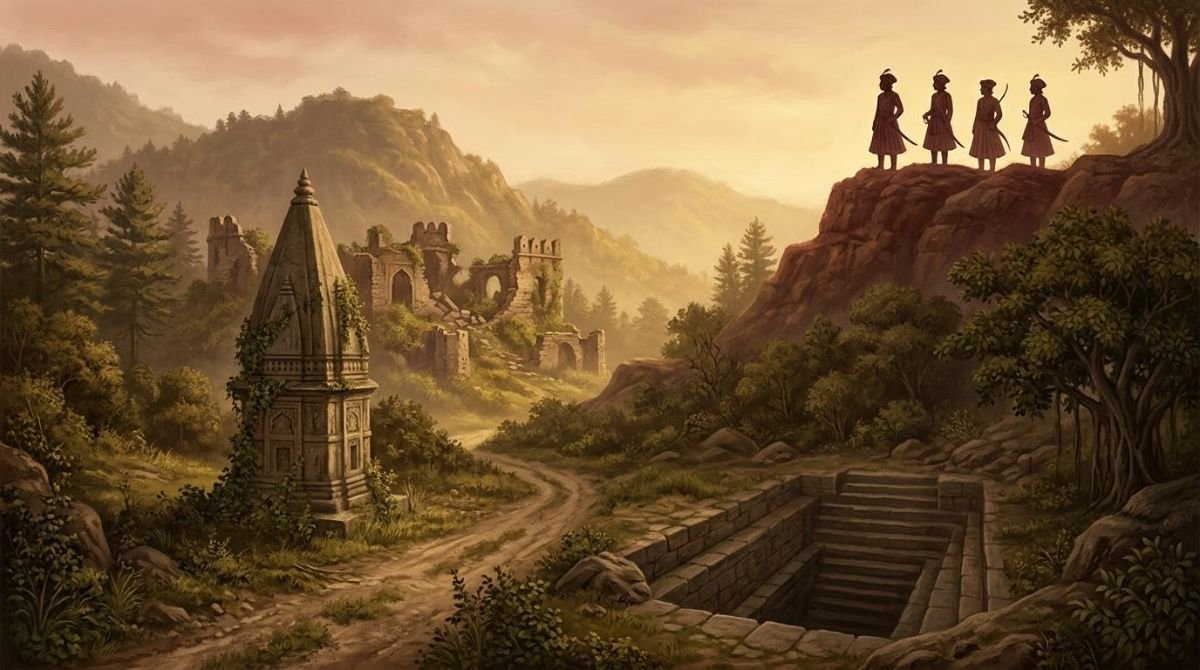
Major Singh says nothing of Goja Chand’s reign. The 1997 history says that Raja Goja Chand made his capital at Chowki Bandi, a pleasant and healthy spot three miles west of Samahni, in today’s Tehsil Samahni of District Bhimber, and remembers him as a ruler who cared for the welfare of ordinary people. At his capital he had solid rock cut away to build masonry baolis, or step-wells, which the book calls fine examples of building and stone-carving, and he built palaces that have since fallen into ruin. He also laid out three highways across his state: one running west from Chowki to Puna, a second running east to Khawlian, and a third running north to Naushera from Sa’dabad. The roads, the book says, made travel and transport much easier for his subjects (Iftikhar Ali Khan (1997), p. 68).
Chibhal Nama (c. 2023) repeats this almost word for word, as it repeats much of the 1997 book, so here it is a copy rather than a second witness (see Chibhal Nama, chapter by chapter). It adds local detail: the capital lay “in the area of Chowki and Bandi”; the eastern road ran to Kahawliyan, the Chib mandi village also written Khawaliyan or Ghawaliyan (see Mandi Ghawaliyan); and Sa’dabad, where the northern road began, lies in today’s Bandala (pp. 53, 79).
Maulvi Zain-ul-Abidin of Samahni, whose manuscript history the 1997 book quotes, puts it a little differently. In his account the seat of Gopal Chand and of his son Shadab Khan remained Bhimber, but the scorching heat of the plains drove them to make the cool Samahni valley their summer capital, and a building in the style of a samadh, known as Goja Khan Dhara, still stands at Chowki (Iftikhar Ali Khan (1997), pp. 117–118). For the rulers who came after him, see The Rajas of Bhimber.
The samadh of Goja Pir
Raja Goja Chand died at Chowki Bandi, says the 1997 history, and his samadh, the memorial built where a Hindu ruler was cremated, still stands in the village of Chowki, Tehsil Samahni. Local people held it in such reverence that the samadh itself came to be called Goja Pir, “Goja the saint” (Iftikhar Ali Khan (1997), pp. 68, 81). The book’s photograph shows a tall stone structure with a pointed, pyramid-like top, dark against the sky, beside the Samahni–Mirpur road, with hills behind it (p. 97). Chibhal Nama is more exact about the place: Goja Pir died at Bandi, now a village of Union Council Chowki, and his samadhi stands at the beginning of the village, on the way from Chowki bazaar to Chowki Graan (pp. 53–54).
A second memorial grew up elsewhere. After a long time, the 1997 history relates, the Chib Rajputs of Watala built a samadh for their ancestor in their own village, because Chowki was distant and hard to reach. This shrine stood a furlong south of Mohra Dhok, and when livestock went missing people made offerings there (p. 68); Chibhal Nama repeats the passage (p. 54). Watala, or Vatala, is the home of the Hindu Chibs who descend from Baba Shadi Shaheed’s grandson Raja Ghaggi Khan, described in The Hindu Chibs of Dewa Vatala. Yet their own historian, Major Singh, a Vatala man who describes his village’s shrines, among them those of the deified Bawa Tabali and of Pir Songa, says nothing of a samadh of Goja Chand there or at Chowki (Major Singh (c. 1926), pp. 40–41, 57). The tradition of the Chowki capital and the two samadhs therefore rests on the 1997 history, the Maulvi’s manuscript and the memorials themselves; Major Singh’s silence neither confirms nor refutes it.
Four sons, four lines
Major Singh’s chart passes straight from Goja Chand to Raja Dharam Chand and names no other son; in his book the clan descends through Dharam Chand’s own four sons (Major Singh (c. 1926), pp. 18–19, 35). The later histories give Goja Chand four sons and a dying wish: he told his heir, his eldest son Shadip Chand, to give each of his brothers a share of the state, and when Goja Chand died, Shadip Chand became ruler of Bhimber and did so (Iftikhar Ali Khan (1997), p. 69). Chibhal Nama tells the same story, with “an equal share” for each brother, and credits the dying wish to Major Singh’s book (pp. 54–55); it is not in the c. 1926 original, but it matches the 1997 history’s own narrative.
What the three histories say
Major Singh, Tarikh-e-Chibhal (c. 1926) · the original
Goja Chand is followed by Raja Dharam Chand alone. Dal Khan, Chhel Khan and Dom Khan do not appear in the book, nor do the Domal, although its chart shows the younger sons of other rajas (pp. 18–19, 26).
Iftikhar Ali Khan (1997)
Four sons: Shadip Chand (Baba Shadi Shaheed); Bel Chand, called Dal Chand or Dal Khan; Chhel Chand or Chhel Khan; and the youngest, Thom Chand, called Dom Chand or Dom Khan. Dal Khan died childless; Chhel Khan’s sons were Ismail Khan, known as Samlu Khan, and Pahlwan Khan (pp. 69–70, 81–82, 388–389).
Chibhal Nama (c. 2023)
The same four in the same order, but the eldest is Dharam Chand, Major Singh’s name for him, and the youngest is Parab Chand, “founder of the Domal qaum”, a name neither older book uses. Chhel Khan’s sons are Kalu Khan and Pahlwan Khan (pp. 54–55).
Where this leaves us
All three agree on the line that matters most, from Goja Chand to Baba Shadi Shaheed. The three younger brothers rest on the 1997 history, whose sources here include the Maulvi’s manuscript, and on Chibhal Nama, which follows it while changing two names. Major Singh’s chart shows the younger sons of other rajas, so his silence about these three is striking, though he never argues against them.
Shadip Chand: Raja Shadab Khan
The eldest son, whom the 1997 history calls Shadip Chand and Major Singh and Chibhal Nama call Dharam Chand, became the most famous of all. As Raja Shadab Khan, and after his death as Baba Shadi Shaheed, he is honoured as the common ancestor of the Chibhal, a great raja and, to his devotees, a saint (Iftikhar Ali Khan (1997), p. 81). The 1997 compiler holds that he had already embraced Islam in his father’s lifetime, on the advice of his spiritual guide Hazrat Piro Shah, but kept it secret until he himself became raja (p. 114); Major Singh held that the emperor converted him by force, and Chibhal Nama has him announce his faith at Sultan Ibrahim Lodi’s court (see Forced or Free?). His sons in the later books, Raja Bhom Khan, Raja Mal Khan and Raja Rupo Khan, founded the Chib lines of Bhimber, of Khari Kariali and of Barhang (Iftikhar Ali Khan (1997), p. 389; Chibhal Nama (c. 2023), pp. 68–69); Major Singh names four, Bhup Chand, Rup Chand, Mal Khan and Gul Muhammad Khan (Major Singh (c. 1926), p. 35).
Bel Chand: Raja Dal Khan
The second son, Bel Chand, known as Raja Dal Khan, received Beri Pattan and the country around it as his jagir. His relations with his elder brother grew steadily worse until they came to open war, and in one battle Dal Khan was killed at Raluh, near Samahni, where his memorial still stands; the older pages of the 1997 book call it “Dal Khan’s Chihani”, his cremation ground. He left no children, so his jagir was taken back into the state of Bhimber (Iftikhar Ali Khan (1997), pp. 69, 82). Elsewhere the compiler explains the quarrel: Dal Khan remained a Hindu and bitterly resented his brother’s conversion (p. 115). Chibhal Nama repeats the story without the motive, spelling the village Ramloh, and counts the killing among the feuds in which “brothers were killed by brothers” (Chibhal Nama (c. 2023), pp. 29, 55); Major Singh does not mention Dal Khan. The spot where he fell, a great rock venerated as Thal Pir, is the subject of Thal Pir: a War Between Brothers.
Chhel Chand: Raja Chhel Khan
The third son, Chhel Chand or Raja Chhel Khan, inherited Chahi, Pothi and other villages about fourteen miles north of Bhimber, and stayed on good terms with his eldest brother. The 1997 history names his two sons as Ismail Khan, known as Samlu Khan, and Pahlwan Khan, whose descendants live at Chahi and at Pothi Jang Khan (Iftikhar Ali Khan (1997), pp. 69, 82, 389). Chibhal Nama places Chahi in the Samahni area and Pothi in the Bhimber area, and calls the elder son Kalu Khan (Chibhal Nama (c. 2023), p. 55). Their story is told in Pothi Jang Khan and Chahi.
Thom Chand: Raja Dom Khan
The youngest, Thom Chand, known as Raja Dom Khan, was given the country east of Samahni but was not content with it, the 1997 history says. After several battles with his eldest brother he was defeated and left his homeland for Parawa Thakiala in Poonch, where he put down two rebellious local tribes, set up his own small state with its seat at a place he called Rajdhani, and embraced Islam at the hand of a dervish, Pir Fazil Shah. From him the Domal tribe arose, whose leaders in the twentieth century included Sardar Fateh Muhammad Khan Karelvi and Sardar Sikandar Hayat Khan (Iftikhar Ali Khan (1997), pp. 70, 82). Chibhal Nama calls him Parab Chand and makes him, for a time, raja of Bhimber in his brother’s place; see The Domal of Poonch.
Sources differ
Major Singh does not mention Dom Khan. The 1997 history tells his departure in two ways: in its chapter on Goja Chand’s sons Shadab Khan drives him out (p. 70); in its chapters on Bhimber and on Raja Bhom Khan he comes down from the hills after Shadab Khan’s death, backs a claimant from the old Thakial and Badhan ruling families, and flees to Poonch only when the emperor in Delhi intervenes (pp. 37, 119). Chibhal Nama adds a third version, in which the Hindu nobles crowned him as Parab Chand while Dharam Chand was in Delhi and deposed him after the martyrdom, when he left for Rajouri and became a Muslim as “Doem Khan” (pp. 59, 62–63, 179–180); yet on p. 103 it repeats the 1997 book’s second version.
Frequently asked questions
Who was Raja Goja Chand?
He was a Hindu raja of Bhimber, also called Gorpal or Gopal Chand and remembered as Goja Pir, and the father of Raja Shadab Khan, Baba Shadi Shaheed. Thakur Major Singh’s Tarikh-e-Chibhal (c. 1926) lists him as No. 464 in the royal line; the 1997 Chib history and Chibhal Nama (c. 2023) make him the sixth raja after Raja Chib Chand and say he ruled from Chowki Bandi near Samahni, in today’s Azad Jammu and Kashmir.
Why is Raja Goja Chand called Goja Pir?
His samadh, the memorial at his cremation place in Chowki near Samahni, came to be held in such reverence by local people that the shrine itself is known as Goja Pir. The Chibs of Watala later built a second samadh for him in their own village, where offerings were made when livestock went missing.
Who were the sons of Raja Goja Chand?
The 1997 Chib history gives him four sons: Shadip Chand, who became Raja Shadab Khan (Baba Shadi Shaheed); Bel Chand, known as Raja Dal Khan; Chhel Chand, or Raja Chhel Khan; and Thom Chand, known as Raja Dom Khan. Chibhal Nama (c. 2023) agrees but calls the eldest Dharam Chand and the youngest Parab Chand, while Thakur Major Singh’s older history names only Dharam Chand. The Chibs of Bhimber, of Chahi and Pothi Jang Khan and the Domal descend from them; Dal Khan left no heirs.
Where is the samadh of Goja Pir?
It stands in the village of Chowki, Tehsil Samahni, District Bhimber, in Azad Jammu and Kashmir, beside the Samahni–Mirpur road; Chibhal Nama places it at the start of the village on the way from Chowki bazaar to Chowki Graan. The 1997 book’s photograph shows a tall stone structure with a pointed, pyramid-like top. Chowki Bandi, his capital, lies about three miles west of Samahni.
What did Raja Goja Chand build?
According to the 1997 history, repeated in Chibhal Nama, he built masonry step-wells (baolis) cut into solid rock and palaces at his capital, Chowki Bandi, which are now in ruins. He also laid out three highways: west from Chowki to Puna, east to Khawlian (Kahawliyan), and north to Naushera from Sa’dabad.
When did Raja Goja Chand rule?
No early source dates his reign. Thakur Major Singh’s Tarikh-e-Chibhal makes his son a contemporary of Sultan Ibrahim Lodi of Delhi (r. 1517–1526), and the 1997 history’s chronology points to the later fifteenth or early sixteenth century. Chibhal Nama (c. 2023) gives 1512 to 1526 in a table of its own, which cites no source.
Sources
- Thakur Major Singh Chib, Tarikh-e-Rajgan-e-Bhimber wa Qaum-e-Chibhal (Tarikh-e-Chibhal; Urdu, c. 1926), pp. 18–19, 21, 26, 29, 35, 40–41, 57.
- Raja Muhammad Iftikhar Ali Khan, Raja Shadab Khan alias Hazrat Baba Shadi Shaheed (Urdu, Barhang/Karachi, 1997), pp. 67–70, 81–82, 388–389; see also pp. 37, 97, 112–119.
- Captain (Retd) Muhammad Nadeem Khan, Chibhal Nama (Urdu, Dua Publications, no date [c. 2023]), pp. 29, 53–55, 59, 62–63, 68–69, 79, 103, 131, 179–180, 241.
- Maulvi Zain-ul-Abidin Kohi Samahnavi, unpublished manuscript history of Chibhal, as quoted in Iftikhar Ali Khan (1997).
This article draws on all three Chib histories: Major Singh’s Tarikh-e-Chibhal (c. 1926, the original), the 1997 history and Chibhal Nama (c. 2023).
Continue reading
Have a question about this history?
Our AI guide answers from the articles on this site, in English or Urdu.
