

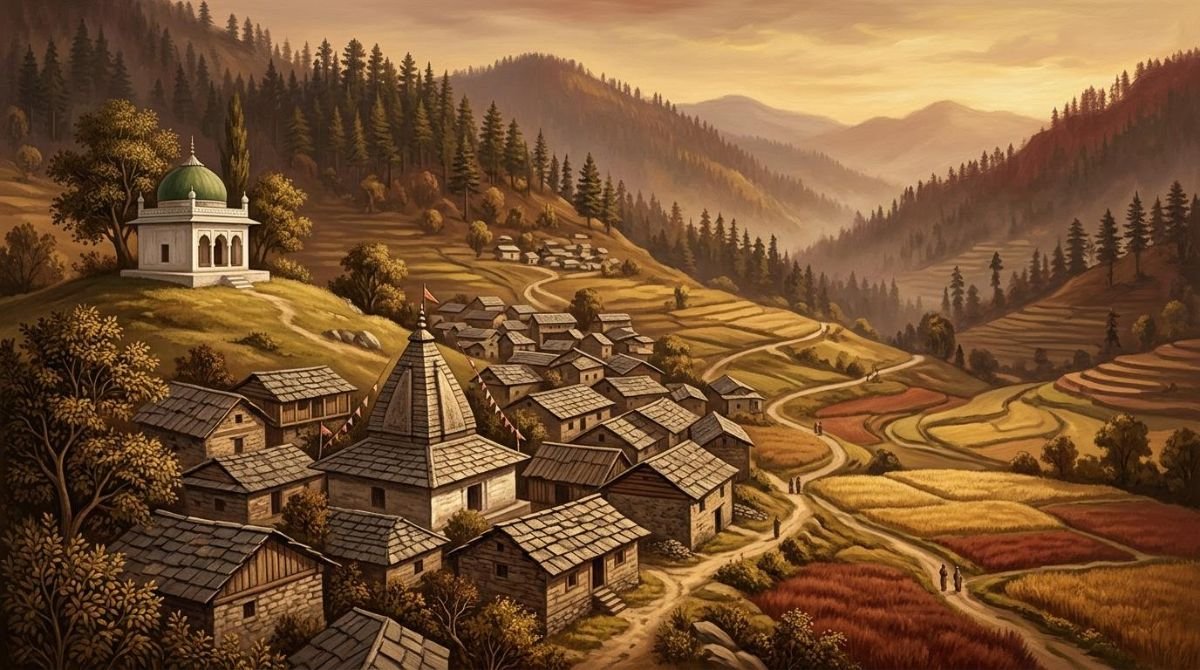
Ghawaliyan (گھاولیاں, also written Ghawliyan, Kahawliyan or Ghadolian), in Tehsil Samahni, District Bhimber, Azad Kashmir, was the second mandi of Chibhal Rajana, founded by Raja Jagat Singh, a son of Raja Rehmatullah Khan of Bhimber. It is unusual among the Chib mandis: according to the 1997 Chib history, two of its three family branches (pattis) became Muslim while the third, Patti Himmat Singh, remained Hindu. Its sons later included a police officer killed at Jammu in 1947 and his brother, probably the first graduate of Chibhal Rajana, who rose to be a district judge.
At a glance
- Location
- Tehsil Samahni, District Bhimber, Azad Jammu and Kashmir
- Founder
- Raja Jagat Singh, son of Raja Rehmatullah Khan (Roop Singh), ruler of Bhimber
- Standing
- “The second mandi of the Rajana family” (Maulvi Zain-ul-Abidin)
- Titles
- Rajana, Mian and Thakra (mandi table)
- Branches
- Patti Kishan Singh and Patti Jaswant Singh (Muslim); Patti Himmat Singh (Hindu)
- Conversion
- At the hands of Pir Syed Hussain Shah Ghazi, whose shrine survives
- Old jagir villages
- Kalal, Dhing, Manpur, Banjoa, Jagapal and Seri
- Main source
- Iftikhar Ali Khan (1997), pp. 122–123, 264–275, 395, 419–423
Mandi Ghawaliyan, the second mandi of the Rajana family
The story of Ghawaliyan begins in the ruling line of the Chib Rajputs of Bhimber. When the younger sons of Raja Madan Khan founded the first mandis of Chibhal, his eldest son, Raja Ismail Khan, kept the throne. Ismail Khan’s son, Raja Jogu Khan, was known to the people as Raja Jog Jit, and the Mughal emperor Aurangzeb, the book says, called him “Chowk Jannat”. He received the qashqa, the forehead mark of rajaship, on his father’s death and governed well. Near Saadabad, in the bed of a stream, he built a residence for the Mughal emperors, Jogi Hatti, from which the imperial camp drew its supplies during stays of several months (pp. 122, 264).
Jogu Khan’s son, Raja Rehmatullah Khan, also called Roop Singh, had two ranis. One bore Raja Karamullah Khan, Raja Jagat Singh, Karam Singh and Fateh Singh; the other bore Mehndi Khan. Karamullah Khan was given the tikka of the throne of Bhimber in the chowk of Bandala and carried on the line of the rajas of Bhimber. Jagat Singh built palaces on the land he inherited, and a village grew up around them. Its descendants, wrote the historian Maulvi Zain-ul-Abidin Kohi Samahnavi, “live in Ghawaliyan Mandi, which is the second mandi of the Rajana family” (p. 265). The book’s mandi table names Raja Jagat Singh as founder and gives the family’s titles as Rajana, Mian and Thakra (p. 395).
Thakur Major Singh, writing in his Tarikh-e-Chibhal of about 1926, made the same point from another angle. In all the mandis of Chibhal except Ghawaliyan, he wrote, the settlers were Muslim Rajputs descended from Raja Jamshed Khan; the Chibs of Ghawaliyan descended from Raja Jog Jit and were, among the Hindus, the tikka or senior family (p. 264, citing Tarikh-e-Chibhal, pp. 93–94).
How Ghawaliyan got its name
The village’s name appears in the book in a remarkable range of spellings: Ghawiyan, Ghawliyan, Ghawaliyan, Kahawliyan, Kawliyan and Ghadolian, with Khawaliyan in the book’s translation of Rose’s Glossary. Two explanations are recorded (p. 265):
- Gah-e-Waliyan, “the place of the saints”. According to common tradition the village was named after the saint at whose hands part of the family embraced Islam, and the name was later worn down to Ghawaliyan.
- Kalluwaliyan, after Kallu Khan. Maulvi Zain-ul-Abidin’s draft history derives it from Kallu Khan, grandson of Nashtari Khan of Patti Kishan Singh and a famous and influential man in his day; Kalluwaliyan in time became Kahawliyan.
Three pattis, two faiths
The fullest account of the family came from one of its own sons, Raja Rangbaz Khan, a retired tehsildar. The Chib Rajgan of Ghawaliyan, he explained, are divided into three pattis, or shares. Raja Jagat Singh had four sons: Kishan Singh, Jaswant Singh, Himmat Singh and Mast Singh, who died without children. Kishan Singh’s grandson Nashtari Khan and five grandsons of Jaswant Singh, Faujdar Khan, Mahtab Khan, Asalat Khan, Shujaat Khan and Amir Khan, all embraced Islam at the same time at the hands of a holy man, Pir Syed Hussain Shah Ghazi. His shrine still stands, and people high and low, the book records, still come to it for spiritual blessing. The descendants of Himmat Singh remained Hindu.
The change of faith carried a heavy price. The proprietorship and jagirs of the Ghawaliyan Rajgan had included the villages of Kalal, Dhing, Manpur, Banjoa, Jagapal and Seri. Because two pattis accepted Islam, the book says, their whole share of the proprietorship and jagir was confiscated under the law then in force, while that of Patti Himmat Singh remained intact. Later, through the efforts of a sister of Mian Onkar Singh of Patti Himmat Singh, whom the book describes as the stepmother of Maharaja Hari Singh and the mother of Rao Ratan Singh, a wazir-e-wazarat (district governor), the Muslim pattis recovered their proprietary rights in the village of Ghawaliyan itself; the rest stayed lost. The mandi table is blunt: these villages were once the jagirs of Ghawaliyan, but now the family has no control over them (p. 395).
Sources differ
The book gives three versions of the family’s link with the ruling house of Jammu and Kashmir. Mian Onkar Singh was Maharaja Hari Singh’s maternal uncle (p. 260); Onkar Singh’s daughter was married to Raja Amar Singh (Thakur Major Singh, quoted on p. 264); and Onkar Singh’s sister was Hari Singh’s stepmother (p. 265). Raja Amar Singh was Hari Singh’s father, so all three point to a marriage between the two families, but they disagree on who married whom. The family tree also places a Siva Singh between Jagat Singh and Kishan Singh, and the mandi table lists the old jagir villages slightly differently.
- Raja Jagat Singh, founder of Mandi Ghawaliyan, son of Raja Rehmatullah Khan
- Kishan Singh: Patti Kishan Singh, Muslim
- His grandson Nashtari Khan accepted Islam; his line includes Kallu Khan, Raja Rahmdad Khan and Raja Rangbaz Khan
- Jaswant Singh: Patti Jaswant Singh, Muslim
- His grandsons Faujdar Khan, Mahtab Khan, Asalat Khan, Shujaat Khan and Amir Khan accepted Islam; Mahtab Khan’s line includes Raja Suhbat Ali Khan Shaheed and Raja Imdad Ali Khan
- Himmat Singh: Patti Himmat Singh, Hindu
- The Mians and Thakurs of Ghawaliyan, down to Mian Onkar Singh and Thakur Fateh Singh
- Mast Singh, who died without children
- Kishan Singh: Patti Kishan Singh, Muslim
The Thakurs of Patti Himmat Singh
Thakur Major Singh’s account of about 1926 describes the Hindu house at its height. Thakur Onkar Singh was a famous and imposing man who served for many years as a tehsildar, and his daughter, Major Singh wrote, married Raja Amar Singh Sahib Bahadur. Onkar Singh’s son Thakur Fateh Singh was then zaildar of Ghawaliyan and a jagirdar; another son, Mian Basant Singh, was long a naib-tehsildar; and a third had settled in Tehsil Rajouri, where he enjoyed considerable influence. The family tree compiled by Raja Rangbaz Khan (p. 423) traces Patti Himmat Singh through many generations of Mians to Mian Onkar Singh and his four sons, among them Thakur Fateh Singh, father of Baldev Singh, a zaildar, and Basant Singh, a tehsildar, father of Puran Singh.
The Malot chapter of the book adds that in the reign of Maharaja Hari Singh, Raja Suhbat Ali Khan of Malot went to court in Jammu against Mian Onkar Singh, then zaildar of Ghawaliyan, and won the zaildari of Malot Mandi (p. 260). The book also quotes a Tarikh-e-Chibhal by a Mian Onkar Singh Chib, published in Delhi in a second edition of 1984, but it does not say whether its author belonged to this family. For the other great Hindu branch of the clan, see The Hindu Chibs of Dewa Vatala.
Patti Kishan Singh and Patti Jaswant Singh
Patti Kishan Singh
The family tree is headed with the note that Kishan Singh’s grandson Nashtari Khan “accepted Islam” (p. 419). From his line came three brothers: Kallu Khan, after whom, by one tradition, the village is named; Mamun Khan, known as Mallu Khan; and Sattar Bakhsh Khan. Kallu Khan’s line runs through Umar Bakhsh Khan, Mustafa Khan and Nur Ali Khan to Raja Rahmdad Khan, numbardar of Ghawaliyan, and his son Raja Rangbaz Khan. Sattar Bakhsh Khan’s descendants include Dr Raja Mazhar Iqbal Khan, M.B.B.S., a chief medical officer.
Patti Jaswant Singh
The tree of Patti Jaswant Singh (pp. 421–422) starts from the five converted grandsons; it notes that no information could be obtained about the descendants of Shujaat Khan and Amir Khan. From Mahtab Khan, through Shamsher Khan and Man Ali Khan, came four brothers: Karam Dad Khan, numbardar, Fazal Dad Khan, Murtaza Khan and Sarandaz Khan (the tree also calls the first and last Muhammad Dad Khan and Sarfraz Khan). Fazal Dad Khan was the father of Raja Suhbat Ali Khan Shaheed, Havildar Raja Inayat Ali Khan and Raja Imdad Ali Khan. Sarandaz Khan’s son was Major Raja Abdul Rahman Khan, whose sons Khalid-ur-Rahman Khan and Abid-ur-Rahman Khan also became majors. Another line from Mahtab Khan, through Diwan Ali Khan and Lal Khan to Muhammad Khan, produced the brothers Allah Ditta Khan, father of Raja Muhammad Anwar Khan, a lawyer, and Raja Ghazanfar Ali Khan, a tehsildar, and Nasrullah Khan, whose sons included Mukhtar Khan, a bank manager, and Raja Imtiaz Khan, a project manager. Faujdar Khan’s line produced Salar Raja Muazzam Khan.
Ghawaliyan in 1931 and 1947
Raja Rahmdad Khan and the 1931 agitation
Raja Rahmdad Khan, numbardar of Ghawaliyan, was the village’s leading figure in the generation before Partition. Although a numbardar, and so a servant of the state, he opposed what the book calls the anti-Muslim measures of Maharaja Hari Singh’s government. During the agitation of 1931 he stood “like an iron wall” in the villages of the Samahni valley, among them Ghawaliyan, Bandala, Samahni and Chowki Bandi, as the right-hand man of Raja Buddhe Khan, zaildar of Samahni, with Raja Syed Muhammad Khan, numbardar of Bandi, at his side. When Buddhe Khan was arrested, both men went underground for a long time and worked for the All Jammu and Kashmir Muslim Conference. From the party’s foundation in 1932 until his death Rahmdad Khan stayed with the Muslim Conference, and the book says Ghawaliyan remained loyal to it because of him.
In October 1947 Rahmdad Khan fought against the State’s Dogra forces alongside Raja Muhammad Afzal Khan, zaildar of Bandala, Raja Kifayat Ali Khan, numbardar of Bandala, Maulvi Mahmud Khan and Raja Allah Ditta Khan. His brother, Havildar Raja Sahibdad Khan of No. 6 Jammu and Kashmir Regiment, was killed on the Skardu front; a cousin, Raja Ali Akbar Khan, and another relative, Raja Jhalla Khan, were killed by an armed band. For a time afterwards Rahmdad Khan lived as a refugee in a village of Tehsil Kharian, District Gujrat.
Raja Suhbat Ali Khan Shaheed
Ghawaliyan’s best-remembered son is Raja Suhbat Ali Khan Shaheed, born in 1913, the son of Raja Fazal Dad Khan. Educated at the primary school in Bandala and at Bhimber, he passed his matriculation with distinction in 1930. In 1931 a British representative sent to tour the state after the disturbances met him at Sarai Saadabad and, once his uncle Raja Karam Dad Khan and other numbardars had vouched for his character, took him into the state police as an assistant sub-inspector. He rose to sub-inspector (the family tree calls him an inspector) and won a reputation for keeping order. In 1947 he was in charge of Thana Gumat in Jammu, and the book says the city stayed calm while he held the post. Sent by his superintendent to investigate a disturbance near the river Tawi, he went with a single constable and was shot dead. His body, thrown into the river, came to rest downstream and was buried that evening by relatives, among them his brother Havildar Raja Inayat Ali Khan.
The killings of Muslims in Jammu followed, one of the darkest episodes of that terrible autumn, in which people of every community lost their lives. Two young relatives who had been living with Suhbat Ali Khan for their schooling, Muhammad Sarwar Khan and Muhammad Zaman Khan, were killed when their convoy for Pakistan was attacked, and his son Raja Ghulam Sarwar Khan was badly wounded. His cousin Abdul Rahman Khan survived, came home with the first exchange of prisoners and later rose to the rank of major.
Raja Imdad Ali Khan, judge
Suhbat Ali Khan’s younger brother, Raja Imdad Ali Khan, born in Ghawaliyan about 1920, is described by the book as probably the first graduate of Chibhal Rajana. After primary school at Bandala and matriculation at Government High School Bhimber in the 1930s, he took his B.A. at the Prince of Wales College, Jammu, and his law degree at Aligarh, and began to practise in Bhimber about a year before Partition. Early in 1948 the new Azad Kashmir government made him Sub-Judge of Bhimber, the first after its founding, with his court sitting for a time at Gotriala in Tehsil Kharian. He rose to District and Sessions Judge, retired in 1975, and then returned to practice at Mirpur as an advocate of the High Court of Azad Kashmir. The author calls him the first law graduate and the first vakil of Chibhal Rajana.
Raja Rangbaz Khan, tehsildar
Raja Rahmdad Khan’s son, Raja Rangbaz Khan, was born about 1923. He took part in the events of 1947 beside his father, was among the first officials of the new Azad Kashmir government, and retired as a tehsildar in its Revenue Department. The book draws on his account of the family’s history and prints the Ghawaliyan family tree he compiled (pp. 419–423).
Notable people of Ghawaliyan
Besides the men above, the book lists these notable people of Mandi Ghawaliyan at the time of writing (p. 275):
- Dr Raja Mazhar Iqbal Khan, M.B.B.S., chief medical officer
- Subedar Raja Shaukat Khan, Subedar Major Raja Muhammad Sharif Khan and Subedar Raja Masud Khan
- Salar Raja Muazzam Khan
- Raja Muhammad Anwar Khan, lawyer, and Raja Ghazanfar Ali Khan, contractor (a tehsildar in the family tree)
- Mukhtar Khan, bank manager, and Raja Imtiaz Khan, project manager
- Major Raja Abdul Rahman Khan, Major Raja Khalid-ur-Rahman Khan and Major Raja Abid-ur-Rahman Khan
- Sub-Inspector Raja Abdul Aziz Khan
Frequently asked questions
Where is Ghawaliyan?
Ghawaliyan is a village in Tehsil Samahni, District Bhimber, in Azad Jammu and Kashmir. It was the seat of Mandi Ghawaliyan, one of the mandis of Chibhal Rajana, and its name is also written Ghawliyan, Kahawliyan, Kawliyan and Ghadolian.
Who founded Mandi Ghawaliyan?
According to the 1997 Chib history, Mandi Ghawaliyan was founded by Raja Jagat Singh, a son of Raja Rehmatullah Khan (Roop Singh), ruler of Bhimber. He built palaces on his inherited land, a village grew up around them, and the book calls it the second mandi of the Rajana family.
Why does the Ghawaliyan family have Hindu and Muslim branches?
Raja Jagat Singh’s descendants formed three pattis. Members of Patti Kishan Singh and Patti Jaswant Singh embraced Islam at the hands of Pir Syed Hussain Shah Ghazi, while Patti Himmat Singh remained Hindu. The book says the Muslim pattis lost most of their jagir as a result.
How did Ghawaliyan get its name?
The book records two traditions. One derives the name from Gah-e-Waliyan, the place of the saints; the other, from Maulvi Zain-ul-Abidin’s manuscript, from Kalluwaliyan, after Kallu Khan, a grandson of Nashtari Khan of Patti Kishan Singh.
Who was Raja Suhbat Ali Khan Shaheed?
Raja Suhbat Ali Khan Shaheed of Ghawaliyan, born in 1913, joined the Jammu and Kashmir state police in 1931 and rose to sub-inspector. He was shot dead near the river Tawi at Jammu in 1947 while in charge of Thana Gumat, and he is remembered by his family and community as a martyr.
Sources
- Raja Muhammad Iftikhar Ali Khan, Raja Shadab Khan alias Hazrat Baba Shadi Shaheed (Urdu, Barhang/Karachi, 1997), pp. 26, 122–123, 260, 264–275, 395, 419–423.
- Thakur Major Singh (printed “Mehjar Singh”), Tarikh-e-Chibhal (1983 Bikrami, about 1926), pp. 93–94, “Khandan Ghawliyan”, as quoted in the book, p. 264.
- Maulvi Zain-ul-Abidin Kohi Samahnavi, manuscript and draft history of Chibhal (unpublished), as quoted in the book, pp. 122–123, 264–265.
- Oral account of Raja Rangbaz Khan, Tehsildar (retired), p. 265, and the genealogy of the Rajgan of Mandi Ghawaliyan compiled by him, pp. 419–423.
This article is part of our series based on the 1997 Chib history; see the book, chapter by chapter. Spellings of names follow the book.
Continue reading
Have a question about this history?
Our AI guide answers from the articles on this site, in English or Urdu.
