

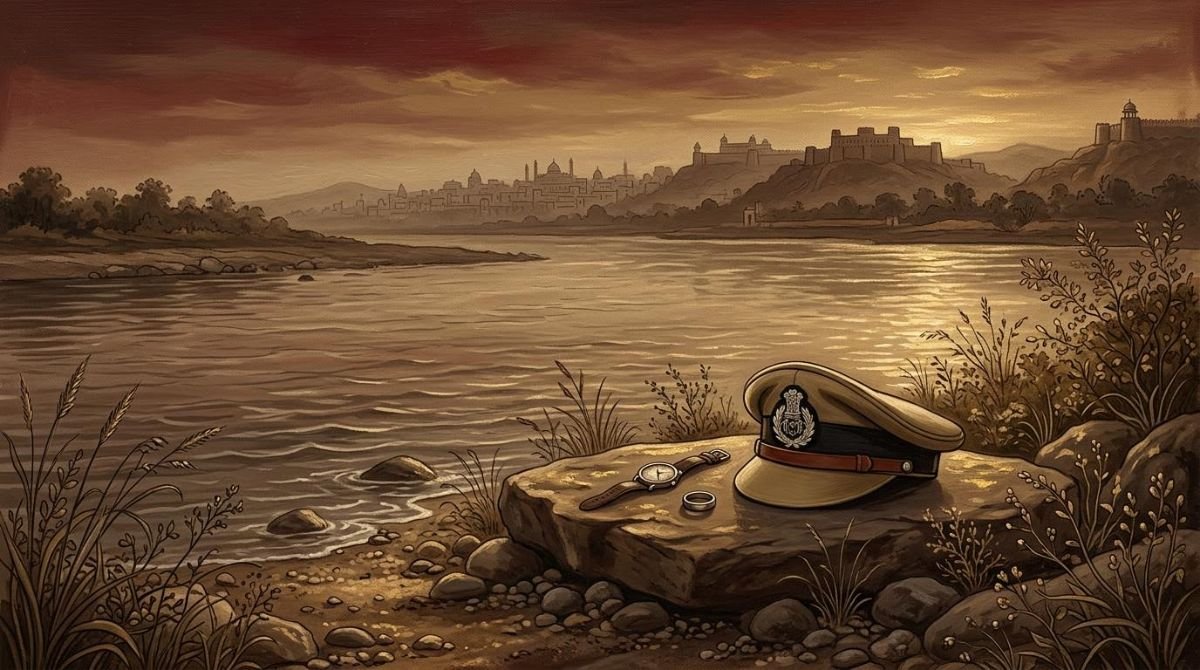
Raja Suhbat Ali Khan (راجہ صحبت علی خاں شہید, 1913–1947) was a Chib Rajput police officer from Ghawaliyan in the Samahni valley, now in Bhimber District of Azad Kashmir. As the sub-inspector in charge of Gumat police station in Jammu, he was shot dead beside the Tawi river in October 1947, at the start of the killings of Jammu’s Muslims, and the 1997 Chib history of Raja Muhammad Iftikhar Ali Khan remembers him as Shaheed-e-Jammu, “the Martyr of Jammu”.
At a glance
- Born
- 1913, at Ghawaliyan (also written Ghawliyan or Kahawliyan), Tehsil Samahni, District Bhimber
- Family
- Son of Raja Fazal Dad Khan of Ghawaliyan; of the Muslim Patti Jaswant Singh of Mandi Ghawaliyan, a branch of the Chib Rajputs
- Education
- Bandala Primary School; matriculation with distinction at Bhimber, 1930
- Career
- Jammu and Kashmir State Police from 1931: Assistant Sub-Inspector, later Sub-Inspector
- Last post
- Thana Gumat (Gumat police station), Jammu
- Died
- October 1947, shot near the Tawi river at Jammu
- Remembered as
- Shaheed-e-Jammu, “the Martyr of Jammu”
- Main source
- Iftikhar Ali Khan (1997), pp. 75, 268–272, 421–422
Who was Raja Suhbat Ali Khan?
Suhbat Ali Khan came from Ghawaliyan, one of the four mandis, or family seats, of Chibhal Rajana, the eastern half of the old Chib Rajput state of Bhimber (see the mandis of Chibhal). According to the manuscript history of Maulvi Zain-ul-Abidin Kohi Samahnavi, quoted in the book, the mandi was founded by Raja Jagat Singh, a son of Raja Rahmatullah Khan, ruler of Bhimber. The family’s own account, given to the book by Raja Rangbaz Khan, a retired tehsildar of the village, says that its three branches (pattis) bear the names of Jagat Singh’s sons Kishan Singh, Jaswant Singh and Himmat Singh. Descendants of the first two embraced Islam at the hands of the saint Pir Syed Hussain Shah Ghazi, while the Himmat Singh patti remained Hindu, so that one family had Muslim and Hindu branches (Iftikhar Ali Khan 1997, pp. 264–265; see Mandi Ghawaliyan). Suhbat Ali Khan belonged to the Jaswant Singh patti, descended from Mahtab Khan, one of the five brothers of that branch who became Muslims (pp. 265, 421–422).
He was born in 1913. He went to the primary school at Bandala, and his father then sent him to the school at Bhimber, where he passed the matriculation examination with distinction in 1930 (p. 268). He should not be confused with his namesake Raja Suhbat Ali Khan of Malot, a lawyer of Bhimber who won the zaildari of Malot Mandi in Maharaja Hari Singh’s time (p. 260).
From Sarai Saadabad to the State police
The next year brought what the book calls “the agitation of 1931”, the disturbances that marked the beginning of organised Muslim protest against the Dogra government of Jammu and Kashmir and that, in the Samahni valley, were led by Raja Buddhe Khan. The book says that the British government sent a representative with full powers, whom it names as “Mr. Lathar” (the English form of the name is uncertain), to tour the State and find out the conditions there. At Sarai Saadabad, the Mughal caravanserai near Bandala (see Mandi Bandala), he picked the young matriculate out of the crowd and asked him, in broken Urdu, how far he had studied. Hearing the answer, he said, “We want to make you a thanedar”, that is, a police station officer, and asked for a certificate of character. The village headmen present, among them Suhbat Ali Khan’s uncle Raja Karmdad Khan, vouched for him, and he was enlisted as an Assistant Sub-Inspector and kept on the officer’s own staff (p. 268).
He rose to Sub-Inspector and, the book says, earned such a reputation for authority that whenever public order broke down, senior officers would send him to restore it and take the credit themselves.
Jammu, October 1947
When the upheaval of 1947 began, Suhbat Ali Khan was in charge of Thana Gumat, the Gumat police station in the city of Jammu. The book describes a city on a knife-edge. In the outskirts, armed gangs, whom it identifies as Hindu, were making life unbearable for Muslims, yet inside the city order held, because, it says, no one dared to make trouble while he commanded the station. That, in the book’s account, is why the gangs resolved to kill him (pp. 268–269).
According to the book, the plot began with an atrocity. Muslims fleeing from the outskirts were driven into a jungle south-east of the city, made to shout slogans and then attacked, and the uproar reached the police. The Superintendent of Police called Suhbat Ali Khan from his home and asked him to go and see what the trouble was. He set off alone; the S.P. sent a single constable with him. As he went down towards the Tawi, someone in the crowd shouted that he must not come back. A single shot was fired, then a burst struck him in the chest, and he died where he fell. The constable returned (p. 269).
His uniform, wristwatch and ring were taken and his body was thrown into the Tawi, but the current carried it only a short way before leaving it on the bank, where people recovered it and sent word to his relatives. Among them were his brother, Havildar Raja Inayat Ali Khan, and Raja Fateh Khan, soldiers who were then interned at Satwari Cantonment. He was buried after the funeral prayers that same evening (p. 269).
The killing had a witness from the Chib country. Raja Hakim Khan of Pothi Jang Khan, a policeman in the State service, saw Suhbat Ali Khan die and only narrowly escaped being killed himself; after a desperate struggle he crossed the Tawi and reached Pakistan, later rejoined the police of Azad Kashmir and died in 1997 (p. 75; see Pothi Jang Khan).
Devoted, brave, resolute and firm-in-faith sons like Raja Suhbat Ali Khan Shaheed come into being only once in centuries.
— Iftikhar Ali Khan (1997), p. 270
The convoy
After his death, the book says, armed gangs began a general massacre of the Muslims of Jammu city, which it calls an extremely bloody chapter in the history of 1947. Some young relatives had been living with Suhbat Ali Khan in Jammu while they studied. Two of them, Muhammad Sarwar Khan, son of Karam Dad Khan, and Muhammad Zaman Khan, son of Murtaza Khan, were put into a convoy formed, in the book’s words, on the pretext of taking people from Jammu to Pakistan. The convoy was led away and its people were killed with knives, axes and spears. Suhbat Ali Khan’s own son, Raja Ghulam Sarwar Khan, was badly wounded, while his cousin Abdul Rahman Khan escaped unhurt; Abdul Rahman Khan came home with the first party returned under the agreement for the exchange of prisoners, joined the army and rose to the rank of Major (pp. 269–270). The family tree printed later in the book marks both Muhammad Sarwar Khan and Muhammad Zaman Khan as having left no descendants (p. 422).
The book records one family’s experience. Historians place it within the wider killings in the Jammu region in October and November 1947, when Muslims were murdered in large numbers and convoys of Muslims being evacuated towards Sialkot were attacked on the road; estimates of the dead vary widely, from tens of thousands upwards. In the same months Hindus and Sikhs were killed and driven from their homes in Mirpur, Rajouri and other western districts of the State. Families of every community in Jammu and Kashmir carried the grief of that autumn for the rest of their lives (see the Chib Rajputs in 1947).
Sources differ
The narrative chapters call Suhbat Ali Khan a Sub-Inspector (pp. 75, 268), but the family tree on p. 422 calls him an “Inspector of Police”. The book gives no exact date for his death, only October 1947, “at the very start of the revolution”. The names of his father’s brothers differ between the two pages of the family tree (Muhammad Dad or Karam Dad, Sarfraz or Sarandaz), and the village is spelt Ghawaliyan, Ghawliyan, Kahawliyan and Ghawian in different places (pp. 75, 264–265, 421–422).
Family and lineage
Suhbat Ali Khan’s father, Raja Fazal Dad Khan, was a well-known leading man of Ghawaliyan, and his father’s elder brother, Raja Karmdad Khan, was one of the headmen who vouched for him in 1931. The genealogy of Ghawaliyan compiled for the book by Raja Rangbaz Khan traces the family as follows (pp. 264–265, 268, 271, 421–422):
- Raja Rahmatullah Khan (Raja Roop Singh), ruler of Bhimber
- Raja Jagat Singh, founder of Mandi Ghawaliyan
- Jaswant Singh, after whom Patti Jaswant Singh is named
- Mian Ajdev Singh (reading uncertain), father of five sons who embraced Islam: Faujdar Khan, Mahtab Khan, Asalat Khan, Shujaat Khan and Amir Khan
- Shamsher Khan, son of Mahtab Khan
- Man Ali Khan, father of Karam Dad Khan, Fazal Dad Khan, Murtaza Khan and Sarandaz Khan
- Raja Fazal Dad Khan
- Raja Suhbat Ali Khan Shaheed (1913–1947), father of Raja Ghulam Sarwar Khan and Shaukat Khan
- Havildar Raja Inayat Ali Khan, father of Mahboob Akhtar and Zahoor Ahmad Khan
- Raja Imdad Ali Khan, District and Sessions Judge, father of Rizwan Ali Khan, Saqib Khan and Atif Khan
- Raja Fazal Dad Khan
- Man Ali Khan, father of Karam Dad Khan, Fazal Dad Khan, Murtaza Khan and Sarandaz Khan
- Shamsher Khan, son of Mahtab Khan
- Mian Ajdev Singh (reading uncertain), father of five sons who embraced Islam: Faujdar Khan, Mahtab Khan, Asalat Khan, Shujaat Khan and Amir Khan
- Jaswant Singh, after whom Patti Jaswant Singh is named
- Raja Jagat Singh, founder of Mandi Ghawaliyan
Raja Imdad Ali Khan, the first Sub-Judge of Bhimber
Suhbat Ali Khan’s younger brother, Raja Imdad Ali Khan, born about 1920, is described as probably the first graduate of Chibhal Rajana. After Bandala Primary School and Bhimber High School, where he matriculated in the 1930s, he took his B.A. at the Prince of Wales College, Jammu, and his LL.B. at Aligarh, and began to practise law at Bhimber about a year before Partition. At the very beginning of 1948 the new Government of Azad Jammu and Kashmir made him Sub-Judge of Bhimber, the first since its establishment, with his court sitting for the time being at Gotriala in Tehsil Kharian. He rose to District and Sessions Judge, retired in 1975 and returned to the bar as an advocate of the High Court of Azad Kashmir at Mirpur. The book calls him the first law graduate and the very first vakil (advocate) of Chibhal Rajana (pp. 271–272; see the liberation of Bhimber, October 1947).
Frequently asked questions
Who was Raja Suhbat Ali Khan Shaheed?
Raja Suhbat Ali Khan (1913–1947) was a Chib Rajput police officer from Ghawaliyan in the Samahni valley of Bhimber District, Azad Kashmir. He joined the Jammu and Kashmir State Police in 1931, rose to Sub-Inspector and was in charge of Gumat police station in Jammu when he was killed in October 1947. The 1997 Chib history of Raja Muhammad Iftikhar Ali Khan calls him the Martyr of Jammu.
How did Raja Suhbat Ali Khan die?
According to the book, the Superintendent of Police sent him to investigate a disturbance in which fleeing Muslims were being attacked. As he went down towards the Tawi with a single constable, he was shot in the chest by members of an armed gang. His body was thrown into the river but was recovered from the bank and buried the same evening.
Why is he called the Martyr of Jammu?
The book says that while he commanded Gumat police station, Jammu city stayed calm even as Muslims were being attacked in its outskirts, and that he was killed for that reason. It honours him as having given his life protecting the lives, property and honour of the State’s Muslims.
Who witnessed his death?
Raja Hakim Khan of Pothi Jang Khan, a fellow member of the Jammu and Kashmir State Police, witnessed the killing and narrowly escaped himself. He crossed the Tawi into Pakistan, later served in the police of Azad Kashmir and died in 1997.
What happened to his family in 1947?
Two young relatives studying with him in Jammu were placed in a convoy said to be bound for Pakistan, which was attacked; his son Raja Ghulam Sarwar Khan was badly wounded, and a cousin, Abdul Rahman Khan, escaped and later became a Major. His brother Raja Imdad Ali Khan became the first Sub-Judge of Bhimber under the Azad Kashmir government in 1948.
Sources
- Raja Muhammad Iftikhar Ali Khan, Raja Shadab Khan alias Hazrat Baba Shadi Shaheed (Urdu, Barhang/Karachi, 1997), pp. 75, 260, 264–275, 419–423.
- Maulvi Zain-ul-Abidin Kohi Samahnavi, unpublished manuscript history of Chibhal, as quoted in the book, pp. 264–265.
- Raja Rangbaz Khan, Tehsildar (retd.), of Ghawaliyan: oral account and genealogy of Mandi Ghawaliyan, in the book, pp. 265, 419–423.
This article is part of our series based on the 1997 Chib history; see the book, chapter by chapter. Spellings of names follow the book.
Continue reading
Have a question about this history?
Our AI guide answers from the articles on this site, in English or Urdu.
