

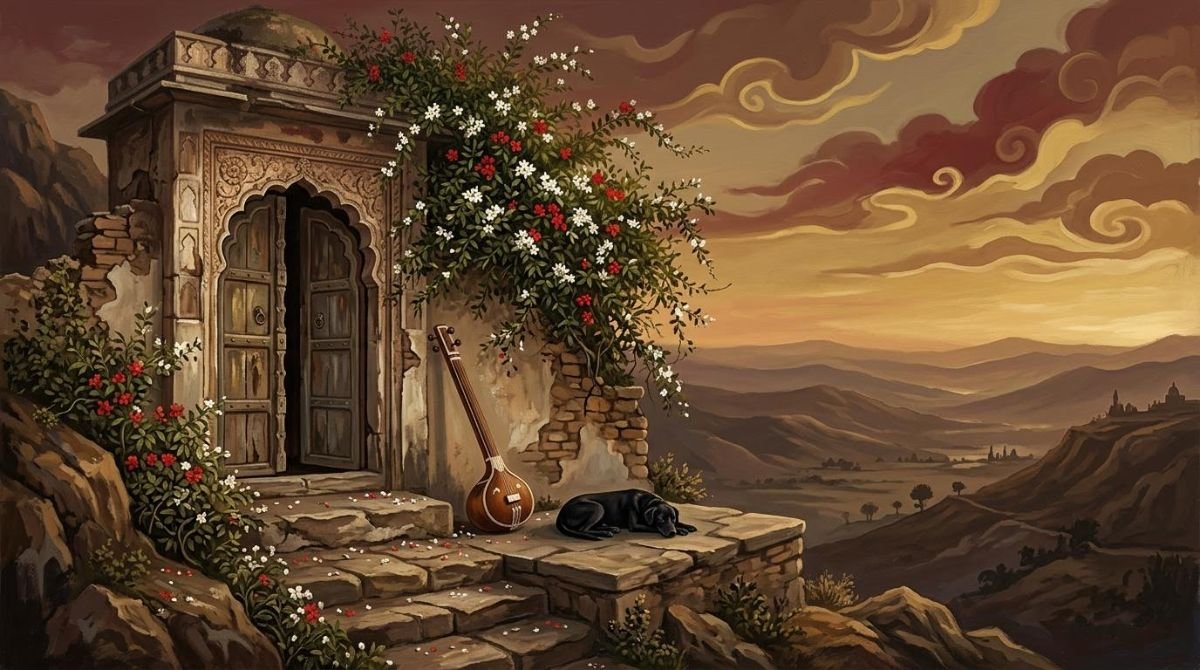
Rani Thakial (رانی تھکیال) was the beloved queen of Raja Shadab Khan, the sixteenth-century raja of Bhimber revered as Baba Shadi Shaheed, and in Chib tradition the wife who entered his grave alive; she lies beside him in his shrine on Aadhi Dhak, near Bhimber in Azad Kashmir. Her story is told together with those of Sajana Teli, the oil-presser who carried her letter to Delhi, and the black dog that guarded the raja’s head, legends still honoured at Chib weddings.
At a glance
- Name
- Rani Thakial, revered as Mai Sahiba; called, as Rajput custom required, by her clan name
- Clan
- The Thakial Rajputs, rulers of Bhimber before the Chibs
- Husband
- Raja Shadab Khan, Baba Shadi Shaheed
- Children
- None, according to Maulvi Zain-ul-Abidin
- Her well
- Rani da Khooh, about three miles south of Bhimber
- Burial
- Beside the Baba in his shrine on Aadhi Dhak, 6–8 miles north of Bhimber
- Sajana Teli
- The raja’s servant and musician; buried just east of the shrine
- Custom
- Bread and alms for a Teli, and bread for a black dog, at weddings
Who was Rani Thakial?
Thakur Major Singh, whose Tarikh-e-Chibhal (about 1926) is quoted at length in Raja Muhammad Iftikhar Ali Khan’s 1997 history of the Chibs, explains her name. The wives of Rajput rajas were never named in public but called after their caste or clan, and this queen came from the Thakial Rajputs; he describes her as wise and a pativrata, a wife wholly devoted to her husband. Her clan had once ruled Bhimber itself: according to the Chib chronicles, the last Thakial raja, Sri Pat, gave his only daughter to Raja Chib Chand, founder of the Chib dynasty, who then took the throne and drove the Thakials from power. By the Thakur’s day, in the 1920s, the Thakials had all become Muslims and lived at Mauza Thakial, in Jammu State on the border of Poonch.
When Sultan Ibrahim Lodi of Delhi summoned the raja to cure him, the Thakur says, he talked it over with Rani Thakial, and together they decided that refusing a sultan would be dangerous. The unpublished history of Maulvi Zain-ul-Abidin of Samahni counts three Ranis besides the Afghan wife the raja married in Delhi: a high-born senior queen, mother of Raja Bhom Khan and Raja Mal Khan; a second queen, mother of Raja Rupo Khan; and Rani Thakial, who had no children. The raja’s own story is told in Baba Shadi Shaheed: ruler, healer and martyr.
Rani da Khooh, the Queen’s Well
Her lasting gift to Bhimber is a well. Rani da Khooh, “the queen’s well”, a deep, round, brick-lined shaft, lies about three miles south of Bhimber beside the old highway from the Punjab to Kashmir, today the Bhimber–Gujrat road, within a village the book names Mohra Sidha (reading uncertain). The village is the ancestral home of two decorated officers of the Pakistan Army, Brigadier (Retd.) Chaudhry Sher Ahmad Khan and Lieutenant Colonel Abdul Aziz, both holders of the Sitara-e-Jurat; Colonel Aziz built and extended, at his own expense, the domed Al-Khizar Masjid beside the well, completed on 12 October 1985. One tradition holds that the Baba’s last duel was fought at the well itself.
Sajana Teli and the letter to Delhi
In the Thakur’s telling, the raja’s long stay in Delhi left Bhimber in disorder: his elder son was simple by nature, the younger had no claim to the throne, and kinsmen began to harass the queen. At last she wrote to her husband and sent the letter with an old and faithful servant, a teli or oil-presser by caste, remembered as Sajana Teli. The Sultan’s soldiers guarded the raja’s door day and night, but Sajana had often played and sung for his master on the chankara, a stringed instrument. One morning he played beneath the palace; the raja knew the sound at once, had him slipped inside, read the painful news, and the next day escaped from a hunting party, riding for Bhimber with Sajana and a black dog.
Sources differ
The Thakur and the compiler of the 1997 history, Raja Muhammad Iftikhar Ali Khan, say that Rani Thakial wrote the letter. The caption beside the photograph of Sajana Teli’s grave in the same book calls it the letter of the raja’s mother, “or Rani Thakial”.
The black dog
The Sultan sent the Afghan noble Haibat Qandhari after the fugitive, and inside his own state the raja turned to fight. Both men struck at once; the raja’s head was severed and Haibat was mortally wounded. The black dog buried its master’s head, and when the raja’s men went out to search for it, the dog went with them and dug it up; a shrine was built where it had lain. A caption in the book places this spot at Mitthi Ret, beside the Bhimber–Samahni road about three miles from Bhimber, where pilgrims on their way to the shrine still make offerings.
Bread for a Teli and a black dog
Loyalty earned a lasting reward. The Thakur writes that in memory of the servant and the dog, Hindu Rajputs gave bread to a Teli and a black dog at every wedding, and the compiler adds that Chibs still give a Teli bread and an alms-gift (dan) when they marry. As long as a single child of Chibhal lives, he writes, Sajana Teli’s memory will endure. His grave lies on the east side of the shrine, outside the lattice that surrounds the graves of the Baba and the queen, beneath a large tree. More of the clan’s customs are collected in customs and traditions of the Chibs.
The nightly visits and the open grave
After the raja was buried on Aadhi Dhak, the story turns to the queen. It is told in two versions.
The Thakur’s version. The widowed Rani seemed strangely content, to the displeasure of the raja’s mother and kinsmen. The raja, it was said, came to her at night to play chaupar, a board game, but she was forbidden to tell anyone. Pressed, she confided in her mother-in-law, and the visits stopped. Her grief grew until she went to his grave and pleaded that, if she had been a faithful wife, he would make room for her beside him; the grave split open and took her in.
The compiler’s version. Iftikhar Ali Khan tells it as a love story. Every evening the queen adorned herself and waited, and every night the Baba came, leaving before dawn. The family, suspicious that a widow should dress so carefully, pressed her until she revealed the secret, and he came no more. Like a fish out of water, she ran to his grave, clung to it and begged him to call her to him; the grave opened, and she entered it alive. He calls it “an immortal miracle”, and closes the book’s long account of the Baba’s wonders with her story.
Sources differ
Maulvi Zain-ul-Abidin’s manuscript says simply that after the raja’s martyrdom Rani Thakial was buried alive with him. The Thakur and the compiler tell of the opened grave, but differ on who learned her secret: her mother-in-law, or the whole family.
The two-coloured jasmine
Tradition adds a final detail: as the queen vanished into the grave, a small piece of her dupatta (head-scarf) was left outside it, and from it a jasmine grew. The compiler describes two ancient jasmines at the door of the tomb, one with the usual white flowers and the other with red flowers that keep falling to the ground, as if still mourning her; a photograph caption in the same book speaks instead of a single old jasmine that has borne both white and red flowers for some four centuries. To devotees the white and red blossoms are a living sign of the love of the Baba and his queen. The shrine and its trees are described in our guide to the shrine of Baba Shadi Shaheed.
Mai Sahiba: Rani Thakial as a saint
Devotees call her Mai Sahiba and honour her as a saint in her own right. In the 1920s the Thakur found the tomb a square platform on which the attendants had lately placed two mounds for the raja and the rani. When Maulvi Raja Wilayat Ali Khan of Barhang took charge for the Auqaf Department in 1962 there was a single earthen mound under a large bush; in 1968 he and the Auqaf manager, Sultan Butt, had the graves of the Baba and Rani Thakial built in masonry, and around 1985 a man from Jhelum known as Babu rebuilt both after the Baba appeared to him in dreams. In 1989 Pir Alauddin Siddiqui, sajjada-nashin of Nerian Sharif, declared that the shrine held not one friend of God but two, one of them a lady of high rank, Mai Sahiba Rani Thakial. Devotees also tell of a soldier freed from captivity after the war of 1971 who lost his reason after insulting the Baba, and recovered when, on the advice of Raja Buddhe Khan of Samahni, he begged forgiveness through her intercession. These testimonies are collected in miracles of Baba Shadi Shaheed.
Places of the legend
| Place | Where | Story |
|---|---|---|
| Rani da Khooh | About 3 miles south of Bhimber, Bhimber–Gujrat road | The well built by Rani Thakial; in one tradition, the site of the duel |
| Mitthi Ret | Bhimber–Samahni road, about 3 miles from Bhimber, below Aadhi Dhak | The duel in another tradition; the black dog buried the head here |
| Kot | About a mile west of the shrine | Ruins of the royal palaces, where the raja’s horse brought his body |
| Shrine of Baba Shadi Shaheed | Summit of Aadhi Dhak, 6–8 miles north of Bhimber | The graves of the Baba and Rani Thakial, and the jasmine |
| Grave of Sajana Teli | East side of the shrine | The loyal servant |
| Tomb of Pir Haibat Khan Qandhari | Puran, Tehsil Sarai Alamgir, Jhelum District (or Fatehpur Purani near Gujrat) | The raja’s opponent in the duel |
For the wider history of the clan, see our guide to the Chib Rajputs.
Frequently asked questions about Rani Thakial
Who was Rani Thakial?
Rani Thakial was the queen of Raja Shadab Khan, the Chib raja of Bhimber revered as Baba Shadi Shaheed. She came from the Thakial Rajputs, who ruled Bhimber before the Chibs, and is known only by her clan name, as was the custom for Rajput queens. She built the well called Rani da Khooh near Bhimber.
Is Rani Thakial buried in the shrine of Baba Shadi Shaheed?
Yes. Her grave lies beside the Baba’s in the shrine on Aadhi Dhak, north of Bhimber. Tradition says the grave opened and received her alive, while Maulvi Zain-ul-Abidin’s manuscript says she was buried alive with him; devotees revere her as Mai Sahiba.
Who was Sajana Teli?
Sajana Teli was the oil-presser servant of Raja Shadab Khan who carried the queen’s letter to Delhi, reached the guarded raja by playing his chankara below the palace and rode home with him. He is buried on the east side of the Baba’s shrine.
Why do Chibs give bread to a Teli and a black dog at weddings?
The custom honours Sajana Teli and the black dog that escaped from Delhi with the raja; the dog is said to have buried the raja’s severed head and then led his men to it. Thakur Major Singh recorded bread for a Teli and a black dog at every wedding, and the 1997 history says Chibs still give a Teli bread and alms.
What is Rani da Khooh?
Rani da Khooh, the Queen’s Well, is a deep brick-lined well about three miles south of Bhimber on the Bhimber–Gujrat road, built by Rani Thakial. One tradition places Baba Shadi Shaheed’s final duel at the well, and the Al-Khizar Masjid stands beside it.
Sources
- Raja Muhammad Iftikhar Ali Khan, Raja Shadab Khan alias Hazrat Baba Shadi Shaheed (Urdu, Barhang/Karachi, 1997), pp. 56, 59, 63, 66–67, 86–93, 98–99, 102–103, 108, 117–119, 354–363, 376–377, 387.
- Thakur Major Singh of Dewa Vatala, Tarikh-e-Chibhal (1983 Bikrami, c. 1926), pp. 26–34, as quoted in the above.
- Maulvi Zain-ul-Abidin Kohi Samahnavi, unpublished manuscript history of Chibhal, as quoted in the above.
This article is part of our series based on the 1997 Chib history; see the book, chapter by chapter. Spellings of names follow the book.
