

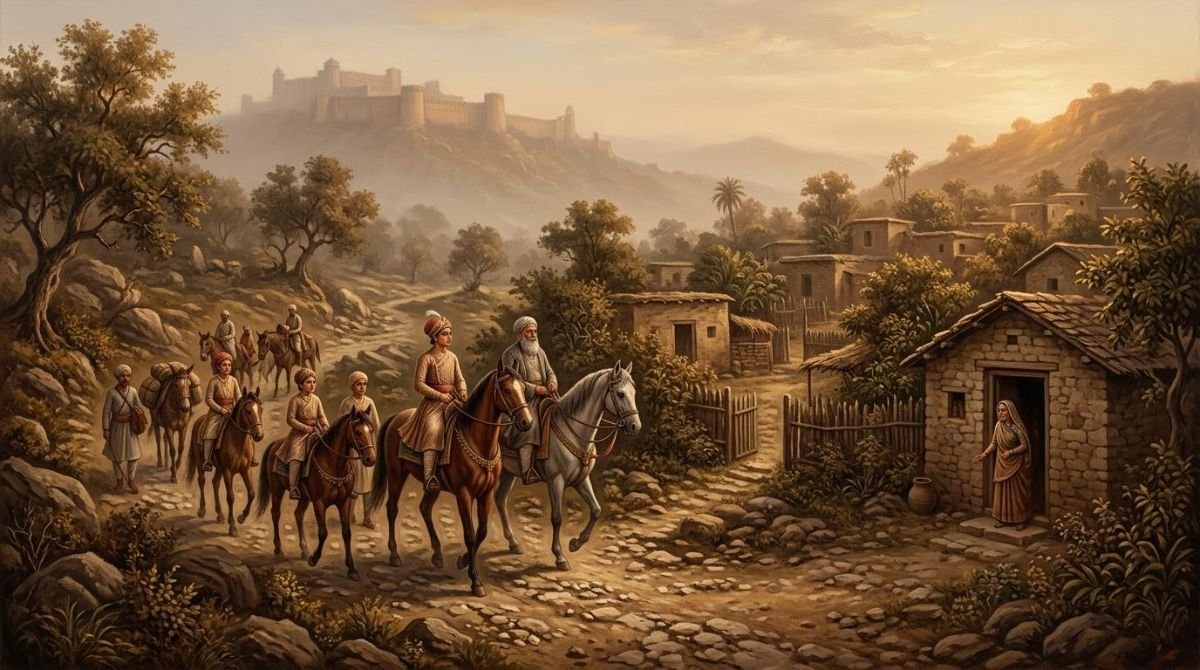
Raja Chib Chand (راجہ چب چند) was the Katoch prince of Nagarkot Kangra from whom the Chib Rajputs and their country, Chibhal, take their name. According to the 1997 Chib history by Raja Muhammad Iftikhar Ali Khan, he came down from the Kangra hills with his father Narain Chand early in the fifteenth century, married the only daughter of Raja Sri Pat, the Thakial ruler of Bhimber, and took the throne after Sri Pat’s death, founding a dynasty that ruled from Bhimber for some four centuries.
At a glance
- Title
- Founder of the Chib tribe (bani-e-qaum-e-Chib) and first Chib raja of Bhimber
- House
- Katoch Rajputs of Nagarkot (Kangra), Kashyap gotra
- Descent
- Son of Narain (Nahar) Chand, grandson of Partab Chand, great-grandson of Raja Megh Chand of Kangra
- Brothers
- Dhru Chand, Ambu Chand and Aji Chand
- First home
- Mughlora, east of Bhimber, where he founded a village named Kangra
- Wife
- Only daughter of Raja Sri Pat of Bhimber (Punja Devi in one account)
- Accession
- First quarter of the 15th century (the book); c. 1230 (Raja Wilayat Khan)
- Successors
- Kalas, Rupal, Rajan, Pheri and Shanti Chand, then Goja Chand
Who was Raja Chib Chand?
Every Chib Rajput traces his descent to Raja Chib Chand. The clan bears his name, and so does Chibhal, the hill country south of the Pir Panjal between the Jhelum and the Chenab, whose capital for centuries was Bhimber, in today’s Azad Jammu and Kashmir. The book calls him bani-e-qaum-e-Chib, the founder of the Chib tribe, and the first of a line of rajas who ruled from the first quarter of the fifteenth century until Raja Sultan Khan in the nineteenth (pp. 21–22, 25, 36). His descendant in the seventh generation, Raja Shadab Khan, revered as Baba Shadi Shaheed, embraced Islam, and most Chib Rajputs today are Muslims, though Hindu Chibs remain in Dewa Vatala and elsewhere.
Colonial writers knew the tradition too. H. A. Rose’s Glossary of the Tribes and Castes of the Punjab (1911), translated in the book, records that the hill tract on the left bank of the Jhelum was named Chibhal after this tribe, and that the Chibs claimed to be a branch of the Katoch royal house of Kangra, at least through the female line (p. 26).
A prince of Nagarkot Kangra
The Katoch were the ancient ruling house of Kangra, in today’s Himachal Pradesh. Thakur Kahan Singh Balauria, whose genealogy the book quotes, explains that Kangra’s original name was Nagarkot or Kot Kangra, which gave the family its title of Katoch. His Shajra Kot Kangra traces the house, of the Kashyap gotra, from Bhumi Chand, said to have sprung from the earth with bow and arrow in hand, through Raja Susharm Chand, who fought Arjuna in the Mahabharata and is credited with building Kangra Fort, down to Raja Megh Chand (pp. 21–22). The story of that ancient line is told in From Kangra to Bhimber: The Katoch Origins of the Chib Rajputs.
Megh Chand, the compiler adds, stands at number 455 on the throne list of Kangra and was ruling when Timur invaded India in 1398; on Timur’s way back from Delhi, he writes, there were skirmishes between Timur’s troops and Megh Chand’s in the south-west of the Beas valley (pp. 31–32). Megh Chand married twice. His first rani bore Hari Chand and Karam Chand, his second Partab Chand and Parag Chand. Hari Chand, the eldest, disappeared, and the rightful heir was Partab Chand, next in age; but the courtiers crowned Karam Chand instead, and Partab Chand, heartbroken at the injustice, soon died. Hari Chand’s line became the Guleria Rajputs of Guler, Karam Chand’s kept Kangra, Parag Chand’s settled in the Hoshiarpur district, and Partab Chand’s became the rajas of Bhimber, the Chibs (pp. 22, 31, 65, 388). The two brother houses are described in Guler and Kangra.
The road to Bhimber
The fullest account of what followed comes from Mian Onkar Singh Chib’s Tarikh-e-Chibhal (second edition, Delhi, 1984), which the book quotes at length (pp. 65–67). Partab Chand’s son Narain Chand had not forgotten the old wrong. Early in the fifteenth century he left his homeland for good, resolved to win a kingdom of his own as his cousins ruled theirs. With a few servants and his four sons, Chib Chand, Dhru Chand, Ambu Chand and Aji Chand, he crossed the hills of Jammu and entered the state of Bhimber. Chib Chand, the eldest, was the most handsome and dashing of the brothers.
At Mughlora, east of Bhimber, the travellers lodged with an old Brahmin woman. Narain Chand sent a servant into the town with a valuable jewel to sell for provisions, for in those days, the chronicle explains, every state had its own coinage and travellers carried gold and jewels instead. The shopkeepers judged the jewel fit for a king and took it to the ruler, Raja Sri Pat of the Thakial Rajputs, who bought it and concluded that its owner must be a man of rank, perhaps of royal blood. Meanwhile the old woman, who worked in the palace, spoke well of young Chib Chand to the queens. Sri Pat sent for Narain Chand, asked about his family, and made his proposal:
I wish to marry my only daughter to your son Chib Chand.
— Raja Sri Pat, as quoted in Onkar Singh’s Tarikh-e-Chibhal (Iftikhar Ali Khan 1997, p. 66)
The wedding was celebrated with great pomp. Besides the dowry, Sri Pat granted the couple several villages east of Bhimber as a jagir. Chib Chand settled there for good, and east of Mughlora he founded a village that he named Kangra, so that the memory of his old home would stay fresh (p. 66).
From son-in-law to raja
A few days after the wedding Narain Chand died, and some time later Raja Sri Pat died too, leaving no son. His heirs claimed the throne, but Chib Chand outmanoeuvred them and took it himself. He met only slight resistance; his defeated rivals fled the country and those who remained accepted his rule. So the Thakials lost Bhimber and Chib Chand became its sole master (p. 67).
The Thakials’ family priests (raj-purohits) then came to ask how they would live now that their patrons were gone. Chib Chand promised to honour them as the purohits of his own clan and bound his descendants to do the same; the Hindu Chibs, Onkar Singh wrote, still recognise the Brahmins of the Verha caste (reading uncertain) as their purohits (p. 67). The old rulers did not give up easily, and Chib Chand spent his strength holding the state against their constant intrigues. His Bhimber reached the Chenab in the east and the Jhelum in the west, the borders of Rajouri and Poonch in the north, and Gujrat and Kharian in the south (pp. 30, 67). Thakur Major Singh adds that in Sri Pat’s day the palaces stood at Aadhi Dhak, where the shrine of Baba Shadi Shaheed now is, and that the town was Jhangar, two or three miles to the north; the later sites are described in Bhimber’s Monuments (p. 42).
Sources differ
Sri Pat is a Thakial Rajput in Tarikh-e-Chibhal (pp. 42, 66), a Brahman in the 1868 Gujrat Settlement (p. 20) and “Sri Pat Wadhan (Badhan)” in Raja Wilayat Khan’s research (p. 30); Maulvi Zain-ul-Abidin’s manuscript names the Thakials and the Badhans as Bhimber’s rulers before Chib Chand (p. 119). Rose says Sri Pat gave part of his state as dowry (p. 26). Griffin and Massy’s Chiefs of the Punjab, quoted on pp. 156–157, tells a darker story: not content with his wife’s jagir, Chib Chand invited his father-in-law’s whole family to a feast, had them killed and made himself raja.
When did Chib Chand rule?
The sources disagree by centuries. The compiler dates Chib Chand’s accession to the first quarter of the fifteenth century (pp. 25, 36, 352). His reasoning is simple: Megh Chand was on the throne of Kangra at Timur’s invasion in 1398, so his great-grandson cannot have taken Bhimber two centuries earlier (p. 32). Griffin and Massy likewise put Chib Chand’s departure from Kangra at about 1400 (p. 156). At the other end of the line, the 1868 Settlement says the Chib rajas stayed Hindu for six generations and that Raja Shadip Chand, of the seventh, became a Muslim under Humayun, while the book makes that raja, Baba Shadi Shaheed, a contemporary of Sultan Ibrahim Lodi and of the Mughal emperors from Babur to Akbar (pp. 20, 26).
The late Raja Wilayat Khan of Thotha Rai Bahadur, in an unpublished history checked against the purohits’ records at Kangra and Hardwar, proposed a much earlier date: Sri Pat, he wrote, died about 1230 and Chib Chand then took Bhimber (pp. 25, 29–31). In his version Chib Chand was a son of Nahar Chand Katoch, raja of Kangra, by a second rani; his brothers were Pirag and Odiyan Chand and his half-brother Sujan Chand; and before coming to Bhimber he held a jagir with its headquarters at Chaprar, near Sialkot, marrying Sri Pat’s daughter Punja Devi. The compiler rejects these points one by one. Narain Chand never sat on the throne of Kangra, since he died in Bhimber; the brothers’ names are wrong; Chaprar never belonged to Kangra; and, as he asks, if Chib Chand had held a fertile plain like Chaprar, why would he have lodged like a traveller in an old woman’s house in rocky Mughlora (p. 32)?
Sources differ
Kahan Singh’s genealogy makes Partab Chand the third of Megh Chand’s four sons (p. 22), while Tarikh-e-Chibhal and the compiler call him second in age (pp. 31, 65). Our article From Kangra to Bhimber follows Hutchison and Vogel’s History of the Panjab Hill States (1933), in which Partab Chand himself settles near Bhimber, marries the local ruler’s daughter and succeeds him, and his son Chib Chand becomes raja. The 1997 book, following Tarikh-e-Chibhal and the Kangra genealogy, has Partab Chand die in Kangra and gives the marriage and the throne to his grandson Chib Chand.
How the sources tell it
The book weighs every account of Chib Chand it could find; the fuller debate over the clan’s origins is set out in Where Did the Chibs Come From?
| Source | Chib Chand’s father | Brothers | Where he settled | Date |
|---|---|---|---|---|
| Tarikh-e-Chibhal (Onkar Singh; Major Singh) | Narain Chand, son of Partab Chand | Dhru, Ambu, Aji Chand | Mughlora, east of Bhimber | Early 15th century |
| Kahan Singh Balauria, Shajra Kot Kangra | Narain or Nahar Chand, son of Partab Chand | Dhru, Ambu, Aji Chand | Bhimber | Not given |
| Raja Wilayat Khan (unpublished) | Nahar Chand Katoch, raja of Kangra | Pirag, Odiyan; half-brother Sujan Chand | Chaprar, then Mangora | c. 1230 |
| Gujrat Settlement, 1868 | Raja Nahar Chand of Kangra | Odhe Chand | Manglora (Mughlora) | Line traced from 965 AD |
| Rose, Glossary (1911) | Not given | Not given | Maghlora | “Fourteen centuries” earlier (as printed) |
| Griffin and Massy, Chiefs of the Punjab | Not given | Ude Chand | Malaura or Mauj Pura (Mughlora) | About 1400 |
The 1868 Settlement adds a further twist, deriving the line from an Iranian prince, Gohar Shah, whose son Abdar Chand is said to have served at the court of Alauddin Khilji; the compiler dismisses this as an invented pedigree of a kind he found among many Muslim families of the subcontinent (pp. 19–21).
In the oldest history (c. 1926)
Thakur Major Singh’s Tarikh-e-Chibhal, whose opening chapters are now online (see Tarikh-e-Chibhal, chapter by chapter), tells Chib Chand’s story in its second chapter (pp. 21–25) and differs from the account above in several points. Like Kahan Singh, he makes Partab Chand the third of Megh Chand’s four sons (p. 9). Narain Chand leaves Kangra “for the sake of conquest”, with a small band of soldiers, once Karam Chand’s line holds the throne; there is no word of a grievance or of an old Brahmin woman, and the travellers simply camp at Mughlora, which Major Singh places four miles east of Bhimber (pp. 9, 21). He dates the departure to “the end of the thirteenth century Bikrami”, about 1240 AD: the early-fifteenth-century date given above for Tarikh-e-Chibhal is Mian Onkar Singh’s, not his (see When did the Chibs come to Bhimber?).
He adds that Chib Chand’s lagis, the family’s hereditary ceremonial servants, were absent at the wedding, so his brothers acted as priest and bard, and that the village of Kangra east of Mughlora still bore its name (p. 22). On the end of Thakial rule he is blunter than Onkar Singh: after Sri Pat’s death, it is said, Chib Chand invited the Thakial kin-group to a feast at which hidden soldiers killed many of them, some saying the food was poisoned (p. 23). The chapter closes with Chib Chand’s vow to the Thakials’ Brahmin priests (pp. 23–25). See The Thakial Rajputs and Chib Chand’s Vow.
The dynasty he founded
After Chib Chand five rajas followed one another on the throne of Bhimber: Kalas Chand, Rupal Chand, Rajan Chand, Pheri Chand and Shanti Chand. Shanti Chand’s son Raja Goja Chand was the father of Raja Shadab Khan, Baba Shadi Shaheed, whose sons and grandsons divided Chibhal and spread the clan across the Bhimber, Mirpur, Kotli, Gujrat and Jhelum country (pp. 33, 68, 388). By the time of Raja Shadi Khan, as Griffin and Massy call him, the house ruled Bhimber and Naushera as tributaries of the Mughal emperors (p. 152).
- Raja Megh Chand — ruler of Kangra in 1398
- Hari Chand — the Guleria line
- Karam Chand — crowned raja of Kangra
- Partab Chand — passed over for the throne
- Narain (Nahar) Chand — left Kangra for Bhimber
- Raja Chib Chand — founder of the Chib tribe
- Kalas Chand, then Rupal Chand, Rajan Chand, Pheri Chand and Shanti Chand
- Raja Goja Chand — father of Raja Shadab Khan (Baba Shadi Shaheed)
- Kalas Chand, then Rupal Chand, Rajan Chand, Pheri Chand and Shanti Chand
- Dhru Chand, Ambu Chand, Aji Chand
- Raja Chib Chand — founder of the Chib tribe
- Narain (Nahar) Chand — left Kangra for Bhimber
- Parag Chand — settled in the Hoshiarpur district
Mughlora, where the story began, is today a village of the Ghanial Chibs, whose sons have included the late Major General Abdul Rahman Khan, a former President of Azad Jammu and Kashmir (p. 352); its families are profiled in Kot Chibban and Mughlora.
Frequently asked questions
Who was Raja Chib Chand?
He was the founder of the Chib Rajput dynasty of Bhimber, in today’s Azad Jammu and Kashmir. A Katoch prince descended from Raja Megh Chand of Kangra, he came to Bhimber with his father Narain Chand early in the fifteenth century, married Raja Sri Pat’s only daughter and succeeded him. The Chibs and their land, Chibhal, are named after him.
When did Raja Chib Chand come to Bhimber?
The 1997 Chib history dates his accession to the first quarter of the fifteenth century, because his great-grandfather Megh Chand was ruling Kangra when Timur invaded in 1398. Griffin and Massy give about 1400. An unpublished family history by Raja Wilayat Khan proposed about 1230, a date the book rejects.
Whom did Raja Chib Chand marry?
He married the only daughter of Raja Sri Pat, ruler of Bhimber, whom most sources call a Thakial Rajput; one account names her Punja Devi. The marriage brought Chib Chand a jagir east of Bhimber and, when Sri Pat died without a son, the throne.
Where did Chib Chand first settle?
At Mughlora, also written Manglora or Maghlora, east of Bhimber, where his family lodged with an old Brahmin woman. He later founded a nearby village that he named Kangra after his homeland. Mughlora is today a village of the Ghanial Chibs.
Are the Chibs Katoch Rajputs?
The Chib chronicles and the Kangra genealogy quoted in the book derive Raja Chib Chand from the Katoch royal house of Kangra through Raja Megh Chand’s son Partab Chand. Rose’s Glossary of 1911 records the same claim, at least through the female line, and some Chib families use the name Chib Katoch.
Sources
- Thakur Major Singh Chib, Tarikh-e-Rajgan-e-Bhimber wa Qaum-e-Chibhal (Tarikh-e-Chibhal; Urdu, c. 1926), pp. 9, 21–25.
- Raja Muhammad Iftikhar Ali Khan, Raja Shadab Khan alias Hazrat Baba Shadi Shaheed (Urdu, Barhang/Karachi, 1997), pp. 19–32, 36, 42, 65–68, 119, 152, 156–157, 352, 388.
- Mian Onkar Singh Chib, Tarikh-e-Chibhal, 2nd ed. (Delhi, 1984), pp. 34–39, as quoted in the book.
- Thakur Major Singh of Dewa Vatala, Tarikh-e-Chibhal (1983 Bikrami, c. 1926), as quoted in the book.
- Thakur Kahan Singh Balauria, Tawarikh-e-Rajputan-e-Punjab, as quoted in the book.
- Raja Wilayat Khan of Thotha Rai Bahadur, unpublished history of the Chibs, as quoted in the book.
- Settlement of District Gujrat (1868); H. A. Rose, A Glossary of the Tribes and Castes of the Punjab and North-West Frontier Province, vol. II (1911), pp. 169–170; L. Griffin and C. F. Massy, The Chiefs of the Punjab (Urdu translation), all as quoted in the book.
This article is part of our series based on the 1997 Chib history; see the book, chapter by chapter. Spellings of names follow the book.
Continue reading
Have a question about this history?
Our AI guide answers from the articles on this site, in English or Urdu.
