

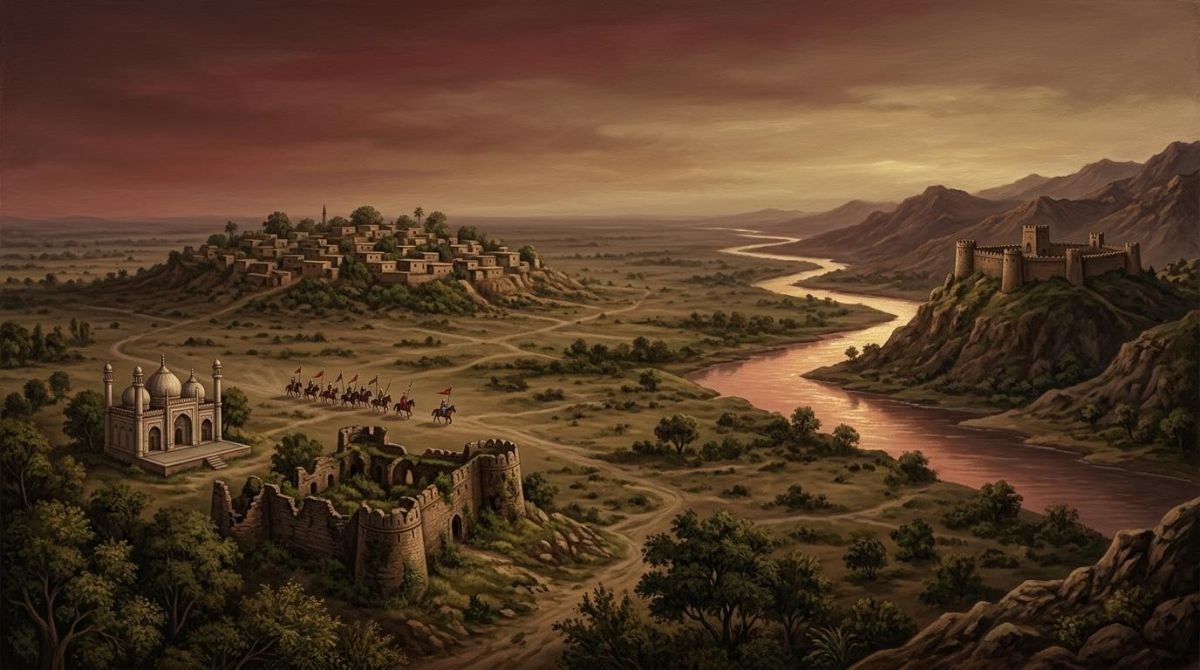
Khari Kariali (also Khari-Khariali, Chibhal Raika or Chibhal Rikki) was the second of the two Chib states: the western half of old Chibhal, between the Bhimber Nala and the River Jhelum. According to the Chib chronicle, it was the inheritance of Raja Mal Khan, son of Raja Shadab Khan (Baba Shadi Shaheed), whose descendants ruled it with the title of Rai until the Sikh conquest of 1808–1810.
At a glance
- Also called
- Khari-Khariali; Chibhal Raika or Rikki; Bhimber Reki; Urdu ریاست کھڑی کریالی
- Founder
- Raja Mal Khan, son of Raja Shadab Khan (Baba Shadi Shaheed)
- Territory
- West of the Bhimber Nala to the Jhelum, including the plain of Khari Kariali
- Seats
- Bhimber Reki, Pindi Jhonjha, Kartu Balani, then Thotha Rai Bahadur; Mangla in one account
- Rulers’ title
- Rai; descendants called Reka or Raika
- Main mandis
- Thotha Rai Bahadur, Panjeri, Daura, Khambi Khanpur (later Bahlwal)
- Last independent ruler
- Raja Bandu (Bando) Khan of Mangla
- End
- Peace of Gujrat, 1810; annexed by Ranjit Singh and given in jagir to Prince Kharak Singh
Where was Khari Kariali?
Old Chibhal, the country of the Chib Rajputs, lay in the foothills below the Pir Panjal between the Jhelum and the Tawi, with its capital at Bhimber, in today’s Azad Jammu and Kashmir. The chronicle explains that it was later split in two (p. 33; see Chibhal and its two divisions). The eastern half, from the Naushera road to Bhimber and from the east bank of the Bhimber Nala to Lala Musa, was Chibhal Rajana, the land of Raja Bhom Khan’s descendants. The western half, from the Bhimber Nala to the River Jhelum and including the plain of Khari Kariali, was Chibhal Rikki, the land of Raja Mal Khan’s descendants.
The Chiefs of the Punjab, quoted in the book, describes Khari Kariali as the country along the Jhelum below Mangla fort (p. 157). Its villages lie today in the Bhimber and Mirpur districts of Azad Kashmir and in Kharian tehsil of Gujrat district in Pakistan’s Punjab. The name Kariali is old: two writers quoted in the book place the ancient city of Pani Koti on the Jhelum where the town of Kariali stands (pp. 35–36).
How Khari Kariali got its name
Thakur Major Singh’s Tarikh-e-Chibhal, quoted in the book, explains that the land west of the Bhimber Nala which went to Raja Mal Khan was settled by two men of the Dutt tribe, Kharak Chand and Karam Chand. Kharak Chand founded Khari and Karam Chand founded Kariala, and the two names were joined as Khari Kariali. He adds that the present town of Bhimber itself lies within Khari Kariali, which is why Raja Bhom Khan built his palaces east of the nala (p. 43).
How Chibhal was divided
The chronicle dates the birth of Khari Kariali to the troubled years after the death of Raja Shadab Khan, the ruler remembered as Baba Shadi Shaheed, in the early Mughal period. His high-born Rajput rani bore Raja Bhom Khan and Raja Mal Khan; a third son, Raja Rupo Khan, was born of another wife (p. 119). A dispute over the succession followed. In one version it set the sons against their uncle Raja Dom Khan (p. 37); in another the brothers and the wider brotherhood harassed Bhom Khan, while Dom Khan came down from the Pir Panjal and stirred up the Thakyals and Budhans, the clans who had ruled Bhimber before Raja Chib Chand (pp. 119, 145).
Bhimber was then subordinate to the emperors of Delhi, and news of the turmoil reached the emperor. To prevent bloodshed among Shadab Khan’s heirs he sent a senior official, who held a darbar at Bhimber. Dom Khan fled towards Poonch, where his descendants became the Domal. A panchayat of the brotherhood then divided Chibhal in two. Bhom Khan, the elder, received the throne of Bhimber and the land east of the Bhimber Nala. Mal Khan, the younger, received the land west of the nala, including the plain of Khari Kariali, as chief jagirdar of a small state within the Bhimber state: the State of Khari Kariali (pp. 37–38, 119, 145). Bhom Khan gave their brother Rupo Khan a single village from his own share, Barhang (p. 119).
Raja and Rai
The division also fixed the titles of the two houses. By ancient custom in Chibhal, the book explains, the elder son was styled Raja and the younger Rai. Bhom Khan’s capital was therefore called Bhimber Rajani or Rajdhani and his descendants Rajana, later also Khanka and Mirzana. Mal Khan built his palaces west of the nala at a place that became known as Bhimber Reki or Rikki, the Rai’s Bhimber, and his descendants were called Reka or Raika, and later Malkal, Thothial, Mahmyal and other gots (pp. 38, 119–120, 145). Both names, the author notes, survived in the revenue records of Bhimber (p. 38).
Sources differ
Thakur Major Singh reads Bhimber Rikki differently, as the Bhimber of the commoners, as opposed to Bhimber Rajani, the Bhimber of the rajas (p. 43). The chronicle calls Mal Khan the second son of Raja Shadab Khan in one place and the youngest in another (pp. 33, 139). British-era histories of the hill states give a quite different origin, making Khari-Khariali the state of Kharak Chand, a brother of Raja Chib Chand, with its capital at Mangla; in the Chib chronicle, Kharak Chand appears only as one of the two Dutt settlers who gave the land its name.
From Bhimber Reki to Thotha Rai Bahadur
Mal Khan’s first seat was his palace at Bhimber Reki. He later moved to Pindi Jhonjha and finally settled at Balani, also called Kartu Balani, a village on the Mughal royal road that ran from Kashmir through Bhimber and Jhelum to Kabul (pp. 139, 141). In his own lifetime his sons divided the territory among themselves. Mal Khan stayed on at Balani with his eldest son, Raja Ali Ghayas Khan (Alghash Khan), and his grandson Budha Khan (p. 139).
Budha Khan’s eldest son, called Raja Mal Khan the second, Malik Khan or Malik Hasan Khan in different passages, left Balani and built palaces on a mound a mile and a half or two miles west of present-day Thotha Rai Bahadur. This kot became the first mandi, or chief seat, of the line, with a dependent holding of 84 villages, and from it grew the village of Thotha Rai Bahadur in Kharian tehsil, which remained the great centre of Raja Mal Khan’s descendants (pp. 139, 141, 145). One later passage, however, puts the headquarters of Khari Kariali at Mangla (p. 167).
Raja Mal Khan’s sons and the mandis of Khari Kariali
The book names four sons of Raja Mal Khan: Ali Ghayas Khan, Jaisak Khan, Tahawwur Khan and Naru Khan. Tarikh-e-Chibhal adds a fifth, Darbar Khan, although elsewhere Naru Khan and Darbar (Darbaru or Nadir) Khan appear to be one man (pp. 139–140, 405, 407). Each line held a mandi, a chiefly seat with its own title, got (sub-clan) and dependent villages. The details below combine the text with the book’s Table of Mandis No. 2 for Chibhal Raika (pp. 401–405).
| Mandi | Founder | Chief’s title | Got | Villages held |
|---|---|---|---|---|
| Thotha Rai Bahadur | Raja Ali Ghayas (Alghash) Khan | Rai | Malkal, Thothial, Malkana, Muhammadial, Miana | 84, later 22 |
| Panjeri | Raja Jaisak Khan | Rai | Jaskal | 22 |
| Daura (Da’ora) | Raja Tahawwur Khan, called Dhor Khan | Khan Sahib | Dhoryal | 22 |
| Khambi Khanpur, later Bahlwal Bala | Line of Naru (Nadir or Darbaru) Khan | Khan Sahib | Reading uncertain | 22, later 12 |
Panjeri
Jaisak Khan left Balani and lived first at Kariala, where a mandi was set up; after a violent clash there, the family’s seat moved to Panjeri. One tradition derives the name from panj bandi, the five shares of the village founded by Jaisak Khan’s four sons and his grandson Husain Khan. His descendants held Panjeri, Kalri, Sahelar, Khadora, Tunin Reki, Tunin Rajani, Pind Rahmanpur, Pind Aziz, Ghazi Gorah, Bhalwal Bala, Bhalwal Zerin and Baoli (p. 139). Two of his sons, Bahlu Khan and Darab Khan, settled on their own shares, and Bahlwal takes its name from Bahlu Khan (p. 140). See Panjeri.
Daura
Tahawwur Khan, known as Dhor Khan, founded a village on his share called Tahawura, a name that wore down over time into Daura (Da’ora). Its chief was styled Khan Sahib and its got is Dhoryal. Its villages included Daura, Pir Khana, Sheikhpur, Thal, Dak, Khal Khanpur, Malikpur, Sirla and Chowki Bandi (p. 140). See Kalri and Mandi Da’ora.
Khambi Khanpur and Bahlwal
By one tradition the fourth mandi was Khambi Khanpur, whose chief was styled Khan Sahib and held 22 villages. It was lost through royal displeasure and passed to Bahlwal Bala, with 12 villages; Khambi, Bahrot, Kastila, Mohri, Sadwal, Bhawanja and Pind Rahman belonged to the old Bahlwal mandi. Much the same villages, with Kalimpur and Dhangrot, are listed for Raja Naru Khan (p. 140).
In the oldest history (c. 1926)
Thakur Major Singh’s Tarikh-e-Chibhal (c. 1926) opens its third part with this division. After Raja Shadi Khan, it says, the state was split in equal shares between Raja Bhum Khan, or Bhup Chand, who kept Bhimber, and Raja Mal Khan, who settled at Pindi Jhonjha, with the Bhimber Nala as the boundary (Major Singh (c. 1926), p. 83). It gives Mal Khan five sons, each with his own villages: Alghash Khan, whose line is at Thotha Rai Bahadur; Dhor Khan, got Dhoryal, mandi Daura; Jaisak Khan, got Jaiskal, mandi Panjeri; Darbar Khan, got Darbyal (reading uncertain), at Khambi, Kalimpur, Dhangrot, Kastila, Bahrot, Mohri and Sadwal; and Naru Khan, at Dab, Sandu’a and three villages whose names are uncertain (pp. 83–84). In this book Darbar and Naru are two different men.
It also names all seven sons of Raja Budha Khan, where the 1997 history names three: Malik Khan, ancestor of the Malkal or Thothyal got; Mamad Khan, of the Mamdal and Samwal (reading uncertain) gots, whose descendants held Lehri, Pothi, Kas Guman (Kasgumah), Chak Nattha and Thohan; Ghiyas-ud-Din Khan; Mirza Khan; Baran Shah; and two whose names are uncertain, Jao-ud-Din Khan and Bhajwa Khan (p. 84). Its chapter on the mandis counts four in Khari Kariali, Thotha Rai Bahadur, Daura (chief’s title Khan), Panjeri (title Rai) and Bhalwal, founded by Darbar Khan, and beside them four chief dheris, Balani, Bisa, Kalri and Samahni, whose sardars held four villages each (pp. 88–89). See also How the Chibs divided into Hindu and Muslim lines.
The house of Raja Alghash Khan
The senior line was that of Raja Ali Ghayas Khan, whom the genealogist-bards called Alghash or Algas Khan. The book describes him as a very influential member of the Mughal court who lived at Balani with his father and probably died there (p. 140). He had three sons: Budha Khan, Shah Khan and Jabbu Khan (p. 141).
Raja Budha Khan was, in the book’s words, a very fortunate raja. Through full access to the Mughal court his family obtained the dependent holding of 84 villages and several mansabs, or imperial ranks. His seven sons flourished, above all Rai Malik Khan, Mamad (Muhammad) Khan and Baran Shah, until the whole country east of the Jhelum, west of the Bhimber Nala and north of the main railway line was filled with their villages (pp. 141, 144):
| Ancestor | Families descended |
|---|---|
| Malik Khan | Malkal (Thothial), Malkana |
| Mamad (Muhammad) Khan | Mamdal, Samwalia |
| Line of Hasan Muhammad Khan | Lehri (from Shamsher Khan) and Pothi Rajgan (from Tarbiyat Khan) |
| Malik Daulat Khan | Kasgumah |
| Ajaib Ali, son of Mian Khan | Thohan |
| Mehr Quli Khan | Chak Nattha |
| Other branches | Budhu Chak, Janhalia, Chak Jani, Purani and Chuha Kariala, among others |
Of all the villages of Raja Mal Khan’s descendants, the author singles out Thotha Rai Bahadur, Bisa and Pothi Rajgan, and in the former state territory Panjeri, Kalri and Kasgumah, as the most advanced (p. 144). See Pothi and Lehri and the Rajgan of Kasgumah.
Shah Khan stayed at Balani. His most famous descendant was Raja Hakim Khan of Samahni, whose daughter’s daughter, a daughter of the Jarral raja of Rajauri, became a consort of the emperor Aurangzeb and the mother of Prince Muazzam, later the emperor Bahadur Shah I. Hakim Khan moved from Goriala to the Samahni valley, received many villages in jagir with a mansab of twelve thousand and built a kot there; for a time the Samahni family also held a mandi (p. 144). His feud with the Rais of Thotha cost that house most of its villages. The families of Jabbu Khan are found at Bisa Kalan, Bisa Khurd, Jagoan and Kotla (p. 141).
The four senior dheris
Besides the mandis, the chronicle records that the Chibhal Raika of Khari Kariali were also known as the four senior dheri-holders, whose chiefs each held about four villages (p. 405). A separate table lists them (p. 406):
| Dheri | Mandi | Chief | Villages |
|---|---|---|---|
| Bilani | Thotha Rai Bahadur | Shah Khan | Bilani, Bilani Kartu, Chhani, Goriala |
| Bisa | Thotha Rai Bahadur | Jiwan Khan (apparently the Jabbu Khan of the text) | Bisa Kalan, Bisa Khurd, Kotla, Jagwal |
| Kalri | Panjeri | Muzaffar Khan | Kalri, Sahelar, Khandora, both Tonins |
| Samahni | Thotha Rai Bahadur | Hakim Khan | Samahni, Dab, Kot, Ralwah and Sandoha (reading uncertain) |
The rulers of Khari Kariali before the Sikhs
Through the Mughal period the heads of both Chib houses governed their states under the emperors. In the weak reign of Muhammad Shah (1719–1748), nicknamed Rangila, both Bhimber and Khari Kariali became independent and enlarged their territories (p. 167). Before the Sikh era, the book names four renowned rulers of Raja Mal Khan’s line (p. 167):
- Raja Ismail Khan, who built a fort in the Khari country named Ismailabad, today Samal or Samwal (not to be confused with Raja Ismail Khan of Bhimber);
- Raja Hasan Muhammad Khan, common ancestor of the jagirdars of Pothi and Lehri;
- Raja Kamal Khan, who built a magnificent mosque near the Samwal fort on the pattern of the Badshahi Masjid of Lahore, completed by his son Raja Surkhru (Sarkhru) Khan;
- Raja Bandu (Bando) Khan, the last independent ruler.
Raja Bandu Khan was a warlike ruler who annexed most of the surrounding country. He even defeated his kinsman Raja Sultan Khan, the last ruler of Bhimber, took the town of Bhimber and seized the strip of land west of the Bhimber Nala. The author calls this quarrel between the two Chib states the forerunner of the ruin of both (pp. 167–168).
The Sikh conquest, 1808–1810
While the two states stood together they held off the Sikh chiefs of the Punjab: Sardar Gujar Singh Bhangi of Wazirabad, his son Sahib Singh Bhangi and Mahan Singh Sukarchakia, father of Ranjit Singh, were all repulsed from Bhimber and Mangla (p. 168). The feud between Raja Bandu Khan of Mangla and Raja Sultan Khan of Bhimber changed everything. In 1808 Ranjit Singh’s commander Diwan Mohkam Chand defeated Sultan Khan, whom Bandu Khan left unaided (see Raja Sultan Khan and the Sikh wars), and between 1808 and 1810 the Sikhs turned on Khari Kariali (p. 169).
Bandu Khan died, and his son Raja Baha-ul-Haq died childless in 1809. Raja Umar Khan of Mangla and Raja Sher Jang Khan of Pothi fought on at Jo’iyan (reading uncertain), Samal, Farida and Mangla. Umar Khan died during a three-month siege of Mangla fort, and his eldest son, Raja Akbar Ali Khan, made peace at Gujrat in 1810, surrendering more than half the state; the forts of Pothi, Samal and Jo’iyan were demolished. When Akbar Ali Khan died childless within six months, Ranjit Singh annexed the whole state and granted three princes of the family a jagir of Rs 10,000 a year, after deducting a quarter as nazrana (pp. 169–170):
| Grantee | House | Jagir (rupees a year) |
|---|---|---|
| Raja Amir Khan, aged ten, brother of Akbar Ali Khan | Mangla, later Lehri | 4,000 |
| Raja Sher Jang Khan | Pothi | 3,000 |
| Raja Azimullah Khan | Kasgumah | 3,000 |
The country itself was given in jagir to Ranjit Singh’s son, Prince Kharak Singh, whose holding ran from Khari Kariali to Manawar (pp. 138, 158, 173). The siege is told in full in our article on Mangla Fort.
Khari Kariali after the Rais
The state was gone, but its families remained among the leading houses of the region. The three grantees of 1810 founded the jagirdar families of Lehri, Pothi and Kasgumah, whose members later served the Sikh, Dogra and British governments and, after 1947, Pakistan and Azad Kashmir; the British record of these families appears in The Chiefs of the Punjab. The senior line continued at Thotha Rai Bahadur, and in 1997 the book names Colonel (Retd) Raja Parvez Masood Akhtar Khan as the present Tikka, or heir, of Khari Kariali and Rai of Thotha Rai Bahadur (p. 185).
Old ceremony survived as well. By Baba Shadi Shaheed’s own instruction, the book records, only the sajjada-nashin (hereditary successor) of the saint Miran Syed Jafar Shah applies the tikka to a new head of the Khari Kariali house, at Thotha Rai Bahadur, just as he does for the heirs of Raja Sultan Khan at Jhelum (p. 114). Rose’s Glossary (1911) noted that the Samwalia, Miana and Malkana gots of this line still enjoyed superior status in his day (p. 27).
In the oldest history (c. 1926)
Thakur Major Singh’s Tarikh-e-Chibhal (c. 1926), the oldest written history of the Chibs, already traces this house to Raja Mal. Its family tree gives Raja Dharam Chand, the name it uses for Raja Shadab Khan, four sons, and beside Raja Mal it writes simply: “from him, the family of Khari Kariyal” (Major Singh (c. 1926), p. 19). His brothers on the tree are Raja Bhup or Bhum Chand (reading uncertain), from whom the later rajas of Bhimber descend; Raja Rup or Udap Chand (reading uncertain), whose descendants lived at Barhang; and a fourth, Gul Mural (reading uncertain), marked as the ancestor of the Samahni family, which the 1997 history instead places within Raja Mal Khan’s own line (see The Samahni Chibs).
The house was a living presence for the author. In his preface he names “Dilawar Khan, Tikka, of Khari Khariyali” first among the distinguished men of the qaum who, he says, had admitted that the Gujrat settlement record’s story of an Iranian ancestor was wrong (p. 5). The 1997 history knows him as Rai Sahib Dilawar Khan of Thotha Rai Bahadur, Tikka of Khari Kariali, who compiled genealogies and notes on the family’s history and died in 1936 (Iftikhar Ali Khan (1997), pp. 24, 143). The whole 1926 family tree is given in The Chib Shajra: 481 Generations in Tarikh-e-Chibhal.
Frequently asked questions
What was Khari Kariali?
Khari Kariali was the western of the two Chib states, lying between the Bhimber Nala and the River Jhelum in what is now Azad Kashmir and the north of Gujrat district. It was ruled by the descendants of Raja Mal Khan, son of Baba Shadi Shaheed, until the Sikhs annexed it in 1810.
Who founded Khari Kariali?
According to the Chib chronicle, the state was created when Raja Shadab Khan’s lands were divided after his death: Raja Bhom Khan received Bhimber and Raja Mal Khan the land west of the Bhimber Nala. British-era histories instead name Kharak Chand, a brother of Raja Chib Chand.
What do Rai and Raika mean?
In Chibhal the elder son was styled Raja and the younger Rai. Mal Khan, the younger brother, took the title Rai, so his seat was called Bhimber Reki and his descendants Reka or Raika, as distinct from the Rajana descendants of Raja Bhom Khan.
How did Khari Kariali end?
After a feud with Bhimber weakened both states, the Sikhs attacked Khari Kariali between 1808 and 1810. Raja Umar Khan died during the siege of Mangla, peace was signed at Gujrat in 1810, and Ranjit Singh annexed the state, leaving the family jagirs worth Rs 10,000 a year.
Who is the Tikka of Khari Kariali?
The Tikka is the head of the senior line of the house, the Rais of Thotha Rai Bahadur near Kharian. In 1997 the Chib chronicle named Colonel (Retd) Raja Parvez Masood Akhtar Khan as the present Tikka of Khari Kariali.
Sources
- Thakur Major Singh Chib, Tarikh-e-Rajgan-e-Bhimber wa Qaum-e-Chibhal (Tarikh-e-Chibhal; Urdu, c. 1926), pp. 5, 19, 26, 83–84, 88–89.
- Raja Muhammad Iftikhar Ali Khan, Raja Shadab Khan alias Hazrat Baba Shadi Shaheed (Urdu, Barhang/Karachi, 1997), pp. 27, 33, 35–38, 43, 114, 119–120, 138–145, 157–158, 167–170, 173, 185, 401–407.
- Thakur Major Singh, Tarikh-e-Chibhal (1983 Bikrami, c. 1926), pp. 61–64, as quoted in the book.
- L. H. Griffin and C. F. Massy, The Chiefs of the Punjab, as quoted in the book.
- H. A. Rose, A Glossary of the Tribes and Castes of the Punjab and North-West Frontier Province, vol. II (1911), in the book’s Urdu translation.
- J. Hutchison and J. Ph. Vogel, History of the Panjab Hill States, vol. II (Lahore, 1933), as summarised in our article on Mangla Fort.
This article is part of our series based on the 1997 Chib history; see the book, chapter by chapter. Spellings of names follow the book.
Continue reading
Have a question about this history?
Our AI guide answers from the articles on this site, in English or Urdu.
