

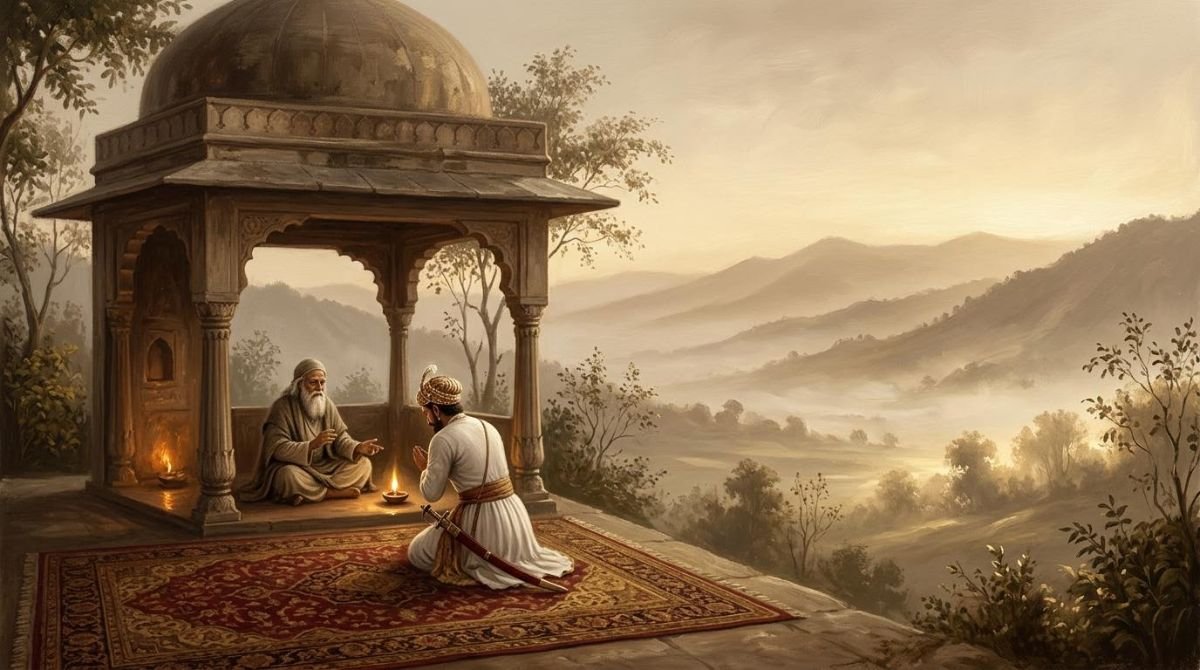
Raja Shadab Khan, the Chib raja of Bhimber revered as Baba Shadi Shaheed (بابا شادی شہید), was the first of his house to embrace Islam, in the first half of the sixteenth century. How it happened is one of the great questions of Chib history: Thakur Major Singh’s Tarikh-e-Chibhal (c. 1926) says the Sultan of Delhi forced the conversion on him, while Raja Muhammad Iftikhar Ali Khan’s history of 1997 argues that Baba Shadi Shaheed’s conversion was a free choice, made in secret years before he took the throne.
At a glance
- Who
- Raja Shadab Khan (Hindu name Dharam Chand or Shadip Chand), raja of Bhimber, the first Chib ruler to accept Islam
- When
- Under Ibrahim Lodi, Babur or Humayun, depending on the source
- Forced?
- Yes, says the Thakur; no, says the 1997 history, which dates it to his father’s lifetime
- Spiritual guides
- Hazrat Piro Shah; bai’at with Miran Syed Jafar Shah (Pir Jafar)
- Lasting sign
- Pir Jafar’s successors still apply the tikka to Chib heirs
- Stayed Hindu
- His brother Raja Dal Khan; his grandson Raja Ghaggi Khan, ancestor of the Hindu Chibs of Dewa Vatala
A Hindu raja on the Kashmir road
The Chib Rajputs descend from the Katoch rajas of Kangra, and for six generations after Raja Chib Chand took the throne of Bhimber, early in the fifteenth century, their rajas were Hindus. Bhimber, in today’s Azad Jammu and Kashmir near the Punjab border, guarded the road by which merchants carried goods between Delhi and Kashmir. Chib Chand’s descendant in the seventh generation, Shadip Chand or Dharam Chand, son of Raja Goja Chand, lived through great changes at Delhi: the last years of the Afghan Lodi sultans, Babur’s victory at Panipat in 1526, the exile and return of Humayun and the early reign of Akbar.
All the sources agree that he became a Muslim and took the name Shadab Khan, and that with him the names in the Chib genealogies change from Chand to Khan. They disagree on when, where and why.
The Thakur’s account: conversion by force
The oldest written version is that of Thakur Major Singh of Dewa Vatala (printed Mehjar or Majhar Singh in the 1997 book), whose Tarikh-e-Chibhal appeared in 1983 Bikrami, about 1926. The Thakur was a Hindu Chib, by the book’s own charts a descendant of the Baba through his grandson Raja Ghaggi Khan. He calls the raja Dharam Chand, a brave and religious man and the last Hindu raja of Bhimber, whom the Emperor of Delhi later made a Muslim by force.
His story begins with a gift of healing from a holy man, the Panj Pir. When Sultan Ibrahim Lodi (r. 1517–1526) fell ill with a boil, the raja was summoned to Delhi and cured him. The grateful Sultan asked him to settle in Delhi and marry there. The raja refused, saying it was against his duty as a Kshatriya, but in the Thakur’s view the rulers of that age pursued conversions by fair means or foul, and the Sultan married him by force to the daughter of a noble. He was given the name Shadab Khan and a palace of his own, two sons were born, and guards rode with him even when he hunted.
The Thakur admits that no Muslim historian records the marriage, explaining that such things could not be written down under Muslim rule; every child of Chibhal, he insists, knows of it. Even in death, he says, the Sultan’s horsemen insisted that the raja be buried as a Muslim rather than cremated.
In the oldest history (c. 1926)
The original pages of Major Singh’s book, now online (see Tarikh-e-Chibhal, chapter by chapter), show that the conversion question was on his mind from the start. In his preface he criticises the Gujrat settlement record, which he calls Tarikh-e-Aqwam-e-Zila Gujrat, for writing that the Chibs’ ancestor came from Iran and that Raja Shadi Khan went to Delhi with presents in Humayun’s reign and became a Muslim at his own request. He blames the ignorance of the village headmen who supplied the story, perhaps under the influence of maulvis, so that the Chibs might be counted real Muslims, and answers with a principle: firmness in religion depends on belief, while the qaum, the lineage or nation, is another thing (pp. 4–5). A Muslim Chib, in other words, needed no Iranian ancestor. He names Muslim Chib notables who, he says, had themselves rejected the Iranian story, among them Dilawar Khan, Tikka of Khari Kariali, and Raja Wafadar Khan of Malot, and says that his book throws light on how Shadi Khan really became a Muslim (p. 5).
Chapter Three gives his answer (pp. 26, 29–30): Dharam Chand refused the Sultan’s offer of a home and a bride in Delhi as contrary to Kshatriya dharma, but in that age, Major Singh writes, the rulers of Delhi spread their faith by fair means or foul, and he was married by force to a noble’s daughter and renamed Shadab Khan. These are the words of a Hindu Chib historian; the reasons the 1997 history gives for a free conversion, set out below, remain the other side of the debate.
Baba Shadi Shaheed’s conversion in the records
Other sources agree that the raja rose to fame under Ibrahim Lodi, but most date his change of faith to the Mughal period:
| Source | Reign | How |
|---|---|---|
| Thakur Major Singh, Tarikh-e-Chibhal (c. 1926) | Ibrahim Lodi | By force, through a marriage imposed at Delhi |
| Maulvi Zain-ul-Abidin Kohi Samahnavi, manuscript | Babur | Not described; he writes that all historians, Griffin included, agree on Babur’s reign |
| Griffin and Massy, The Chiefs of the Punjab | Babur | He presented himself at court, accepted Islam and took the name Shadab Khan, and was confirmed in his state |
| Family account of the Pothi, Kasgumah and Lehri houses, in the 1997 book | Babur | Of his own will, at the hands of a Qazi of Delhi |
| Settlement report of Gujrat District (1868) | Humayun | No details; most of his descendants were Muslims, a few remained Hindu |
| Hutchison and Vogel, History of the Panjab Hill States (1933) | “Probably not later than the time of Babar” | Sadi took the name Shadab Khan and was confirmed in his lands |
| Iftikhar Ali Khan (1997) | In his father’s lifetime; declared on his accession | Freely, guided by Hazrat Piro Shah |
H. A. Rose’s Glossary of 1911 adds that “Sar Sadi” was the first of the Chibs to accept Islam, though it puts his death in the reign of Aurangzeb, a date the 1997 history corrects to the reign of Akbar. Griffin, writing as a British official, noted that the Chibs nevertheless made Shadab Khan a saint, whose grave both Hindus and Muslims of the tribe visited.
What the oldest Chib history says
In the oldest history (c. 1926)
Near the end of his book, in a chapter on “the Chib qaum and the religion of Islam”, Major Singh returns to the question with six numbered arguments against the Gujrat record’s story of a willing conversion (Tarikh-e-Chibhal, pp. 97–99). A willing convert, he reasons, would have been sent home to govern, not kept under guard; Haibat Qandhari would not have been sent after him with an army; Haibat, a kinsman, would have been received as a guest, not fought, unless the raja was resisting arrest; a shahid dies for his faith, not in a political quarrel; the raja forbade a masonry tomb, though a king’s tomb is usually splendid; and his grave opened to take in his Hindu Rani, a point that rests on the legend told in his third chapter. He concludes that the raja “loved his old dharam more” (p. 99), while insisting that proof either way would neither harm the Hindu Chibs nor touch the faith of the Muslim Rajputs, and that each reader must judge (pp. 97–98).
He then names the ways Islam spread in Chibhal: the power of the Delhi emperors, the policy of the Muslim Rajas of Bhimber, and marriage, since the children of Hindu wives were counted Muslim and Hindu and Muslim Ranis often shared one household. He also cites the Shahjahan Nama for an imperial order that no Hindu might make a Muslim woman a Hindu and cremate her (pp. 99–101). The 1997 history, whose case follows, answers the forced-conversion view in general terms but does not take up these six points one by one. The marriage customs are described in Chib Marriage and Inheritance.
The case for a free conversion
The compiler of the 1997 history, Raja Muhammad Iftikhar Ali Khan of Barhang, a Muslim descendant of the Baba, finds the Thakur’s account open to question for several reasons (Iftikhar Ali Khan (1997), pp. 113–115):
- Character. A man who left his kingdom to share thirteen or fourteen years of Humayun’s exile out of friendship could not be forced out of his faith; religion, he writes, is an inner matter.
- Policy. In his view the Muslim rulers of India did not make compulsion their practice, and would hardly have passed over hundreds of states near Delhi to force Islam on a remote hill raja.
- The healing gift. The court did not need his conversion to use his healing powers, which Hindu and Muslim Chibs still share equally.
- His descendants. Nobody forced his descendants to become Muslims, and his grandson Raja Ghaggi Khan kept the Hindu faith unmolested to the end.
- Pir Jafar. A forced convert would hardly have bound his family for ever to the successors of a Muslim saint.
- Dal Khan’s revolt. Had the conversion been imposed by Delhi, why would his Hindu brother have made war on him over it?
His own account is that the prince accepted Islam while his father was still alive. His spiritual guide, Hazrat Piro Shah, told him to keep it secret, for reasons of prudence, until he became raja; once on the throne he declared his faith and, at Piro Shah’s bidding, took the pledge of discipleship (bai’at) with Miran Syed Jafar Shah. His kinsmen tried hard to turn him back and even plotted against him, but he held firm, and to his efforts the compiler credits the faith of most of his descendants today.
“With great respect and deference, we are compelled to differ from Thakur Mehjar Singh on this point.”
— Iftikhar Ali Khan (1997), p. 115
A family account printed in the same book offers a further picture: even as a Hindu, Raja Shadi Chand was devoted to a holy man named Hazrat Miran Sahib Kashmiri, and in Babur’s reign he accepted Islam of his own will at the hands of a Qazi of Delhi.
Reading the sources
The accounts may preserve different memories of one event: a Hindu chronicler explaining a royal ancestor’s conversion as imposed from outside, and Muslim descendants remembering it as an act of faith. Both agree on the essentials, a healer-raja of Bhimber, a summons to Delhi, a marriage there and a new name, and both agree that his healing gift and his tomb remained shared by Hindu and Muslim Chibs.
Piro Shah, Pir Jafar and the tikka
The compiler’s strongest evidence is a custom. By the Baba’s own command, he writes, the hereditary successors (sajjada-nashin) of Miran Syed Jafar Shah performed the coronation of every new raja of Bhimber. The practice outlived the state itself: to this day the sajjada-nashin of Pir Jafar, and he alone, applies the tikka, the mark of succession, to the heirs of the house of Khari Kariali at Thotha Rai Bahadur in Tehsil Kharian, and to the descendants of Raja Sultan Khan, the last ruler of Bhimber, in Jhelum city. The book calls Pir Jafar the Baba’s murshid (spiritual guide) and shows his baithak, a small domed building, at the village of Pir Jafar in Tehsil Kharian, District Gujrat.
One family, two faiths
The conversion divided the family without dividing its memory. Raja Dal Khan, the Baba’s Hindu brother, died fighting him at the great rock now called Thal Pir. The youngest brother, Raja Dom Khan, became a Muslim separately, at the hands of Pir Fazil Shah in Poonch, and founded the Domal. Raja Ghaggi Khan’s descendants, the Hindu Chibs of Dewa Vatala, held to the old faith, and the 1868 settlement report likewise notes a few Hindu Chibs whose forefathers never converted.
Yet the Baba belonged to both communities. Hindus called his shrine Sidh Sadi and Muslims Bawa Shadi Shaheed; Hindu and Muslim Chibs alike brought their children there for the first head-shaving, as the Thakur and the British writers both record, and Chibs of both faiths shared his healing touch. The full story of his life is told in Baba Shadi Shaheed: ruler, healer and martyr.
Frequently asked questions
When did Baba Shadi Shaheed accept Islam?
The sources disagree: Thakur Major Singh’s Tarikh-e-Chibhal places it under Sultan Ibrahim Lodi (1517–1526), Griffin and Maulvi Zain-ul-Abidin under Babur, and the 1868 Gujrat settlement report under Humayun. The 1997 history says he became a Muslim in his father’s lifetime and declared it when he became raja.
Was Baba Shadi Shaheed forced to convert?
Thakur Major Singh (c. 1926) wrote that the Sultan of Delhi forced Islam and a marriage on him. Raja Muhammad Iftikhar Ali Khan (1997) rejects this, arguing from the raja’s character, his devotion to his Muslim spiritual guides and his family’s later history that the conversion was free.
Who was Baba Shadi Shaheed’s spiritual guide?
According to the 1997 history, his first guide was Hazrat Piro Shah, who advised him to keep his conversion secret until he became raja; he then took bai’at with Miran Syed Jafar Shah, known as Pir Jafar, of Tehsil Kharian, Gujrat. Another family account names Hazrat Miran Sahib Kashmiri.
Did all the Chibs become Muslims after Baba Shadi Shaheed?
No. Most of his descendants became Muslims, but his brother Raja Dal Khan stayed Hindu, and the line of his grandson Raja Ghaggi Khan became the Hindu Chibs of Dewa Vatala. His shrine was honoured by Hindu and Muslim Chibs alike.
What is the tikka of Pir Jafar?
By the Baba’s command, the successors of his spiritual guide, Miran Syed Jafar Shah, crowned each new raja of Bhimber. Their sajjada-nashin still applies the tikka, the mark of succession, to the descendants of Raja Sultan Khan in Jhelum and of the Khari Kariali house at Thotha Rai Bahadur.
Sources
- Thakur Major Singh Chib, Tarikh-e-Rajgan-e-Bhimber wa Qaum-e-Chibhal (Tarikh-e-Chibhal; Urdu, c. 1926), pp. 4–5, 26, 29–30, 97–101.
- Raja Muhammad Iftikhar Ali Khan, Raja Shadab Khan alias Hazrat Baba Shadi Shaheed (Urdu, Barhang/Karachi, 1997), pp. 19–21, 26–27, 64, 68–70, 88–93, 113–117, 152, 156–157, 165–166, 353, 372–375, 393–394.
- Thakur Major Singh of Dewa Vatala, Tarikh-e-Chibhal (1983 Bikrami, c. 1926), pp. 26–34, as quoted in the above.
- Maulvi Zain-ul-Abidin Kohi Samahnavi, unpublished manuscript history of Chibhal, as quoted in the above.
- Sir Lepel Griffin and C. F. Massy, The Chiefs of the Punjab (Urdu version, Tazkira-e-Ruasa-e-Punjab), as quoted in the above.
- Settlement report of Gujrat District (1868), as quoted in the above.
- H. A. Rose, A Glossary of the Tribes and Castes of the Punjab and North-West Frontier Province, vol. II (Lahore, 1911), “Chibh”, pp. 169–170.
- J. Hutchison and J. Ph. Vogel, History of the Panjab Hill States, vol. II (Lahore, 1933), “Bhimbar and Khari-Khariyali”, pp. 725–729.
This article is part of our series based on the 1997 Chib history; see the book, chapter by chapter. Spellings of names follow the book.
Continue reading
Have a question about this history?
Our AI guide answers from the articles on this site, in English or Urdu.
