

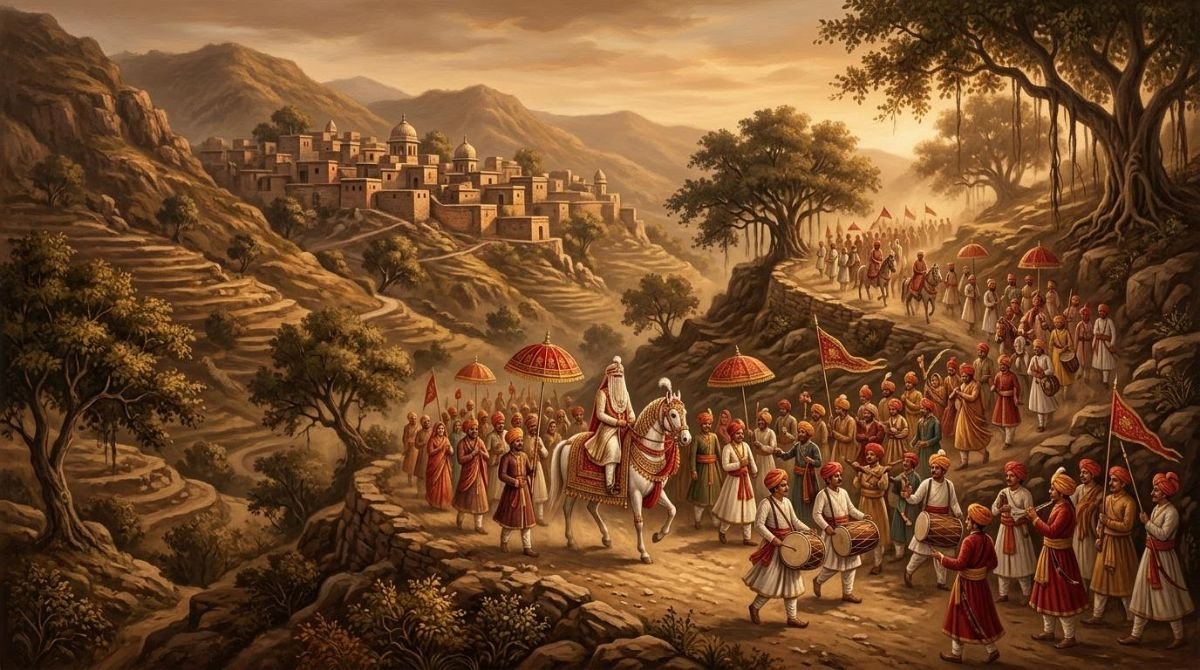
Chib Rajput marriage customs, as Thakur Major Singh recorded them in Tarikh-e-Chibhal about 1926, rested on rank. The Chibs, the Rajput clan of Bhimber in today’s Azad Jammu and Kashmir and of the neighbouring districts of the Punjab, were divided into three grades, Rajas, Mandiyals and Dheridars, and a family took brides from below but gave its daughters only within its own grade or above. Property followed an equally old rule: among Hindu and Muslim Chibs alike it was divided by the line of each wife, not equally among all sons. The two later Chib histories, of 1997 and about 2023, give the clan’s grades in other terms but add little to his account of marriage and inheritance.
At a glance
- Source
- Thakur Major Singh, Tarikh-e-Chibhal (c. 1926), Part Three, Chapters Six and Seven (pp. 95–101)
- Three grades
- Rajas (the Rajgan), Mandiyals (families of the mandis) and Dheridars (holders of dheris)
- The rule
- Brides taken from lower grades; daughters given only within one’s own grade or above
- The Rajgan
- Gave daughters only to Sayyids or within their own families
- Wedding rites
- Once a Brahmin’s rites followed by a maulvi’s nikah; the Hindu rites were fading by 1926
- Hindu Chibs
- Married the Manhas as equals, gave daughters to the Jamwal, took brides from the Salaria, Rakwal and others
- Inheritance
- By the Dharam Shastra: shares by wives (chunda-vand), not equal shares by sons (pagvand)
- Later histories
- The 1997 history (after Rose, 1911) and Chibhal Nama (c. 2023) grade the clan as Mandial, Garhial and Dheral (Dherial); neither records the marriage or inheritance rules
Three grades: Rajas, Mandiyals and Dheridars
Near the end of his book, in a short chapter on the customs of the Chib qaum (رسم و رواج قوم چب), Thakur Major Singh of Deva Vatala, the Hindu Chib who wrote the first history of the Chib Rajputs, sets out the order on which the rest depends. The Chib Rajputs, he writes, have three grades: first the Rajas, second the Mandiyals and third the Dheridars (Major Singh (c. 1926), p. 95).
The Rajas are the Rajgan, the royal families; in the same part of the book the Rajgan of Bhimber are given four gots (sub-clans), the Rajana, who were the ruling house of Bhimber, the Marjana, the Rika and the Khanka (p. 94). The Mandiyals are, in his own gloss, “the people of the mandis”, the great family estates held by junior branches of the royal house: Rampur Bandala, Malot, Ghawaliyan and Rajal in Chibhal proper (p. 93), and Thotha Rai Bahadur, Daura, Panjeri and Bhalwal in Khari Kariali, the western half of the old Chib country (pp. 88–89). The Dheridars held dheris, smaller hereditary holdings. Besides the four mandis of Khari Kariali, the book names four “chief dheri-holders”, Balani, Bisa, Kalri and Samahni, whose sardars each held four villages as tenure-holders (p. 89). The mandis are described in The Mandis of Chibhal, and the terms in our glossary of Chib clan terms.
| Grade | Who they were | Took brides from | Gave daughters to |
|---|---|---|---|
| 1. Rajas (Rajgan) | The royal families; the Rajgan of Bhimber had four gots: Rajana, Marjana, Rika and Khanka | All grades | Sayyids, or within their own families only |
| 2. Mandiyals | The families of the mandis, the great estates of junior branches of the royal house | The Dheridars, and each other | The Rajgan, or each other; never to the Dheridars |
| 3. Dheridars | Holders of dheris, smaller hereditary holdings, the chief of them at Balani, Bisa, Kalri and Samahni | The book states no rule | The Mandiyals and the Rajgan took their daughters |
The 1997 Chib history of Raja Muhammad Iftikhar Ali Khan uses the same phrase, “chief dheri-holders” holding four villages each, and lists the villages in a table of its own, among them Bisa Kalan, Bisa Khurd, Kotla and Jagwal under Bisa, and Dab, Kot and Ralwah under Samahni (Iftikhar Ali Khan (1997), pp. 405–406).
What the three histories say
Major Singh, Tarikh-e-Chibhal (c. 1926) · the original
Three grades: first the Rajas (the Rajgan), second the Mandiyals, “the people of the mandis”, third the Dheridars. The Rajgan took brides from all three but gave their daughters only to Sayyids or among themselves; the Mandiyals took daughters from the Dheridars without giving their own, and married theirs to the Rajgan or among themselves. The grading still stood in his day, though the Hindu wedding rites of the Muslim Chibs were fading (pp. 95–96). He knows no garhs: the Ghaggial of Deva, Vatala and Anbaryala appear as the Hindu branch of the family, treated in a section of their own.
Iftikhar Ali Khan (1997)
Has no chapter on marriage, but translates H. A. Rose’s Glossary of 1911: three grades, the Mandial, Garhial and Dheral, the families of four mandis, of four garhs (strongholds) held by the Ghaggial and of 84 dheris. Rose found it hard in his day to say who belonged to which grade, though feeling on the point still ran high; the Ghanial, as former holders of the throne, would not give daughters to other gots, and the Samwalia, Miana and Malkana married within their own got or gave their daughters to Sayyids or Gakkhars (pp. 26–27).
Chibhal Nama (c. 2023)
Repeats Rose’s three grades, as Mandial, Garhial and Dherial, without naming him, and says the clan was graded in this way before it divided into its fourteen sub-branches; it adds definitions of the mandi, the jagir, the dheri and the garh and long lists of dheri families (pp. 116–120). It says nothing of whom each grade married, of the wedding rites or of the division of property.
Where this leaves us
All three describe a ranked clan in which the families of the mandis stood below the ruling line, and both accounts of marriage agree that the highest families married their daughters only within their own circle or to Sayyids. Major Singh’s is the only account of how the grades married, and the only one written from inside the clan while the rules were still kept; the garh grade comes from Rose, and Chibhal Nama adds definitions but no new evidence about marriage.
Chib Rajput marriage customs: giving daughters upward
Anthropologists call this pattern hypergamy: a bride may move up the ladder of rank, or across it, but never down. It was common among Rajput clans, and in Major Singh’s description the Chibs kept it strictly (pp. 95–96). The Rajgan took brides from every grade but gave their own daughters only to Sayyids, families descended from the Prophet Muhammad, or within their own families. The Mandiyals took brides from the Dheridars but did not give them daughters in return; they married their daughters to the Rajgan or among themselves. The system of grades, he adds, still stood in his day.
The pattern had changed over time. At first, Major Singh writes, the Muslim Chibs, like the Hindus, married among their old relatives, Rajput clans such as the Muslim Manhas, the Jarral, the Mangral and the Bhau. Partly for lack of such relatives and partly under the influence of Islamic law, they had since opened marriage among themselves (p. 95). The change is easier to see against the two traditions: Hindu Rajput custom forbids marriage within one’s own clan, while Islamic law allows marriage between cousins, so Muslim Chib families could now find matches inside the Chib brotherhood itself.
From Brahmin rites to nikah
For a time, Major Singh says, the marriage customs of Hindu and Muslim Chibs were almost alike (p. 95). At a Muslim Chib wedding a Brahmin used to come first and perform the customary rites, and then a maulvi performed the nikah, the Islamic marriage contract. By his day these Hindu customs were slowly dying out, although the grading of families remained (p. 96). The Hindu Chibs kept older wedding observances of their own, recorded in other chapters of the book:
- Bread for a Teli and a black dog. To this day, the author wrote, Hindu Chibs give bread to a Teli (oil-presser) and a black dog at a wedding, in reward for the loyalty of the Teli servant and the dog who, in the legend, stood by Raja Dharam Chand, revered by Muslim Chibs as Baba Shadi Shaheed. It shows, he says, that Rajputs do not forget a kindness, even from an animal (p. 32); Chibhal Nama (c. 2023) repeats the custom and the remark almost word for word (p. 62). The legend is told in Rani Thakial, Sajana Teli and the Black Dog.
- The bandha. Hindu Chib families who now perform a child’s first haircut at home leave a lock, the bandha, and complete the rite at home at the time of the wedding, when no goat is slaughtered (p. 34).
- The Verha Brahmins. Brahmins of the Verha caste received equal dues at Hindu Chib weddings, a duty traced to a vow of Raja Chib Chand (pp. 23–25); see Chib Chand’s Vow.
Other customs of the clan, from the first haircut to the tikka of investiture, are gathered in Customs and Traditions of the Muslim Chib Rajputs.
Hindu and Muslim Ranis in one household
Marriage was also, in Major Singh’s view, a main road by which Islam spread through Chibhal. In the chapter after the customs, on the Chib qaum and Islam, he names three causes: the power of the Delhi emperors, the policy of the Muslim Rajas of Bhimber and marriage (p. 100). His arguments about the first Chib convert are discussed in Forced or Free? How Baba Shadi Shaheed Embraced Islam. Hindu Rajputs, he writes, often gave their daughters to Muslim families, and while a Hindu could not marry a Muslim woman and make her a Hindu, he was welcomed if he became a Muslim to marry her (p. 100).
A Hindu girl married into a Muslim Raja’s house regarded herself as a Hindu, but her children were called Muslim.
— Major Singh (c. 1926), p. 101
So the houses of the Muslim Rajgan often held both Hindu and Muslim Ranis. The practice had stopped some years before he wrote, and the Muslim Rajputs had begun to marry among themselves (p. 101). The book’s genealogies show such a household at the point where the Chib line divided by faith. Raja Ghanni Chand, whom Major Singh counts as the first of the Muslim rajas of Bhimber (p. 99), had four sons by a Hindu Rani, Malu, Anbu, Sanjhu (reading uncertain) and Dolu, and a fifth, Jamshed Khan (written Jamsher), by a Muslim Rani; it was Jamshed Khan who received the throne of Bhimber. Malu in turn married three wives, from the Charak, Rakwal and Salehri clans (p. 81). The 1997 history also gives Ghanni Khan a Hindu and a Muslim Rani, and Malu the same three wives, though it names the Hindu sons a little differently (Iftikhar Ali Khan (1997), p. 120). Major Singh gives Raja Dharam Chand (Shadab Khan) himself two wives, Rani Thakial and the daughter of a Delhi nobleman whom the emperor made him marry (pp. 26, 29); Chibhal Nama, citing manuscripts it does not name, gives him three, the Delhi wife, a sister of Haibat Khan Qandhari, the Hindu Rani Thakiala and a Rani of the Sadhan tribe (Chibhal Nama (c. 2023), pp. 67–68), and it repeats the 1997 account of Ghanni Khan’s two Ranis (p. 70).
The Hindu Chibs: Manhas, Jamwal and the Jaidev greeting
The Hindu Chibs, the descendants of Raja Ghaggi Khan at Deva, Vatala and other villages (see The Hindu Chibs of Dewa Vatala), lived among the Dogra Rajputs of the Jammu hills, and Major Singh, one of them, places his community precisely in their order of rank (p. 96). Rank showed in two ways: whom one could marry, and how one was greeted. In his account the Rajput salutation Jaidev (جیدیو, roughly “hail, lord”) passed both ways between equals; a family of higher rank answered it with “Ram Ram”, and lower ones offered it without receiving it back.
| Clan | Marriage with the Hindu Chibs | Greeting |
|---|---|---|
| Jamwal, the ruling clan of Jammu | Received Chib daughters in marriage | Answered the Chibs’ “Jaidev” with “Ram Ram” |
| Manhas | Married with the Chibs on equal terms | “Jaidev” exchanged as equals |
| Bhau and Jarral | Not stated | “Jaidev” exchanged as equals |
| Salaria, Rakwal and others (some names uncertain: Mahliya?, Mial?, Langay?, Sen?) | Gave brides to the Chibs but did not receive Chib daughters | Greeted the Chibs with “Jaidev” |
| Non-Rajput castes | None | Greeted the Chibs with “Jaidev” |
Major Singh gives an example from Ghawaliyan, home of the Hindu “Tikka” (senior) family of the Chibs: Thakur Onkar Singh, long a tehsildar, married his daughter to Raja Amar Singh (p. 94). The 1997 history links the Ghawaliyan family by marriage to the household of Maharaja Hari Singh of Jammu and Kashmir, but describes the relationship differently on different pages (Iftikhar Ali Khan (1997), pp. 260, 264–265). Titles were shifting too: the Hindu Chibs had formerly been styled Mian, Major Singh notes, but Thakur, the title he used himself, was coming into use (p. 96; part of the sentence is unclear in the lithograph).
Inheritance: chunda-vand and pagvand
The chapter ends with property. The division of property, and adoption, Major Singh writes, followed the Dharam Shastra, the Hindu law books, and among Hindu and Muslim Rajputs alike the method of dividing ancestral property was one and the same. It was called chunda-vand (چونڈا وند), division by wives (pp. 96–97). In castes that allowed widows to remarry, by contrast, property went by pagvand (پگ وند), equally to every son (p. 97). Both terms belong to the customary law of the Punjab: chunda is a woman’s braided hair and pag a man’s turban, so an estate was shared out “by braids” or “by turbans”. His own example shows the difference: a man marries twice and has one son by the first wife and three by the second.
| Heir | Chunda-vand (by wives) | Pagvand (by sons) |
|---|---|---|
| The only son of the first wife | One half | One quarter |
| Each of the three sons of the second wife | One sixth | One quarter |
Major Singh adds that in the high Muslim Rajput families a second marriage, apparently meaning the remarriage of a widow, was not customary (p. 97). For the Muslim Chibs, then, the rule he records was the custom of the clan rather than Islamic law, under which every son takes an equal share whoever his mother was. The 1997 history has no comparable account of these marriage and inheritance rules, and neither has Chibhal Nama (c. 2023), whose only remarks on the subject are Rose’s grades; apart from Rose’s notes, which the 1997 history translates, Major Singh’s chapter is the fullest description of them in the three Chib histories, written just as the old order was beginning to change.
Frequently asked questions
What were the three grades of the Chib Rajputs?
According to Thakur Major Singh’s Tarikh-e-Chibhal (c. 1926), the Chibs were divided into Rajas (the royal Rajgan), Mandiyals (the families of the mandis, the great estates of junior branches) and Dheridars (holders of smaller holdings called dheris). Families took brides from lower grades but gave their daughters only within their own grade or above. H. A. Rose’s Glossary of 1911 gives a different set of grades, Mandial, Garhial and Dheral, which Chibhal Nama (c. 2023) repeats.
Whom did the Chib Rajgan marry their daughters to?
Major Singh writes that the Rajgan took brides from all three grades but gave their own daughters only to Sayyids or within their own families. The Mandiyals gave their daughters to the Rajgan or married among themselves, and took brides from the Dheridars without giving them daughters in return.
What is chunda-vand?
Chunda-vand is the division of an inheritance by wives: the estate is first split equally between the lines of each wife, then among her sons. Major Singh says Hindu and Muslim Chibs both followed it about 1926, so the only son of one wife received as much as three sons of another wife together. Castes that allowed widow remarriage used pagvand, equal shares for every son.
Did Hindu and Muslim Chibs marry each other?
In earlier times, yes. Major Singh writes that Hindu Rajputs often gave daughters to Muslim Rajgan houses, where a Hindu wife kept her faith but her children were counted Muslim, so many Muslim rajas had both Hindu and Muslim Ranis. He says the practice had stopped some years before he wrote, about 1926.
Whom did the Hindu Chibs marry?
According to Tarikh-e-Chibhal, the Hindu Chibs married the Manhas as equals, gave daughters to the Jamwal, the ruling clan of Jammu, and took brides from clans such as the Salaria and Rakwal without giving their own daughters in return. Greetings followed the same order: the Jamwal answered the Chibs’ Jaidev with Ram Ram.
Does Chibhal Nama describe Chib marriage customs?
Hardly. Chibhal Nama (c. 2023), the third Chib history, repeats H. A. Rose’s grades of Mandial, Garhial and Dherial and defines the mandi, the jagir and the dheri, but it says nothing of whom each grade married or of how property was divided. Thakur Major Singh’s chapter of about 1926 remains the main source.
Sources
- Thakur Major Singh Chib, Tarikh-e-Rajgan-e-Bhimber wa Qaum-e-Chibhal (Tarikh-e-Chibhal; Urdu, c. 1926), pp. 23–26, 29, 32, 34, 81, 88–89, 93–101.
- Raja Muhammad Iftikhar Ali Khan, Raja Shadab Khan alias Hazrat Baba Shadi Shaheed (Urdu, Barhang/Karachi, 1997), pp. 26–27, 120, 260, 264–265, 405–406.
- Captain (Retd) Muhammad Nadeem Khan, Chibhal Nama (Urdu, Dua Publications, no date [c. 2023]), pp. 62, 67–68, 70, 116–120.
- H. A. Rose, A Glossary of the Tribes and Castes of the Punjab and North-West Frontier Province (Lahore, 1911), “Chibh”, as translated in Iftikhar Ali Khan (1997), pp. 26–27.
This article draws on all three Chib histories: Major Singh’s Tarikh-e-Chibhal (c. 1926, the original), the 1997 history and Chibhal Nama (c. 2023).
Spellings of names follow the books; readings marked “uncertain” could not be read with certainty in the old lithograph.
Continue reading
Have a question about this history?
Our AI guide answers from the articles on this site, in English or Urdu.
