

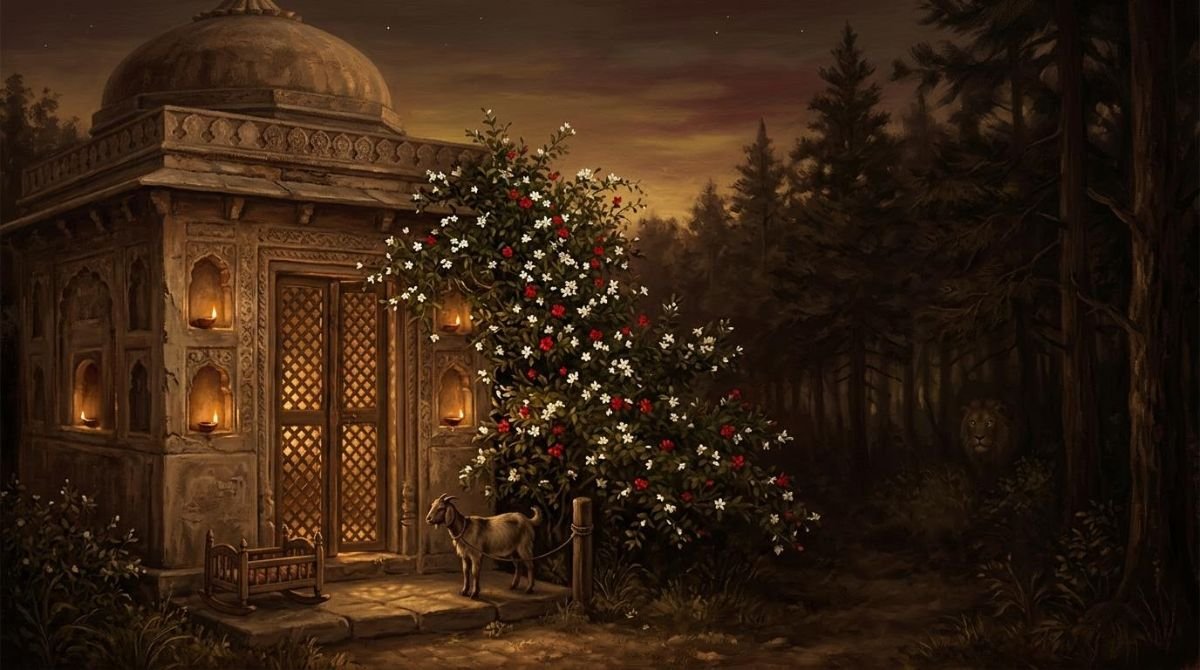
The Baba Shadi Shaheed miracles (karamat, کرامات حضرت بابا شادی شہید) are the wonders that devotees attribute to Raja Shadab Khan, the 16th-century Chib ruler of Bhimber whose shrine stands on Aadhi Dhak in Azad Kashmir. The 1997 Chib history gives them a whole chapter: first the traditions of his lifetime, then about twenty accounts that nine named narrators, from a shrine supervisor to a village tailor, told the author on oath they had witnessed, most of them between 1957 and 1997. They are summarised here as those devotees told them.
At a glance
- Source
- Raja Muhammad Iftikhar Ali Khan (1997), chapter on the karamat, pp. 353–387
- Older traditions
- Thakur Major Singh’s Tarikh-e-Chibhal (c. 1926) and Maulvi Zain-ul-Abidin’s manuscript
- Narrators
- Nine named devotees; Maulvi Raja Wilayat Ali Khan, at the shrine from 1962 to 1984, tells the most
- Period
- 1957 to March 1997, with one account from the late 1940s
- Commonest theme
- A vow (mannat) of a goat for the gift of a child
- Refrain
- Rumi’s line “Auliya ra hast qudrat az Ilah”: the friends of God have power from God
About these accounts
The author says he included only accounts whose narrators were alive, had seen the events themselves and told him on oath, and he regarded them as beyond doubt. We summarise them as the testimony of those devotees, keeping their own framing; we neither vouch for them nor dismiss them, and readers will weigh them according to their own beliefs. People who came to the shrine for help are not named here.
Traditions of the Baba’s lifetime
The chapter opens with wonders that the Chib Rajputs have handed down for generations and that both the Hindu historian Thakur Major Singh of Dewa Vatala and the Muslim historian Maulvi Zain-ul-Abidin of Samahni recorded. The author first heard the story of the Baba’s last battle from his own father as a child. The full life is told in Baba Shadi Shaheed (Raja Shadab Khan).
The healing gift
While still a prince, Kanwar Shadip Chand is said to have received from a faqir the power to cure a carbuncle by passing his hand over it. Its fame reached Sultan Ibrahim Lodhi of Delhi, who suffered from such a boil; summoned to Delhi, the Raja cured him within days and was rewarded with a jagir worth two and a half lakh. A second gift, from an old holy man remembered as the Panj Pir, was the cure of kanpera (painful swellings below the ear, as in mumps) by a touch of the big toe of the right foot. The book says this power passed to his descendants: the author had often seen elderly women touch a sick child with the big toe of the right foot, and the child recover.
The prophecy at Mitthi Ret
Pursued from Delhi by Pir Haibat Khan Qandhari, the Raja faced him at Mitthi Ret, three or four miles north of Bhimber at the foot of Aadhi Dhak; others place the fight at Rani da Khuh on the Bhimber–Gujrat road. Haibat Khan declared that if he were killed, a fair would be held at his grave every Thursday. The Raja answered that if he fell, fairs would be held at his grave every day. Devotees see the fulfilment of this in the unbroken stream of pilgrims at Aadhi Dhak, which, the author writes, did not stop even when the shrine could be reached only by a steep climb of about three miles.
The headless rider
Tradition relates that the Raja, being within his own frontier, invited his opponent to strike first. Haibat Khan’s sword severed the Raja’s head, yet his body, still seated on the horse, struck back and cut Haibat Khan’s neck. The two horses turned in opposite directions. Haibat Khan’s stopped at Mauza Puran in the Sarai Alamgir tehsil of Jhelum, where his tomb stands on a mound; the Raja’s carried his body towards his palaces at Kot, about a mile west of the present tomb, and he was buried where the shrine now stands.
Sources differ
Thakur Major Singh’s older account, also quoted in the book, has the two men strike at the same instant, places Haibat Khan’s shrine (Pir Qandhari) at Mauza Fatehpur Purani, and adds that a black dog buried the Raja’s severed head and later led his servants to it.
Rani Thakial
The best-loved story concerns his queen, Rani Thakial. Devotees relate that after his burial the Raja came to her every night and left before dawn, on condition that she tell no one. When the family pressed her to explain why she adorned herself each evening, she revealed the secret and the visits stopped. Grief-stricken, she ran to his grave and begged to be taken to him; the grave opened, and she entered it alive. The story is told more fully in Rani Thakial, Sajana Teli and the Black Dog.
Thal Pir and the informer’s line
Raja Shafqat Khan of Ralwah in the Samahni valley, grandson of the elder Raja Alif Khan, told the author a tradition of his own family about the death of the Baba’s Hindu younger brother, Raja Dal Khan, who made war on him after his conversion. Defeated at Ralwah, Dal Khan hid by a huge rock (thal in the local Pahari) and was found through an informer, whom the narrator names as his own ancestor. Grieving over his brother’s body, the Raja forgave the informer the blood but foretold that no young man of his line as handsome and strong as the slain prince would live beyond that age. Three men of Ralwah, the schoolteacher Chaudhry Muhammad Akbar, Chaudhry Muhammad Yasin and Chaudhry Muhammad Azam, who owns the plot, confirmed the tradition in the author’s presence. The spot, Thal Pir, is venerated, and wild, sweet-smelling flowers are said to bloom there all year; see Thal Pir.
The shrine supervisor’s testimonies
Most of the eyewitness accounts come from Maulvi Raja Wilayat Ali Khan of Barhang, a descendant of the Baba who served at the shrine for the Auqaf Department from 1962 to 1984 and was in his eighty-fifth year when the author interviewed him. His career is told in From Mujawirs to Auqaf.
Graves rebuilt to a dream’s measurements
In 1962 the tomb held only a heap of earth overgrown by a large bush; in 1968 the graves of the Baba and Rani Thakial were rebuilt in masonry and a dome was raised. In about 1985, the Maulvi related, the Baba appeared in a dream to a man of Jhelum known as Babu and told him to rebuild both graves over the old ones. Babu dismissed it as a dream until, the next night, the Baba asked him sternly whether his ears needed twisting. He came to the shrine, obtained permission from the construction supervisor, Babu Abdul Khaliq, and returned with masons and cement. When the supervisor gave him the length and breadth of the graves, Babu said they were exactly the measurements he had been told in his dream.
Vows answered
Several of his accounts follow one pattern: a pilgrim vows a goat (mannat), prays at the tomb, and returns to sacrifice it when the prayer is answered. He told the author of:
- a man who arrived with a goat in the mid-1980s because a relative involved in a fatal accident in Saudi Arabia had been acquitted;
- a woman from Qazi Chak in Jhelum district, childless after twelve years of marriage, to whom the Maulvi gave dates over which he had prayed and some litanies to recite; a child was born nine months later, and she came back with her husband, a Subedar in the Pakistan Army, to sacrifice a goat;
- a man from Gujranwala, childless after fifteen years of marriage, who came in the early 1970s and later had a daughter and two sons;
- a man from Rawalpindi, married for sixteen years without children, who had a son.
One story was told as a warning. In the mid-1970s two couples from New Mirpur Khori, near Fatehpur in Gujrat district, each childless for about six years, made vows at the shrine. One household found its vowed goat so unruly that it sold the animal and bought another. The Maulvi related that the child born to that couple had what looked like a goat’s tail on its back, and that the infant and its father both died soon afterwards. He presented it as the consequence of breaking faith with something held in trust (amanat) for the saint.
The lion’s salute
It has long been said in Chibhal that in the last watch of every Thursday night a lion comes to pay its respects at the tomb, and many people claimed to have seen it. The Maulvi said that in 1962, lying on the roof of his house near the shrine, at a time when there was no electricity and dense jungle all around, he saw two brilliant lights appear before him like powerful bulbs and then vanish: the eyes, he believed, of the lion come to salute the Baba.
The soldier who came home
The Maulvi also passed on a story told to him by Raja Buddhe Khan, the jagirdar of Samahni, after Pakistani prisoners of war came home from India following the 1971 war. A father from Gujrat district had vowed a goat for his son’s release. Climbing Aadhi Dhak with the freed son, the young man lost patience and abused his father, and at once, the story goes, his mind became deranged and he grew violent. The party turned back, and at Bhimber the police locked him up for safety. Raja Buddhe Khan, who happened to be in town, visited him and advised him to ask the Baba’s pardon through the intercession of Mai Sahiba Rani Thakial. He recovered, went straight to the shrine and sacrificed two goats instead of one. See Raja Buddhe Khan.
The thieves who lost their sight
In the early 1970s, the Maulvi said, thieves carried off the shrine’s cash box. Barely two furlongs away their sight failed them; when they begged forgiveness it returned, and they fled in terror, leaving the box on the ground, where the shrine’s servants found it.
His own calling
The Maulvi counted his own life among the Baba’s favours. In 1957, while still a railway employee in Lahore, he had prayed at the tomb for a chance to serve it; five years later, against all expectation, he was posted there. Soon afterwards, he said, a tall, radiant figure of royal bearing appeared to him in a dream and told him he had been made the shrine’s gaddi-nashin (successor), and he became widely known as its sajjada-nashin. After a lifetime without children, he married in his mid-fifties and became a father, the first birth following soon after pilgrims offered a cradle at the shrine.
Testimonies of other devotees
Raja Inayat Khan of Mughlora: the sceptical neighbour (1958)
Raja Inayat Khan of Mughlora (see Kot Chibban and Mughlora), aged 77 when the book was written, had served on the personal staff of the last two Viceroys of India, Lord Wavell and Lord Mountbatten, and travelled widely during the Second World War. In 1958, when he was in business in Gujranwala, a neighbouring shopkeeper confided that he had been married for eighteen years without a child. Inayat Khan suggested a vow at the shrine of his ancestor, while warning that it went against his friend’s creed: the man followed the Ahl-e-Hadith school, which rejects seeking a saint’s intercession. In time the neighbour went and made the vow; within a year he had a son, returned to the shrine with his family and a goat, and visited it often for the rest of his life.
Sawar of Barhang: a son for a landowner
Sawar, son of the late Rahmdad, originally of Barhang and settled at Chakanwali in Gujrat district, took a landowner of his village who had no son to the shrine. The man vowed a goat, a son was born at the end of the natural term, and he returned to make the sacrifice.
Chaudhry Iqbal Naseem: the pilgrim who fell
The author’s childhood friend and classmate, Chaudhry Iqbal Naseem of Chak Fazil near Kharian, recalled a party that walked from his village to fulfil a vow about fifty years earlier. On the steep climb up Aadhi Dhak one exhausted man began to rave and spoke disrespectfully of the Baba; at once, Iqbal Naseem said, he was thrown to the ground so hard that his head split open. The party dressed his wound and, when he came round, they all begged the Baba’s forgiveness. The account breaks off at this point in the book.
Subedar Raja Muhammad Afzal Khan: the saint who was summoned
Subedar (retd.) Raja Muhammad Afzal Khan of Sari’ah near Kharian, a pious man devoted to the Sufis who died in 1996, told the author about his spiritual guide, Hazrat Naqibullah Shah of Qasur. The saint seldom left his lodge but agreed to visit the Subedar’s home. Days after he returned to Qasur, an acquaintance claimed to have seen him at Bhimber. When the Subedar asked, the saint confirmed it: on his first night back, he said, Baba Shadi Shaheed had come to him and complained, “You reached my son’s house, but did not take the trouble to come to me,” and kept him awake all night, so the next morning he had set out for Bhimber to pay his respects at the shrine.
Master Muhammad Boota: the goat in the forest
Master Muhammad Boota, a tailor with a shop in Bhimber’s Main Bazaar, from Sirla (reading uncertain) near Bhimber, was a political worker and close companion of the late Azad Kashmir President K. H. Khurshid, and a lover of Punjabi poetry and of Iqbal. He described a party from the Khari area of Mirpur that set out in the early 1990s, after some disagreement within the family, to fulfil a vow. At the boundary of Sirla the vowed goat leapt from their vehicle and vanished, and after searching in vain they went home. Some ten to fifteen days later a shepherd found it unharmed in a forest so full of wild animals that, Boota said, no lone animal could survive there, and brought it to the shop of his cousin, the tailor Master Lal Din. The family returned in astonishment and took the goat on to the shrine.
Master Raja Khan Malik Khan: the mosque roof
The late Master Raja Khan Malik Khan of Barhang, a companion of Chaudhry Ghulam Abbas in the Kashmir freedom movement and secretary of the shrine’s first management committee, related that the wooden roof of the shrine mosque fell in three or four times until the Baba told him in a dream to build a dome instead. The domed roof, he said, was still standing more than half a century later.
The Auqaf manager’s accounts
Sardar Muhammad Fazil Nadeem of Sarsawa in Kotli district, of the Sudhan family, was the Auqaf Department’s manager at the darbar for four postings between 1984 and 1997. He gave the author three accounts:
- Two friends of God (1989). The khatib (preacher) of the shrine mosque at the time objected to reciting the Fatiha at the tomb. That year Hazrat Pir Alauddin Siddiqui, sajjada-nashin of Nerian Sharif at Tarar Khal in Poonch, visited, recited the Fatiha, then went back for another hour and a half of prayer. He explained that he had done so deliberately, and declared that the shrine held not one friend of God but two, one of them Mai Sahiba Rani Thakial. The khatib, the manager said, never objected again.
- The doctors’ son (1989). A married couple, both specialist doctors, had been childless for years although tests found nothing wrong. They made a vow at the shrine, and within a year they had a son and came back to sacrifice a goat.
- The cancelled transfer (March 1997). Early in March 1997 the manager was ordered to Muzaffarabad, and his replacement arrived. On 16 March Syed Sikandar Hussain Shah, a blind holy man and devotee of Hazrat Sain Saheli Sarkar, visited with ten or twelve disciples and told the newcomer that the Baba had told him the transfer would not stand. Within days the new posting was withdrawn and Fazil Nadeem’s transfer cancelled.
The red and white jasmine
The chapter ends with the wonder that any visitor can see. Tradition says that as Rani Thakial entered the grave, a scrap of her dupatta (head-scarf) was left outside, and a jasmine grew from it. Beside the door of the tomb, the author writes, jasmine has grown for centuries, one plant bearing white flowers, as jasmine does the world over, and the other red, as if still mourning the Rani’s end. For the author it was a sign beyond reason’s reach; for Chib families it is the living memorial of the love between the Baba and his queen. See the guide to the shrine.
Baba Shadi Shaheed miracles: the testimonies at a glance
| Narrator | From | When | What he relates |
|---|---|---|---|
| Maulvi Raja Wilayat Ali Khan | Barhang, Bhimber | 1957 to c. 1985 | Graves rebuilt to a dream’s measurements; vows for children and an acquittal; the lion; the thieves; his own calling |
| Raja Buddhe Khan, through the Maulvi | Samahni | After 1971 | The returned prisoner of war |
| Sawar son of Rahmdad | Barhang; Chakanwali, Gujrat | Not dated | A son for a landowner |
| Chaudhry Iqbal Naseem | Chak Fazil, Kharian | Late 1940s | A pilgrim struck down for insolence |
| Subedar Raja Muhammad Afzal Khan | Sari’ah, Kharian | Before 1996 | His spiritual guide summoned to Bhimber in a dream |
| Raja Inayat Khan | Mughlora, Bhimber | 1958 | A sceptical neighbour’s son |
| Master Muhammad Boota | Sirla, Bhimber | Early 1990s | The vowed goat that survived the forest |
| Raja Shafqat Khan | Ralwah, Samahni | Family tradition | Thal Pir and the informer’s line |
| Sardar Muhammad Fazil Nadeem | Sarsawa, Kotli | 1989 and 1997 | Two friends of God in one tomb; the doctors’ son; the cancelled transfer |
| Master Raja Khan Malik Khan | Barhang, Bhimber | Before 1947 | The domed roof of the mosque |
Read together, the testimonies show what the shrine means to its devotees: a place to make and keep vows, above all for children; a place whose sanctity it is dangerous to insult; and a place where Rani Thakial is honoured beside her husband as an intercessor. After almost every account the author adds a line of Rumi, “Auliya ra hast qudrat az Ilah”: the friends of God have power from God. The customs that grew from these beliefs are described in Chib customs and traditions.
Frequently asked questions
What miracles are attributed to Baba Shadi Shaheed?
Tradition credits him in his lifetime with a healing gift for carbuncles and mumps, a prophecy that fairs would be held at his grave every day, and fighting on after he was beheaded. After his death his wife Rani Thakial is said to have entered his grave alive, and a jasmine with white and red flowers to have grown beside it. The 1997 Chib history adds about twenty testimonies of answered vows and other wonders from named devotees.
Who recorded the testimonies about Baba Shadi Shaheed?
Raja Muhammad Iftikhar Ali Khan of Barhang collected them for his Urdu history of 1997 from narrators who, he says, told him on oath what they had seen. Older traditions about the Baba’s lifetime come from Thakur Major Singh’s Tarikh-e-Chibhal (c. 1926) and the manuscript of Maulvi Zain-ul-Abidin of Samahni.
Why do pilgrims vow goats at the shrine?
A vow (mannat) is a promise to make an offering if a prayer is granted. At Aadhi Dhak the usual vow is a goat, sacrificed at the shrine once the prayer is answered, most often, in the book’s accounts, for the birth of a child.
What is the tradition of the lion at the shrine?
It has long been said in Chibhal that a lion comes to salute the tomb in the last watch of every Thursday night. Maulvi Raja Wilayat Ali Khan told the author that in 1962 he saw two brilliant lights near the shrine in the dark, which he took to be the lion’s eyes.
What is the two-coloured jasmine of Baba Shadi Shaheed?
It is a jasmine beside the tomb on Aadhi Dhak that, according to the book, has borne white and red flowers for centuries. Devotees say it grew from a scrap of Rani Thakial’s head-scarf left outside the grave when she entered it alive.
Sources
- Raja Muhammad Iftikhar Ali Khan, Raja Shadab Khan alias Hazrat Baba Shadi Shaheed (Urdu, Barhang/Karachi, 1997), pp. 63, 84–93, 116–118, 190–192, 353–387.
- Thakur Major Singh (printed “Mehjar Singh”) of Dewa Vatala, Tarikh-e-Chibhal (1983 Bikrami, c. 1926), pp. 26–34, as quoted in the book.
- Maulvi Zain-ul-Abidin Kohi Samahnavi, unpublished manuscript history of Chibhal, as quoted in the book.
- Testimonies given to the author by Maulvi Raja Wilayat Ali Khan, Sawar son of Rahmdad, Chaudhry Iqbal Naseem, Subedar Raja Muhammad Afzal Khan, Raja Inayat Khan, Master Muhammad Boota, Raja Shafqat Khan, Sardar Muhammad Fazil Nadeem and Master Raja Khan Malik Khan.
This article is part of our series based on the 1997 Chib history; see the book, chapter by chapter. Spellings of names follow the book.
